What Ballot Initiative Spending Can and Can鈥檛 Do
A central fear about ballot initiatives is that well-funded interests can exploit the process to buy policy outcomes. The empirical record presents a more complicated picture.聽
Across the initiative campaigns analyzed here, money is necessary for campaigns to compete, but they do not reliably determine outcomes. While there are several cases of monied groups spending excessively to influence the outcome of an initiative, there are also high-profile cases where money was not enough to overcome public opinion, particularly on issues that people care about. Finally, our analysis builds on previous studies that found well-funded actors are more influential when playing defense.
Blocking Is Easier Than Passing
Figure 11 plots the difference in the amount spent in support and in opposition of a ballot initiative from 2013 through 2024 and the winning or losing margin of each initiative. If money were determinative, the figure would show all the points clustered in the upper right quadrant (indicating successful measures when more money was spent in support of them) or in the lower left quadrant (indicating failed measures when more money was spent against them). The data show a different pattern. While the majority of initiatives (69 percent) with more money in support than against passed鈥攕howing that money in support helps secure wins鈥攁lmost a third of initiatives that received more money in support than against failed. Spending advantage matters, but it is neither necessary nor sufficient for victory.
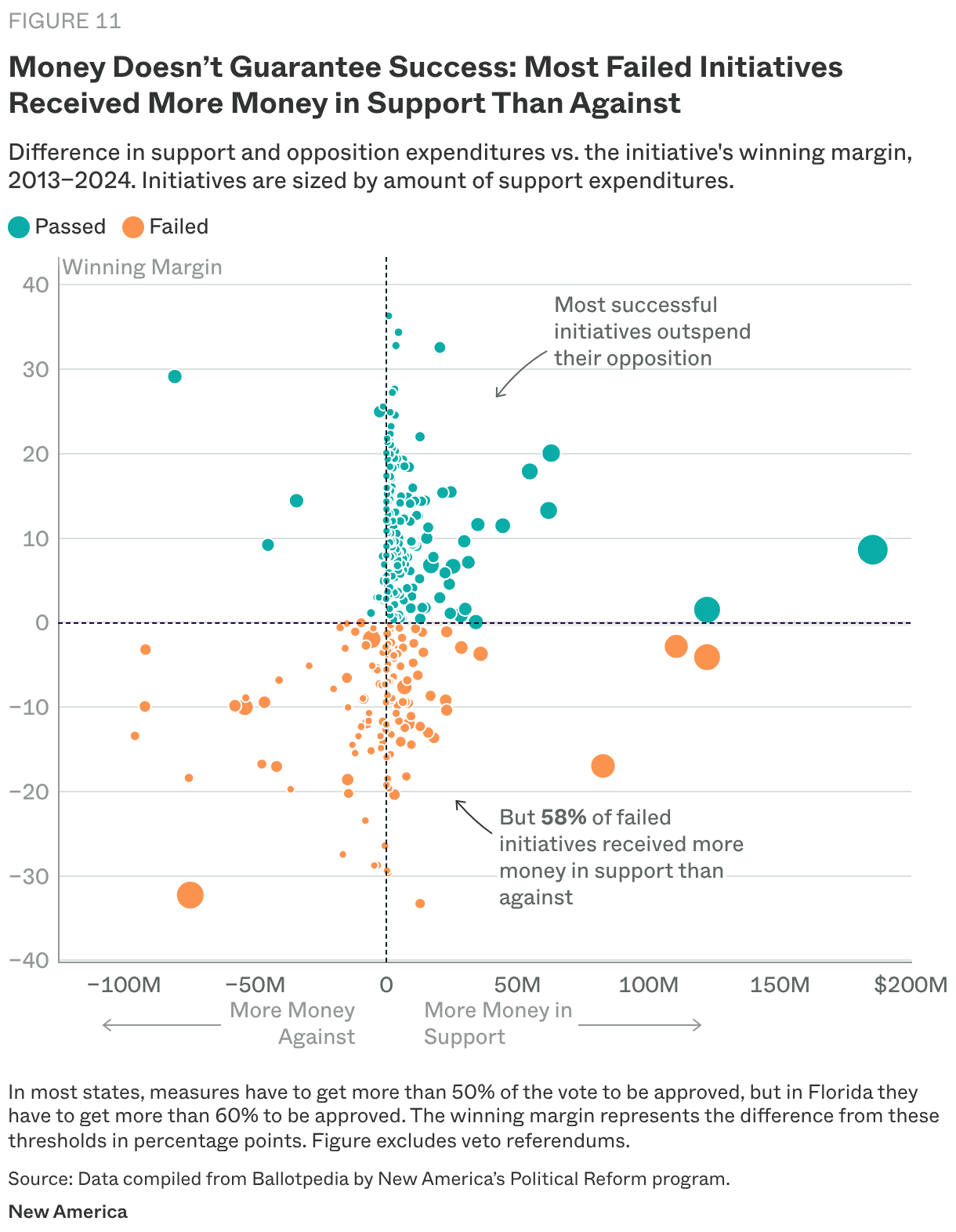
Meanwhile, nearly 71 percent of initiatives that received more funding in opposition than support failed, while only 22 percent passed. This finding reinforces research by Elizabeth Gerber and John Matsusaka showing that money鈥攅specially from wealthy economic interests鈥攊s . In essence, campaign advertising is most effective when it raises doubt鈥攔einforcing voters鈥� natural risk aversion and status quo bias鈥攔ather than building support. This tendency is more acute in .
Process Barriers Can Override Spending
Some of the initiatives that failed despite having more money supporting them than opposing them did so because of procedural barriers. For example, Florida鈥檚 two ballot initiatives in 2024鈥攐ne to enshrine abortion rights and another to legalize marijuana鈥攚ere defeated despite receiving millions more in support than in opposition and a majority of votes (with 57 percent and 56 percent, respectively), because Florida has a 60 percent threshold for initiatives to pass. Ohio鈥檚 2024 ballot initiative, which would have established a nonpartisan citizen redistricting commission, received $35 million more in support than in opposition, but it failed, in part because of confusion introduced by the ballot summary language written and approved by Ohio鈥檚 secretary of state.
Issue Popularity Matters
A lot, of course, has to do with whether what the initiatives propose is actually popular among voters: There is only so much money can do when the topic of the initiative is something voters really want or really dislike. Figure 12 shows the winning and losing margins of initiatives from 2013 to 2024 by topic and the amount spent in support of them. The figure indicates that there are some topics that are popular and tend to pass when put to a vote while others are unpopular and often fail.聽
For example, abortion-related initiatives have been mostly successful. Of the 15 initiatives on the topic, nine were approved by voters, and only one of these was to restrict abortion access ( in 2024). Of the six that were not approved, three sought to restrict abortion, and three sought to enshrine abortion as a right (including Florida鈥檚 2024 ballot initiative that received a majority of votes but didn鈥檛 reach the 60 percent threshold). Similarly, of the 20 initiatives related to labor rights or wages, 18 were approved by voters. The majority of these initiatives (17) sought increases to the minimum wage, adoption or expansion of paid sick leave, or stronger collective bargaining rights. Similarly, the majority of initiatives (65 percent) seeking to legalize or decriminalize drugs like marijuana (and in some cases psychedelics and psilocybin) were approved by voters.聽
The lone successful initiative that favored corporations was California鈥檚 Proposition 22 in 2020 (proposing that app-based drivers be classified as contractors), for which supporters outspent opponents by roughly ten to one. Post-election polling and subsequent analysis suggested that many voters remained confused about the measure鈥檚 practical effects, a reminder to be extra cautious when overwhelming spending advantage collides with confusing or technical ballot language.
Some topics tend to be unpopular with voters, regardless of how much money is poured into the initiative. This is particularly the case for initiatives dealing with gambling, hunting, alcohol, and tobacco, as Figure 12 shows. There were 32 initiatives on these topics, of which only 12 were approved by voters. Many of the initiatives that voters did not approve had to do with increases in taxes on cigarettes or with the legalization or expansion of betting, gambling, or casinos. Of these, the most notable examples are California鈥檚 2022 initiatives to legalize sports betting, Propositions 26 and 27. Proposition 26 won 33 percent of the vote despite supporters far outspending the opposition ($127 million in support versus $45 million in opposition). Proposition 27 won only 17 percent of the vote despite having $164 million in support, but it faced an opposition campaign that spent $239 million.
These numbers also demonstrate that the kinds of expensive campaigns that spark concerns about money in the initiative process are more likely when corporate interests in lucrative industries try to expand their markets or block taxes and regulations. Grassroots advocacy groups interested in protecting and expanding health care access (excluding reproductive health measures), economic justice, and civil rights are unlikely to need to raise and spend as much money as sports betting companies trying to legalize gambling, for example.
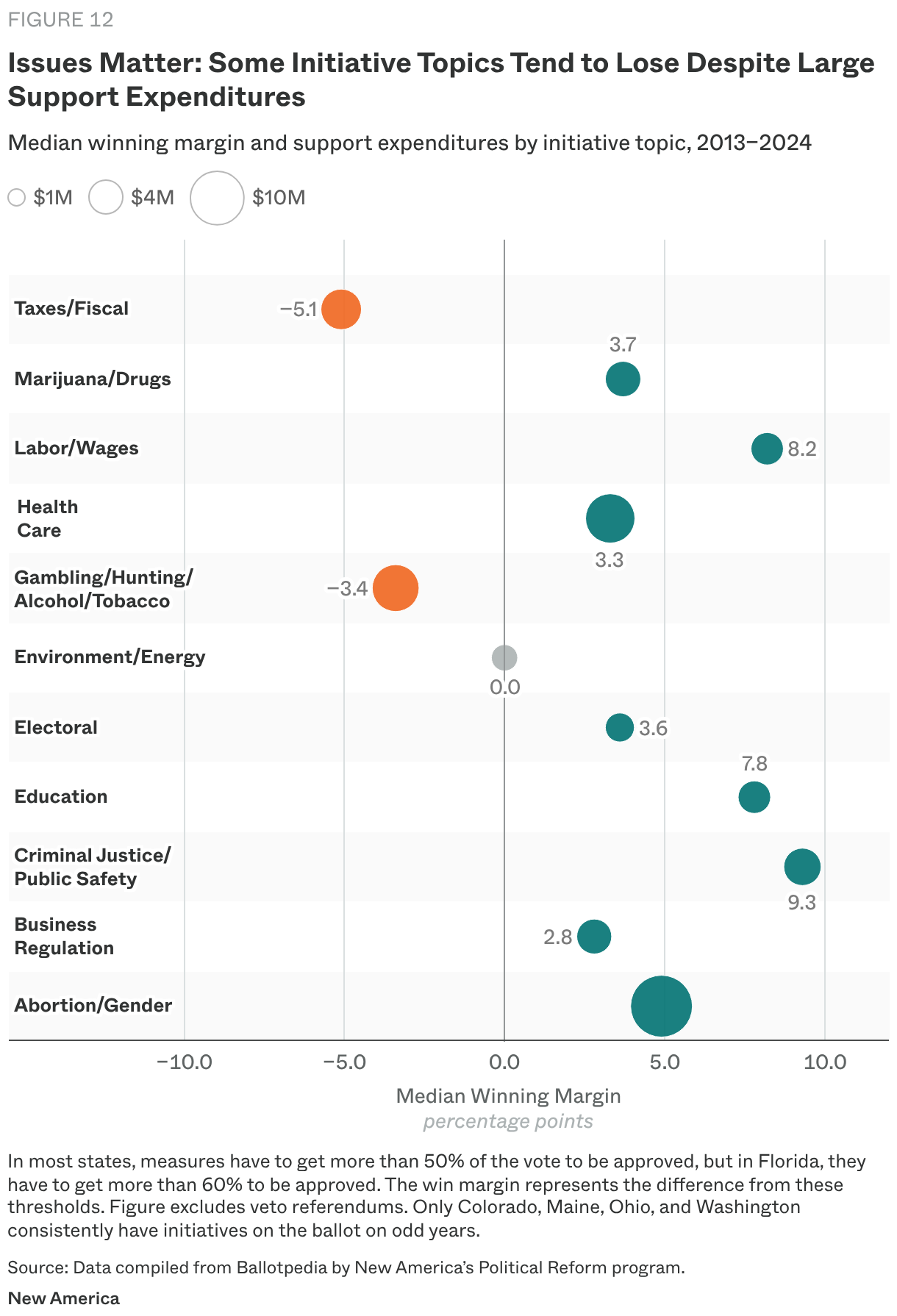
One way to think about this dynamic is that when a proposal is not popular to begin with, heavy spending alone cannot compensate for a lack of public support. On the other hand, when proposals are popular with voters, heavy spending is not necessary to win their support. This supports the idea that direct democracy serves as a path to enact policies that are broadly popular with the public but not elected officials, and it suggests that the ballot initiative process is not fully captured by deep-pocketed interests.
