Compared to Candidate Campaigns, Lobbying, and the Cost of Doing Nothing
Every pathway to policy change in modern American politics costs money. Legislative advocacy calls for sustained lobbying, polling, communications, coalition management, and often multiple election cycles of candidate support with no guaranteed end point. Statewide candidate races in today鈥檚 nationalized and polarized political climate routinely cost tens of millions of dollars. Inaction has a price too: years of staff time and sunk advocacy costs that produce nothing.聽
How do ballot measures compare to other policy change pathways? First, each pathway is structured differently, as shown in Table 2, so costs and returns are not directly comparable. A ballot measure affects only one policy at a time in a state, for example, while investing in a U.S. senator can lead to changes across multiple policy domains nationwide. A citizen-led ballot measure targets a specific, predefined policy outcome, whereas even a fully aligned senator or governor must negotiate with other actors, often resulting in legislation substantially different from what they started with. The . Ballot measure campaigns are usually subject to fewer restrictions because they are largely considered as . An individual donor or one company can bankroll an entire campaign for a ballot measure. In contrast, donations to candidate campaigns are subject to contribution limits and other restrictions to avoid corruption. This also probably means there is less dark money circulating around ballot measure campaigns, whereas the restrictions associated with candidate campaigns encourage workaround and subterfuge.
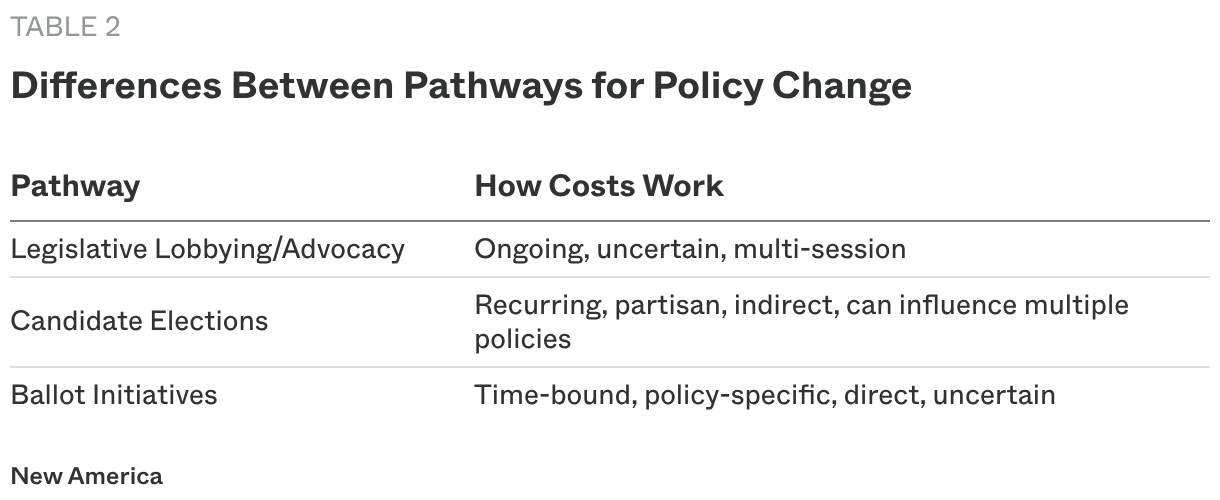
Despite these differences, comparison can help contextualize initiative campaign costs and help organizers within initiative states decide how to spend limited resources.
Compared to Statewide Candidate Races
In Figure 9, we compare the average amount spent on ballot initiatives at the state level with the total amount of reported expenditures on U.S. Senate and gubernatorial races for states that had both ballot initiatives and either a U.S. Senate or gubernatorial race in the same year in recent cycles. To be sure, these are not straightforward comparisons: As explained before, money going to ballot initiatives works differently than money going to candidate campaigns. Still, these comparisons help contextualize the amounts spent on these different avenues for policy change.
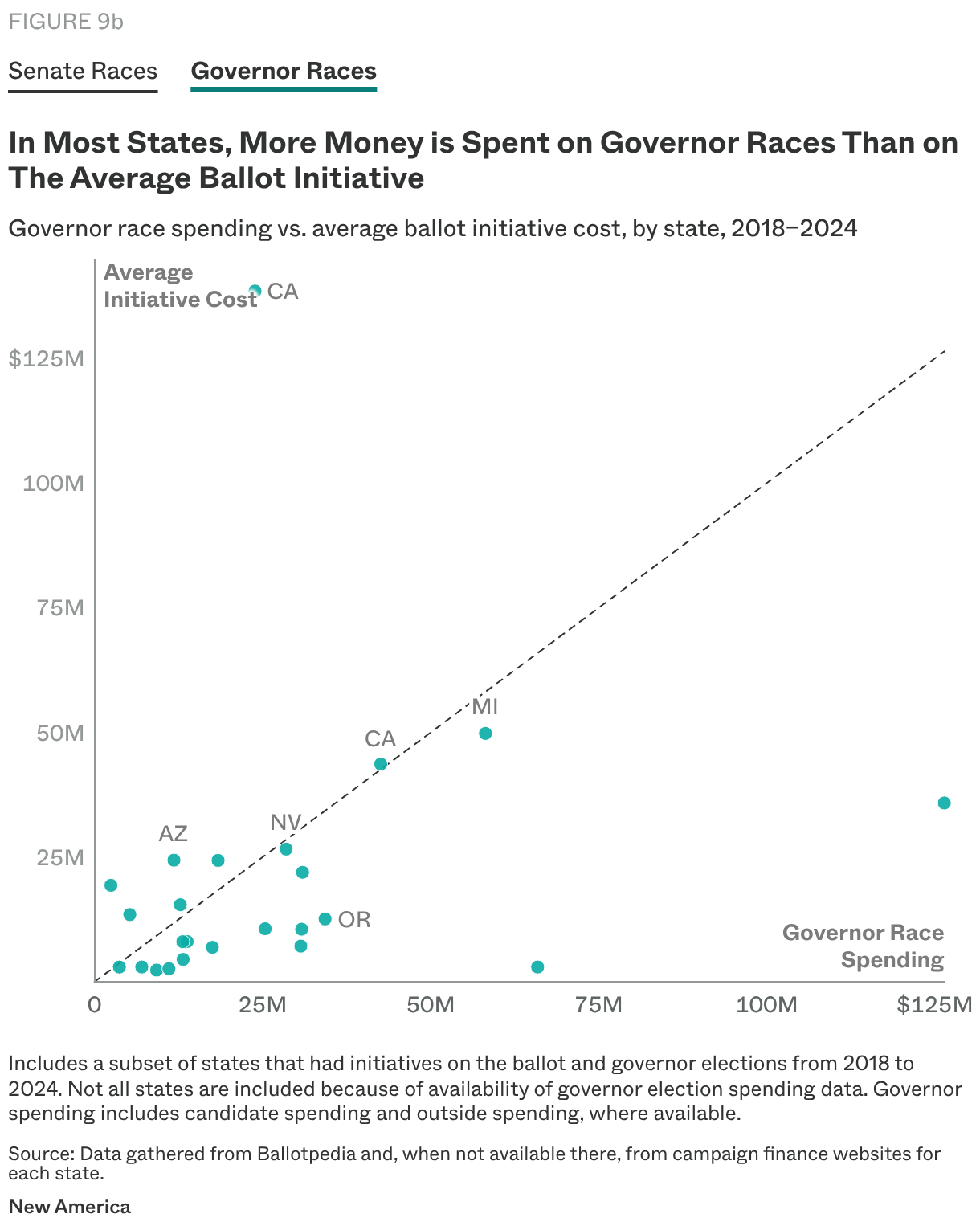
Points below the dashed line correspond to elections where more was spent on candidate races than on the average ballot measures, and points above the line correspond to elections when spending on the average ballot measure was greater than on candidate races. Because there are often multiple measures on the ballot but only one race for governor or senator, we show the average amount spent on ballot measures in each state. As the figures show, more money is often spent on Senate or gubernatorial candidates than on the average ballot initiative. This is especially true for Senate contests, likely because their fundraising is more nationalized and the stakes are perceived as higher than in a state race. As usual, California and Florida are exceptions. In 2024, two ballot initiatives in Florida reported an average of $159 million in expenditures, compared to an estimated $95 million spent on the Senate race. In California, an average of $139 million was spent on six ballot measures, while an estimated $6 million was spent on the Senate election.聽
As another point of comparison, John Matsusaka finds that, in California, far than on state legislative races. From 2000 to 2020, about $4.2 billion was spent on ballot measures compared to $1.5 billion spent on legislative races in the state. This difference likely reflects the potential policy impact of ballot initiatives but also the decline in electoral competition for legislative seats in California.
Compared to Lobbying
Figure 10 compares ballot measure spending with state-level lobbying expenditures in even-numbered years from 2014 to 2024, using data for the states that report it (Alaska, California, Colorado, Florida, Maine, Massachusetts, Michigan, Montana, Nebraska, Oregon, and Washington). Again, this is not a direct or straightforward comparison: Lobbying money is often spread across different policy issues, while initiative spending is concentrated on a few distinct policy proposals. Lobbying may take years of relationship-building and repeated legislative pushes to produce uncertain results. Ballot initiatives can secure a clear, yes-or-no outcome in a couple of years.
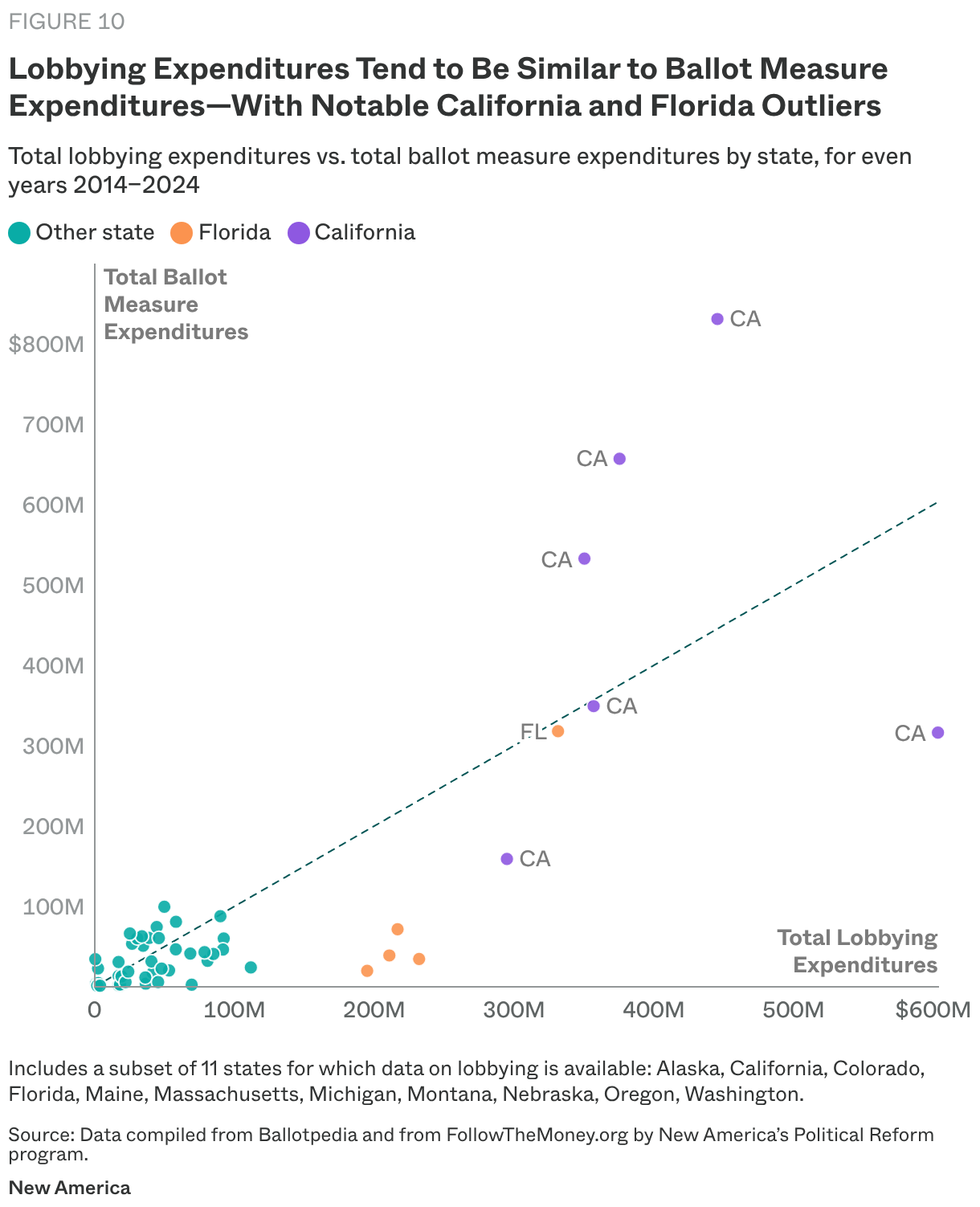
Of course, lobbying and citizen initiatives can be complementary, with lobbying helping to find allies in the legislature for specific ballot measures. For the most part, ballot measures and lobbying expenditures cluster around the equivalence line. The biggest exception is, as usual, California. In 2016, 2020, and 2022, California reported more spending on ballot measures than on state-level lobbying, but in 2014 and 2024, more was reported on lobbying than on ballot measure campaigns.
The Cost of Doing Nothing
Critiques of ballot initiatives tend to rest on an implicit comparison between direct democracy and an idealized vision of representative democracy. In this idealized system, legislators are broadly responsive, policymaking is done in-house by lawmakers, and public preferences are translated into law through routine legislative functions. In practice, that is not the system policy advocates are operating within. On many high-salience or structural issues, legislatures are constrained by a cocktail of partisan incentives, capacity limitations, institutional self-interest, and procedural rules that make action extremely unlikely regardless of public support.聽
The relevant comparison, then, is often not 鈥渋nitiative versus lobbying the legislature鈥� but 鈥渋nitiative versus permanent inaction.鈥� Sometimes, it鈥檚 lobbying and initiative. In the 26 states where citizens cannot place new laws or amendments on the ballot, less money is almost certainly spent on policy influence鈥攂ut that cost savings is cold comfort for residents who are chronically underserved or ignored by their representatives. The initiative process is expensive. The alternative, for many advocates, is not a cheaper legislative path but no path at all.
Medicaid expansion is a case in point. While most Medicaid expansions under the Affordable Care Act occurred through ordinary legislation, the initiative process was decisive in several conservative states where legislatures had repeatedly refused to act, including Idaho, Missouri, Oklahoma, Nebraska, South Dakota, and Utah. Most tellingly, , eight lack any statewide initiative options (the other two, Wyoming and Florida, technically permit at least one form of statewide initiative, but their processes are so restrictive as to be functionally inaccessible).
In proposing that Wisconsin adopt an initiative process, he cited eight issues that polling shows enjoy overwhelming bipartisan support but continue to stall in the legislature, including Medicaid expansion, mandatory background checks for gun purchases, and redistricting reform. (This tracks with previous research findings by this report鈥檚 authors that Wisconsin has among the lowest policy congruence on social and economic issues of all non-initiative states.)
Against that backdrop, the cost comparison is not between expensive ballot initiatives and a cheap, frictionless legislative process, but between ballot initiatives and the real-world alternatives available when legislatures will not move. Initiative costs look different: They are often higher up front, but they are finite. They usually culminate in a clear, time-bound decision. Most importantly, they offer a chance of success when other avenues have repeatedly failed.聽
This point is especially pronounced for structural reforms that by design threaten the interests of incumbent officeholders and institutions. The legislative pathway holds little promise for achieving significant electoral and good governance reforms. One strategist who specializes in ranked-choice voting reforms said that you usually assume a minimum of four cycles to get a reform bill through the legislature, which he estimates could run a minimum of $400,000. While that is less than the cost of a ballot initiative, he also observed that, despite years of lobbying statehouses, no legislature had yet passed a bill to adopt ranked-choice voting statewide, but two states had enacted the voting system via ballot initiative.
Similarly, after repeated legislative and partisan resistance to meaningful anti-gerrymandering reform, grassroots organizers in Michigan used the initiative process to create an independent redistricting commission. This case, as well as Maine鈥檚 multiple citizen-led measures to pass and defend ranked-choice voting, is emblematic of direct democracy鈥檚 power, as President Theodore Roosevelt put it, 鈥�.鈥澛�
To be clear, ballot initiatives are seldom the cheapest or best option for advocates. Practitioners attest that lobbying (and financing candidate campaigns) is a more cost-effective strategy, and one to be tried first or alongside initiative campaigns. The advocates behind many of the high-profile initiatives discussed in this report often pursued legislation repeatedly before turning to the ballot. Sometimes, though, the initiative is simply the only politically viable path to force an issue onto the legislative agenda or effect policy change鈥攏o matter how much money you鈥檙e prepared to throw at the effort.
