Who鈥檚 Funding Ballot Initiatives?
Modern ballot initiative campaigns are often portrayed as dominated by wealthy donors, corporate interests, and out-of-state money. That critique captures part of the story, but it misses important context and evidence. Following the money in ballot initiative campaigns reveals a more complex financing structure that combines broad-based individual participation with extremely concentrated funding at the top and how elite donors operate differently at different stages of the process. Finally, by the admittedly poor standards of American campaign finance, there is also an unusually high degree of transparency and legibility. Understanding how these structures and patterns interact is important for accurately diagnosing the capture problem and evaluating what reform can and cannot accomplish.
Donations are Concentrated at the Top, Broad Beneath the Surface
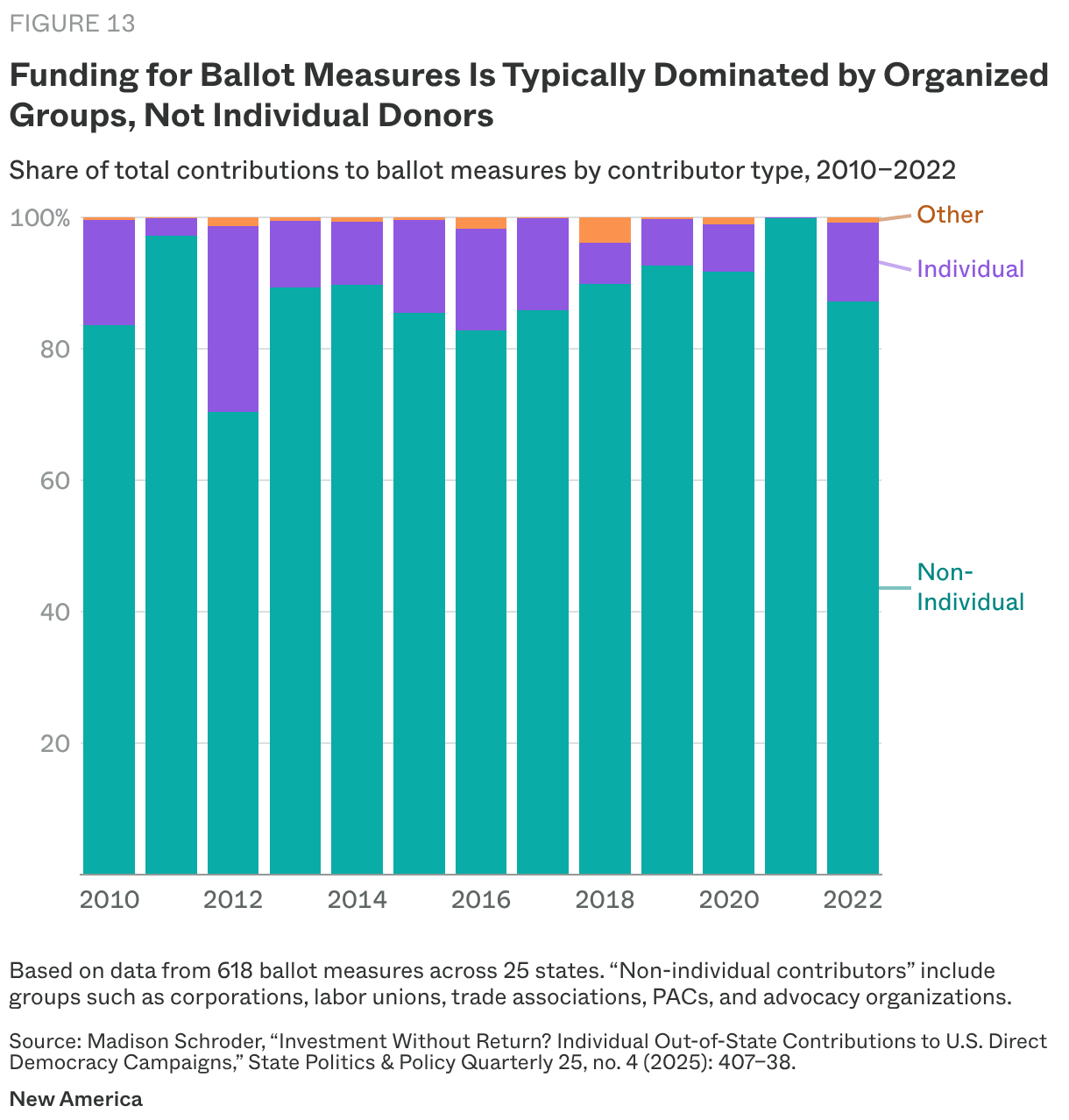
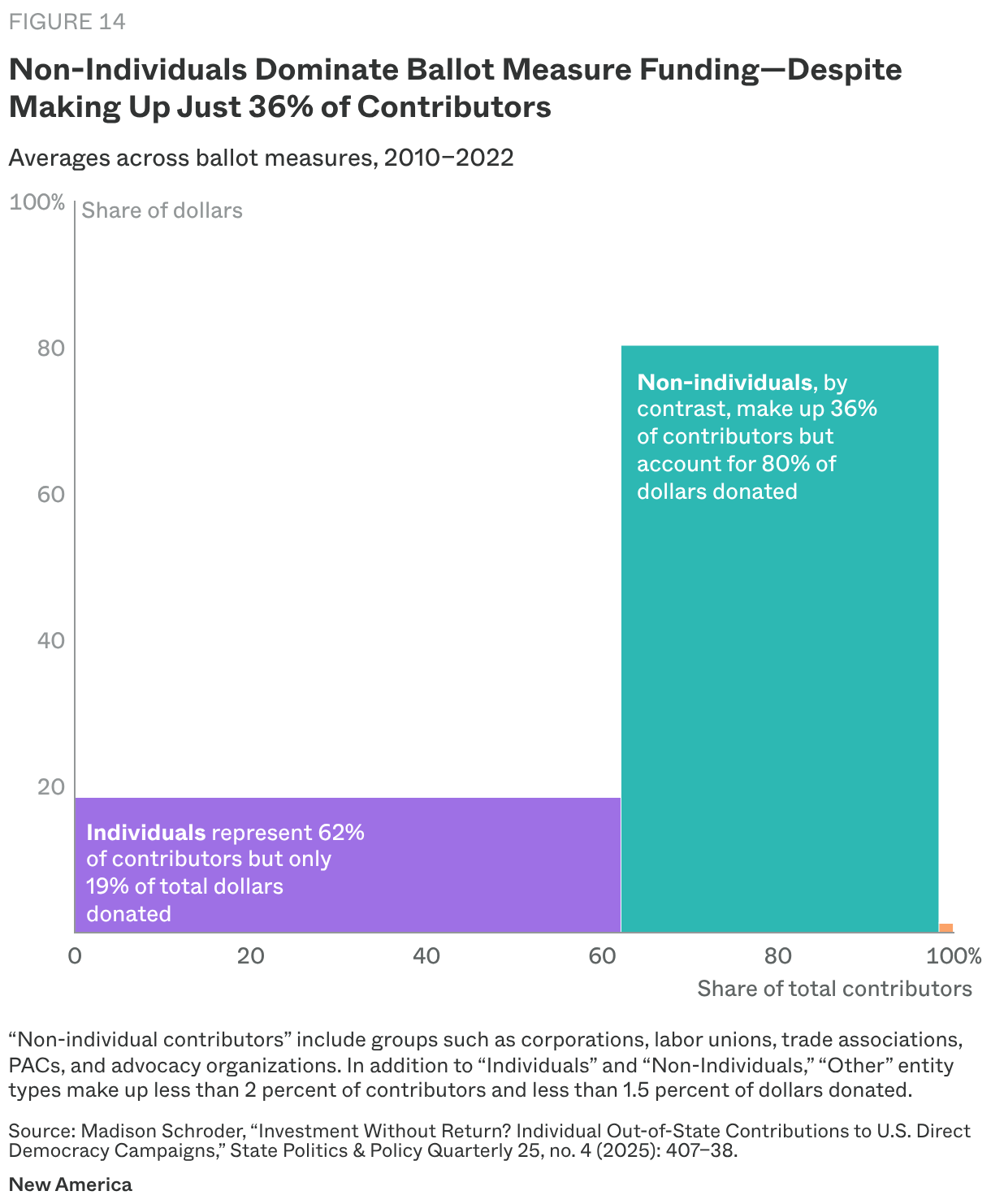
To investigate claims about elite capture of ballot initiatives, we analyzed to 667 ballot measures across 25 states from 2006 to 2022, which includes amounts donated, contributor type, and location, among other details. We find that funding of ballot measures is typically dominated by organized groups rather than individual donors. Non-individual contributors鈥攕uch as corporations, labor unions, trade associations, PACs, and advocacy organizations鈥攑rovided roughly 70 to 90 percent of total campaign funding in most cycles, as shown in Figure 13. And as Figure 14 illustrates, individuals made the highest number of contributors but they supplied a much smaller share of total dollars.
Out-of-State Donors are Misunderstood
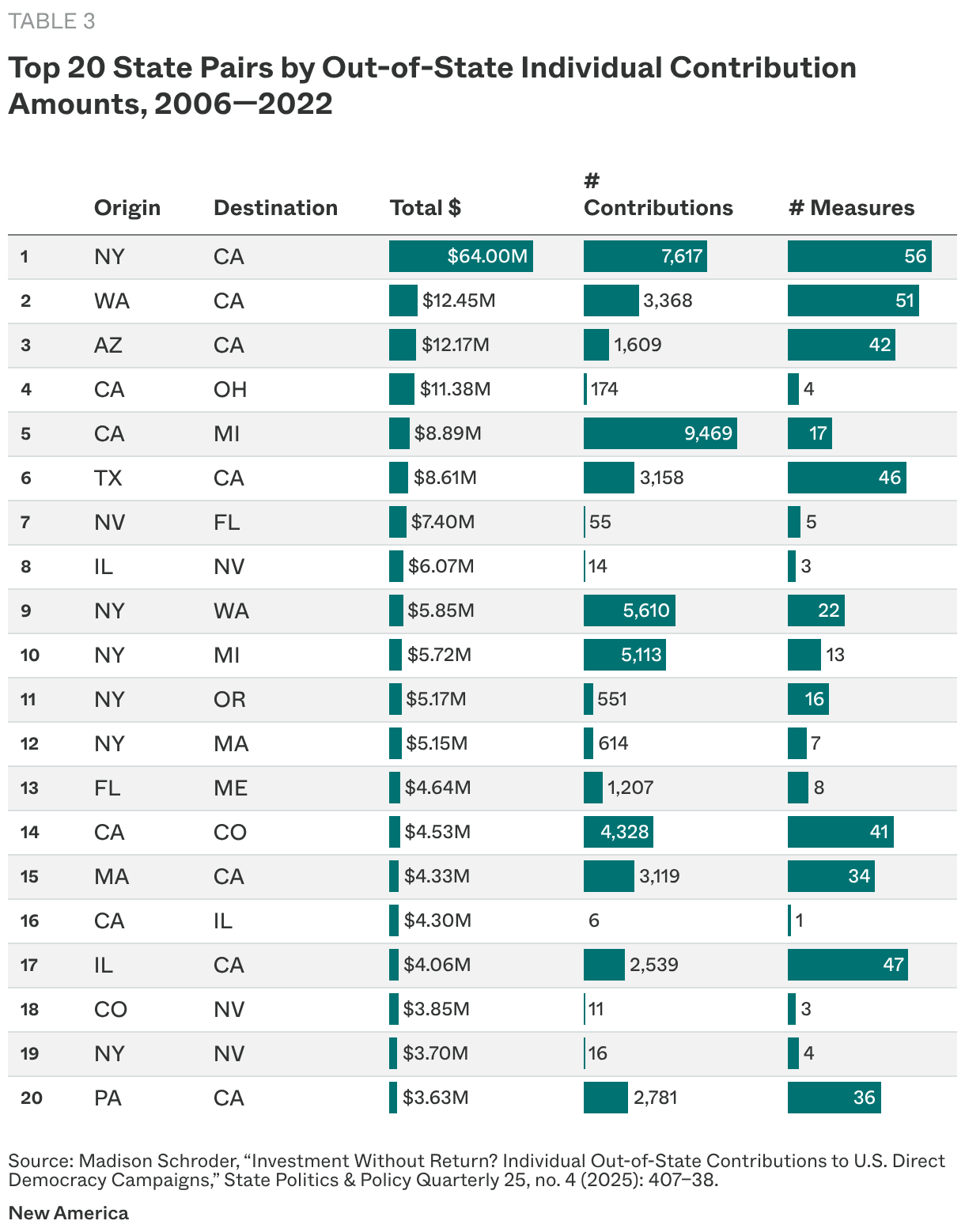
These patterns align with Schroder鈥檚 finding鈥攑ublished in the 2025 article, 鈥�鈥濃�攖hat out-of-state donor participation is overwhelmingly small-dollar and widely distributed, but overall amounts come from a small share of large donors. Total contributions from out of state more than doubled between 2006 and 2022, rising from roughly $200 million to nearly $500 million per cycle. Among out-of-state donors, more than 86 percent of contributions are $100 or less. Yet donations above $10,000鈥攍ess than 1 percent of total contributions鈥攁ccount for roughly 86 percent of total dollars. Schroder finds that contributions disproportionately come from ZIP codes with low-to-middle median incomes. Individual donors also tend to give more than once, often across multiple states, and to social or moral issues, particularly abortion and LGBTQ+ protections, substance use policy, and election reform. A sizable share of the out-of-state contributions comes from New York and Texas, states without initiative processes (see Table 3). These findings suggest that participation in out-of-state ballot initiatives is nationalized and, in some cases, that voters are using other states鈥� direct democracy processes as an outlet for political expression unavailable to them at home.
The surge in out-of-state donations cuts two ways. Initiative campaigns enable a distributed, issue-based engagement that crosses state lines and can boost progress on national issues by showing support in unlikely places. On the other hand, these numbers raise the question of whether residents of one state should be able to influence the policies of another. High-salience measures now routinely attract national donor networks, which sometimes finance a substantial share of campaign activity in states where these donors cannot vote. Perhaps cross-state diffusion effects and the idea of states as testing grounds for future national policy give voters in one state a legitimate stake in the outcome of an initiative campaign in another.
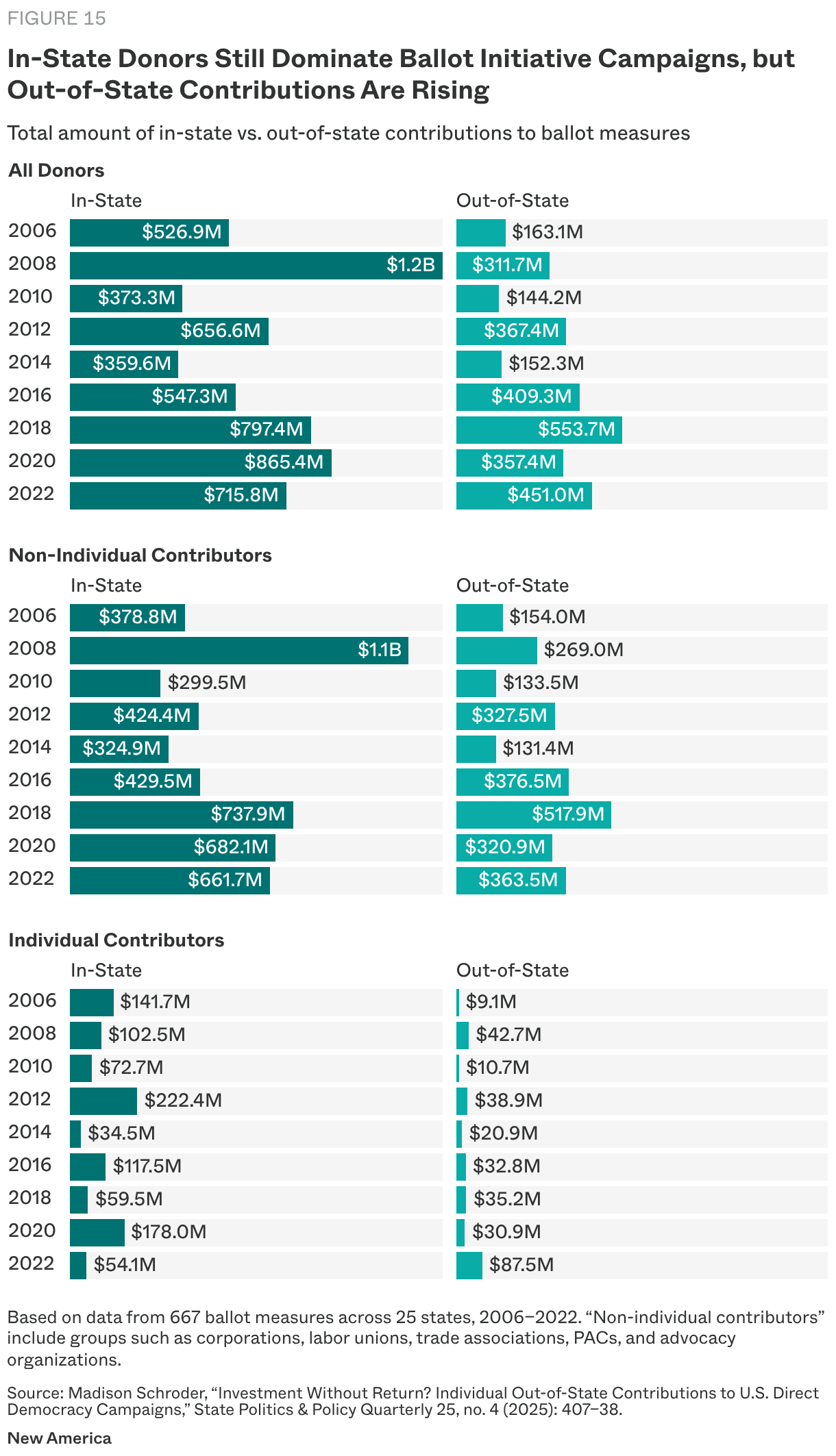
At the same time, it would be a mistake to overcorrect and treat initiative campaigns as out-of-state-driven affairs. In most cases, out-of-state donors are not displacing local participation. In-state donors still make up a majority of donors, and the campaigns themselves remain anchored in state-level political contexts. Figure 15 shows that the majority of contributions to state initiatives originate in-state. Over nine election cycles examined, contributions from in-state individuals trumped those from out-of-state individuals in every cycle but one, 2022. Nevertheless, state legislatures have recently moved to restrict outside participation in initiative campaigns by requiring signature gatherers to be in-state residents or imposing extra compliance burdens on nonresident circulators.
Ideological Money on Offense, Corporate Money on Defense
Despite a broad base of individual small donors, the funding that makes initiative campaigns viable in the first place remains heavily concentrated at the top with large individual donors and organized advocacy groups. This is especially true in states where qualification costs are high. (Economically driven interest groups such as corporations and unions do spend heavily on campaigns, but because they are more likely to fund opposition campaigns, their influence often begins after the qualification stage.)聽
Within the category of ultra-rich individual donors, there are several visible cases where the critique of elite influence lands cleanly. Among individual contributors to initiatives, Michael Bloomberg holds the record for most money given, having contributed nearly $46 million to California鈥檚 Proposition 31 (a successful veto referendum to uphold a ban on flavored tobacco products) in 2022. Bloomberg鈥檚 contribution represented 92 percent of the total amount spent. Charles Munger鈥檚 $10 million contribution represented 98 percent of the total contributed to California鈥檚 Proposition 54 in 2016, which succeeded in requiring the public display of legislative bills prior to a vote. Henry Nicholas was responsible for 96 percent of the total amount contributed to Ohio鈥檚 Issue 1 in 2017 to secure rights for victims of crimes. Of course, many individuals channel their donations through political organizations, like Brian Heywood, who has , mostly through a political action committee. Regardless of whether these causes reflect , when rich individuals exploit the initiative process to set the agenda, it weakens the democratic value and credibility of initiatives as the 鈥減eople鈥檚 tool.鈥澛�
Crucially, the presence of large donors does not mean they are consistently getting what they want. Research by John Matsusaka provides a critical corrective. In , Matsusaka analyzed over 2,600 state initiatives and found that only 4 percent of successful initiatives benefited business interests, compared to 16 percent of legislatively referred measures. Matsusaka鈥檚 of whether ballot initiatives are good for business and organized labor found that, of all business-related state-level initiatives from 1904 to 2021, anti-business initiatives were significantly more common (56 percent) than pro-business initiatives (37 percent), and anti-business initiatives were more than twice as likely to pass. When comparing the subset of measures that were constitutional amendments鈥攚hich can be placed on the ballot by the legislature or citizens鈥擬atsusaka found that legislatively referred amendments were pro-business by roughly a three-to-one ratio, while citizen-initiated amendments were about evenly split between pro- and anti-business.听
Zooming in on contributions to California ballot measures between 2000 and 2020, initiatives are systematically less favorable to business interests than laws produced through legislatures. In addition, business groups directed about , compared to less than 1 percent to opposing legislatively referred propositions; unions show a similar shift, with a majority of spending devoted to defense. In dollar terms, business groups have spent nearly twice as much opposing initiatives as supporting them.
A Different Kind of Capture
These patterns indicate that the role of money in initiatives differs from the standard model of a system captured by economic interests. Those organized players remain major funders, but much of their spending is reactive, aimed at blocking proposals rather than advancing them. By contrast, two-thirds of contributions by wealthy individuals in Matsusaka鈥檚 dataset were made in support of measures. The result is a system in which funding is concentrated, but results are not consistently aligned with the preferences of big corporations and financial elites. Matsusaka concludes that 鈥渘othing akin to capture emerges when citizens make the laws; if anything, the situation is the reverse鈥攃itizens use the process to capture benefits from businesses through taxes or regulations that transfer rents from companies to taxpayers, consumers, or the general public.鈥� Matsusaka theorizes that organized interest groups are less effective at capturing the ballot initiative process than legislative politics because channels like contributing to 鈥渞eelection campaigns, lobbying, and revolving doors [are not] available when an issue is decided by a public vote. The only lever available in ballot proposition elections is mass-media campaign spending, which seems to be a tool with limited effectiveness.鈥�
Taken together, the data suggests that direct democracy does not eliminate elite influence, as the Progressives who first championed initiatives in the early 1900s had hoped, but it does redistribute it away from the interest-group capture of representative democracy toward episodic agenda-setting by well-resourced and ideologically-driven actors. Initiative campaigns do rely on concentrated funding, and wealthy donors can determine which issues reach the ballot. But once measures qualify, organized economic interests are more often defending against proposals than securing favorable outcomes, and voters frequently act independently of funding advantages.听
This distinction matters for reform. If the primary leverage point is at the start-up stage, then efforts to broaden access and reduce entry costs for grassroots campaigns may do more to counterbalance concentrated funding than attempts to regulate campaign spending alone. And given the broader legal environment, where limits on political contributions and spending remain constrained, restricting direct democracy on the grounds that wealthy actors participate risks closing off one of the few arenas where voters can directly override entrenched interests.
鈥淚f we don鈥檛 let ourselves have nice things because people we don鈥檛 like might also benefit from [the process], then we鈥檒l never have nice things,鈥� one expert told us. Wealthy actors will continue to spend in politics across all institutional settings. The relevant question is whether to maintain mechanisms, however imperfect, that also allow the public to translate preferences into policy.
The Practical Benefits and Limits of Transparency
Ballot initiative spending differs from other forms of political spending in structure and legibility. In traditional legislative policymaking, influence is fragmented across years of candidate campaigns, lobbying, and informal relationships. Campaign donations, lobbying activity, and coalition-building may shape policy over time, but the causal chain is often opaque. Even when spending is disclosed, the motivations behind it鈥攁nd its ultimate policy impact鈥攁re not always clear. As a result, the total cost of influencing legislation is difficult to measure, and attribution is murky.
Initiative spending, by comparison, is time-bound and legible. Donors fund signature gathering, advertising, litigation, and voter outreach over a defined period, and these expenditures are generally disclosed in ways that clearly link donors to advocacy around specific policy campaigns.
This relative clarity gives initiative spending a practical advantage for funders and organizers, who can plan around predictable timelines and budgets. It also provides a degree of transparency that is less common in other domains of political spending. Still, concerns about the cost and capture of direct democracy have prompted states such as California, Washington, and Alaska to adopt stronger initiative campaign finance disclosure rules. These include prominent 鈥渢op-donor鈥� disclaimers on advertisements, rapid reporting requirements, true-source disclosures designed to prevent donors from hiding behind nonprofits, and requirements that petitioners identify the measure鈥檚 primary funders during signature gathering.
Disclosure Changes How Money Flows, Not How Much
Disclosure is the only available tool for states to regulate campaign finance in ballot campaigns. As mentioned earlier, the Supreme Court has ruled against contribution and spending limits on the grounds that ballot campaigns are political speech. Enhanced disclosure rules make it easier for journalists, opposing campaigns, and regular voters to identify sources of funding for initiative campaigns. But to what extent does disclosure impact donor behavior and overall campaign spending?
There is no strong evidence that disclosure reduces overall spending or deters most major donors from participating. Initiative spending has risen sharply in the years following the implementation of more stringent transparency measures. Some reputation-sensitive donors have probably adapted by shifting contribution channels or strategies. Yet there is credible evidence that disclosure deters some donors at the margin, particularly in certain policy and geographic contexts.听
For example, in larger states, where most ballot campaign funding is heavily concentrated, initiative campaigns are already highly visible, often nationalized, and professionalized. The policy stakes tend to be higher. Corporations, industry groups, and wealthy individuals from both in state and out routinely participate with the expectation that their role will be public. In this setting, disclosure affects how money is interpreted more than whether it enters the campaign.
In smaller states, enhanced disclosure may have more bite. Where political and economic networks are smaller and more localized, in-state donors are more likely to be directly connected to the communities affected by the initiative. Identification may carry reputational and relational costs that outweigh the potential policy gain. Outside spending is also more likely to be scrutinized and stigmatized, making big national or out-of-state donors hesitant to engage. In some cases, that visibility might even undermine the campaign. One grassroots organizer suggested their state鈥檚 disclosure laws are at least somewhat effective in deterring big out-of-state donors. In their experience, disclosure concerns have been a deal-breaker for multiple would-be donors. One donor even made repealing the disclosure law a condition of future support for their organization鈥檚 initiative efforts.听
Of course, if the measure is ideologically or commercially important to even a few deep-pocketed interests, money is going to flow regardless of state size or disclosure regime. After California strengthened top-donor formatting requirements, online ad coverage, and original-donor disclosure rules, ballot measure spending has continued to break spending records thanks to a handful of expensive campaigns. Washington has one of the nation鈥檚 strongest ballot measure disclosure systems, including top-donor identification on ads, and still produces some of the country鈥檚 most expensive and donor-driven initiative cycles. Alaska added true-source disclosure rules in 2020 and major money continued to flow鈥攖he 2024 campaign to defend top-four voting reportedly raised more than $15 million, much of it from out of state.
Where Visibility Matters
The literature on the effects of campaign finance disclosure laws on donor behavior is sparse. However, there is some indirect and revealed-preference evidence suggesting marginal deterrent effects on donations. Donors rarely admit to being afraid of disclosure, but consistent patterns of litigation following the passage of new transparency laws鈥攑articularly top-donor ad disclaimers and true-source disclosures that complicate hidden pass-through giving鈥攃ombined with evasive structuring of contributions, suggest that there are plenty of anonymity-seeking or -demanding donors. Alaska is the clearest recent example: Opponents litigated true-source and disclaimer rules through multiple rounds in federal and state courts and ultimately lost. Maine offers another case: During the same-sex marriage referendum fights, national advocacy groups fought donor-disclosure requirements in court, implying that public identification was viewed as costly or .听
By comparison, multiple recent studies have sought to understand whether disclosure helps voters make more informed decisions about ballot measures. Because ballot initiative contests lack party labels and incumbent or candidate performance cues, voters have to rely on other heuristics to interpret complex proposals. In this context, campaigns often spend heavily on ads and messaging, . This is where disclosure can serve as a much-needed informational shortcut, and, if presented optimally to voters, could disincentivize expensive misinformation campaigns.
Research on Washington State鈥檚 Initiative 1634鈥攁 2018 measure backed by the soft drink industry to preempt local beverage taxes鈥攆ound that revealing top donors shifted voter attitudes when paired with explanations that connected donors directly to the policy鈥檚 purpose. Similarly, suggests that donor information can shift voter opinions at levels comparable to party cues or policy information, but its effects are limited to more informed voters, who are better able to interpret donor interest. A different study found that who supports and opposes a ballot measure, and that this endorsement cue, rather than information about the measure鈥檚 policy substance, .听
That insight further explains why top-donor disclaimers on ads are more valuable to voters than searchable databases. Database disclosure is passive: The information exists, but voters must go look for it, and most never will. Top-donor ad disclaimers convert that into active disclosure by placing funder identities directly on television, radio, mail, and digital ads. Donor identities effectively function as endorsements; endorsements guide voters鈥� decisions in the absence of party labels and other heuristics that we know influence candidate selections. Washington鈥檚 requirement that political committees list their top five contributors on ads and California鈥檚 DISCLOSE framework are significant because they make donor identity part of the campaign message itself. That increases reputational risk, especially for corporations and trade groups with public-facing brands. Adding top-donor tables to official voter guides could serve a similar function, particularly in all-mail states鈥攊ncluding Washington, Oregon, and Colorado, which are also some of the most active initiative states鈥攚here voters complete ballots at home with the official guide nearby. In states where voters go to the polls and the guide sits unopened on the kitchen counter, its informational value would be considerably lower.
Disclosure Rules Vary, and Can Do Harm
Unfortunately, disclosure systems may be more effective at undermining grassroots-led initiative campaigns than highly professionalized ones. The four most active initiative states west of the Rockies, plus Idaho and Alaska, which recently adopted some of the country鈥檚 most aggressive transparency rules, illustrate how much compliance burdens vary in practice. (See the Appendix for more details.)
States such as California prioritize expansive disclosure through low committee thresholds and early itemization requirements: Ballot-measure committees generally qualify at $2,000鈥攑ocket change for state ballot campaigns that run an average of $8 million just for signature gathering鈥攚hile contributions of $100 or more must be itemized, alongside rapid pre-election reporting and prominent top-donor ad disclaimers. That creates a rich public record, but it also means that modest grassroots campaigns can be drawn into full compliance regimes at a very early stage.
Idaho sits at the lighter-touch end of the spectrum, imposing fewer burdens on campaigns generally but also providing voters with less timely and less intuitive information about who is financing ballot campaigns. Again, because Idaho is a small pond, weaker disclosure rules might be offset by stronger incentives for journalists and other campaign stakeholders to identify and expose major sponsors of ballot campaigns.
Disclosure costs are not borne evenly across campaign types. A committee backed by a single corporation or trade association that writes a seven-figure check may generate relatively little reporting complexity. A citizen-led campaign raising the same amount through thousands of $25 or $50 donations can face far greater burdens in data collection, treasurer capacity, software, legal compliance, and other risks. Low thresholds can therefore operate regressively, advantaging concentrated wealth over distributed participation. The most efficient systems likely combine light-touch treatment for genuinely small or volunteer-driven efforts with strong transparency for large donors and voter-facing advertising. Top-donor disclaimers on ads, true-source tracing for intermediary entities, and rapid reporting of major late money likely generate more value to voters than forcing grassroots, small-donor-funded campaigns into dense reporting systems that few ordinary voters will ever consult.
A final implication is that disclosure, while valuable, does not fully resolve the deeper capture problem. Intense transparency can expose who is trying to buy influence, but it does not necessarily prevent dominant economic actors from overwhelming the field. In Montana, organizers advanced a 2026 initiative, the 鈥淢ontana Plan,鈥� that would prohibit corporations and other artificial entities from spending money on candidates or ballot measures, explicitly attempting to challenge or route around Citizens United.
