A Chapter of: Soleimani’s Shadow
VII. The Future of the Fatemiyoun Division
Much has changed since the confluence of the Syrian civil war’s escalation; the rise of ISIS and Russia’s entry into the Syrian war helped make the Fatemiyoun, Zeibaniyoun, and Iran’s narratives of transnational religious duty go viral. Iran has rhetorically ended its war against ISIS, the Assad regime has substantially degraded the armed Syrian opposition, and the United States killed Soleimani. Despite these changes and some level of demobilization, the Fatemiyoun and Zeibaniyoun continue to play a significant role in the Middle East. Their cultural production has continued and expanded, they have played a role in domestic Iranian politics, continue to operate in Syria, and have been touted as a potential actor in a projected future war with Israel. The networks and organizations mobilized to defend the Assad regime and the narratives used to mobilize them are unlikely to disappear from the region’s politics anytime soon.
End of the Islamic State, Drawdown
In November 2017, after a months-long campaign in eastern Syria, Tehran declared victory against the Islamic State, claiming the credit. By that time, the caliphate had lost its strongholds in Iraq to a coalition of U.S.-, Iraq-, and Iranian-led paramilitary groups.1 In Syria, pro-Assad forces and U.S.-backed Syrian Democratic Forces (SDF), separated by the Euphrates River, were progressing down the valley toward the border with Iraq.2 IRGC-led forces led the offensive in capturing the border town of Al Bukamal, re-opening a viable land supply route from Iran to the Levant that had been lost since the middle of 2012.3 After that operation, Soleimani published a letter to Supreme Leader Khamenei, declaring the end of the Islamic State.4 Afterwards, with the end of major operations, the number of IRGC forces including Fatemiyoun and Zeynabiyoun has been reduced, though they have continued deployments to Syria.
The Fatemiyoun and Zeynabiyoun reaffirmed their allegiances and vowed they would be ready to fight for the Islamic Republic, anytime, anywhere. In a statement attributed to Fatemiyoun commanders and rank-and-file, the paramilitary group congratulated Soleimani for commanding forces in the defeat of the "Zionist Da'esh [ISIS] terrorist group," and that the "blood of the martyrs is still watering the tree of the pure Muhammadean Islam."5 The statement warned that the "masters of Da'esh in Tel Aviv and Washington" would stoke sectarianism among Muslims, that Fatemiyoun would fight until the destruction of global Zionism." Although Khamenei is not widely acknowledged as an imam outside of his hardcore supporters in Iran the statement also called for Fatemiyoun to rally behind Iran‘s Supreme Leader.
The Zeynabiyoun echoed the Fatemiyoum message in a subsequent letter attributed to its commanders, fighters, and families of martyrs.6 The statement said that Zeynabiyoun fighters, who have "experience of defense against Wahabbis in Pakistan answered the call of the commander of Muslims worldwide [Khamenei] and under Soleimani command, followed the "valuable teachings of the eight years of Sacred Defense [Iran-Iraq War]" to defend the shrine of Zeynab. The group vowed to help build an Islamic world and affirmed readiness to fight for "parts of the Islamic world under attack by Global Arrogance [West] and international Zionism."
After claiming the end of ISIS, Fatemiyoun's cultural deputy Hojjat Gonabadinejad said the group would draw down its forces and focus on cultural activities.7 In another instance, Gonabadinejad said that a Fatemiyoun Basij base formed in Mashhad, where there is an exclusive base for Fatemiyoun fighters in the Golshahr neighborhood.8 While there were reports that the Fatemiyoun has stopped recruitment, the paramilitary group has since publicly touted its deployments to Syria.9
The IRGC for the most part sat out major Assad offensives in Idlib until early 2020 after Soleimani's death by a U.S. drone strike. Soleimani's successor Esma'il Gha'ani deployed the Fatemiyoun and Zeynabiyoun as a show of strength, and more than a dozen were killed.10 While the Quds Force and Russia helped Assad make significant and strategic territorial gains, Turkey put a stop to the offensive after dozens of its forces died in an airstrike.11 Hezbollah fighters were confirmed killed in Turkish retaliations, and a number of Iranians also died but their deaths were not made public.12 The decision to not publicize the deaths reflects the fact that the Iranian public and the IRGC are more willing to accept Pakistani and Afghan deaths than Iranian deaths.
The Fatemiyoun have paid a heavy price for their service. Then-Fatemiyoun Cultural Affairs Director, Hojjat ol-Eslam Zahir Mojahed, said in 2018 that 2,000 fighters died and 8,000 were injured.13 That may not be the full figure of the dead, either. A report in IRGC-linked Tasnim in 2019 said that Fatemiyoun had the highest number of "martyrs in the Resistance Front," and that more than triple the amount of Afghans than Iranians were killed.14 There are no official figures about Iranian deaths. Researcher Ali Alfoneh has documented 571 Iranian deaths between 2012 and February 2020 based on publicly released information.15 The real fatality rate is probably higher because Iranian media continues to censor deaths in Israeli airstrikes. Former IRGC commander and prominent pundit Hassan Abbasi said in 2019 that there were 2,300 Iranians killed in Syria.16 Whatever the actual figures, the Guard Corps has controlled the flow of information about fatalities in order to minimize public blowback, while also using the release of information about deaths and rituals of martyrdom, such as funerals and commemorations, in order to advance its narratives.
The Zeynabiyoun was practically silent between late 2017 and early 2020. A noteworthy incident was the Iranian police's brief March 2017 arrest of Zeynabiyoun Brigade commander Abbas Musavi and a companion because of expired permits, which raised the ire of some pro-IRGC supporters on Telegram.17 After the eastern Syria campaign, there was no evidence of continued Zeynabiyoun deployments. A blog called "Voice of the Defenders," which claims to be run by former IRGC fighters, lamented in August 2019 that Iranian officials were ignoring Pakistani fighters who had returned to Iran, and that fighters who returned to their home countries were being watched by Pakistani intelligence services, and that "various reports are published about [their] arrests or going missing."18
However, in early 2020, during the offensive in Idlib, Iranian media declared that about a dozen Zeynabiyoun fighters died and were being returned to Qom for burial (See Figure 22).19 Fatemiyoun also released photos in March 2020 that showed Zeynabiyoun members hoisting the paramilitary group’s flag (See Figure 23).20 It is possible that the Zeynabiyoun, like its big brother group, demobilized a large number of fighters after the end of 2017, possibly the entire fighting force, and that fighters were remobilized in early 2020. The paramilitary group has also paid a heavy price. Alfoneh documents 130 fighters killed, though that figure is an absolute minimum.21
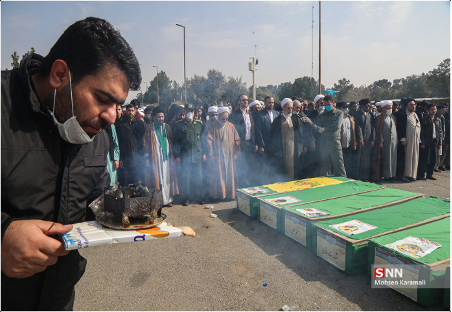
Mourners in Qom attending the funeral ceremony of Zeynabiyoun Brigade fighters in March as news of the COVID-19 pandemic in Iran was spreading. Some of the mourners wear masks.22
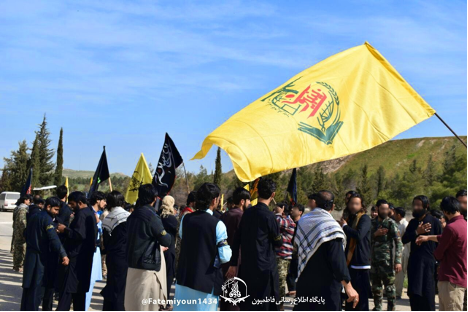
Zeynabiyoun flag hoisted, with the Fatemiyoun in the back, during a mourning ceremony to mark the anniversary of Hazrat-e Zeynab's death in the vicinity of Aleppo, March 2020.23
Building Cultural Influence and Deepening Ties
Two years into Syria’s civil war, building influence among Afghan and Pakistani Shia constituents became a fixation for the IRGC. The formation of the Fatemiyoun Division's Cultural Directorate in 2017 centralized the group's cultural and outreach activities. The Fatemiyoun had cultural bases in Syria that predated the directorate.24 But the directorate’s consolidation represented an effort to bring more coherence to cultural programs such as trainings for clerics, religious ceremonies, and memorials.25
When discussing the directorate's formation, Mojahedi said that "there is no difference between the cultural trench and the front line," because "the enemy in its media war is attacking us in our own backyard."26 He referred to a belief popular with the Supreme Leader and the Guard Corps that the U.S. government is using American cultural products like Hollywood as tools of foreign policy to undermine Iranian religiosity and the Islamic Republic's values.27 Mojahedi also said that the directorate would coordinate cultural activities related to the Fatemiyoun and prevent individuals from taking advantage of the Fatemiyoun's name when they've had no official ties.28
A multi-billion dollar religious foundation has deepened its involvement with the Fatemiyoun. The current Cultural Directorate chief is Hojjat ol-Eslam Hojjat Gonabadinejad, who is also the Director of the Cultural Organization of the Holy Reza Precinct, a multi-billion dollar, Vatican-like institution that oversees the Imam Reza Shrine in Mashhad, and has conglomerates and business interests in industries like pharmacy and agriculture.29 The religious precinct only answers to the Supreme Leader.30 Media sources cited Hojjat Gonabadinejad as the Fatemiyoun Cultural Deputy as early as March 2017.31
The Fatemiyoun referred to Mojahedi as cultural directorate deputy in that year, though Iranian media cited him as cultural affairs director in January 2018.32 Mojahedi left the directorate sometime after that point. The precinct's involvement with the Fatemiyoun grew under the tenure of former trustee Ebrahim Raisi, 2017 presidential candidate whom Khamenei appointed as judiciary branch chief in 2019.33 Raisi has met with families of deceased fighters several times including in his post as judiciary chief.34 Raisi's successor at the Precinct, Hojjat ol-Eslam Ahmad Marvi, has continued meeting with families of "martyrs."35 Since Raisi's tenure, the precinct has increased its involvement with the Fatemiyoun. Its media directorate has helped produce several documentaries about Fatemiyoun fighters.36 The precinct in 2017 handed over 36 housing units at low rent to families of deceased fighters in Baqer Shahr, on the outskirts of the capital Tehran.37 The latter included a workshop to teach tailoring in the "housing-cultural complex," in which there is also a prayer room.38
Although Instagram and Facebook shut down the outlet's official channels, its Telegram channel today has the widest audience. The group continues to have a small presence on Twitter. It also uses Iranian Sorush, which is supposed to be the alternative to Telegram. The center produced at least 30 documentaries, which involve the group's exploits, and profiles of deceased fighters and commanders.39 The first documentaries on the Fatemiyoun were produced by state outlets like the Islamic Revolution Documentary House, which produced a documentary on Tavassoli in the spring of 2015.40 The Fatemiyoun's media center started producing content the following year.41 The 2017 documentary War, Camera, I explored a Fatemiyoun cameraman who said that if there are no cameras to record "the children of Khomeini," then the group would allow others to write its history.42
During a televised panel discussion, Pouriya Najafi, the director of a documentary on the Fatemiyoun called The Commander of Palmyra, praised the Fatemiyoun Media Center for "taking up a weapon in hand" and portraying the "bravery of the shrine defending warriors." In that panel, film critic Ne'matollah Sa'idi said that "he who narrates the war wins the field."43 To fill technical gaps, it produced documentaries with state- and IRGC-linked media shops like Islamic Televisions and Radio Association, Ofogh TV, Cheshmeh Documentary Center, and Haghighat Documentary Center.44
Mysticism and the special relationship between martyrs and God appear as themes in the narratives about Fatemiyoun and Zeynabiyoun. By implementing values such as the desire for martyrdom and piety, a mujahid may develop a closer relationship with the divine. There are numerous accounts of fighters including in the Iran-Iraq War seeing Imams in their dreams, or family members having a premonition that they would achieve martyrdom.45
One example is a video circulated on IRGC-linked news agencies and social media in which slain Fatemiyoun commander Sadrzadeh told the camera, "God willing, I’ll be with Abbas on Tas'ua."46 The interpretation of that video was that he predicted his own death, which is a common story in the narrative about martyrs. Other narratives involve family members having premonitions about his death, often saying that an Imam visited them in a dream.47 Qom Municipality has set up a website for a "virtual pilgrimage" of the graves of fighters buried in Qom's cemetery (See Figure 24).48 In one documentary narrative featured on the site, an Afghan fighter always wanted to visit Karbala to see Imam Hossein's Shrine.49 He died in Syria before he could. His remains were mistakenly sent to Karbala instead of Iran. God fulfilled his wish after he sacrificed his life for the righteous cause.
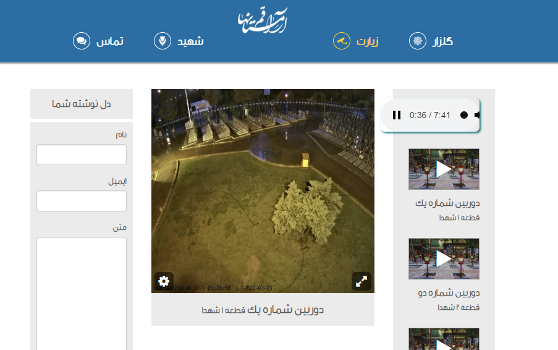
Screenshot from the website launched by government authorities in the Iranian city of Qom where visitors can conduct a "virtual pilgrimage” to the graves of Afghan and Pakistani fighters buried in Qom's cemetery. The website plays a somber religious song. 50
Like the IRGC, the Fatemiyoun have also fused their activities into a religious-based calendar to sustain their culture and spread their message. The Fatemiyoun also held group activities in Iran and Syria for 24 birthdays and deaths of the Imams. They advertise these events on social media. Pro-IRGC social media accounts, and IRGC-linked news agencies echo Fatemiyoun activities. Events include anniversaries of the death of fighters, the most important of which is Tavassoli's. Other cultural activities included theater and art competitions.51 IRGC Chief Commander Hossein Salami issued a statement on the 2020 anniversary of his death praising Tavassoli and the paramilitary group.52 Shiite religious events are also important ceremonies.
One of the most important ones is Arba'een, or the fortieth day after the death of Imam Husayn, during which millions of Shiites go on pilgrimage to Karbala, with long treks on foot. Along the way, volunteers set up aid stations, known as movakkeb, to give away food and water. Iran has overseen the distribution of propaganda material in these aid stations with the goal of tying the Islamic Republic to Shiism. Similarly, the Fatemiyoun have also set up aid stations for pilgrims at various religious sites, distributing propaganda material and showcasing documentaries about the group and posters to martyrs under Fatemiyoun banners. Other religious and ideological activities sponsored by the Imam Reza shrine in Mashhad and the Hazrat-e Ma'sumeh shrine in Qom include shrine volunteers, known as servants (sing. khadem), visiting the families of fallen Fatemiyoun fighters or distributing aid during the COVID-19 pandemic.53
Flood Relief is Like Defending the Shrine
To boost their image in Iran, the Fatemiyoun have participated in humanitarian aid efforts. In March and April 2019, unprecedented floods struck Iran's northeast and southwest regions.54 Soleimani encouraged the Fatemiyoun to deploy to Iran's southwest to help flooded areas. The Islamic Republic's failure to appropriately respond to the flood raised blistering public criticism.55 Soleimani stepped in, declaring in a statement that he would deploy to help with flood relief efforts in the hard-hit southwest for a month, and called on Guard Corps commanders and veterans to do the same.56
Arriving in Khuzestan, he announced through his social media accounts that helping in flood relief efforts is like "defending a shrine."57 Shortly after, a poster circulated on social media requesting volunteers. That poster was claimed by the Fatemiyoun Division Warriors Committee, a veterans group, and the IRGC Basij Fatemiyoun Division Martyrs Area 6 Meysam, a paramilitary Basij base stationed in Mashhad that named itself after the Fatemiyoun and is active in organizing events for the group.
IRGC-led paramilitary groups deployed to help in flood relief efforts in the southwest, a move that proved controversial in the Iranian public. After reports and footage appeared of Fatemiyoun and Iraqi paramilitary groups helping with flood efforts, many Iranians on social media called it a move to crack down on people fed up with the poor government response. The short documentary From Defense to Aid, released in 2019, chronicles the Fatemiyoun's flood aid effort, pushing back against the perception that the fighters deployed to crack down on Iranians, arguing they did so to demonstrate solidarity.58
The debate came on the heels of a warning by the Tehran Islamic Revolution Court Chief Prosecutor Hojjat ol-Eslam Musa Qazanfarabadi in March 2019 that "if we don't help the revolution, Iraqi Hashd al-Sha'bi [PMF], Afghan Fatemiyoun, Pakistani Zeynabiyoun, and Yemeni Houthis will come and help the revolution."59 He made the remarks at Qom's Ma'sumiyeh Seminary School, a top institution for training clerics who graduate to the Islamic Republic's military and security services. While it stirred controversy on social media, no official rebuked or pushed back against him. His statements followed the 2017-2018 nationwide protests.
During the COVID-19 pandemic, the Fatemiyoun has heavily publicized its aid efforts, both in Iran and Syria. In Iran, it showed volunteers helping disinfect areas, as well as giving aid packages to the families of deceased fighters.60 The group showed a factory in Syria in which fighters produced masks for distribution to Syrians, and said that a number of masks were exported to Afghanistan.61 They called themselves "defenders of health," connecting the anti-COVID-19 effort today to defending the shrine.62 IRGC-linked news agencies and media have reported on these activities in positive terms. The aid efforts have not proven to be as controversial as the deployment during flood relief just a year earlier.
Syria, Afghanistan, and Preparation for War with Israel
Despite the Fatemiyoun's earlier announcement that its military operations were over, the group continues to have a military presence in Syria. It continues to promote fighters stationed in various bases including Aleppo, Deir Ezzor, and Palmyra.63 Fighters frequently hold religious ceremonies and attend addresses at the shrine of Hazrat-e Zeynab. Many demobilized fighters have, nonetheless, returned to Iran and Afghanistan often to communities that are openly hostile to them. Those who have returned to Afghanistan hide in secret amid the fear of prosecution, and remain closeted about their tours of duty in Syria for fear of being cast as profit seeking mercenaries.64 Yet, even in secret, returnees represent a possible reserve force that the IRGC can call up again in the event that Iran enters into a conflict with a major regional rival like Israel. Indeed, Iranian Foreign Minister Javad Zarif suggested in late 2020 that the Fatemiyoun could help Afghan government forces in the future, raising the prospect of a Fatemiyoun deployment post-U.S. withdrawal should Tehran’s ties with the Taliban deteriorate.65
As can be seen from the Fatemiyoun propaganda poster in Figure 25 below, the Guard Corps is drilling the destruction of Israel as an ideological objective into Fatemiyoun fighters. Khamenei, Khomeini, and many officials and commanders consider Israel's existence as fundamentally illegitimate.66 Tehran has incurred significant costs in order to continue supporting Palestinian factions like Hamas. Foreign Minister Mohammad Javad Zarif declared to a gathering of foreign ambassadors in Tehran in 2019 that "we are proud to be pressured for our support to Palestine."67 Khamenei declared in 2015 that Israel would be destroyed by 2040.68
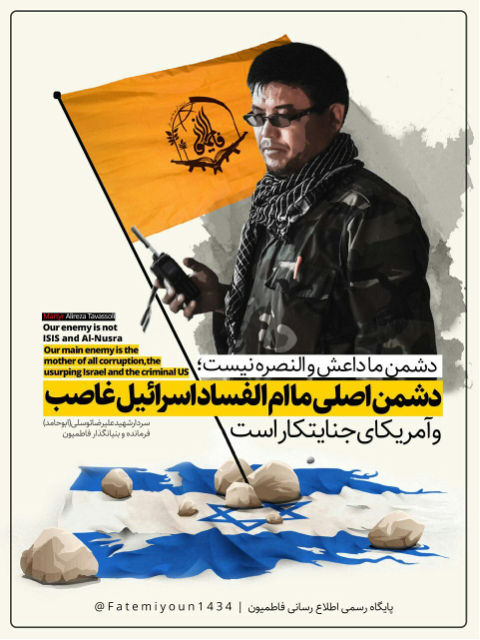
Poster of deceased Fatemiyoun co-founder Alireza Tavassoli, with text in Persian and English that reads: ”Our enemy is not ISIS and al-Nusrah. Our main enemy is the mother of all corruption, the usurper Israel and the criminal U.S.” The poster was distributed on Fatemiyoun's social media channels in May 2020 to mark the anti-Israel Quds Day, held on the last Friday of every Ramadan since 1979.
Many Guard Corps commanders, including those who deployed to Syria, have declared that they expect an eventual war with Israel. In the documentary Time of Being about the Fatemiyoun, the narrator showed footage of Tavassoli overlooking the Golan Heights, promising that the Fatemiyoun would go to fight Israel soon.69 The narrator in the documentary blamed Israel and the United States for stoking war in Syria to "help Israel's security and weaken the resistance," but that "we will not stop until ending the lives of Zionists."
Israel has launched hundreds of airstrikes against Guard Corps positions in Syria in recent years, most of which are not claimed.70 Israel's declared objectives have been to prevent "game changing" Iranian weapons transfers, such as advanced air defense systems.71 A September 2019 Israeli strike on the Fatemiyoun position near Al Bukamal in eastern Syria, for instance, sent a strong message that Israel considered all IRGC positions, including proxy positions, to be fair game for targeting.72 The Fatemiyoun compound would have probably helped consolidate the IRGC's position near the border crossing, which is perceived as constituting the "land corridor." In response to the strike, the Fatemiyoun's Imam Sadeq Division stationed in Palmyra held a drill. Neither the Fatemiyoun nor the IRGC has the means to counter Israeli strikes, and Russia has not intervened to prevent such Israeli strikes. Nor are they able to retaliate in a way that does not invite more strikes. The aim of the drill was to raise morale following strikes for which the group had no answers.
Soleimani’s Shadow
- Executive Summary
- I. Introduction
- II. The Origins of Iran’s Afghan and Pakistani Shi’a Networks
- III. Crossroads in Khuzestan: Afghan Shi’a Mobilization During the Iran-Iraq War
- IV. The Arab Spring: A New Phase of Iranian Proxy Warfare Strategy
- V. Keeping the Faith in Sacred Defense
- VI. Spinning the Fatemiyoun: Raising an Army of Disposable Afghan Diaspora Online
- VII. The Future of the Fatemiyoun Division
- Conclusion: Soleimani’s Legacy and What it Means for the Future of Proxy Warfare
- Appendix I-Timeline: The Rise of Iran’s Afghan Shia Cadres
- Appendix II-Prominent Fatemiyoun Propaganda Organizations and Groups
Citations
- "Timeline: the Rise, Spread, and Fall of the Islamic State," The Wilson Center, October 28, 2019. .
- Ibid.
- David Adesnik, Behnam Ben Taleblu, H.R. McMaster, "Burning Bridge: The Iranian Land Corridor to the Mediterranean," Foundation for Defense of Democracies, June 18, 2019. .
- "Gen. Soleimani Congratulates Ayatollah Khamenei and Muslims on ISIS termination," Office for The Preservation and Publication of the Works of Grand Ayatollah Khamene'i, November 21, 2017. .
- Ahmad Majidyar, "After ISIS, Fatemiyoun Vows to Fight with “Axis of Resistance” to Destroy Israel," Middle East Institute, November 22, 2017, ; "بیانیه مهم «لشکر فاطمیون» خطاب به سرلشکر سلیمانی" ("bayani-ye mohemm-e 'lashkar-e fatmiyoun' khatab be sarlashkar soleimani," "Important Statement by 'Fatemiyoun Division' Addressed to Major General Soleimani"), Farda News, November 21, 2017. .
- "نامه فرماندهان و خانواده شهدای زینبیون به سردار سلیمانی" ("name-ye farmandehan-e va khanevade-ye shohada-ye zeynabiyoun be sardar soleimani," "Letter of Zeynabiyoun Commanders and Families of Martyrs to Commander Soleimani"), Jam-e Jam, November 25, 2017. .
- Ahmad Shuja Jamal, "Mission Accomplished? What’s Next for Iran’s Afghan Fighters in Syria," War on the Rocks, February 13, 2018. .
-
“سوریه فداکاریهای گردان فاطمیون را فراموش نخواهد کرد”
(“Syria Will Not Forget The Sacrifices of The Fatemiyoun Battalion”), Astan News, November 23, 2017. ;
“رزمندهای که مبارز میدان «کرونا» شد/ از «فاطمیون» تا «گلشهر»” (“razmandeyi ke mobarez-e meydan-e ‘corona’ shod/ az ‘fatemiyoun’ ta ‘golshahr,’ “The Warrior Who Became Combatant in Field of “Corona”/ From “Fatemiyoun” to “Golshahr”), Mehr News, April 11, 2020. . - Ibid.
- “21 از نیروهای تیپ فاطمیون و زینبیون در ادلب سوریه کشته شدند" (“21 nafar az niruha-ye tipp-e fatemiyoun va zeynabiyoun dar idlib-e suriye koshte shodand," "21 Fatemiyoun and Zeynabiyoun Brigade Forces Killed in Syria's Idlib"), Radio Farda, March 1, 2020. .
- "Eight fighters with Lebanon’s Hezbollah killed in Syria," Associated Press, February 29, 2020. .
- Ibid.; "تحولات جدید در سوریه و لزوم بازگشت به تاکتیکهای حاج قاسم" ("tahavvolat-e jadid dar suriyeh va lozum-e bazgasht be taktikha-ye haj qasem," "New Developments in Syria and The Necessity of Returning to The Tactics of Haj Qasem," Seda-ye Modafe'an, February 29, 2020. .
- "مسئول لشکر فاطمیون در ایران: نیروهای افغان 'دو هزار کشته' دادهاند" ("mas'ul-e lashkar-e fatemiyoun dar iran: niruha-ye afghan 'do hezar koshte' dadehand," "Fatemiyoun Division Official in Iran: Afghan Forces Have Given 'Two Thousand Dead"), BBC Persian, January 16, 2018. .
- "نخستین شهید فاطمیون چه کسی بود؟" ("nokhostin shahid-e fatemiyoun che kasi bud?," "Who Was The First Fatemiyoun Martyr?"), Fash News, September 14, 2019. .
- Alfoneh, "Iranian combat fatalities in Syria since January 2012: IRGC (563); Regular Military: (8). February 2020: 3.” Twitter, February 29, 2020. .
- "IRGC Strategist Hassan Abbasi Praises Iranian Parents Who Handed Over Their Oppositionist Children For Execution: Educating People To This Level Is The Pinnacle Of The Islamic Republic's Achievement; Adds: 2,300 Iranians Have Been Killed In Syria War," Middle East Media Research Institute, March 13, 2019. .
- “بازداشت فرماندهان لشکر زینبیون در قم” (“bazdasht-e farmandehan-e lashkar-e zeynabiyoun dar qom,” “The Arrest of Zeynabiyoun Division Commanders in Qom”) Zeitoons, March 3, 2017. .
- "از زینبیون چه خبر؟" ("az zeynabiyoun che khabar?," "What News of The Zeynabiyoun?"), Seda-ye Modafean, August 14, 2019. .
-
"تشییع و تدفین پیکر 12 شهید مدافع حرم در قم" ("tashi' va tadfin-e peykar-e 12 shahid-e modafe'-e haram dar qom," "Burial of The Remains of 12 Martyred Shrine Defenders in Qom"), SNN, March 1, 2020. . - @Fatemiyoun1434, "دسته عزاداران جبهه مقاومت در سوگ حضرت زینب کبری(س)" ("dast-e azadaran-e jebhe-ye moqavemat dar sowg-e hazart-e zeynab-e kobra (pbuh)," "Mourners of The Resistance Front in Mourning"), Telegram, March 11, 2020. .
- Ali Alfoneh, “Shiite Pakistani combat fatalities in Syria since November 22, 20214: 174. February 2020: 12.,” Twitter, March 1, 2020. .
-
"تشییع و تدفین پیکر 12 شهید مدافع حرم در قم" ("tashi' va tadfin-e peykar-e 12 shahid-e modafe'-e haram dar qom," "Burial of The Remains of 12 Martyred Shrine Defenders in Qom"), SNN, 1 March, 2020. . - @Fatemiyoun1434, "دسته عزاداران جبهه مقاومت در سوگ حضرت زینب کبری(س)" ("dast-e azadaran-e jebhe-ye moqavemat dar sowg-e hazart-e zeynab-e kobra (pbud)," "Mourners of The Resistance Front in Mourning"), Telegram, March 11, 2020. .
- "مستند آخرین فصل زندگی" ("mostanad-e akharin fasl-e zendegi," "Last Chapter of Life Documentary"), Aparat, April 23, 2018. .
- "مسئول هیئت رزمندگان فاطمیون در سوریه چه کسی بود؟+ عکس" ("mas'ul-e hey'at-e razmandegan-e fatemiyoun dar suriyeh che kasi bud? + ax," "Who Was The Head of the Fatemiyoun Warriors Mourning Group in Syria? + Photos"), Rouz News, March 1, 2020. .
- "معاونت فرهنگی فاطمیون : از اقدامات خودسرانه جلوگیری میکنیم" ("mo'avenat-e farhangi-ye fatemiyoun: az eqdamat-e khodsarane jelogiri mikonim," "Fatemiyoun Cultural Directorate: We Will Prevent Unauthorized Actions"), Fatemiyoun, September 19, 2017. .
- Amir Toumaj, "Iran's Economy of Resistance: Implication For Future Sanctions," AEI's Critical Threats Project, 2014, 2.
- "معاونت فرهنگی فاطمیون : از اقدامات خودسرانه جلوگیری میکنیم" ("mo'avenat-e farhangi-ye fatemiyoun: az eqdamat-e khodsarane jelogiri mikonim," "Fatemiyoun Cultural Directorate: We Will Prevent Unauthorized Actions"), Fatemiyoun, September 19, 2017. .
- Mike Saidi, "Supreme Leadership, Economics, and Clout in Iran," AEI's Critical Threats Project, June 17, 2019. .
- Ibdi.
- "ابوحامد و فاتح، زینت بخش محفل یادواره شهدای لشگر فاطمیون هستند" ("abu hamed va fateh, zeynat bakhsh-e mahfel-e yadvare-ye shohada-ye lashkar-e fatemiyoun hastand," "Abu Hamed and Fateh Decorate The Circle of Fatemiyoun Division Martyrs"), Mehr News, March 1, 2017. .
-
"معاونت فرهنگی فاطمیون : از اقدامات خودسرانه جلوگیری میکنیم"
("mo'avenat-e farhangi-ye fatemiyoun: az eqdamat-e khodsarane jelogiri mikonim," "Fatemiyoun Cultural Directorate: We Will Prevent Unauthorized Actions"), Fatemiyoun, September 19, 2017. ;
"مسئول لشکر فاطمیون در ایران: نیروهای افغان 'دو هزار کشته' دادهاند" ("mas'ul-e lashkar-e fatemiyoun dar iran: niruha-ye afghan 'do hezar koshte' dadehand," "Fatemiyoun Division Official in Iran: Afghan Forces Have Given 'Two Thousand Dead"), BBC Persian, January 16, 2018. . - "Ebrahim Raisi Appointed Judiciary Chief," United States Institute of Peace, March 8, 2019. .
- Fatemiyoun1434, "آخرین شب از اجتماع بزرگ وارثان ولایت برگزار شد" ("akharin shab az ejtema'-e bozorg-e varesan-e velayat bargozar shod," "The Last Night of the Great Gathering of The Inheritors of Guardianship Was Held"), Telegram, October 16, 2018. ; "جهلزدایی از منطقه و جهان از برکات خون شهدای مدافع حرم است" ("jahl-zodayi az mantaqeh va jahan az barakat-e khun-e shohada-ye modafe'-e haram as," "Eliminating Ignorance From The Region and The World is One of The Blessings of The Blood of Martyred Shrine Defenders"), Islamic Azad University News Agency, January 23, 2020. .
- Hamid Farshbaf, "دیدار جمعی از علما، اساتید، نخبگان و فعالان فرهنگی افغانستان با تولیت آستان قدس رضوی" ("didar-e jam'-i az olama, asatid, nokhbegan va fa'alan-e farhangi-ye afghanestan ba towliat-e astan-e qods-e razavi," "The Meeting of a Gathering of Afghan Scholars, Teachers, Intellectuals, and Cultural Activists With The Trustee of The Reza Holy Precinct"), Reza Holy Precinct. .
- “مستند آقا سلمان (شهید محمد حسینی)” (“mostanad-e aqa salman,” “Mr. Salman Documentary (Martyr Mohammad Hosseini)”), Aparat, December 3, 2018. ; “مستند حبیب (شهید محمد اسحاق نادری)” (“mostanad-e habib (shahid mohammad es’haq naderi,” “Habib Documentary (Martyr Mohammad Es’haq Naderi”), Aparat, December 28, 2018. .
- "تحویل واحدهای مسکونی آستان قدس رضوی به خانواده شهدای لشکر فاطمیون + گزارش تصویری" ("tahvil-e vahedha-ye maskuni-ye astan-e qod-se razavi be khanevadeh-ye shohada-ye lashkar-e fatemiyoun + gozaresh-e tasviri," "Handing Over Housing Units of Reza Holy Precinct to The Families of Martyred Shrine Defenders"), Ghased News, February 28, 2017. . Archived at: .
- "اولین کارگاه مشاغل خانگی ویژه خانواده شهدای فاطمیون افتتاح میشود" ("avvalin kargah-e mashaghel-e khanegi-ye vizhe-ye khanevadeh-ye shohada-ye fatemiyoun eftetah mishavad," "The First House Works Worskhop Dedicated to Families of Martyred Fatemiyoun Will be Inaugurated"), Bagher Shahr News, July 1, 2017. .
- @Fatemiyoun1434, “ مستند پیشنهادی از تولیدات مرکز رسانه فاطمیون" (“30 mostanad-e pishnehadi az tolidat-e makaz-e rasane-ye fatemiyoun,” “30 Suggested Documentary Productions From The Fatemiyoun Media Center,” March 13, 2020. .
- "مستند بسیار زیبای فاتحان فردا/رشادت بی نظیر مدافعان حرم" ("mostana-e besiar ziba-ye fatehan-e farad/reshadat-e bi nazir-e modafe'an-e haram," "The Very Beautiful Documentary Conquerors of Tomorrow/Unparalleled Bravery of Shrine Defenders"), Aparat, September 7, 2015. .
- "جنگ، دوربین، من" ("jang, durbin, man, "War, Camera, I"), Tebyan, November 25, 2017. .
- Ibid.
- "سعیدی : کسی که جنگ را روایت میکند پیروز میدان است" ("Sa'idi: kasi ke jang ra vevayat mikonad piruz-e meydan ast," "Sa'idi: He Who Narrates The War Wins The Field"), Ammar Film, September 22, 2019. .
- "جنگ، دوربین، من" ("jang, durbin, man, "War, Camera, I"), Tebyan, November 25, 2017. ; Fatemiyoun1434, "کلیپ اختصاصی | صد حیف که نتوانستیم ابعاد وجودی #ابوحامد را بیشتر درک کنیم" ("clip-e ekhtesasi | sad heyf ke natavanestim ab'ad-e vojudi-ye #abuhamed ra bishtar dark konim," "Exclusive Clip | So Unfortunate That We Were Unable To Understand #AbuHamed's Character More"), Telegram, February 28, 2020.
- “Greetings Upon Ebrahim,” 109.
- Fatemiyoun Media Center Official Channel, “ایشالا تاسوعا پیش عباسم – شهید مصطفی صدرزاده” (“ishallah tasu’a pish-e abbasam – shahid mostafa sadrzadeh,” “God Willing I’ll be With Abbas on Tas’ua – Martyr Mosfata Sadrzadeh”) , Aparat video, 1:41, September 19, 2018. .
- "مادرم خواب زینب (س) را که دید، گفت: "پسرم عاقبت به خیر شد” (“madaram khab-e zeynab (s) ra ke did, goft: ‘pesaram aqebat be kheyr shod,” “When My Mother Saw Zeynab (pbuh) in a Dream, She Said: ‘My Son Faced a Good Destiny”), Tasnim News, December 14, 2015. .
- “Visual Pilgrimage of Unknown Martyrs and Martyrs of Shrine Defenders; Behesht-e Ma’sumeh Cemetary; Qom Province Municipality,” Azm Ziarat, accessed 8 May, 2020. .
- “روایت ابوذر بیوکافی از کربلایی شدن شهید فاطمیون+فیلم” (“revayat-e abuzar bivkafi az karbala’i shodan-e shahid-e fatemiyoun+film,” “Abuzar Bivkafi’s Account of a Fatemiyoun Martyr Going to Karbala+Film”), Tasnim News, November 15, 2019. .
- “Visual Pilgrimage of Unknown Martyrs and Martyrs of Shrine Defenders; Behesht-e Ma’sumeh Cemetary; Qom Province Municipality,” Azm Ziarat, accessed May 8, 2020. .
- “نخستین کنگره بزرگداشت شهدای جبهه مقاومت در قم آغاز شد” (“nokhostin kongere-ye bozorgdasht-e shohada-ye jebhe-ye moqavemat dar qom aghaz shod,” “The First Congress To Commemorate Martyrs of Resistance Front in Qom Began”), Haraa, January 12, 2019. .
- “پیام فرمانده کل سپاه به همسر فرمانده فاطمیون” (“payam-e farmande-ye koll-e sepah be hamsar-e farmande-ye fatemiyoun,” “The Message of the IRGC Chief to The Spouse of Fatemiyoun Commander”), Khabar Online, February 27, 2020. .
- “دیدار خادمیاران رضوی با خانواده شهدای تیپ فاطمیون” (“didar-e khademin-e razavi ba khanevade-ye shohada-ye tipp-e fatemiyoun,” “Meeting of Razavi Servants With The Families of Fatemiyoun Brigade Martyrs”), Astan News, September 8, 2019. .
- “Southwest Iran hit hard by flooding, evacuation underway in Ahvaz,” Reuters, April 10, 2019. .
- “Iranian Officials Criticized As Severe Flooding Wreaks Havoc,” RadioFreeEurope/RadioLiberty, April 3, 2019. .
- "سردار سلیمانی به مدت یک ماه به مناطق سیل زده میرود” (“sardar soleimani be moddat-e yek mah be manateq-e seyl zadeh miravad,” “Commander Soleimani Will Go To Flooded Areas For a Month”), International Quran News Agency, April 5, 2019. .
- “پیام ویژه سردار سلیمانی به مشتاقان دفاع از حرم” (“payam-e vizhe-ye sardar soleimani be moshtaqan-e modafean az haram,” “Special Message of Commander Soleimani to Those Excited To Defend Shrine”), Al-Alam, .
- Fatemiyoun Media Center Official Channel, “از دفاع تا امداد | مستند حضور فاطمیون در مناطق سیل زده” (“az defa’ ta emdad | mostanad-e hozur-e fatemiyoun dar manateq-e seyl zadeh,” “From Defense to Aid | Documentary on Presence of Fatemiyoun in Flood-Stricken Areas”), Aparat video, 11:06, May 14, 2019. .
- Amir Toumaj, “Senior Iranian official: foreign Shiite militias to fight in Iran if Islamic Republic in danger,” FDD’s Long War Journal, March 8, 2019. .
- "کمک به قطع زنجیره سرایت کرونا توسط نخبههای فاطمیون+فیلم" (“komak be qat-e zanjireh-ye serayat-e corona tavassot-e nokhbegan-e fatemiyoun+film,” “Helping Cut Chain of Corona’s Spread by Fatemiyoun Elite+Footage”), Tasnim News, July 25, 2020. .
- "تولید و توزیع ماسک فاطمیون برای مردم سوریه+ فیلم” (“tolid va tozi-e mask-e fatemiyoun bara-ye mardom-e suriyeh,” “Production and Distribution of Fatemiyoun Mask For The Syrian People+Footage”), Tasnim News, April 7, 2020, ; “نیروهای فاطمیون در بحران «کرونا» آستین همت بالا زدهاند” (“niruha-ye fatemiyoun dar bohran-e ‘corona’ astin-e hemmat bala zadand,” “Fatemiyoun Forces Got To Work During The ‘Corona’ Crisis”), Fars News, May 9, 2020, .
- "'فاطمیون'؛ مدافعان حرمی که 'مدافعان سلامت' شدند + تصاویر" (“’Fatemiyoun’: modafe’an-e harami ke ‘modafe’ean-e salamt’ shodand + tasavir,” “’Fatemiyoun’; Shrine Defenders Who Became ‘Defenders of Health’ + Footage,”) .
- Amir Toumaj, “IRGC-led Afghan group releases Syria training camp video,” FDD’s Long War Journal, August 15, 2020, ; “برپایی دورههای آموزشی ویژه رزمندگان فاطمیون در سوریه+ تصاویر” (“barpayi-e doreha-ye amuzeshi-e vizhe-e razmandegan-e fatemiyoun dar suriyeh + tasavir,” “Special Training Courses For Fatemiyoun Warriors in Syria + Images”), Defa Press, November 15, 2020. .
- Jamal, “The Fatemiyoun Army,” 19.
- Tamim Hamid, “Armed by Iran, 2,000 Afghans Still in Syria: Zarif,” Tolo News, December 22, 2020. .
- Ehud Yaari, “How Iran Plans To Destroy Israel,” The American Interest, August 1, 2015,
- “افتخار میکنیم به خاطر فلسطین تحت فشار هستیم” (“eftekhar mikonim be khater-e felestin taht-e feshar hastim,” “We Are Proud To be Pressured Because of Palestine”), Jahan News, February 13, 2019. .
- Elliott McLaughlin, “Iran's supreme leader: There will be no such thing as Israel in 25 years,” CNN, September 11, 2015. .
- "مستند وقت بودن" ("mostanad-e vaqt-e budan," "Time of Being Documentary"), Aparat, 2019. .
- Yaniv Kubovich, “Israel Attacked 1,000 Iranian and Hezbollah Targets in Syria Since 2017,” Haaretz, August 13, 2020. .
- Judah Ari Gross, “Netanyahu: Israel acts to keep game-changing arms away from Hezbollah,” Times of Israel, January 9, 2018. ; Suleiman al-Khalidi, “Israel launches major air strikes on Iran-linked targets in Syria,” Reuters, January 12, 2021,..
- "حمله موشکی رژیم صهیونیستی به مقر فاطمیون در البوکمال+عکس” (“hamle-ye mushaki-ye rezhim-e sahynist-i be maqarr-e fatemiyoun dar albu kamal + aks,” “Zionist Regime Missile Attack Against Fatemiyoun Position in Al Bukamal + Photo”), Khabari, September 15, 2019. ; Felicia Schwartz &ÌýNazih Osseiran, “Israel Strikes Iran-Related Targets in Syria,” Wall Street Journal, January 13, 2021. .