A Chapter of: Soleimani’s Shadow
I. Introduction
On February 28, 2015, Afghan Fatemiyoun Division1 forces came under heavy attack from Jabhat al-Nusra fighters as Fatemiyoun fighters tried to seize Tal Gharin Hill in Syria's southern Daraa Governorate.2 It was the twentieth night of “Operation Martyrs of Quneitra,” an all-out assault by forces loyal to the government of Syria’s President Bashar al-Assad on a pocket of the province that had fallen into the hands of Syrian rebel forces after the defection of a leading general with the Syrian Arab Army (SAA).3 Gaining control of the tiny ridge near the edge of the Golan Heights only 15 kilometers from Israel’s border would not only mean retaking control of a key SAA electronic warfare base that had fallen into rebel hands, it would also deliver a much needed win for Iran after one of its top generals was killed by Israel only about a month earlier in Quneitra.4 Around midnight, Fatemiyoun’s commander and co-founder Ali Reza Tavassoli and his deputy Reza Bakhshi mounted a three-sided assault on the hill, capturing prized high ground, at least temporarily.
At dawn, Syrian rebel forces launched assaults to retake the hill. According to the official Iranian narrative of what happened next, Afghan Fatemiyoun fighters dug in as Israeli artillery rained overhead from across the border.5 Fatemiyoun fighters faced wave after wave of assaults, stacking the corpses of their enemies as a shield against the onslaught and resupplying their dwindling ammunition and supplies from the dead that littered the hillside. By dusk, Fatemiyoun casualties numbered 18 dead, 50 injured. Scores of fighters opposed to Assad’s regime—an estimated 180 fighters in all—had been killed.6 Soon after nightfall, three rockets hit Tal Gharin Hill, decapitating Fatemiyoun’s leader Tavassoli, also known as Abu Hamed.7 Tavassoli's right-hand man, Bakhshi, also known as Fateh or the Conqueror, died in the battle as well.
When the Fatemiyoun Media Center in 2018 released a documentary through its social media channels and advertised it on IRGC-linked media about Tavassoli’s life and fight, it was this last gruesome fact that would stand out in the narrative. Tavassoli's decapitation was, according to Fatemiyoun lore, a fitting end for a devoted defender of Imam Husayn’s memory. The grandson of the Prophet Muhammad and the third of Imam of Shia Islam, Husayn ibn Ali had also been decapitated during the Battle of Karbala, the legendary clash that sealed the sectarian split between Shi’a and Sunni Muslims. Meeting a fate similar to Imam Husayn, Master of Martyrs, was a blessing, Tavassoli's wife later said in an interview featured in the documentary.8 Like other great martyrs before him, Tavassoli’s wife recalled, he had a premonition the end was coming and sent his wife a cryptic message: "The feather of the peacock is beautiful, do not give it to the vulture."9 She learned of his death from a Fatemiyoun WhatsApp channel.10
Official accounts of Tavassoli and Fateh’s death place the blame on Israel. Some rank-and-file Fatemiyoun fighters, however, believe that the Guard Corps assassinated Tavassoli in a drone strike because he had become too independent.11 This internal skepticism among some in the rank-and-file stems from Iran’s reported mistreatment of a number of Afghan fighters after their Syrian tours were over. As documented by Ahmad Shuja, an Afghan researcher who conducted extensive interviews with Fatemiyoun fighters for the U.S. Institute of Peace, inter-ethnic and class frictions between Iranian commanders and Fatemiyoun’s mostly immigrant fighters were and are still quite pronounced.12 Grievances over promised rewards, such as citizenship papers, became an especially sore point, according to a fighter interviewed by Shuja: "As long as the Iranians need you, you are Mr. So-and-So. But when they are done with you, then you’re ‘Afghan the Donkey.’”13
Lingering skepticism and schisms that emerged from the post-deployment experience of many Fatemiyoun fighters point to a vulnerability in Iran’s proxy warfare strategy. Iran’s development of proxies and particularly its use of narratives tied to religious and sectarian themes have certainly provided a powerful tool for mobilization and fighting in pursuit of Iranian interests. The strategy’s success to date is due in large part to the fact that it targets young Afghans whose lives have stalled due to the ongoing civil war in their country and, in some cases, frustrated efforts to migrate to Europe, as noted by researcher Mohsen Hamidi.14 It, however, has also empowered forces who are not fully under Iranian control and given rise to narratives that have transnational and complex implications. The extent to which Iran can centralize control over these forces and the narratives will be a critical factor in the broader success of Iranian proxy warfare strategy.
For American policymakers and others tasked with confronting Iranian proxy warfare, building strategically on opportunities created by dissension within Fatemiyoun ranks requires comprehensive real-time assessments of how Iran’s propaganda machine works. Above all, policymakers interested in containing escalation risks need to think about proxy warfare not just in terms of guys with guns, but also how Iran uses its propaganda machine to achieve its success.
Astroturfing Afghan Shia Militancy Online: A Visible Cultural and Narrative Footprint
The story of how the IRGC leveraged cultural production to shape the Fatemiyoun Divison’s narrative into a force multiplier highlights how the digitization of sectarian and ethnic divides can transform the experience of individual grievance and socio-economic marginalization into a catalyst to mobilize armies, militias, and mercenaries. To the extent possible, this report assesses what made the IRGC’s transformation of the origin story of Afghan and Pakistani Shia marginalization in South Asia into an effective means of rallying armed proxies to its cause for a generation and turned the Fatemiyoun into a weapon of war against its adversaries in Syria. Based, in part, on a review of the wide array of Persian language battlefield memoirs written by Fatemiyoun fighters as well as social media produced by the Fatemiyoun’s media and cultural affairs unit, this report analyzes the narratives and tropes that have served as a through line in the IRGC’s promotion of proxy propaganda.
Whether fact, fiction, or something in between, rumors of friction between the Fatemiyoun’s commander, Tavassoli, and his long-time sponsors in Iran’s most powerful military institution suggest that the mythos of Fatemiyoun’s battlefield heroism is not impermeable. There is little dispute that Tavassoli’s biography has played an outsized role in IRGC financed propaganda used to mobilize Afghan and Pakistani fighters. In death and in life, Tavassoli gained tremendous popularity, and proved himself a capable military commander. The IRGC and the Fatemiyoun consistently hold up the story of Tavassoli’s last stand as an example of bravery and skill that all fighters should aspire to.
In addition to the feature-length documentary about Tavassoli’s last stand at Tal Gharin, Fatemiyoun’s media affairs and cultural unit produced multiple clips and memes depicting Tavassoli striding toward the frontline.15 The narrative of Tavassoli’s battlefield prowess took on greater social currency after he was killed in 2015, as the IRGC sought to capitalize on the mythos of his martyrdom. In memorials and in memes, Tavassoli’s image has taken on a beatified quality, his visage appearing frequently alongside the faces of Iran’s Supreme Leader Ayatollah Ali Khamenei and Grand Ayatollah Ruhollah Khomeini, Islamic Republic founder on banners, posters, and other propaganda materials.
Tavassoli’s nephew Ebrahim would tout his uncle’s legendary last stand on Tal Gharin Hill as he joined the Fatemiyoun in Syria in 2017.16 When Ebrahim later died in August 2019 after stepping on a mine in a clearing operation in Al Bukamal in eastern Syria, the Tavassoli family legend of martyrdom only grew, and their lives solidified as a central thread in the IRGC’s weave of Fatemiyoun propaganda.17 The story of how, why, when, and where the Fatemiyoun Division fights is almost as important as the fighting itself for Iran’s strategy in the Middle East.
Narrative’s Place in Iranian Proxy Warfare Strategy
Rallying co-religionists in Afghanistan and Pakistan to defend religious symbols and protect narratives of shared identity is an extension of Iran’s soft war for influence across a broad swath of Muslim-majority states. The pejorative term for this phenomenon is “propaganda.” But, as Edward Bernays, the American political strategist and godfather of public relations, noted in his classic treatise on the subject, propaganda is a consistent and continuing effort to create or shape events and outcomes by shaping “support for an opinion or a course of action.”18 In the case of Iran’s proxy wars, cultural productions that communicate and reinforce ideas about the defense of the Shi’a realm are situated somewhere between what the American international relations scholar Joseph S. Nye, Jr. has called “soft power,”19 and what the communication theorist Monroe Price has called “soft war.”20
Outclassed militarily, for now, by its chief rivals—Israel and the United States—Iran relies on asymmetric means to challenge the regional status quo. This includes the use of political warfare to erode the influence of Iran’s challengers and to build cohesion with a constituency whose identity-driven grievances stem from an outsider status that transcends traditional geographic and political boundaries. Since the start of the Arab Spring in 2011, those means have included non-military lines of effort, such as an aggressive battle for hearts and minds meant to persuade allied constituents in the Shi’a community of the righteousness of Iran’s causus belli in what Price has called the “market for loyalties.”21 Iranian leaders and elites welcomed the upswell of civil society activism that precipitated the fall of several rival secularly oriented regimes but viewed the fall of Syria, its one steadfast regional Arab ally, as an existential threat.22
In this context, narratives and messages weaved into public statements, movies, memes, news, social media, constituted a kind of psychological warfare or subversion of culture and identity aimed at forcing “the system to disintegrate from within.”23 Narrative is a crucial element of political mobilization, and it is the lifeblood of violent political movements and warmaking. The system of stories that shape beliefs and mobilize action is underpinned by the peculiar logic of a movement’s ideas about just cause for challenging the status quo through organized violence.
Through its cultivation of ties to Shia diaspora populations, Iran sought to halt the ascendance of pro-democratic, pluralist movements that might threaten its own regime.24 As Iran scholar Afshon Ostovar has pointed out, leaders in Tehran, and most notably Soleimani, saw the promise and peril in the groundswell of populist civic activism that toppled governments in Egypt and Tunisia. By necessity, in the view of Tehran, that effort included outreach to proxy forces. In more neutral terms, it might be better to cast Iran’s efforts to build up the machinery of strategic communications in support of proxy forces such as Liwa Fatemiyoun as a kind of counter-counterinsurgency.
In the Syrian war, the IRGC shaped the myth of martyrdom prevalent in Fatemiyoun narratives in order to attract supporters, recruit and deploy forces into combat. Throughout the war in Syria, Israel has figured prominently in Fatemiyoun propaganda as the main enemy25 and the Guard Corps has also cast Saudi Arabia and the United States as the true sponsors of ISIS, even as the Guard Corps benefited from U.S. airpower during operations against caliphate fighters in Iraq.26 These narratives have also been instrumental in efforts to quell an occasionally rebellious rank and file, and to energize frontline fighters when morale ebbs.
In Fatemiyoun narratives, Tavassoli's last stand at Tal Gharin Hill, for instance, is a central strand, connecting the current fight in Syria to the glorious sacrifices of Shi’ite followers of Imam Hussein ibn Ali during the Battle of Karbala in 680 CE, a bedrock event in the millennium-old schism between Sunni and Shia followers of Islam. It also serves as the connective tissue for mobilizing historical grievances around the marginalization of Shia communities in predominantly Sunni states. In this context, the bedrock mythos of the Fatemiyoun centers on rebellion against unjust Sunni rulers, as well as their allies, and sacrifice in the name of righteous resistance and just governance under Shia religious law, which under the Iranian revolutionary formulation of velayat-e fiqh privileges the authority of a singular clerical leader as the central engine of jurisprudence and rule of law.27
The narrative is more than a means of mobilization and maintaining discipline. The IRGC has a second audience in mind when it casts Fatemiyoun fighters as heroic, self-sacrificing defenders of the faith. For Iran, this narrative plays a critical role in its forward defense strategy of publicly touting its control over proxies as a deterrent and means of retaliation against the United States.28 In communicating to different audiences, the narrative helps justify Iran’s actions in the region, mobilize specific groups to act in Iran’s defense, and constitutes a means of signaling deterrent capabilities to Iran’s Israeli and American rivals.
Qassem Soleimani, the late commander of the IRGC's external operations branch the Quds Force, served as both medium and message, snapping frontline selfies with Fatemiyoun fighters, touting the glories of righteous war and recounting their heroics for the IRGC’s ever-present camera right up until his death. Within hours of reports of the U.S. drone strike on Soleimani’s convoy near Baghdad airport, the Fatemiyoun Division’s official Twitter account began blasting out memes and posts that fused Solemani’s narrative with that of Tavassoli (See also Figures 1 and 2 for materials circulated via Telegram).29
The implied threat of this narrative—when used as a signal to the United States—is that a confrontation between the United States and Iran will not be restricted to a symmetrical clash of states or a secretive tit for tat of covert, deniable operations in which Israel and the United States would have the advantage. Instead, Iran hopes to signal that confrontation holds the potential for a clash with Shi’a and other Muslims across the region, with Iran at the lead, and that the assassination of Iranian commanders will only serve to further strengthen Iran’s influence and position.
Across its many audiences, Iran’s narrative seeks to inspire a desire for martyrdom and religiously tinged jus ad bellum grounds for waging war. Iran’s political leadership has also repackaged these narratives for a population that appears to be increasingly skeptical of Iran’s military adventures abroad. The IRGC leadership believes that this not only gives it a competitive advantage against adversaries, but also helps rejuvenate its ideological aspirations.
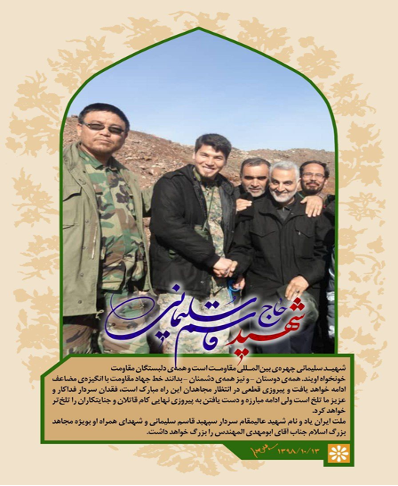
Five martyred commanders of the Resistiance Front in one frame. From right, deceased Fatemiyoun Division commander Reza Khavari; Soleimani; deceased IRGC commander Hossein Badpa; deceased Fatemiyoun commander Reza Bakhshi; and Tavassoli. The infographic also carries a quote from Supreme Leader Ayatollah Ali Khamenei praising Soleimani as “international face of resistance.”30
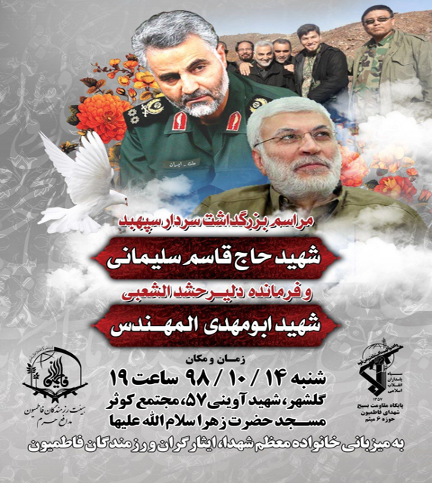
A poster advertising a commemoration ceremony for Soleimani and his deputy in Iraq Abu Mahdi al-Muhandis held in Mashhad.31
While the IRGC controls the Fatemiyoun Division and the division’s Pakistani Shi’ite twin, the Zeynabiyoun Brigade, Tehran still insists that both groups are made up of volunteers inspired to answer the call of Shia jihad and to defend Shi’ite holy shrines in Syria. The Guard Corps connects stories of the Fatemiyoun’s battlefield sacrifices to narratives dating back to the early advent of sectarian schisms within Islam and its broader geopolitical goals, but is wary of fully abandoning the plausible deniability that the use of proxies can grant.
The Fatemiyoun Division has, nonetheless, increasingly played a role in Iran’s military efforts beyond Syria.32 Former Fatemiyoun fighters have been sighted in Yemen and on Libya’s frontlines, and some were reportedly deployed from Syria, but it is unclear whether they were sent to Libya under Iranian orders.33 Thousands of fighters have also returned home to Afghanistan where rising instability and threats from ISIS and the Taliban could energize and reactivate Fatemiyoun networks that are far beyond Tehran’s control. The deployment of Fatemiyoun fighters in Syria since the civil war’s early days, suggests the Fatemiyoun Division is well-positioned to support Iran’s regional strategy and that Tehran may be anticipating a different kind of proxy war altogether in the years ahead.
Pitfalls of Iran’s Narrative Strategy and What the Narrative Means for the United States
It is far from clear whether Iran’s strategic approach and mobilization of narratives regarding the Fatemiyoun Division will be effective. Tehran’s public support for transnational revolution in defense of Shi’a communities risks could trigger an escalation of tensions with Israel, Saudi Arabia, and the United States and stir up domestic discontent. Using one narrative to signal to multiple audiences holds great promise for Iranian strategy, but it also introduces a level of complexity that can backfire.
At the same time, while the United States exerted more pressure and more direct confrontation through the assassination of Soleimani, the imposition of sanctions and other actions, there are reasons to question the credibility of the U.S. commitment when it comes to containing perceived threats from Iranian proxies. For instance, while the United States in 2019 designated the Fatemiyoun and Zeynabiyoun as terrorist groups pursuant to Executive Order 13224,34 it has not mounted a sustained, direct campaign to disrupt these groups and they continue to operate freely.
This presents a sharp contrast to global U.S. counterterrorism campaigns against Sunni jihadist groups such as al-Qaeda or ISIS. The Trump administration elected to partially subcontract its response to Iran’s proxy warfare to Israel. The Trump administration came close to but eventually pulled back from taking stronger military action in the wake of Iran’s probing of American red lines with attacks on oil tankers in the Persian Gulf or the downing of an American drone.35 Given these complexities, the jury is still out on whether the United States will succeed in managing escalation risks in the future, particularly as the Biden administration recalibrates the United States’ approach to Iran and its proxies.
Tracing the evolution of the Guard Corps’ cultivation of Fatemiyoun Division and Zeynabiyoun Brigade fighters, and the narratives that drew them to the Syrian civil war is important to navigate these complex dynamics. Iran’s ability to mobilize a wide array of proxies from across the region is dependent on its ability to effectively message and frame narratives of grievance. Much like their frontline adversaries, ISIS, the scores of young Afghan and Pakistani men stirred to take up arms in defense of Shi’ite shrines to Fatima and Zeynab, first heard the call while surfing YouTube or by watching viral video clips passed from cellphone to cellphone.
The Fatemiyoun’s song of martyr mythos online, on the battlefield, and at the gravesite, represents an unparalleled triumph of the Guard Corps’ experimentation of what our colleagues, Peter Singer and Emerson T. Brooking, have called “Like War” or “the weaponization of social media.”36 But it also empowers the scores of young Afghan and Pakistani men to shape narratives with an impact on the prospects for a potential U.S.-Iran escalation in a way that they would previously have been incapable of—and not necessarily to the benefit of Iran.
The Guard Corps places a high value on cultural production and political warfare in its proxy strategy, and promoting the mythos of martyrdom on the frontlines of Iran’s Forward Defense strategy is central to that enterprise. However, in doing so, the IRGC has also linked conflicts across the region to a greater extent than it has before and played into sectarian narratives that may prove difficult to control while giving power to a network that, while deeply indebted to Iran, is not fully under its control. Analyzing the origin and evolution of Fatemiyoun communications strategy is, therefore, critical to tracking the degree of effective control or influence Iran exerts over one of its key proxies in the region.
This report attempts to do just that. It is divided into eight parts, including this introductory section. The second section, outlines the origin story of the Fatemiyoun Division and explains how millennium-old tropes about martyrdom in the Shia faith became the rallying cry of the 1979 Iranian revolution and soon drew many Afghan and Pakistani faithful to Ayatollah Khomeini’s cause. It also explores how influential Iranian clerics in major cities in eastern Iran near the Afghan and Pakistani border became an important resource for marginalized migrants who poured into Iran in waves as South Asia was rocked by the U.S.-Soviet proxy war in the 1980s. The third section details how Guard Corps commanders mobilized Afghan and Pakistani fighters to join them on the front at the crossroads of the disputed territory of Khuzestan during the Iran-Iraq War. The fourth section examines in depth the language, signs, and symbols that are so central to the Fatemiyoun media wing’s cultural production. The fifth section explains how the IRGC reactivated the Fatemiyoun’s social networks as the Syrian civil war began in 2011. The sixth section traces the impact of the Guard Corps progressive consolidation of the Fatemiyoun’s propaganda machine as Iran turned its attention from the fight against ISIS in Syria in 2017 to other pressing objectives in its regional proxy war strategy. The seventh section contemplates the Fatemiyoun Division’s potential future trajectory, and the concluding section reflects on the implications of Soleimani's death for the movement and the region.
Soleimani’s Shadow
- Executive Summary
- I. Introduction
- II. The Origins of Iran’s Afghan and Pakistani Shi’a Networks
- III. Crossroads in Khuzestan: Afghan Shi’a Mobilization During the Iran-Iraq War
- IV. The Arab Spring: A New Phase of Iranian Proxy Warfare Strategy
- V. Keeping the Faith in Sacred Defense
- VI. Spinning the Fatemiyoun: Raising an Army of Disposable Afghan Diaspora Online
- VII. The Future of the Fatemiyoun Division
- Conclusion: Soleimani’s Legacy and What it Means for the Future of Proxy Warfare
- Appendix I-Timeline: The Rise of Iran’s Afghan Shia Cadres
- Appendix II-Prominent Fatemiyoun Propaganda Organizations and Groups
Citations
- In the scholarly literature on the Fatemiyoun Division and Zeynabiyoun Brigade, the group’s name is sometimes transliterated into English from the Arabic Liwa Fatemiyoun and at other times translated directly from the Persian Lashkar-e Fatemiyoun to Fatemiyoun Division while the Tipp-e Zeynabiyoun is translated into English as Zeynabiyounna. In this report, we use the original Persian since the groups are both Afghan in origin.
- "چهل حکایت و خاطرات شنیدنی از شهدای لشکر فاطمیون" ("Chehel hekayat va khaterat-e shenidani az shohaday-e lashkar-e fatemiyoun," "Forty Memorable Accounts and Memoirs of Fatemiyoun Division Martyrs"), Martyr Ebrahim Hadi Cultural Group, 2016, 18-19.
- Leith Aboufadel, “Northern Dara’a: Syrian Army and Hezbollah Advancing Towards Tal-Al Harra,” Al-Masdar News, February 22, 2015. ; Nicholas Blanford, “Iranian-backed Advance in Southern Syria Rattles Israel,” Christian Science Monitor, March 6, 2015. .
- For details on the 2015 Southern offensive in Syria, see: Phil Sands and Suha Maayeh, “Exclusive: The Spy Who Fooled the Assad Regime,” The National News, March 17, 2015. ; Leith Aboufadel, “Northern Dara’a: Syrian Army and Hezbollah Advancing Towards Tal-Al Harra,” Al-Masdar News, February 22, 2015. ; “Iran general died in 'Israeli strike' in Syrian Golan,” BBC, January 19, 2015. .
- "چهل حکایت و خاطرات شنیدنی از شهدای لشکر فاطمیون" ("Chehel hekayat va khaterat-e shenidani az shohaday-e lashkar-e fatemiyoun," "Forty Memorable Accounts and Memoires of Fatemiyoun Division Martyrs"), Martyr Ebrahim Hadi Cultural Group, 2016, 18-19.
- Ibid.
- Ibid.
- Two years after Tavassoli was killed in a battle in Syria, the IRGC-led Fatimiyoun Media Center released a 42-minute documentary that recounts his life story and military exploits. A version of the documentary is available here: "مستند فرمانده" ("Mostanad-e farmandeh," "Commander’-A documentary about the life of Alireza Tavassoli"), Bultan News, April 1, 2017. .
- "مستند فرمانده" ("Mostanad-e farmandeh," "Commander’-A documentary about the life of Alireza Tavassoli"), Bultan News, April 1, 2017. .
- Ibid.
- Ahmad Shuja Jamal, The Fatemiyoun Army: Reintegration into Afghan Society, Special Report No. 443, United States Institute of Peace, March 2019, 5. .
- Ibid, 11.
- Ibid.
- Mohsen Hamidi, “The Two Faces of the Fatemiyun: Revisiting the Male Fighters,” Afghanistan Analysts Network, July 8, 2019. .
- "برگزاری مراسم دعای ندبه، یادبود شهدای جاویدالاثر #فاطمیون" ("bargozariy-e marasem-e du'ah-e nudbah, yadboud-e shohada-ye javid al-asar-e #Fatemiyoun," "Holding Nudba prayer ceremony, commemorating the eternal #Fatemiyoun martyrs") Telegram, December 12, 2019. .
- “برادرزاده ابوحامد، فرمانده شهید فاطمیون چهکسی بود؟” (“baradarzadeh-ye abu hamed farmande-ye shahid-e fatemiyoun che kasi bud?,” “Who Was The Nephew of Abu Hamed, Martyred Fatemiyoun Commander?”), Tasnim News, August 11, 2019. .
- Ibid.
- Edward L. Bernays, Propaganda, New York: Horace Liverwright, 1928, 19-21. .
- Joseph S. Nye Jr., “Soft Power,” Foreign Policy, Autumn 1990, No. 80, 153-171.
- Monroe E. Price, “Iran and the Soft War,” International Journal of Communication, No. 6, 2012, 2397–2415.
- Monroe E. Price, “Strategic Communication in Asymmetric Conflict,” Dynamics of Asymmetric Conflict, 6:1-3, 2013, 135-136.
- Price, op.cit., “Iran and the Soft War,” 2012, 2399.
- Ibid, 2399-2400
- Afshon Ostovar, Vanguard of the Imam: Religion Politics, and Iran’s Revolutionary Guards, Oxford: Oxford University Press, 2016, 240.
- Ahmad Majidyar, “After ISIS, Fatemiyoun Vows to Fight with ‘Axis of Resistance’ to Destroy Israel,” Middle East Institute, November 22, 2017,
- Alex Vatanka, “Iran’s Islamic State Problem Isn’t Going Away,” Foreign Policy, June 19, 2017. . “Why did the US create ISIS?” Office for the Preservation and Publication of the Works of Grand Ayatollah Khamenei, November 16, 2020. .
- Hamid Mavani, “Ayatullah Khomeini's Concept of Governance (wilayat al-faqih) and the Classical Shi‘i Doctrine of Imamate,” Journal of Middle Eastern Studies, 47:5, 807-824, 2011.
- For more detailed analysis on the evolution of Iran’s Forward Defense strategy, see: Alex Vatanka, “Whither the IRGC of the 2020’s?” Â鶹¹û¶³´«ý, January 15, 2021. source.
- Liwa Fatimeyoun’s official Twitter handle posted updates and commentary almost daily before its suspension: ; archived version of Fatimeyoun’s Twitter account: ; the group’s new Twitter page formed in December 2020 is @gharin1434: .
- "پنج سردار شهید جبهه مقاومت در یک قاب" ("panj sardar-e shahid-e jebhe-ye moghavemat dar yek ghab," "Five Martyred Commanders of the Resistance Front in One Frame"), Telegram, January 3, 2020. .
- "مراسم بزرگداشت سردار سپهبد شهید حاج قاسم سلیمانی و فرمانده حشدالشعبی شهید ابومهدی المهندس" ("marasem-e bozorgdasht-e sardar sepahbod shahid hajj Qasem Soleimani va farmande-ye hashd ol-sha'bi shahid Abu Mahdi al-Muhandis," "Commemoration Ceremony for Commander Lieutenant General Martyr Haj Qasem Soleimani and Popular Mobilization Forces Commander Martyr Abu Mahdi al-Muhandis"), Telegram, January 4, 2020. .
- See: Candace Rondeaux, “How the Return of Iranian-Backed Militias From Syria Complicates U.S. Strategy,” World Politics Review, May 24, 2019. ; Tolonews.com, “Afghans Returning Home After Fighting War in Syria,” April 1, 2019. .
- See: U.S. Foreign Military Studies Office, Operational Environment Watch (OE Watch), April 2020, 42, ; Declan Walsh, “By Air and by Sea Mercenaries Landed in Libya. Then the Plan Went South,” New York Times, May 25, 2020. ; and Deir Ezzor 24, ” “New Rapprochment between Russia and Iran in Deir Ezzor,” July 2020, ; Jonathan Saul, Parisa Hafezi, Michael Georgy, “Exclusive: Iran steps up support for Houthis in Yemen's war – sources,” Reuters, March 21, 2017. .
- On September 23, 2001, President George W. Bush signed Executive Order 13224. The order gives the U.S. government the authority to trace and halt funding flows to individuals and entities found by U.S. national security agencies to be linked with terrorist activity. In 2019, President Donald J. Trump amended the order to consolidate the rules and parameters for terrorism financing designations. See: White House, “Executive Order on Modernizing Sanctions to Combat Terrorism, Sept. 10, 2019. . In January 2019, the U.S. Treasury’s Office of Foreign Asset Control (OFAC) issued a sanctions notice naming the Fatemiyoun Divison and Zeynabiyoun Brigade. See: U.S. Treasury, Press Release, “Treasury Designates Iran’s Foreign Fighter Militias in Syria along with a Civilian Airline Ferrying Weapons to Syria,” January 24, 2019. .
- Mark Landler, Julian E. Barnes, and Eric Schmitt, “U.S. Puts Iran on Notice and Weighs Response to Attack on Oil Tankers,” New York Times, June 14, 2019. .
- P.W. Singer and Emerson T. Brooking, Like War: The Weaponization of Social Media, New York: Houghton, Mifflin Harcourt, 2018.