Soleimani’s Shadow
Abstract
Thousands of ethnic Afghan foreign fighters with the Iranian-backed Fatemiyoun Division and Zeynabiyoun Brigade have fought and died in Syria’s civil war over the last decade. Shia fighters from Afghanistan and Pakistan have been critical not only to Iran’s successful quest to restore Syrian President Bashar al Assad’s regime, but as an asset for Tehran in its fight for regional primacy against Israel and other rivals. Fatemiyoun fighters will continue to serve on the frontlines of Iran’s proxy wars across the Middle East long into the future.
This report assesses what made the IRGC’s transformation of the origin story of Afghan and Pakistani Shia marginalization in South Asia into an effective means of rallying armed proxies to its cause for a generation and turned the Fatemiyoun into a weapon of war against its adversaries in Syria. Based, in part, on a review of the wide array of Persian language battlefield memoirs written by Fatemiyoun fighters as well as social media produced by the Fatemiyoun’s media and cultural affairs unit, this report analyzes the narratives and tropes that have served as a through line in the IRGC’s promotion of proxy propaganda.
Acknowledgments
The authors would like to thank Peter Bergen and Daniel Rothenberg, co-directors of the Â鶹¹û¶³´«ý/Arizona State University Future of War project for their support throughout the production of this paper. A deep debt of gratitude is owed to David Sterman for applying his sharp editorial eye to the text and sharing his analytical intuition throughout the research for this report. A special thanks is also owed to the many ASU faculty and staff at the Center on the Future of War and School of Politics and Global Studies who lent their support through workshops, commentary, and who most importantly allowed the project team the time and space needed to bring this report to fruition.
We are especially grateful to several Afghan, Iranian, European and American scholars who helped frame our analysis and on whose shoulders we stand; for their incisive analysis on the myriad ties that bind Iran, Afghanistan and Syria thanks in particular goes to Ahmad Shuja Jamal, Ali Alfoneh, Ghulam Sakhi Darwish, Niamatullah Ibrahimi, Afshon Ostavar, Lars Hauch, and Tobias Schneider.
Joe Wilkes, Naomi Morduch-Toubman, Joanne Zalatoris, and Maria Elkin laid out the paper and website. Thanks to Emily Schneider for her deft copyedit. This paper was supported in part by a grant from the Carnegie Corporation of New York.
It is worth noting that some of the best contemporary research is produced by Iranian, Syrian, and Afghan journalists and analysts who take great risks to bring the world news from the toughest and most unforgiving warzones known to man. Although many publish their works anonymously for fear of retribution we know that we are ever in their debt, and hope that in some small way that our gratitude lifts their spirits in this most troubled of times in the region. All errors of fact or interpretation are, of course, the authors’ alone.
Downloads
Executive Summary
Thousands of ethnic Afghan foreign fighters with the Iranian-backed Fatemiyoun Division and Zeynabiyoun Brigade have fought and died in Syria’s civil war over the last decade. Shia fighters from Afghanistan and Pakistan have been critical not only to Iran’s successful quest to restore Syrian President Bashar al Assad’s regime, but as an asset for Tehran in its fight for regional primacy against Israel and other rivals. Fatemiyoun fighters will continue to serve on the frontlines of Iran’s proxy wars across the Middle East long into the future.
The recruitment and deployment of thousands of Afghan paramilitary fighters at the knife’s edge of Iran’s proxy wars by the Islamic Revolutionary Guard Corps (IRGC) represents a watershed moment in the evolution of Tehran’s information warfare capabilities. Fatemiyoun fighters are the first forces to be deployed by Tehran at the peak of the age of militarized online “astroturfing” and propaganda by proxy and the IRGC has accordingly used social media to grow the Fatemiyoun brand online. Iranian financed propaganda about Afghan foreign fighters in Syria has played a vital role in making the IRGC’s proxy strategy a success. The Iranian support for the Fatemiyon Division’s media production unit illustrates the increased Iranian reliance upon and use of strategic narratives that bind together transnational mobilizations in the wake of the Arab Spring.
For 40 years, the IRGC has placed a premium on mobilizing volunteer Shi’a co-religionists to fight in Iran’s proxy wars. Afghan foreign fighters in Syria hail primarily from the ranks of migrant ethnic Hazara laborers whose families have traversed Iran’s eastern borders with Afghanistan and Pakistan for generations. Their commanders and Iranian handlers were part of a wave of recruits who defended Grand Ayatollah Ruhollah Khomeini’s regime during the Iran-Iraq War in the 1980s. Fatemiyoun fighting forces punch far above their weight in part because of their deep connections with key players in Iran’s revolutionary history.
However, the Fatemiyoun Division is the first unit to be reorganized from tooth to tail under the aegis of the IRGC’s evolving post-Arab Spring military doctrine of “forward” defense, which relies partly on irregular forces deployed beyond Iran’s borders to secure its foreign policy objectives and deter adversaries like the United States and Israel. Today’s Afghan foreign fighters were recruited from 2012 forward under guidance from the IRGC Quds Force’s late commander Qassem Soleimani. The Fatemiyoun Division has subsequently also become part of the everyday weave of Iranian life. This is true especially in parts of the country with strong pro-Islamist leanings where streets are named after fallen fighters. Murals and shrines to the fallen Fatemiyoun dot the landscape of Tehran as well as Qom and Mashhad, which are home to large ethnic Afghan communities.
The IRGC has revived and repurposed Afghan networks to fit Iran’s twenty-first century fight for regional primacy and effort to control post-Arab Spring narratives regarding regional conflicts, not just the military balance in particular conflicts. With support from Lebanese fighters from Hezbollah, Afghan-Shi’a foreign fighters have fought alongside Syrian-Arab Army regulars, local militias, and Russian mercenaries with the Wagner Group in some of the most strategically important battles in Syria. From their battles at the edge of the Golan Heights as part of Iran’s long running push to fight Israel to their repeated attempts to retake Palmyra, Aleppo, and strategic points in Quneitra and Deir Ezzor, Fatemiyoun fighters have extended Iran’s bridge to Hezbollah and increased Tehran’s ability to project power across the northern Middle East.
Right up until the moment of his death, Qassem Soleimani, the late commander of the IRGC's external operations branch the Quds Force, served as both medium and message, snapping frontline selfies with the Fatemiyoun, touting the glories of righteous war and recounting their heroics for the IRGC’s ever-present camera. Like many other proxy forces operating in the Middle East, the Fatemiyoun had a substantial social media following on YouTube and Twitter until both platforms took down their accounts. But they retain a presence on other social media platforms, nonetheless, as a result of IRGC investment. They also have thousands of followers on encrypted social media platforms such as Telegram and its Iranian government-controlled counterpart, Soroush.
The Guard Corps places a high value on cultural production and political warfare in its proxy strategy. Promoting the mythos of martyrdom on the frontlines of Iran’s forward defense strategy is central to that enterprise. However, in doing so, the IRGC has also linked conflicts across the region to a greater extent than it has before and played into sectarian narratives that may prove difficult to control in the future while giving power to a network that, while deeply indebted to Iran, is not fully under its control.
Key Findings
- The Fatemiyoun Division traces its antecedents to the IRGC’s decades-long proxy campaigns.
- The Fatemiyoun’s founding commanders fought in IRGC-backed proxy units against the Ba’athists in Iraq, and the Soviets in Afghanistan.
- The Fatemiyoun’s smaller sister unit, the Zeynabiyoun Brigade, also traces its roots back to the 1980s when Pakistani-Shi’a acolytes of Grand Ayatollah Ruhollah Khomeini preached revolution in the predominantly Shi’ite border town of Parachinar.
- The Fatemiyoun Division’s mobilization since 2013 reflects significant shifts in Tehran’s overall strategy that emphasize the critical role of narrative control.
- Proxy warfare is not simply a matter of guys with guns, it also includes the way states use propaganda to shape the story of their interventions and mobilize fighters.
- In the wake of the Arab Spring and the rise of ISIS, Iran increasingly promoted a narrative emphasizing transnational and religious aspects of its proxy network often at the cost of plausible deniability and covertness.
- When civil war broke out in Syria in 2011 it posed a threat to Iran’s one true Arab state ally, Syria, and to the IRGC’s regional influence. The IRGC tasked the Quds Force with deploying proxies in part to manage that challenge, gradually escalating its intervention as Assad’s grip on power devolved as a means of controlling escalation risks.
- Although Qassem Soleimani, the commander of the external operations branch, the Quds Force, was often credited as Iran’s military mastermind, the IRGC’s Hossein Hamedani was the original architect of Iran’s strategy in Syria.
- Hamedani and the IRGC drew on narratives of Sacred Defense to covertly mobilize and recruit Afghan and Pakistani Shi’ites until their numbers grew large enough to form distinct paramilitary units.
- The successful 2014 war against ISIS allowed Iran to promote a cult of personality around Soleimani that helped stoke the embers of cultural mobilization for proxy paramilitaries like the Fatemiyoun Division.
- Russian escalation in Syria in 2015 created the space for Iran to further promote Afghan and Pakistani paramilitaries.
- The number of Iranian forces in Syria increased significantly in the wake of Russia’s intervention, and Iran more aggressively promoted narratives about the Fatemiyoun Division and Zeynabiyoun Brigade.
- Iran’s Supreme Leader Ayatollah Ali Khamenei was one of the first senior Iranian officials to publicly embrace the Fatemiyoun in a speech given in Mashhad in 2016.
- The IRGC embraced the war in public, generating buzz via religious songs, public pageantry, traditional and social media about the Fatemiyoun and Zeynabiyoun volunteers.
- While Iranian coverage of the Fatemiyoun expanded in 2015 despite Afghanistan’s protests, Iran sought to minimize coverage of the Zeynabiyoun because it viewed the prospect of blowback from Pakistan as a serious risk.
- The Afghan and Pakistani Shi’a militias that Iran mobilized and the narratives through which Iran framed the mobilization will continue to shape the Greater Middle East for years to come even as the militias’ involvement in Syria winds down.
- After Iran declared the end of the Islamic State in late 2017, the Fatemiyoun Division and Zeynabiyoun Brigade declared they would fight anywhere, anytime. The Fatemiyoun subsequently announced a drawdown of its forces in Syria and a renewed focus on cultural affairs.
- Senior Iranian officials consolidated the Fatemiyoun Division’s propaganda wing. At the same time, the Fatemiyoun’s cultural affairs unit expanded the scope of its activities.
- Despite a brief lull in Fatemiyoun and Zeynabiyoun operations after the 2017 drawdown, fighters from both contingents were reportedly killed in the 2020 battle for Idlib.
- The IRGC began recalling Fatemiyoun fighters back to Iran as early as 2018, by some accounts, provoking controversy with the Iranian public, but even after Soleimani’s assassination the Fatemiyoun Division remains in a prime position to mobilize for Iran’s next proxy war ventures.
- IRGC investment in Fatemiyoun Division influence campaigns creates real battlefield dividends for Iran, but it also carries significant escalation risks.
- Inside Afghanistan, the practical effect of narratives around the Fatemiyoun Division’s battlefield successes may present an attractive alternative for embattled Shia communities that are increasingly being targeted by both ISIS and the Taliban as U.S. forces drawdown.
- Tehran’s suggestion in late 2020 that Fatemiyoun fighters might serve as a counterterrorism force for the Afghan government could increase the risk that Shia paramilitaries will compete for influence in what is shaping up to be a new chapter in Afghanistan's long running civil war, as the United States withdraws.
- The net effect of these dynamics could erode U.S. influence not only in Afghanistan but in South Asia writ large, because there is no telling if Tehran will be able to exert sustained control over its Afghan proxies long-term.
I. Introduction
On February 28, 2015, Afghan Fatemiyoun Division1 forces came under heavy attack from Jabhat al-Nusra fighters as Fatemiyoun fighters tried to seize Tal Gharin Hill in Syria's southern Daraa Governorate.2 It was the twentieth night of “Operation Martyrs of Quneitra,” an all-out assault by forces loyal to the government of Syria’s President Bashar al-Assad on a pocket of the province that had fallen into the hands of Syrian rebel forces after the defection of a leading general with the Syrian Arab Army (SAA).3 Gaining control of the tiny ridge near the edge of the Golan Heights only 15 kilometers from Israel’s border would not only mean retaking control of a key SAA electronic warfare base that had fallen into rebel hands, it would also deliver a much needed win for Iran after one of its top generals was killed by Israel only about a month earlier in Quneitra.4 Around midnight, Fatemiyoun’s commander and co-founder Ali Reza Tavassoli and his deputy Reza Bakhshi mounted a three-sided assault on the hill, capturing prized high ground, at least temporarily.
At dawn, Syrian rebel forces launched assaults to retake the hill. According to the official Iranian narrative of what happened next, Afghan Fatemiyoun fighters dug in as Israeli artillery rained overhead from across the border.5 Fatemiyoun fighters faced wave after wave of assaults, stacking the corpses of their enemies as a shield against the onslaught and resupplying their dwindling ammunition and supplies from the dead that littered the hillside. By dusk, Fatemiyoun casualties numbered 18 dead, 50 injured. Scores of fighters opposed to Assad’s regime—an estimated 180 fighters in all—had been killed.6 Soon after nightfall, three rockets hit Tal Gharin Hill, decapitating Fatemiyoun’s leader Tavassoli, also known as Abu Hamed.7 Tavassoli's right-hand man, Bakhshi, also known as Fateh or the Conqueror, died in the battle as well.
When the Fatemiyoun Media Center in 2018 released a documentary through its social media channels and advertised it on IRGC-linked media about Tavassoli’s life and fight, it was this last gruesome fact that would stand out in the narrative. Tavassoli's decapitation was, according to Fatemiyoun lore, a fitting end for a devoted defender of Imam Husayn’s memory. The grandson of the Prophet Muhammad and the third of Imam of Shia Islam, Husayn ibn Ali had also been decapitated during the Battle of Karbala, the legendary clash that sealed the sectarian split between Shi’a and Sunni Muslims. Meeting a fate similar to Imam Husayn, Master of Martyrs, was a blessing, Tavassoli's wife later said in an interview featured in the documentary.8 Like other great martyrs before him, Tavassoli’s wife recalled, he had a premonition the end was coming and sent his wife a cryptic message: "The feather of the peacock is beautiful, do not give it to the vulture."9 She learned of his death from a Fatemiyoun WhatsApp channel.10
Official accounts of Tavassoli and Fateh’s death place the blame on Israel. Some rank-and-file Fatemiyoun fighters, however, believe that the Guard Corps assassinated Tavassoli in a drone strike because he had become too independent.11 This internal skepticism among some in the rank-and-file stems from Iran’s reported mistreatment of a number of Afghan fighters after their Syrian tours were over. As documented by Ahmad Shuja, an Afghan researcher who conducted extensive interviews with Fatemiyoun fighters for the U.S. Institute of Peace, inter-ethnic and class frictions between Iranian commanders and Fatemiyoun’s mostly immigrant fighters were and are still quite pronounced.12 Grievances over promised rewards, such as citizenship papers, became an especially sore point, according to a fighter interviewed by Shuja: "As long as the Iranians need you, you are Mr. So-and-So. But when they are done with you, then you’re ‘Afghan the Donkey.’”13
Lingering skepticism and schisms that emerged from the post-deployment experience of many Fatemiyoun fighters point to a vulnerability in Iran’s proxy warfare strategy. Iran’s development of proxies and particularly its use of narratives tied to religious and sectarian themes have certainly provided a powerful tool for mobilization and fighting in pursuit of Iranian interests. The strategy’s success to date is due in large part to the fact that it targets young Afghans whose lives have stalled due to the ongoing civil war in their country and, in some cases, frustrated efforts to migrate to Europe, as noted by researcher Mohsen Hamidi.14 It, however, has also empowered forces who are not fully under Iranian control and given rise to narratives that have transnational and complex implications. The extent to which Iran can centralize control over these forces and the narratives will be a critical factor in the broader success of Iranian proxy warfare strategy.
For American policymakers and others tasked with confronting Iranian proxy warfare, building strategically on opportunities created by dissension within Fatemiyoun ranks requires comprehensive real-time assessments of how Iran’s propaganda machine works. Above all, policymakers interested in containing escalation risks need to think about proxy warfare not just in terms of guys with guns, but also how Iran uses its propaganda machine to achieve its success.
Astroturfing Afghan Shia Militancy Online: A Visible Cultural and Narrative Footprint
The story of how the IRGC leveraged cultural production to shape the Fatemiyoun Divison’s narrative into a force multiplier highlights how the digitization of sectarian and ethnic divides can transform the experience of individual grievance and socio-economic marginalization into a catalyst to mobilize armies, militias, and mercenaries. To the extent possible, this report assesses what made the IRGC’s transformation of the origin story of Afghan and Pakistani Shia marginalization in South Asia into an effective means of rallying armed proxies to its cause for a generation and turned the Fatemiyoun into a weapon of war against its adversaries in Syria. Based, in part, on a review of the wide array of Persian language battlefield memoirs written by Fatemiyoun fighters as well as social media produced by the Fatemiyoun’s media and cultural affairs unit, this report analyzes the narratives and tropes that have served as a through line in the IRGC’s promotion of proxy propaganda.
Whether fact, fiction, or something in between, rumors of friction between the Fatemiyoun’s commander, Tavassoli, and his long-time sponsors in Iran’s most powerful military institution suggest that the mythos of Fatemiyoun’s battlefield heroism is not impermeable. There is little dispute that Tavassoli’s biography has played an outsized role in IRGC financed propaganda used to mobilize Afghan and Pakistani fighters. In death and in life, Tavassoli gained tremendous popularity, and proved himself a capable military commander. The IRGC and the Fatemiyoun consistently hold up the story of Tavassoli’s last stand as an example of bravery and skill that all fighters should aspire to.
In addition to the feature-length documentary about Tavassoli’s last stand at Tal Gharin, Fatemiyoun’s media affairs and cultural unit produced multiple clips and memes depicting Tavassoli striding toward the frontline.15 The narrative of Tavassoli’s battlefield prowess took on greater social currency after he was killed in 2015, as the IRGC sought to capitalize on the mythos of his martyrdom. In memorials and in memes, Tavassoli’s image has taken on a beatified quality, his visage appearing frequently alongside the faces of Iran’s Supreme Leader Ayatollah Ali Khamenei and Grand Ayatollah Ruhollah Khomeini, Islamic Republic founder on banners, posters, and other propaganda materials.
Tavassoli’s nephew Ebrahim would tout his uncle’s legendary last stand on Tal Gharin Hill as he joined the Fatemiyoun in Syria in 2017.16 When Ebrahim later died in August 2019 after stepping on a mine in a clearing operation in Al Bukamal in eastern Syria, the Tavassoli family legend of martyrdom only grew, and their lives solidified as a central thread in the IRGC’s weave of Fatemiyoun propaganda.17 The story of how, why, when, and where the Fatemiyoun Division fights is almost as important as the fighting itself for Iran’s strategy in the Middle East.
Narrative’s Place in Iranian Proxy Warfare Strategy
Rallying co-religionists in Afghanistan and Pakistan to defend religious symbols and protect narratives of shared identity is an extension of Iran’s soft war for influence across a broad swath of Muslim-majority states. The pejorative term for this phenomenon is “propaganda.” But, as Edward Bernays, the American political strategist and godfather of public relations, noted in his classic treatise on the subject, propaganda is a consistent and continuing effort to create or shape events and outcomes by shaping “support for an opinion or a course of action.”18 In the case of Iran’s proxy wars, cultural productions that communicate and reinforce ideas about the defense of the Shi’a realm are situated somewhere between what the American international relations scholar Joseph S. Nye, Jr. has called “soft power,”19 and what the communication theorist Monroe Price has called “soft war.”20
Outclassed militarily, for now, by its chief rivals—Israel and the United States—Iran relies on asymmetric means to challenge the regional status quo. This includes the use of political warfare to erode the influence of Iran’s challengers and to build cohesion with a constituency whose identity-driven grievances stem from an outsider status that transcends traditional geographic and political boundaries. Since the start of the Arab Spring in 2011, those means have included non-military lines of effort, such as an aggressive battle for hearts and minds meant to persuade allied constituents in the Shi’a community of the righteousness of Iran’s causus belli in what Price has called the “market for loyalties.”21 Iranian leaders and elites welcomed the upswell of civil society activism that precipitated the fall of several rival secularly oriented regimes but viewed the fall of Syria, its one steadfast regional Arab ally, as an existential threat.22
In this context, narratives and messages weaved into public statements, movies, memes, news, social media, constituted a kind of psychological warfare or subversion of culture and identity aimed at forcing “the system to disintegrate from within.”23 Narrative is a crucial element of political mobilization, and it is the lifeblood of violent political movements and warmaking. The system of stories that shape beliefs and mobilize action is underpinned by the peculiar logic of a movement’s ideas about just cause for challenging the status quo through organized violence.
Through its cultivation of ties to Shia diaspora populations, Iran sought to halt the ascendance of pro-democratic, pluralist movements that might threaten its own regime.24 As Iran scholar Afshon Ostovar has pointed out, leaders in Tehran, and most notably Soleimani, saw the promise and peril in the groundswell of populist civic activism that toppled governments in Egypt and Tunisia. By necessity, in the view of Tehran, that effort included outreach to proxy forces. In more neutral terms, it might be better to cast Iran’s efforts to build up the machinery of strategic communications in support of proxy forces such as Liwa Fatemiyoun as a kind of counter-counterinsurgency.
In the Syrian war, the IRGC shaped the myth of martyrdom prevalent in Fatemiyoun narratives in order to attract supporters, recruit and deploy forces into combat. Throughout the war in Syria, Israel has figured prominently in Fatemiyoun propaganda as the main enemy25 and the Guard Corps has also cast Saudi Arabia and the United States as the true sponsors of ISIS, even as the Guard Corps benefited from U.S. airpower during operations against caliphate fighters in Iraq.26 These narratives have also been instrumental in efforts to quell an occasionally rebellious rank and file, and to energize frontline fighters when morale ebbs.
In Fatemiyoun narratives, Tavassoli's last stand at Tal Gharin Hill, for instance, is a central strand, connecting the current fight in Syria to the glorious sacrifices of Shi’ite followers of Imam Hussein ibn Ali during the Battle of Karbala in 680 CE, a bedrock event in the millennium-old schism between Sunni and Shia followers of Islam. It also serves as the connective tissue for mobilizing historical grievances around the marginalization of Shia communities in predominantly Sunni states. In this context, the bedrock mythos of the Fatemiyoun centers on rebellion against unjust Sunni rulers, as well as their allies, and sacrifice in the name of righteous resistance and just governance under Shia religious law, which under the Iranian revolutionary formulation of velayat-e fiqh privileges the authority of a singular clerical leader as the central engine of jurisprudence and rule of law.27
The narrative is more than a means of mobilization and maintaining discipline. The IRGC has a second audience in mind when it casts Fatemiyoun fighters as heroic, self-sacrificing defenders of the faith. For Iran, this narrative plays a critical role in its forward defense strategy of publicly touting its control over proxies as a deterrent and means of retaliation against the United States.28 In communicating to different audiences, the narrative helps justify Iran’s actions in the region, mobilize specific groups to act in Iran’s defense, and constitutes a means of signaling deterrent capabilities to Iran’s Israeli and American rivals.
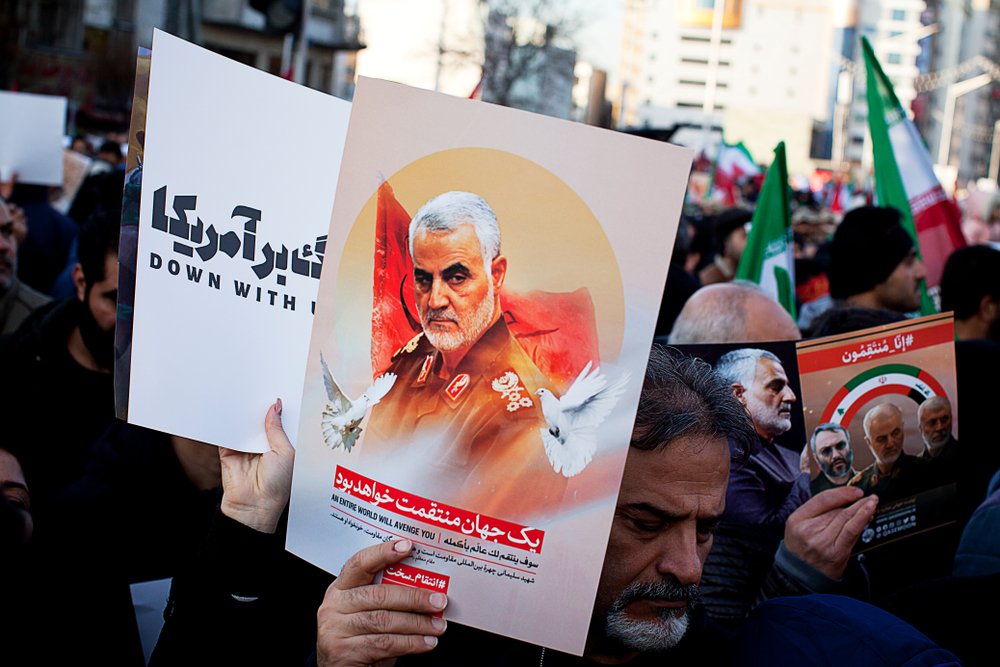
Qassem Soleimani, the late commander of the IRGC's external operations branch the Quds Force, served as both medium and message, snapping frontline selfies with Fatemiyoun fighters, touting the glories of righteous war and recounting their heroics for the IRGC’s ever-present camera right up until his death. Within hours of reports of the U.S. drone strike on Soleimani’s convoy near Baghdad airport, the Fatemiyoun Division’s official Twitter account began blasting out memes and posts that fused Solemani’s narrative with that of Tavassoli (See also Figures 1 and 2 for materials circulated via Telegram).29
The implied threat of this narrative—when used as a signal to the United States—is that a confrontation between the United States and Iran will not be restricted to a symmetrical clash of states or a secretive tit for tat of covert, deniable operations in which Israel and the United States would have the advantage. Instead, Iran hopes to signal that confrontation holds the potential for a clash with Shi’a and other Muslims across the region, with Iran at the lead, and that the assassination of Iranian commanders will only serve to further strengthen Iran’s influence and position.
Across its many audiences, Iran’s narrative seeks to inspire a desire for martyrdom and religiously tinged jus ad bellum grounds for waging war. Iran’s political leadership has also repackaged these narratives for a population that appears to be increasingly skeptical of Iran’s military adventures abroad. The IRGC leadership believes that this not only gives it a competitive advantage against adversaries, but also helps rejuvenate its ideological aspirations.
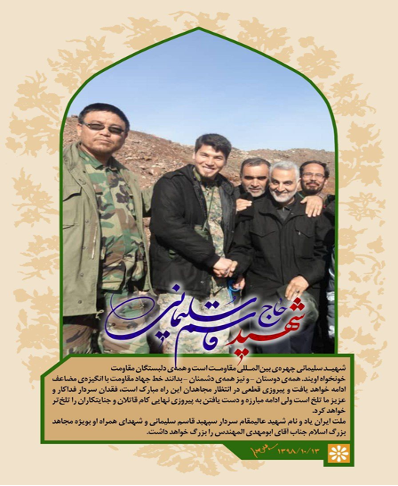
Five martyred commanders of the Resistiance Front in one frame. From right, deceased Fatemiyoun Division commander Reza Khavari; Soleimani; deceased IRGC commander Hossein Badpa; deceased Fatemiyoun commander Reza Bakhshi; and Tavassoli. The infographic also carries a quote from Supreme Leader Ayatollah Ali Khamenei praising Soleimani as “international face of resistance.”30
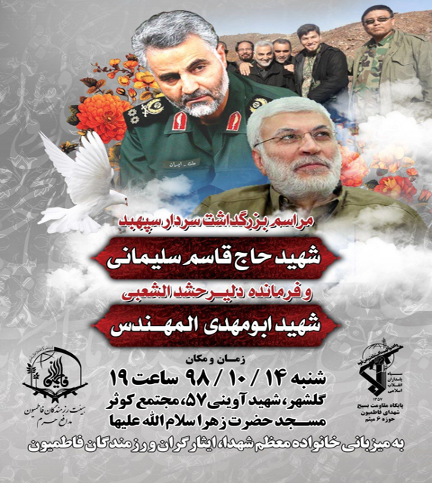
A poster advertising a commemoration ceremony for Soleimani and his deputy in Iraq Abu Mahdi al-Muhandis held in Mashhad.31
While the IRGC controls the Fatemiyoun Division and the division’s Pakistani Shi’ite twin, the Zeynabiyoun Brigade, Tehran still insists that both groups are made up of volunteers inspired to answer the call of Shia jihad and to defend Shi’ite holy shrines in Syria. The Guard Corps connects stories of the Fatemiyoun’s battlefield sacrifices to narratives dating back to the early advent of sectarian schisms within Islam and its broader geopolitical goals, but is wary of fully abandoning the plausible deniability that the use of proxies can grant.
The Fatemiyoun Division has, nonetheless, increasingly played a role in Iran’s military efforts beyond Syria.32 Former Fatemiyoun fighters have been sighted in Yemen and on Libya’s frontlines, and some were reportedly deployed from Syria, but it is unclear whether they were sent to Libya under Iranian orders.33 Thousands of fighters have also returned home to Afghanistan where rising instability and threats from ISIS and the Taliban could energize and reactivate Fatemiyoun networks that are far beyond Tehran’s control. The deployment of Fatemiyoun fighters in Syria since the civil war’s early days, suggests the Fatemiyoun Division is well-positioned to support Iran’s regional strategy and that Tehran may be anticipating a different kind of proxy war altogether in the years ahead.
Pitfalls of Iran’s Narrative Strategy and What the Narrative Means for the United States
It is far from clear whether Iran’s strategic approach and mobilization of narratives regarding the Fatemiyoun Division will be effective. Tehran’s public support for transnational revolution in defense of Shi’a communities risks could trigger an escalation of tensions with Israel, Saudi Arabia, and the United States and stir up domestic discontent. Using one narrative to signal to multiple audiences holds great promise for Iranian strategy, but it also introduces a level of complexity that can backfire.
At the same time, while the United States exerted more pressure and more direct confrontation through the assassination of Soleimani, the imposition of sanctions and other actions, there are reasons to question the credibility of the U.S. commitment when it comes to containing perceived threats from Iranian proxies. For instance, while the United States in 2019 designated the Fatemiyoun and Zeynabiyoun as terrorist groups pursuant to Executive Order 13224,34 it has not mounted a sustained, direct campaign to disrupt these groups and they continue to operate freely.
This presents a sharp contrast to global U.S. counterterrorism campaigns against Sunni jihadist groups such as al-Qaeda or ISIS. The Trump administration elected to partially subcontract its response to Iran’s proxy warfare to Israel. The Trump administration came close to but eventually pulled back from taking stronger military action in the wake of Iran’s probing of American red lines with attacks on oil tankers in the Persian Gulf or the downing of an American drone.35 Given these complexities, the jury is still out on whether the United States will succeed in managing escalation risks in the future, particularly as the Biden administration recalibrates the United States’ approach to Iran and its proxies.
Tracing the evolution of the Guard Corps’ cultivation of Fatemiyoun Division and Zeynabiyoun Brigade fighters, and the narratives that drew them to the Syrian civil war is important to navigate these complex dynamics. Iran’s ability to mobilize a wide array of proxies from across the region is dependent on its ability to effectively message and frame narratives of grievance. Much like their frontline adversaries, ISIS, the scores of young Afghan and Pakistani men stirred to take up arms in defense of Shi’ite shrines to Fatima and Zeynab, first heard the call while surfing YouTube or by watching viral video clips passed from cellphone to cellphone.
The Fatemiyoun’s song of martyr mythos online, on the battlefield, and at the gravesite, represents an unparalleled triumph of the Guard Corps’ experimentation of what our colleagues, Peter Singer and Emerson T. Brooking, have called “Like War” or “the weaponization of social media.”36 But it also empowers the scores of young Afghan and Pakistani men to shape narratives with an impact on the prospects for a potential U.S.-Iran escalation in a way that they would previously have been incapable of—and not necessarily to the benefit of Iran.
The Guard Corps places a high value on cultural production and political warfare in its proxy strategy, and promoting the mythos of martyrdom on the frontlines of Iran’s Forward Defense strategy is central to that enterprise. However, in doing so, the IRGC has also linked conflicts across the region to a greater extent than it has before and played into sectarian narratives that may prove difficult to control while giving power to a network that, while deeply indebted to Iran, is not fully under its control. Analyzing the origin and evolution of Fatemiyoun communications strategy is, therefore, critical to tracking the degree of effective control or influence Iran exerts over one of its key proxies in the region.
This report attempts to do just that. It is divided into eight parts, including this introductory section. The second section, outlines the origin story of the Fatemiyoun Division and explains how millennium-old tropes about martyrdom in the Shia faith became the rallying cry of the 1979 Iranian revolution and soon drew many Afghan and Pakistani faithful to Ayatollah Khomeini’s cause. It also explores how influential Iranian clerics in major cities in eastern Iran near the Afghan and Pakistani border became an important resource for marginalized migrants who poured into Iran in waves as South Asia was rocked by the U.S.-Soviet proxy war in the 1980s. The third section details how Guard Corps commanders mobilized Afghan and Pakistani fighters to join them on the front at the crossroads of the disputed territory of Khuzestan during the Iran-Iraq War. The fourth section examines in depth the language, signs, and symbols that are so central to the Fatemiyoun media wing’s cultural production. The fifth section explains how the IRGC reactivated the Fatemiyoun’s social networks as the Syrian civil war began in 2011. The sixth section traces the impact of the Guard Corps progressive consolidation of the Fatemiyoun’s propaganda machine as Iran turned its attention from the fight against ISIS in Syria in 2017 to other pressing objectives in its regional proxy war strategy. The seventh section contemplates the Fatemiyoun Division’s potential future trajectory, and the concluding section reflects on the implications of Soleimani's death for the movement and the region.
Citations
- In the scholarly literature on the Fatemiyoun Division and Zeynabiyoun Brigade, the group’s name is sometimes transliterated into English from the Arabic Liwa Fatemiyoun and at other times translated directly from the Persian Lashkar-e Fatemiyoun to Fatemiyoun Division while the Tipp-e Zeynabiyoun is translated into English as Zeynabiyounna. In this report, we use the original Persian since the groups are both Afghan in origin.
- "چهل حکایت و خاطرات شنیدنی از شهدای لشکر فاطمیون" ("Chehel hekayat va khaterat-e shenidani az shohaday-e lashkar-e fatemiyoun," "Forty Memorable Accounts and Memoirs of Fatemiyoun Division Martyrs"), Martyr Ebrahim Hadi Cultural Group, 2016, 18-19.
- Leith Aboufadel, “Northern Dara’a: Syrian Army and Hezbollah Advancing Towards Tal-Al Harra,” Al-Masdar News, February 22, 2015. ; Nicholas Blanford, “Iranian-backed Advance in Southern Syria Rattles Israel,” Christian Science Monitor, March 6, 2015. .
- For details on the 2015 Southern offensive in Syria, see: Phil Sands and Suha Maayeh, “Exclusive: The Spy Who Fooled the Assad Regime,” The National News, March 17, 2015. ; Leith Aboufadel, “Northern Dara’a: Syrian Army and Hezbollah Advancing Towards Tal-Al Harra,” Al-Masdar News, February 22, 2015. ; “Iran general died in 'Israeli strike' in Syrian Golan,” BBC, January 19, 2015. .
- "چهل حکایت و خاطرات شنیدنی از شهدای لشکر فاطمیون" ("Chehel hekayat va khaterat-e shenidani az shohaday-e lashkar-e fatemiyoun," "Forty Memorable Accounts and Memoires of Fatemiyoun Division Martyrs"), Martyr Ebrahim Hadi Cultural Group, 2016, 18-19.
- Ibid.
- Ibid.
- Two years after Tavassoli was killed in a battle in Syria, the IRGC-led Fatimiyoun Media Center released a 42-minute documentary that recounts his life story and military exploits. A version of the documentary is available here: "مستند فرمانده" ("Mostanad-e farmandeh," "Commander’-A documentary about the life of Alireza Tavassoli"), Bultan News, April 1, 2017. .
- "مستند فرمانده" ("Mostanad-e farmandeh," "Commander’-A documentary about the life of Alireza Tavassoli"), Bultan News, April 1, 2017. .
- Ibid.
- Ahmad Shuja Jamal, The Fatemiyoun Army: Reintegration into Afghan Society, Special Report No. 443, United States Institute of Peace, March 2019, 5. .
- Ibid, 11.
- Ibid.
- Mohsen Hamidi, “The Two Faces of the Fatemiyun: Revisiting the Male Fighters,” Afghanistan Analysts Network, July 8, 2019. .
- "برگزاری مراسم دعای ندبه، یادبود شهدای جاویدالاثر #فاطمیون" ("bargozariy-e marasem-e du'ah-e nudbah, yadboud-e shohada-ye javid al-asar-e #Fatemiyoun," "Holding Nudba prayer ceremony, commemorating the eternal #Fatemiyoun martyrs") Telegram, December 12, 2019. .
- “برادرزاده ابوحامد، فرمانده شهید فاطمیون چهکسی بود؟” (“baradarzadeh-ye abu hamed farmande-ye shahid-e fatemiyoun che kasi bud?,” “Who Was The Nephew of Abu Hamed, Martyred Fatemiyoun Commander?”), Tasnim News, August 11, 2019. .
- Ibid.
- Edward L. Bernays, Propaganda, New York: Horace Liverwright, 1928, 19-21. .
- Joseph S. Nye Jr., “Soft Power,” Foreign Policy, Autumn 1990, No. 80, 153-171.
- Monroe E. Price, “Iran and the Soft War,” International Journal of Communication, No. 6, 2012, 2397–2415.
- Monroe E. Price, “Strategic Communication in Asymmetric Conflict,” Dynamics of Asymmetric Conflict, 6:1-3, 2013, 135-136.
- Price, op.cit., “Iran and the Soft War,” 2012, 2399.
- Ibid, 2399-2400
- Afshon Ostovar, Vanguard of the Imam: Religion Politics, and Iran’s Revolutionary Guards, Oxford: Oxford University Press, 2016, 240.
- Ahmad Majidyar, “After ISIS, Fatemiyoun Vows to Fight with ‘Axis of Resistance’ to Destroy Israel,” Middle East Institute, November 22, 2017,
- Alex Vatanka, “Iran’s Islamic State Problem Isn’t Going Away,” Foreign Policy, June 19, 2017. . “Why did the US create ISIS?” Office for the Preservation and Publication of the Works of Grand Ayatollah Khamenei, November 16, 2020. .
- Hamid Mavani, “Ayatullah Khomeini's Concept of Governance (wilayat al-faqih) and the Classical Shi‘i Doctrine of Imamate,” Journal of Middle Eastern Studies, 47:5, 807-824, 2011.
- For more detailed analysis on the evolution of Iran’s Forward Defense strategy, see: Alex Vatanka, “Whither the IRGC of the 2020’s?” Â鶹¹û¶³´«ý, January 15, 2021. source.
- Liwa Fatimeyoun’s official Twitter handle posted updates and commentary almost daily before its suspension: ; archived version of Fatimeyoun’s Twitter account: ; the group’s new Twitter page formed in December 2020 is @gharin1434: .
- "پنج سردار شهید جبهه مقاومت در یک قاب" ("panj sardar-e shahid-e jebhe-ye moghavemat dar yek ghab," "Five Martyred Commanders of the Resistance Front in One Frame"), Telegram, January 3, 2020. .
- "مراسم بزرگداشت سردار سپهبد شهید حاج قاسم سلیمانی و فرمانده حشدالشعبی شهید ابومهدی المهندس" ("marasem-e bozorgdasht-e sardar sepahbod shahid hajj Qasem Soleimani va farmande-ye hashd ol-sha'bi shahid Abu Mahdi al-Muhandis," "Commemoration Ceremony for Commander Lieutenant General Martyr Haj Qasem Soleimani and Popular Mobilization Forces Commander Martyr Abu Mahdi al-Muhandis"), Telegram, January 4, 2020. .
- See: Candace Rondeaux, “How the Return of Iranian-Backed Militias From Syria Complicates U.S. Strategy,” World Politics Review, May 24, 2019. ; Tolonews.com, “Afghans Returning Home After Fighting War in Syria,” April 1, 2019. .
- See: U.S. Foreign Military Studies Office, Operational Environment Watch (OE Watch), April 2020, 42, ; Declan Walsh, “By Air and by Sea Mercenaries Landed in Libya. Then the Plan Went South,” New York Times, May 25, 2020. ; and Deir Ezzor 24, ” “New Rapprochment between Russia and Iran in Deir Ezzor,” July 2020, ; Jonathan Saul, Parisa Hafezi, Michael Georgy, “Exclusive: Iran steps up support for Houthis in Yemen's war – sources,” Reuters, March 21, 2017. .
- On September 23, 2001, President George W. Bush signed Executive Order 13224. The order gives the U.S. government the authority to trace and halt funding flows to individuals and entities found by U.S. national security agencies to be linked with terrorist activity. In 2019, President Donald J. Trump amended the order to consolidate the rules and parameters for terrorism financing designations. See: White House, “Executive Order on Modernizing Sanctions to Combat Terrorism, Sept. 10, 2019. . In January 2019, the U.S. Treasury’s Office of Foreign Asset Control (OFAC) issued a sanctions notice naming the Fatemiyoun Divison and Zeynabiyoun Brigade. See: U.S. Treasury, Press Release, “Treasury Designates Iran’s Foreign Fighter Militias in Syria along with a Civilian Airline Ferrying Weapons to Syria,” January 24, 2019. .
- Mark Landler, Julian E. Barnes, and Eric Schmitt, “U.S. Puts Iran on Notice and Weighs Response to Attack on Oil Tankers,” New York Times, June 14, 2019. .
- P.W. Singer and Emerson T. Brooking, Like War: The Weaponization of Social Media, New York: Houghton, Mifflin Harcourt, 2018.
II. The Origins of Iran’s Afghan and Pakistani Shi’a Networks
From Mashhad to Kabul and Back Again: Early Roots of Afghan Shia Jihadist Factions, 1950-1979
The Fatemiyoun Division and Zeynabiyoun Brigade origin story is deeply rooted in the Iranian revolution, the U.S.-Soviet proxy war in the 1980s, and Iran’s mobilization of South Asian proxies during the Iran-Iraq War. Historically, Iran has exerted considerable cultural, religious, and political influence over Afghanistan’s Shia minority, and for generations, key religious and cultural sites in the Iranian cities of Mashhad and Qom have been a major draw for Shia among Afghanistan’s ethnic Hazaras.
Long marginalized under laws and customs promulgated by Afghanistan’s dominant Pashtun Sunni elites, ethnic Hazaras are of Turkic, Mongol, and Persian extraction, and their distinctive features have marked them with an outsider status in both Afghanistan and Iran.1 But, since the start of the anti-monarchist, anti-colonial uprisings in both countries that started with the rise of political Islam across the region in the 1950s, Iran has served as a kind of cultural, political, and economic refuge for Shia Hazaras and a patron to a certain class of Hazara elites.
Although there has been no official census in Afghanistan since 1978,2 various estimates suggest Afghan Shia Hazaras constitute anywhere from 10 to 20 percent of the country’s 27 million people.3 For generations under the Afghan monarchy, Hazaras’ minority status resulted in their enslavement in the eighteenth and nineteenth centuries, and for much of the twentieth and twenty-first centuries Hazaras have traditionally been politically marginalized and discriminated against in the realm of education and labor.4 Successive waves of civil unrest and civil war in Afghanistan have also resulted in the forced migration of millions of Hazaras who, over the last century, have settled in large clusters in Mashhad, Qom and the Pakistani city of Quetta.
While Afghanistan outlawed slavery under a constitutional provision passed in 1923, the rise of Pashtun nationalism in the 1930s in the country, the resettlement of Pashtuns in traditionally Hazara areas, and the constant whittling away of land rights in the twentieth century placed Hazaras firmly in the country’s underclass.5 Consequently, for generations, most Hazaras lived in poverty and many worked as domestic servants or manual laborers. As Afghan scholar Amin Saikal notes, Afghan ruling elites frequently persecuted and exploited Hazaras.6 These factors and Afghanistan’s long history of widespread political violence have contributed to a kind of culture of exile among Afghan Shia and a valorization of resistance and outsider status that permeates the music, literature, media, and art of the community.7
For many years, a lack of access to government-subsidized public schools up until the late 1960s and 1970s meant that informal education through religious centers of learning such as mosques and madrassahs remained one of the few consistent sources of education for Afghan Shias.8 Consequently, in search of higher and better education, large numbers of Shias traveled to Iran and Iraq’s religious cities.9 As a result, a sizable number of educated Afghan Hazara academics, religious scholars, and influential politicians also studied in Iran. Sayed Ismail Balkhi and Ayatollah Mohaqiq Kabuli are among the most prominent in this cadre, and count as the first-nodes in the network of Afghan-Iranian Shia leaders that later played a crucial role in the relations between revolutionary Iran and Afghan Shias.
Born in 1919, Balkhi is often thought of as the ideological progenitor of Afghanistan’s Shia jihadist movements and the link between Afghan Shia, Qom, a key hub of religious power in Iran, and Tehran, the seat of political power in Iran. Kabuli, on the other hand, is often thought of as the more authoritative religious figure within the movement. Born in 1928, Kabuli came of age in the years after the abolishment of slavery in Afghanistan and later spent time in exile in Syria, then Najaf before settling in Qom.10 The two represent important interrelated strands of the distinctive ethno-political culture at the root of the Fatemiyoun movement.
A pioneer of his generation and later an iconic revolutionary figure among Afghan Hazara Shia, Balkhi was part of a wave of reformist student political movements that emerged during the turbulent reign of Afghanistan’s regent Zahir Shah.11 He was an early adopter of the ideological tenets of political Islam and studied religious theology in the eastern Iranian city of Mashhad. In 1935, during an anti-Reza Shah protest, Balkhi escaped violent state suppression of uprisings in Mashhad and retreated to the western Afghan city of Herat, where he began making public speeches and established pro-republican political cells.12
After serving a 15-year prison term for his involvement in a violent anti-government putsch against Zahir Shah in Kabul in 1950, Balkhi continued his political organizing activities in the northern Afghan city of Mazar-e Sharif and the Afghan capital of Kabul. Balkhi was eventually drawn back to Iran in 1967 when he embarked on a religious pilgrimage to visit Shia sacred sites Mashhad and Qom in Iran, Najaf in Iraq, and Damascus in Syria where he met scores of Shia scholars, revolutionists, and anti-Reza Shah dissidents including Ayatollah Khomeini, who was then living in exile in Najaf.13 In their meetings, the two clerics talked of the crucial role of resistance, revolution, and rebellion in harnessing the power of social movements in support of political Islam.14 Over time, Balkhi’s cross-border consultations and political activism would eventually earn more sustained attention and his teachings gained greater attention in the early 1970s from co-revolutionaries in Iran.
By February 1979, the Iranian revolution had shifted into full gear. The Shah had fled Iran and Khomeini had returned from exile in France. Khomeini and his followers methodically started to eliminate and sideline rivals in the opposition that toppled the Shah in order to establish a government that enforced their rigid interpretations of Islamic law.15 In the narrative of Khomeini's followers, the cleric's return and the project to Islamize Iran was akin to an explosion of light, and these acts were necessary for the path of correctly implementing God's law. The Pahlavi dynasty's fall and Khomeini’s rise rocked the world, accelerating an Islamist movement that arose in part from the ashes of British and French colonialism in the aftermath of WWII.
It also made manifest the long sought-after dream of Shia revolutionaries building a republic based on the governing religious principle of velayat-e faqih or “guardianship of the jurist,” which vests Islamic clerics with supreme authority in interpreting and administering the law.16 And, in Afghanistan, where the rebellion against the Soviet incursion was raging, Iran’s revolution in governance found echoes in the formation in 1979 of a loosely knit revolutionary council known as the Shuray-e Ittefaq in the predominantly Shia region known as the Hazarajat, marking the first time in generations that Hazara communities were self-governed in Afghanistan.17
Soon after taking power, Khomeini dispatched several representatives (wakil) to predominantly Shia areas across the Hazarajat region in northwestern and central Afghanistan. Some 12 clerics served as official envoys of Khomeini’s Office of the Supreme Leader throughout the 1980s.18 In addition to collecting funds, Khomeini’s representatives preached and advocated taking a more hardline stance against the regime in Kabul.19 It was in this way that the very personal bond between Khomeini and Balkhi reinforced connections between Iranian elites and Afghan Shia. Following the Soviet invasion of Afghanistan and after Khomeini’s Islamic revolutionary movement successfully overthrew the government of Reza Shah in 1979, there were increasing signs that Balkhi and Khomeini’s hardline religious views were becoming more influential among Afghan Shia religious leaders.
In the early stages of the anti-Soviet resistance, Afghan Shia adherents of Khomeini’s revolutionary doctrine of velayat-e fiqh, who were popularly known as the Khat-e Imam20 (Imam’s Line), launched full-scale cultural and religious campaigns aimed at mobilizing support for a sustained resistance movement.21 Disorganized at the outset, the Khat-e Imam eventually sought out an ideological organizing principle in the form of fatwas or religious edicts blessing violent political resistance or jihad and formed their own jihadist factions with separate liaison offices in Tehran and Qom. Facilitated by the Islamic Republic, these groups were later reorganized into an umbrella council known as Ettelaf-e Hashtgana (the coalition of eight Shia parties).22
Yet, while the Iranian revolution and the Afghan anti-Soviet uprising provided the initial spark that would seed the first Afghan Shia jihadi factions that ultimately gave rise to Iran’s modern strategy of proxy warfare and the religious narratives that undergird it, the Iran-Iraq War was played a much more significant role in the formation of the Pakistani and Afghan networks that would pave the way for the Fatemiyoun.
Citations
- For detailed background on Afghanistan’s Hazara communities, see: Niamatullah Ibrahimi, The Hazaras and the Afghan State: Rebellion, Exclusion and the Struggle for Recognition, Hurst & Company, London, 2017; and Amin Saikal, “Afghanistan: The Status of the Shi'ite Hazara Minority,” Journal of Muslim Minority Affairs, 32:1, 80-87, 2012. DOI: 10.1080/13602004.2012.665623.
- Andrew Pinney, “An Afghan Population Estimation. Snapshots of an Intervention. The Unlearned Lessons of Afghanistan’s Decade of Assistance. 2001,” Afghanistan Analysts Network, 2011. .
- As noted by Afghan scholar Amin Saikal, the majority of Hazaras count themselves as members of the Twelver-Shia Imamate sect, but a slim minority within the Hazara community belong to Afghanistan’s majority Sunni sect. Amin Saikal, “Afghanistan: The Status of the Shi'ite Hazara Minority,” Journal of Muslim Minority Affairs, 32:1, 80-87, 2012, 81-82.
- Niamatullah Ibrahimi, The Hazaras and the Afghan State: Rebellion, Exclusion and the Struggle for Recognition, Hurst & Company, London, 2017, 111.
- Ibid, 110-112.
- Amin Saikal, “Afghanistan: The Status of the Shi'ite Hazara Minority,” Journal of Muslim Minority Affairs, 32:1, 80-87, 2012, 80-83.
- Ali Karimi, “Medium of the Oppressed: Folk Music, Forced Migration, and Tactical Media,” Communication, Culture & Critique 10, 2017, 729–31.
- Ibrahimi, op.cit., 111
- Ibid, 112
- Ayatollah Kabuli died in June 2019. For details on his biography see: "آیت الله محقق کابلی، از مراجع تقلید شیعیان افغانستان درگذشت", 9, (“ayatollah mohaqeq kabul, az maraje-e taqlid shi’ayan-e afghanestan dargozasht,” “Ayatollah Kabuli, One of Afghanistan’s Shiite Sources of Emulation, Has Died”), BBC Persian, June 11, 2019, ; Ijtihadnet.com, “Ayatollah Mohaqiq Kabuli Passes Away,” June 11, 2019. .
- Hafizullah Emad, “Radical political movements in Afghanistan and Their Politics of Peoples' Empowerment and liberation,” Central Asian Survey, 20:4, 427-450, 2001. DOI:10.1080/02634930120104627
- Ibrahimi, op.cit., 109
- "ماجرای ملاقات تاریخی سید اسماعیل بلخی با امام خمینی در نجف +تصاویر" (“majera-ye mulaghat tarikhy-ye sayed ismail balkhi ba Imam Khomeini dar Najaf+Tasaveer,” “The historic meeting of Said Ismail Balkhi with Imam Khomeini in Najaft+pictures”), Ahl-ul Bayt News Agency (ABNA), July 13, 2013. .
- Ibid.
- Misagh Parsa, Democracy in Iran, London: Harvard University Press, 2016, 61-97.
- Ruhollah Khomeini, “Islamic Government,” in Princeton Readings in Islamist Thought: Texts and Contexts from Al-Banna to Bin Laden, eds. Roxanne L. Euben and Muhammad Qasim Zaman, Oxford: Princeton University Press, 2009, 176.
- Niamatullah Ibrahimi, “The Dissipation of Political Capital among Afghanistan’s Hazaras: 2001-2009,” Working Paper, Crisis States Research Centre, June 2009, 1. .
- "اولین همایش نکوداشت نمایندگان و وکلای امام خمینی در افغانستان" (“awalin humayesh nekod’asht nomayendagan wa wokaly-e imam Khomeini dar Afghanistan,” “The First Memorial and Appreciation Conference of Imam Khomeini’s Representatives in Afghanistan”), Shia News Association (Shafaqna), June 4, 2016. .
- Niamatullah Ibrahimi, The Failure of a Clerical Proto-State: Hazarajat, 1979-1984, Working paper no. 6, Crisis States Research Center and London School of Economics and Political Science, September 2006, 6.
- "خط امام خمینی (ره) در افغانستان" (“khat-e imam khomeini (ra) dar Afghanistan,” “Imam Khomeini’s Line [Path] in Afghanistan”), Fars News Agency, February 11, 2019, .
- Ibid.
- "آسیب شناسی احزاب جهادی تشیع در افغانستان" (“aasib shenasi ahzab-e jihadi tashayyu dar afghanistan,” “Pathology of Shia Political Parties in Afghanistan”), Sayed Jafar Adeli Hussaini, , October 20, 2011. The coalition was established as part of a power-sharing arrangement with Sunni jihadi groups in the Mujahidin-led interim government led by President Burhanuddin Rabbani.
III. Crossroads in Khuzestan: Afghan Shi’a Mobilization During the Iran-Iraq War
In 1980, a combination of perceived threats and opportunities drove Iraq’s Saddam Hussein to invade Iran. The proximate cause of Baghdad’s conflict with Tehran lay in a long simmering territorial dispute over the oil-rich and predominantly Arab border region of Khuzestan. But, Hussein was also deeply alarmed by Khomeini's open calls for the overthrow of Iraq’s Ba’athist regime.1 After several assassination attempts against senior Iraqi officials that Hussein suspected were sponsored by Tehran, Hussein subsequently expelled thousands of Iranian backed Dawa Party members from Iraq in the early 1980s.2
At the same time, Iran itself was in turmoil, facing insurgencies in peripheral and predominantly minority regions, like Kurdistan, even as Khomeini’s government moved to consolidate its power by purging the military of royalist and anti-revolutionary elements. In the summer of 1980, as Khomeini’s government struggled to gain its footing amid the U.S. Embassy hostage crisis, Hussein saw the domestic turmoil in Iran as an opportunity to annex disputed territory and push back the Iranian border with Iraq deeper into Khuzestan. After a summer of border skirmishes, Hussein’s Iraqi forces invaded Iran in September 1980, triggering the longest conventional war of the twentieth century. Initially caught off guard, Khomeini ultimately welcomed the conflict, seeing it as an opportunity to purge Iran’s military and consolidate power at home while exporting the revolution abroad.3
It was during this early phase of the eight year-long Iran-Iraq War that Khomeini’s government began to craft the narrative of martyrdom and sacrifice on the battlefield known as "Sacred Defense."4 In the context of the conflict with Baghdad, Saddam Hussein and his Gulf backers as well as the United States were the modern day Yazidi and the fight to secure Khuzestan and Kurdistan was a reenactment of the Battle of Karbala. Khomeini’s government cast the war as an opportunity for the faithful to demonstrate that they were followers of Imam Hussein, willing to fight for God until the end. Martyrdom was also a vehicle through which to save the community from the penury of unjust, un-Islamic rule and cleanse the Shia community of its impiety and impurity.5
Iranian forces suffered several battlefield defeats but as the skirmishes with Iraq drifted into a stalemate, Khomeini continued to invest in reinforcing cross-border links with revolutionary Shia cadres in neighboring Afghanistan. There were several channels of interaction between Afghan Shia jihadi factions and the Islamic Republic administration, but the most significant was with Afghan Shia who had earned strong support from Khomeini because of their early loyalty to the Iranian revolutionary cause. Ayatollah Kabuli who had returned from teaching in Najaf to Afghanistan at the outset of the anti-Soviet uprising was among them. It was through the networks of madrassahs and mosques led by Afghan allies like Kabuli and other informal channels that the new revolutionary government in Tehran developed its first iteration of a comprehensive proxy warfare strategy.
More formally, Tehran managed its relations with its Afghan Shia allies through distinct administrative and military channels. Iran’s Office of the Representative of the Supreme Leader for Afghanistan Affairs served as the main outreach office to the Afghan Shia jihadi factions for cultural and religious affairs. This office, through the Iranian Supreme Leader’s special representative for Afghanistan, also mediated between Shia groups at times of conflict and disagreement.6
In 1982, after a series of battlefield losses, Khomeini rejected Hussein’s offer of a truce, demanded his removal, and invaded Iraq with the help of Iraqi Shia paramilitaries trained by the IRGC.7 Three years later, in 1985, Iran’s military leaders merged those Iraqi militia forces and other units into a single force under the command of Iranian expeditionary force officers in Department 900, a special intelligence unit predecessor to the Quds Force that had been established a year earlier to sustain a northern front against Iraq and was headquartered at what was then called the Ramezan Base.8 Officers in Ramezan also briefly oversaw an Afghan unit in the war.
As far as ideological training and material military support, it was Iran’s Liberation Movements Unit, under the control of Sayed Mehdi Hashemi that oversaw IRGC operations abroad including its Shia clients in Afghanistan.9 Hashemi’s Liberation Movements Unit, however, soon fell out of favor for its perceived disloyalty to Khomeini and suspicious behavior in the eyes of IRGC’s leadership; the unit dissolved in 1982.10
From the mid-1980s forward, the Guard Corps sponsored the formation of Afghan groups that later would constitute the leadership cadres of the Fatemiyoun. After the Soviet invasion of Afghanistan, the Guard Corps dispatched operatives to train Afghan forces initially in Afghanistan, and, following the Iraqi invasion, on bases in Iran under the supervision of Islamic Movements Training Center, which answered to the IRGC Intelligence unit.11 Then-Guard Corps commander Mohammad-Javad Hakim Javadi, who was training Afghans for jihad against the Soviets, proposed to form and deploy an Afghan unit to the front with Iraq in order to better train them before deployment to Afghanistan.12
By the late 1980s, the IRGC also dispatched several officers to serve as cultural and military advisers in Afghanistan where they embedded with cells in the anti-Soviet resistance movement.13 Thus, the Abouzar Brigade was born, named after one of the companions of Prophet Muhammad whose steadfast support to Ali later led to his exile. The name was especially redolent of the long history of Hazara migration and the community’s outsider status in Afghanistan. Young Hazara men have long viewed cross-border migration to Iran from the Hazarjat region in Afghanistan’s central highlands and from Quetta, Pakistan as almost a rite of passage.14
Iran’s Ministry of Foreign Affairs at the same time began making inroads with more moderate anti-Soviet Afghan factions. These subtler Iranian diplomatic efforts with the assistance of the Quds Force and the Office of the Special Representative to the Supreme Leader laid the foundation for the formation of a more broadly based Afghan Shia political movement later coordinated by the Hizb-e Wahdat Islami Afghanistan (Islamic Unity Party of Afghanistan), which was established in 1989 just as the Soviets withdrew.15
Afghan Islamist political parties provided the bulk of the Abouzar Brigade’s recruits and after they were eventually integrated into the command structures of Ramezan Base, the first Abouzar contingent deployed to the western front of Kurdistan in the winter of 1985-1986.16 Some fighters worked on a rotation between fronts, deploying back and forth between battlefields in Iraq and Afghanistan.17 A year after its formation, however, the Abouzar Brigade disbanded.
Iranian commander Javadi blamed this on Ramezan's failure to support the unit.18 Official estimates have put the number of Abouzar Brigade fatalities at 2,000-3,000, a remarkably high figure.19 In a collection of Abouzar Brigade memoirs written many years later and published in 2019, several fighters recounted how Iranians ordered Afghans to storm enemy strongholds and march directly into the line of fire, a phenomenon echoed in the way the Quds Force apparently deployed Afghan Fatemiyoun fighters a generation later.20 This may explain why Abouzar commanders refused to fight any longer. Javadi and a former Abouzar commander lamented that the unit could have been the precursor to "another Hezbollah" in Afghanistan, but the use of Afghans as cannon fodder in Iraq spoiled any chance of standing up a permanent Shia militia element loyal to Tehran in Afghanistan.21
A sizable enough remnant remained in the 1990s that Javadi was able to cobble together a new contingent as hardline Sunni Taliban forces began sweeping across Afghanistan. Sepah-e Mohammead was meant to be a sectarian militant organization loyal to Iranian leadership. With support from Quds Force commanders, Sepah-e Mohammad established training bases in Zahidan, capital of Sistan and the Baluchistan province of Iran. The Afghan Shia paramilitary force’s primary objective was to destabilize the Taliban’s hold in western Afghanistan and secure a buffer zone along the Iranian border. It made two failed attempts by fomenting a small rebellion in Herat city and dispatching a small armed unit into the border district of Herat province.22 The former was crushed and the latter ambushed.
The Sepah-e Mohammad contingent dissolved in the mid-1990s. Some members, however, remained on an informal covert reserve status, most probably for what Iran anticipated might be a Taliban-ruled and Saudi-influenced Afghanistan. According to Javadi, Northern Alliance commander Ahmad Shah Massoud once said, "If I want to imagine Islamic mujahid it would be the forces of Mohammad Corps."23 The U.S. military invasion in late 2001, however, neutralized the potential threat of an Iranian backed Shi’ite paramilitary fifth column, and the unit fully disbanded following the 2001 U.S. incursion into Afghanistan.24
While the Guard Corps did not sponsor a major Pakistani Shiite militia, a Pakistani cleric named Arif al-Husayni established a pro-Khomeini network among Pakistani Shiites. Al-Husayni was one of Khomeini's students prior to the revolution in Najaf. He preached Khomeini's brand of Islamic revolution in the eastern town Parachinar, where Pakistani Shiites predominantly reside, and he is sometimes referred to as the "spiritual father of the Zeynabiyoun," Fatemiyoun’s Pakistani counterpart.25 Although al-Husayni was assassinated in 1988 at the height of Arab infiltration into the jihadi factions of northwest Pakistan, his networks, like others in Afghanistan that Tehran had invested in, endured throughout the Taliban era and into the post-Taliban era albeit at a reduced scale.
A Fickle Affair: The Quds Force and Afghan Shia in the Post-Soviet Era, 1990-2001
After the withdrawal of the Soviet army and the formation of the predominantly Hazara faction of Hezb-e Wahdat, relations between the mainstream Shia groups and Iran were fundamentally transformed. Hezb-e Wahdat leaders’ gradual exercise of political compromise with their one-time Sunni rivals among the mujahedin reshaped its relations with Iran.26 As a result, Iran began to shift its attention beyond its traditional Shia clients in Afghanistan, as the country became more unstable under the Soviet-backed regime of Najibullah.27
When Najibullah’s government collapsed in 1992, fierce internecine battles between warring ethnic factions erupted across Kabul. Iran began to adopt a more pragmatic approach to its foreign policy in Afghanistan by focusing on its interest in maintaining stability in Afghanistan rather than exporting the revolution through its Shia clients.28 The most dramatic evidence of this change is Iran’s decision to cut ties with the leadership of Hizb-e Wahdat in response to its violent opposition to Rabbani’s predominantly Tajik and Uzbek Northern Alliance interim government. At the same time, Iran also encouraged other small non-Hazara Shia groups within the Wahdat Party to split and join the government.29
For many Hazaras in Kabul, however, anti-government resistance was a do-or-die quest to ensure that the discriminatory regime of the past was not resurrected under Rabbani’s government. Consequently, for many young Hazara leaders in Kabul, Iran’s open support for Rabbani’s regime dramatically reduced the Quds Force’s influence during the early 1990s. But that changed quickly when the Taliban overtook Kabul in 1996 and drove Hezb-e Wahdat and Rabbani’s Jamiat-e Islami party out of the Afghan capital. Alarmed by the rapid pace of Taliban advancement across the country, Iran soon realized the perils of its fickle foreign policy in Afghanistan and joined Russia and India in extending military and financial support to the anti-Taliban Northern Alliance.
Iran’s support to the Northern Alliance increased in 1996 and 1997.30 To that end, Soleimani, who had recently been elevated as Quds Force commander, played an instrumental role in the formation and empowerment of the anti-Taliban resistance front known as “Jabha-e Muttahed” (the United Front) in the north of Afghanistan.31 Iran’s reassured support to the Northern Alliance resistance—until the defeat of the Taliban in 2001—through the Quds Force was critical, and Soleimani’s role was pivotal in making that happen.32
By the mid-1990s, the Quds Force, which was then under the command of Ahmad Vahidi, had already dispatched its own diplomats and military advisers to Afghanistan to support Afghan Shia groups and the Northern Alliance resistance against the Taliban. This group included Soleimani who after serving on the frontlines of the Iran-Iraq War in Kurdistan was appointed as the Quds Force regional commander in the southeastern Iranian province of Kerman and ran counter-narcotics operations along the Afghan-Iranian border.33 In Afghanistan’s interior, Quds Force general and Soleimani’s eventual successor Esmail Ghani focused on advising Hazara resistance fighters.34
After the Taliban consolidated its power across the country in 1997, and took several Iranian diplomats hostage in 1998,35 the Quds Force attempted to remobilize Sepah-e Mohammad (Mohammad Army) to fight alongside other Northern Alliance contingents against the Taliban. The Quds Force even deployed them to predominantly Sunni districts in Takhar, Farah, and parts of Herat, but they failed to rally local support.36 Soleimani eventually dissolved the contingent, but the IRGC’s assistance to both Shia and Tajik resistance forces in the fight against the Taliban helped Iran mend fences with disaffected Afghan Shia groups, including more mainstream moderate elements within the Hezb-e Wahdat Party.
Citations
- Hal Brands, "Why Did Saddam Invade Iran? New Evidence on Motives, Complexity, and the Israel Factor," Journal of Military History, July 2011, 75:3, 861-885.
- One of the most infamous incidents involving Saddam’s backlash against the Dawa Party resulted in the illegal detention, torture, and massacre of hundreds of men and women after an unsuccessful assasination attempt against Saddam on July 8, 1982 in the town of Dujali. See: Human Rights Watch, “Judging Dujali,” November 19, 2006. .
- "برکات دفاع مقدس در کلام امام خمینی (س)" ("barekat-e defa'e moqaddas dar kalam-e Imam Khomeyni,” "The Blessing of Sacred Defense in The Word of Imam Khomeini"), Institute for The Preservation and Publication of The Works of Imam Khomeyni, September 29, 2018. .
- "چرا جنگ تحمیلی به «دفاع مقدس» مشهور شد؟!" ("chera jang-e tahmili be 'defa-e moqaddas' mashur shod?!," "Why Did The Imposed War Became Known as 'Sacred Defense'?!"), Quds Online, September 25, 2016, .
- Meir Hatina, Martyrdom in Modern Islam, New York: Cambridge University Press, 2014, 80 – 89.
- “Interview with Shaikh Hussain Ibrahimi, Khamenei’s Special Envoy for Afghanistan,” Jamaran News, August 16, 2012. .
- "Iran Rejects Iraq's Call For Cease-fire," New York Times, June 13, 1982. ; "IRAQ vii. IRAN-IRAQ WAR" in Encyclopedia Iranica, accessed March 30, 2020. .
- Ali Alfoneh, "Generational change in the Iranian Revolutionary Guards Corps Quds Force: Brigadier General Iraj Masjedi," American Enterprise Institute, March 29, 2012, ; Ramezan Base's personnel also included forces from Nosrat Base, a top-secret Guard Corps Base formed after 1982 that recruited among Arab tribes in southwestern Iran, see: Amir Toumaj, "Death of a General: What Shaban Nasiri Reveals Â鶹¹û¶³´«ý Iran’s Secretive Qods Force," War on the Rocks, March 23, 2018. .
- Rosa Shapiro-Thompson, “Importing Arms, Exporting the Revolution: Mehdi Hashemi and His Fatal Leak to Ash-Shiraa,” The Yale Review of International Studies, April 2019. .
- "گزارش| واحد 'نهضتهای آزادیبخش'؛ گروهی مورد حمایت 'منتظری' که در خدمت دشمن بود" (“wa’hid nehzat-haye azadi-bakhsh; groh-e mowred hemayat montazeri ki dar khedmat doshman bod,” “The Liberation Movements Unit backed by Montazeri was at the service of the enemy”), Tasnim News Agency, May 13, 2020. .
- Mohammad Sarvar Raja'i, "از دشت لیلی تا جزیره مجنون" ("az dasht-e leyli ta jazire-ye majnun," "From Leyli Field to Majnun Island"), Qom: Islamic Revolution Cultural Front Studies Desk Oral History Unit, 2019, 42-43.
- Raja'i, From Leyli Field, 517-519.
- Alireza Nader, Ali G. Scotten, Ahmad Idrees Rahmani, Robert Stewart, Leila Mahnad, Iran’s Influence in Afghanistan: Implications for the U.S. Drawdown, National Security Research Division, RAND Corporation, 2014, 5.
- Alessandro Monsutti, “Migration as a Rite of Passage: Young Afghans Building Masculinity and Adulthood inIran,” Iranian Studies, Apr., 2007, 40: 2, 170-174.
- Niamatullah Ibrahimi, “The Dissipation of Political Capital among Afghanistan’s Hazaras: 2001-2009,” Working Paper, Crisis States Research Centre, June 2009. .
-
Mohammad Sarvar Raja'i,
"از دشت لیلی تا جزیره مجنون" ("az dasht-e leyli ta jazire-ye majnun," "From Leyli Field to Majnun Island"), Qom: Islamic Revolution Cultural Front Studies Desk Oral History Unit, 2019, 42-43; Raja'i, From Leyli Field, 517-519. - Mohammad Sarvar Raja'i, "از دشت لیلی تا جزیره مجنون" ("az dasht-e leyli ta jazire-ye majnun," "From Leyli Field to Majnun Island"), Qom: Islamic Revolution Cultural Front Studies Desk Oral History Unit, 2019, 42-43; Raja'i, From Leyli Field, 517-519.
- Leyli Field, Op. Cit., 520.
- "چهل حکایت و خاطرات شنیدنی از شهدای لشکر فاطمیون" ("chehel hekayat va khaterat-e shenidani az shohaday-e lashkar-e fatemiyoun," "Forty Memorable Accounts and Memoires of Fatemiyoun Division Martyrs"), Martyr Ebrahim Hadi Cultural Group (Iran), 2016, 10; Raja'i, From Leyli Field, 26.
- "ابوذر میتوانست حزب الله ای در افغانستان باشد" ("abuzar mitavanest Hezbollah-i dar afghanestan bashad," "Abuzar Could Have Been a Hezbollah in Afghanistan"), Bultan News, January 24, 2016. .
- "ابوذر میتوانست حزب الله ای در افغانستان باشد" ("abuzar mitavanest Hezbollah-i dar afghanestan bashad," "Abuzar Could Have Been a Hezbollah in Afghanistan"), Bultan News, January 24, 2016. .
- "چهل حکایت و خاطرات شنیدنی از شهدای لشکر فاطمیون" ("chehel hekayat va khaterat-e shenidani az shohaday-e lashkar-e fatemiyoun," "Forty Memorable Accounts and Memoires of Fatemiyoun Division Martyrs"), Martyr Ebrahim Hadi Cultural Group (Iran), 2016, 10; Raja'i, From Leyli Field.
- Mohammad Sarwar Rajayi , “Story of Afghanistani fighters in sacred defence,” Ettelaat Daily, 2014. www.ettelaat.com (Accessed on August 2, 2018).
- "تشکیل هسته اولیه لشکر فاطمیون با ۲۵ نفر" ("tashkil-e haste-ye avvaliye-e lashkar-e fatemiyoun ba 25 nafar," "Forming The First Nucleus of The Fatemiyoun Division With 25 Individuals"), Shoma News, October 25, 2015. .
- "مستند عاشقان ایستاده میمیرند" ("The documentary of ‘lovers die standing’"), Islamic Republic of Iran Broadcasting (Iran), July 19, 2017. .
- "دولت هاشمی و جناحهای سیاسی افغانستان؛ آزمون و خطای بیفرجام" (“dawlat-e hashimi wa jinah-ha-ye seya’si Afghanistan; azmon o khata’ ye be farja’m” “Hashimi’s Administration and Afghan Factions; Unfinished Trial and Errors,”) Ayub Arvin, BBC Persian, June 13, 2018. .
- Ibid.
- Ibid.
- Ibid.
- Larry P. Goodson, “Afghanistan and The Changing Regional Environment,” Chapter 5 in Afghanistan’s Endless War: State Failure, Regional Politics and the Rise of the Taliban, Seattle: University of Washington Press, 2001, 165.
- Waheed Paima’n, "قاسم سلیمانی و افغانستان" (“qassem soleimani wa Afghanistan,” “Qassem Soleimani and Afghanithe gstan,”), Daily Hashte Subh, January 3, 2020, ; Also see: Alireza Nader, Ali G. Scotten, Ahmad Idrees Rahmani, Robert Stewart, Leila Mahnad, Iran’s Influence in Afghanistan: Implications for the U.S. Drawdown, National Security Research Division, RAND Corporation, 2014, 5.
- "تاثیر بود و نبود سلیمانی در خاورمیانه" (“ta’sir bod-o-nabod-e soleimani dar kha’war mia’na,” “The Impact of Soliemani’s Presence and Absence in the Middle East,”) quoted from The New Yorker interview with Wali-Nasr. See at: , Annabaa Center for Strategic Studies, January 4, 2020
- Ali Alfoneh, “Brigadier General Qassem Suleimani (sic): A Biography,” American Enterprise Institute, 2011. .
- "سربازان سپاه قدس چگونه به خانه همسایه رسیدند؟" (“sarba’za’n-e sepah-e quds chegona ba kha’na-e hamsa’yeh rasidand?,” “How did Quds Forces’s Soldiers End up in the Neighbor’s Yard?”), Iran Wire, February 20, 2020, .
- Larry P. Goodson, “Afghanistan and The Changing Regional Environment,” Chapter 5 in Afghanistan’s Endless War: State Failure, Regional Politics and the Rise of the Taliban, Seattle: University of Washington Press, 2001, 165.
- Phone interview with a Hazara historian, Washington, D.C., August 2020.
IV. The Arab Spring: A New Phase of Iranian Proxy Warfare Strategy
From Covert Escalation Management to Overt Intervention
In the decades following the Iranian revolution, Syria served both as a base of support for Iran’s most potent proxy Hezbollah and a territorial bridge that allowed Tehran to expand its strategic depth across the Middle East.1 Syria was in effect Iran's "35th province," as Mehdi Taeb, the director of pro-Khamenei think tank Ammar Base, once put it, and if Assad’s Damascus fell, so too would Tehran.2 The Arab Spring and the uprising against Bashar al-Assad’s government in Damascus in 2011, however, launched a new phase of Iranian proxy warfare strategy that saw not only a new managerial mode for Hezbollah but new roles for Afghan and Pakistani fighters.
As the conflict in Syria escalated, Iran, despite the harsh economic toll from sanctions imposed due to its nuclear program, progressively stepped up its support, spending billions to prop up Assad’s regime.3 In the early phases of the crisis, Iran deployed a Law Enforcement Forces commander to lead the mission, followed by Quds Force Operations and Training commander Mohsen Chizari.4 Syria dispatched teams of security and military officers for training on cyberwarfare and surveillance for training in Tehran.5 A Syrian officer who defected said that the Iranians were responsible for the arrest of many activists early on.6 Syria, said Ali Akbar Velayati, Khamenei’s foreign policy adviser, is the “golden ring of resistance” for Iran, and the Shia in the Middle East, and must be defended at all costs.7
At the beginning of Syria’s civil war in 2011, Iran’s military aid to Assad’s regime was largely covert, and Tehran strived to maintain a degree of plausible deniability.8 Initially Iran heavily censored coverage of the deteriorating security situation for Assad’s government and denied any military involvement. That changed after the U.S. Treasury issued several assessments in 2011 and 2012 detailing a number of arms embargo sanctions violations by Iranian airline companies. In May 2012, Quds Force commander Esmail Ghani openly acknowledged that Iranian forces were in the country serving in an advisory capacity and providing a transfer of experience to Syria.9
Throughout 2012, Iran progressively increased the number of advisers and operatives it sent to Syria and also provided forces loyal to Assad with training, weapons, communications, and internet surveillance equipment.10 Despite the extra support, Syria was, however, unable to staunch the flow of its massive manpower losses due to large-scale defections within the ranks of Syria’s security forces and high battlefield casualty numbers. Yet, the Quds Force, which was principally organized as an advisory train-and-equip force, was ill-prepared to take on a direct combat role in Syrian counterinsurgency operations.
Tehran, moreover, was unwilling to risk the potential escalation of retaliatory measures by Israel and the United States that the direct involvement of its own forces might trigger.11 A new strategy was needed quickly and Soleimani turned to Hossein Hamedani, one of the Quds Force’s most experienced commanders, to roll out a plan for Iranian military assistance in Syria. During the 1970s under the Shah, Hamedani served in Iran’s airborne special forces, and after the revolution he played a crucial role in Khomeini’s violent suppression of the Kurdish insurgency.12 Hamedani was subsequently on the frontlines for almost the entirety of the Iran-Iraq War.
He later led the Guard Corps' effort to crush the Green Movement in Tehran in the 2009 post-election protests.13 Years after the 2009 protests, Hamedani told Javan-e Hamedan weekly that he recruited and organized 5,000 thugs in three battalions to crack down on protests, which showed that "if we want to train mujahids we must bring such individuals who know their way with knives and blades."14 When, in January 2012, Hamedani arrived in Damascus with a new strategy in hand he encouraged Assad to apply similar techniques.15 Hamedani, however, soon encountered resistance from Syrian officials when he pushed to expand training to include urban warfare tactics, and Hamedani told Khamenei that he was unable to fulfill his mission there.16
Hamedani insisted that Assad’s best bet for survival was the formation of a homegrown Basij type militia force to help crush urban uprisings, but Syrian officials remained fixed on conventional warfare.17 After anti-Assad Syrian rebels took dozens of IRGC advisers hostage in August 2012, it was all the more evident that a new approach was urgently needed.18 Khamenei and Soleimani reassured Hamedani, telling him not to be discouraged: "Syria is sick, and it does not know it is sick… Syrian officials must be made to understand this sickness. If Syria refuses to go to the doctor, you force it to go to the doctor. If Syria refuses to take its medicine, you keep giving it medicine and make sure the medicine is taken until the sickness is cured.” 19
Hamedani eventually managed to convince his Syrian counterparts that a change was needed, and began fully training Syrian forces three months later.20 Designated by Khamenei as the lead architect of Iran’s Syria strategy, Hamedani next turned his attention to crafting a more durable and comprehensive strategy for Syria and began working in consultation with Hezbollah’s chief Hasan Nasrallah. Nasrallah, in turn, acted as Iran’s official representative for Iran policy in Syria, and put Hezbollah in charge of managing day-to-day operations.21 By the summer and fall of 2013, scores of local recruits underwent intensive urban warfare training under the auspices of Iranian advised forces variously known early on as the People’s Army, Popular Defense Forces, and National Defense Forces.22
Yet, while progress was made on some fronts, Russia’s entry into the war and progressive increase of deployments of military advisers hindered Iran’s ability to control strategic outcomes. The tug of war between Iran and Russia over how best to train and organize local paramilitary forces undercut Tehran’s influence and its ability to maintain plausible deniability.23 In the fall of 2013, the BBC released a documentary that included video footage of an IRGC operational base near Aleppo taken by an IRGC videographer who had likely been sent to Syria to produce packaged propaganda, but was killed during a skirmish near the ancient city in August.24 The subsequent escalation of U.S. sanctions and increasing financial involvement of Saudi Arabia and Turkey in backing their own proxies in Syria and other unstable parts of the Middle East in 2013 placed enormous strain on the Assad regime.25 It was these events that paved the way in part for Iran’s reactivation of Quds Force networks in Afghanistan and Pakistan, and an aggressive push to backfill personnel gaps in the Syrian armed forces with the force of new recruits.
Citations
- Mohammad Khalilpur, "روایتی متفاوت از منطق حضور ایران در سوریه" ("revayati motefavet az manteq-e hozur-e iran dar suriyeh," "A Different Account Â鶹¹û¶³´«ý The Logic of Iran's Presence in Syria"), Qom: Dar Masir-e Aftab (In The Path of the Sun), 2016.
- "Iran News Round Up," Critical Threats Project, February 14, 2013, .
- An Iranian lawmaker in May 2020 said that Iran has "perhaps" spent between $20-30 billion Syria, though the actual figure is probably higher. See: Arsalan Shahla, "Iran Has Spent as Much as $30 Billion in Syria, Lawmaker Says," Bloomberg, May 20, 2020, ; Amir Toumaj & David Adesnik, "Iran Spends $16 Billion Annually to Support Terrorists and Rogue Regimes," Foundation For Defense of Democracies, January 10, 2018,
- Gol-Ali Baba'i, "پیغام ماهیها" ("peygham-e mahiha," "Message From Fishes"), Tehran: 27 Publications and Sa'eqeh Publication, 2015, 434; U.S. Treasury, Press Release, “Administration Takes Additional Steps to Hold the Government of Syria Accountable for Violent Repression Against the Syrian People,” May 18, 2011. ; U.S. Treasury, Press Release, “Treasury Designates Iranian Ministry of Intelligence and Security for Human Rights Abuses and Support for Terrorism,” February 16, 2012. ; U.S. Treasury, Press Release, “Treasury Designates Syrian Entity, Others Involved in Arms and Communications Procurement Networks and Identifies Blocked Iranian Aircraft,” September 19, 2012, .
- Sam Dagher, Assad or We Burn the Country, New York: Little, Brown and Company, 2019, 269.
- Ibid.
- "Iranian official: Attack on Syria is attack on us," Associated Press published in Times of Israel, January 26, 2013, .
- Ostovar, op.cit., 2016, 208.
- Hamed Mohammadi, "سوریه: چاله عنکبوت" ("suriyeh: chale-ye ankabut," "Syria: a Spider Hole"), London: Keyhan London, 2018, 22-27; "در صورت حمله جایی در اسراییل سالم نمیماند" ("dar surat-e hamle jayyi dar esrae'el salem namimanad," "In Case of Attack, No Where in Israel Will Be Left Unscathed"), Farda News, September 16, 2012, .
- Dagher, Assad, 289.
- The Quds Force has broader authorities. One U.S. official said that it is like rolling the State Department and the CIA all into one; Afshon Ostovar, "Sectarian Dilemmas in Iranian Foreign Policy," Carnegie Endowment For International Peace, 2016. .
- Saeed Kamali Dehghan, "Senior Iranian commander killed in Syria," The Guardian, October 9, 2015, .
- Al-Jazeera, “Iranian Opposition in Protest Call,” January 30, 2010. .
- "ماجرای ۵۰۰۰ آشوبگری که در فتنه ۸۸ به دست «سردار همدانی» مدافع امنیت شدند" ("majara-ye 5000 ashubgari ke dar fetne-ye 88 be dast-e 'sardar hamedani' modfa'e amniat shodand," "The Story of the 5,000 Rioters Who Became Defenders of Security at The Hands of 'Commander Hamedani] in The '88 Sedition [2009 protests]"), Student News Network, October 10, 2015. .
- Baba'i, Message from Fishes, 434; Saeed Kamali Dehghan, "Senior Iranian commander killed in Syria," The Guardian, October 9, 2015. .
- Babai, Message from Fishes, 437-438.
- Ostovar, op.cit., 2016, 208-213.
- Ostovar, op.cit., 2016, 212.
- Babai, Message from Fishes, 437-438.
- Ibid, 439.
- Ibid, 441.
- Ostovar, op.cit., 2016, 210.
- For details on the Russian role in Syria’s proxy war and frictions between Russian and Iranian military advisers see: Candace Rondeaux, “Decoding the Wagner Group: Analyzing the Role of Russian Private Military Contractors in Russian Proxy Warfare,” November 7, 2019. source.
- Yalda Hakim, “Iran’s Secret Army,” BBC, November 3, 2013, .
- For more detailed analysis on the Gulf States involvement in proxy warfare in the post-Arab spring era see: Alexandra Stark, “The Monarch’s Pawns? Gulf State Proxy Warfare, 2011-Today,” Â鶹¹û¶³´«ý, June 15, 2020. source.
V. Keeping the Faith in Sacred Defense
Iran Revives the Shia Jihad Narrative
After Hamedani’s freshly trained local militia forces successfully repelled a rebel attack near the presidential palace in early 2013, Assad gave Hamedani a much freer hand to build out a unified command structure for local Alawite and Shia paramilitaries under the National Defense Forces.1 Yet, Assad’s forces continued to lose ground to rebel forces affiliated with Jabhat al-Nusra. When, in the spring of that same year, Jabhat al-Nusra began shelling the Sayyida Zainab Mosque and was nearly at the gates of the suburban Damascus shrine complex where Ali and Fatima’s daughter and the Prophet Muhammad’s granddaughter is buried, Soleimani saw in the onslaught an opportunity to turn the tide.2
Before the 1979 Iranian revolution, the site of the Sayyida Zainab shrine was considered a lesser stop along the Shia route of Middle Eastern Shia pilgrimage sites, but after Iran financed improvements to the site that saw the construction of the site’s iconic golden domed mosque in the 1980’s it began to attract more visitors.3 Traffic to the site and its significance as a cultural node in Syria began to increase in the late 1980s and early 1990s when senior Shia leaders also pushed for the construction of a tomb and schools and offices nearby.4 Toward the end of the Iran-Iraq War in the 1990s, small waves of itinerant Afghan construction workers and former fighters began flocking to the site and formed a small community there.5
Situated in an area of suburban Damascus that for decades has been predominantly Sunni, the Sayyida Zainab shrine was a point of sectarian friction even before the Arab Spring brought tensions to a high boil.6 While the steady stream of Twelver Shia pilgrims that flooded the site each summer provided an economic boost to the area, their open displays of religious rituals occasionally provoked hostile responses from locals. Not surprisingly, the shrine also emerged as a central battleground in the early stages of Syria’s civil war. Jabhat al Nusra’s attacks on the Sayyida Zainab shrine and its subsequent desecration of the shrine of Hujr ibn Uday, a closer supporter of Ali and son-in-law of the Prophet Muhammad, in the Damascene suburb of Adra in May 2013 compounded sectarian tensions fears. In a documentary about the Fatemiyoun's formation, Origin Story, the desecration of Uday incident is cited as the reason that Tavassoli decided to form the Fatemiyoun Division.7
The attacks provided a bitter reminder of unsettled scores and entrenched caste divisions that had long roiled the Middle East, providing an opening for Iran to expand its influence. In his televised statements, Soleimani connected the defense of the Sayyida Zeynab shrine to the Imam Ali Shrine in Iraq's Najaf, and the Imam Reza Shrine in Iran's Mashhad, warning that "if Syria falls to these [Sunni extremists]" they will destroy "Shiite sanctities." Soleimani referenced the 2006 bombing in Samarra, Iraq when he explained in his oral history how he coined the term "shrine defenders" at "the beginning of the Syria crisis."8 Although nearly seven years had passed since the bombing of the al-Askari Mosque of the Golden Dome in Samarra, Iraq, the sectarian fury the bloody event unleashed had in no way faded.9
Throughout 2013, Iranian media expanded coverage of "shrine defenders” who died on the battlefield in Syria, though it generally covered the funerals of non-Iranians killed in action; a reflection of the desire to limit the perception of Iranian involvement for both foreign and domestic audiences. The singular exception was the assassination of Quds Force general Hasan Shateri, also known as Hesam Khoshnevis, in February 2013 as he traveled from Damascus to Beirut, where he was stationed.10 Whether the fighter was of high-rank like Khoshnevis or a lowly Afghan foot soldier, the Sacred Defense narrative served two purposes: to draw more frontline recruits and to build a stay-behind cadre of support as an insurance policy in the event of Assad’s downfall. Should Assad be removed from power, the foreign fighters who answered the call to defend sacred Shia sites could theoretically serve as a bulwark in the creation of a much smaller Alawite-led statelet that would still allow Iran to maintain its land bridge to Lebanon and Hezbollah.11
Protection of the holy Damascene shrines of Sayyida Zeynab and Sayyida Roqayya proved a highly effective motivation for mobilizing proxy forces from across the region and from Afghanistan in particular, where Hazara communities repeatedly came under attack from Taliban insurgents from 2001 forward. Relying on a narrative of persecution also helped connect the fight in Syria to the fight against Sunni extremists in Afghanistan and Pakistan.12 Drawing on collective Shiite memories of persecution dating to the Battle of Karbala, Syria, Iran, and Hezbollah capitalized on it to mobilize Shiite fighters.13
Fatwas for jihad in Syria by loyalist senior clerics like the Qom-based Ayatollah Kabuli and Iraqi Ayatollah Kazem Ha'eri, who has a large following among Iraqi paramilitaries, provided religious legitimacy to the cause, though other prominent senior clerics in Qom and Najaf disputed the ruling.14 Those objections proved to be largely inconsequential. The call to defend the shrines in Damascus went viral on social media and spread by word of mouth. Registration forms for volunteer fighters soon began appearing online in Iran.15
The Sacred Defense movement was nascent, but it would gain momentum in 2014. The Syrian crisis was sectarian before Tehran's entry, thanks to the Alawite-dominated leadership's policies.16 However, Iran embraced the sectarian narrative of defending the Shiite faith against "takfiris," a term used to describe Sunni extremists who ex-communicate other Muslims, but also any and all opposition fighters to Assad.17
Enter Fatemiyoun and Zeynabiyoun
The first public news in the English language press about the Fatemiyoun appeared in 2014, including an article in the Wall Street Journal that reported that Afghans deployed for promises of money and residency.18 The early reporting on the Fatemiyoun generally created a perception that Afghans, as well as Iranians, who deployed to Syria were mercenaries, a notion that Iran and its supporters felt compelled to push back against. Fatemiyoun fans took to social media platforms like Instagram to refute the claims, saying that fighters only wished to protect the shrines and defend their faith, and that they only received small stipends.19
In the early phases of the Syrian conflict, the IRGC covertly recruited Shia from across the region as part of its mobilization to defend the Assad regime. The first waves of Afghan fighters were auxiliaries of Iraqi contingents in Syria.20 The founders of the Fatemiyoun were 22 Afghans, many of whom were veterans of the wars against the Soviets, Ba’athists, and Taliban.21 Tavassoli played a key role in mobilizing Afghans in Iran for the defense of the shrines in Syria, and Tavassoli’s own history illustrates how Iran’s mobilization of proxies during the Arab Spring drew on the networks developed in the 1980s and 1990s in Afghanistan and Pakistan.
Tavassoli had deployed to the Iran-Iraq War but was refused a position at the front because he was a teenager. He later saw action against the Taliban in the 1990s while fighting for the reconstituted remnants of the Sepah-e Mohammad forces. According to the Fatemiyoun documentary about Tavassoli’s life, he and other Sepah-e Mohammad and Abouzar Brigade veterans who resided in Mashhad kept in touch through religious gatherings.22 In the documentary, his spouse avers that Tavassoli started holding weekly meetings with other veterans to discuss the wars they fought, and that he gradually convinced some to join (See Figure 3). The very first group affiliated with Tavassoli’s circle of veterans deployed in May 2013, but Fatemioyun at this time was covert.23 The founders decided to change the name of the group from the Corpsman of Muhammad, a legacy of the Muhammad Corps decades earlier, to Fatemiyoun, meaning "Fatima’s people."24
Footage from the documentary Time of Being in which a fighter recounts that Tavassoli gathered a meeting of 22 men to fight in Syria to "defend" the shrine.25
Most media accounts and oral histories of the Fatemiyoun Division credit Tavassoli with initiating the idea to form the Fatemiyoun in order to defend the shrines. The self-initiative account, however, seems unlikely. The IRGC at the time was overseeing the deployments of Lebanese Hezbollah and militant Iraqi-Shiite deployments to Syria.26 The Guard Corps likely obfuscates its role in the Fatemiyoun's formation to project an image that the narrative of the Islamic revolution was truly inspirational.
During this covert recruitment phase, Iranian media acknowledged some Afghan fatalities and directly tied them to the defense of the shrine. The first known official Fatemiyoun fatality was three months after the initial wave deployed to Syria in secret, but that death was hidden from the public because of "the people's lack of familiarity from Fatemiyoun Brigades jihadi activities in its early months," according to a report in IRGC-linked media years after the fact.27
In December 2013, documentary filmmaker Ruhollah Rafi'i told a gathering of Afsaran, a pro-IRGC group, that he met an Afghan in Syria who had gone to fight there on his own initiative, and fought as a component of the Syrian NDF (National Defense Forces).28 The filmmaker said that the Afghan was there to "defend the Islamic revolution" and the shrine.29 The filmmaker added that he spoke with the fellow when forces took Zeynabiyeh neighborhood in suburban Damascus, which is the area surrounding the shrines, around the time of Ashura, the most sacred holiday in the Shia religious calendar. That added even deeper religious significance, connected the battle to Karbala, and hinted at divine assistance.
While Afghans were buried in Iran initially in secret, that started to change toward late 2013, several months before the Fatemiyoun's official formation.30 The funerals of most fighters, however, were not publicized in order to minimize the perception of involvement. In one example, two fighters were called "defenders of the shrine of Hazrat-e Zeynab."31 Their joint funeral ceremony at their residence city of Qom was held at the shrine of Hazarat-e Fatima Ma'soumeh, the sister of the eighth Shiite Imam Reza. The fighters' caskets carried banners that read "Ya Hossein," meaning "Oh Hossein," a Shiite slogan.32 The two were buried in Qom's Behesht-e Ma'sumeh cemetery in a special section next to unknown martyrs.
The Pakistani Zeynabiyoun Brigade likewise formed covertly. A commander called Abbas said that the Quds Force formed ties with militants in 2001, when the United States invaded Afghanistan.33 After pleading with handlers, according to an official account, fighters eventually received the green light to form a unit of 50, but a condition was that they could only recruit from Pakistanis who lived in Iran, while "all of our trained warrior and jihadi forces were in Pakistan."34 A significant number of recruits were clerics who studied in Qom's Al-Mostafa University, an important state-owned seminary school where foreign students, like Tavassoli decades earlier, have studied.35
The first gathering of Pakistani recruits was in the winter of 2013-2014, and the first deployment was in spring 2014, according to an official history on the Iranian Judiciary's website.36 Among the Zeynabiyoun ranks were militiamen who fought against Sunni extremists in Pakistan.37 The Zeynabiyoun did not publicize their operations or fighters’ deaths in order to avoid scrutiny from Pakistan’s intelligence services or Salafi jihadists and to avoid tensions between Iran and Pakistan.38 Iran's desire to not advertise its use of Pakistani nationals in proxy warfare so as to not increase tensions with Islamabad stands in contrast with Iran's more liberal record of publicizing the role of Afghan militants, despite Kabul's protests.39
For Iran, the Afghan and Pakistani diaspora provided a cheap and disposable way to backfill the manpower deficits that had so concerned Hamedani and the IRGC. Large numbers of impoverished Afghans and Pakistanis provided a recruitment pool that could be connected to the existing networks characterized by figures like Tavassoli. The overwhelming majority of fighters were recruited in Iran, home to approximately 3 million Afghan refugees, only a third of whom are registered.40 Although the Guard Corps primarily recruited from the Afghan refugee diaspora in Iran, a smaller number of Afghans who lived in Syria around the Sayyida Zeynab shrine also took up arms.41
Hundreds were also directly recruited from Afghanistan.42 As previously mentioned, many Afghans migrated to Iran following the Soviet-Afghan war, and many continue to look to Iran for better opportunities. Afghans in Iran have faced, nonetheless, widespread discrimination, a fact openly acknowledged by Guard Corps commanders who often used it as leverage in enticing recruits.43 Moreover, a severe economic downturn in 2013-2014 stemming in part from the U.S. drawdown in Afghanistan contributed to an influx of Afghan Shia refugees to Iran.44 The Guard Corps ably exploited these vulnerabilities, paying Fatemiyoun meager salaries of anywhere between $400-$1,000 per month and promising Afghan refugees permanent residency status.45
While Pakistani Shiites number fewer than Afghans, an influx of refugees into Iran created a larger base of recruits. Zeynabiyoun fighter Abbas added the recruitment base grew after the United Arab Emirates expelled 12,000 Pakistani Shiites, many of whom went to Iran and enlisted in the Zeynabiyoun.46
Historian Tom Cooper, citing Guard sources, said that the Quds Force in 2012 had incurred significant losses after it deployed two divisions of Iranian fighters to Damascus.47 Iran's decision to expand the recruitment of Pakistani and Afghan fighters coincided with its decision to fully shift to proxy warfare in Syria as a result of early Iranian losses. By 2013, the IRGC concluded that it needed to expand the presence of foreign fighters under its command to augment the training of Syrian paramilitaries in the NDF. Facing the prospect of further losses and the hemorrhage of manpower in Assad's army, the Guard Corps doubled down on proxies. In 2013, Hezbollah also openly intervened, marking a turning point in the war.48 The Fatemiyoun announced its formation later that same year.
Proxy warfare via Pakistani and Afghan fighters allowed escalation control and a cheap means to change facts on the ground. As the Syrian uprising continued to devolve into war, Iran faced tightening international sanctions over its nuclear program and was reeling from the 2009 post-election protests.49 Deploying even larger numbers of Iranians elevated the risk of provoking even tighter sanctions. It would have also generated criticism back home, where many Iranians would have questioned the logic of escalating retaliatory risks for what many Persians viewed as an Arab autocracy. For these reasons, the Guard Corps maintained that its presence in Syria was limited to advise and assist operations, and it tried to obfuscate its presence on the ground. That is where the magic of the media and the IRGC’s propaganda machine came in handy.
Citations
- Babai, Message from Fishes, 446-447.
- Ruth Sherlock, "The Telegraph visits the mosque on Syria's front line," The Daily Telegraph, Posted May 17 2013, .
- Toby Matthiesen, “Syria: Inventing a Religious War,” New York Review of Books, June 12, 2013. .
- Toby Matthiesen, “Syria: Inventing a Religious War,” New York Review of Books, June 12, 2013. .
- Phone interview with Hazara historian, August 2020.
- Sabrina Mervin, “Sayyida Zaynab, Banlieue de Damas Ou Nouvelle Ville Sainte Chiite ?” Cahiers d’Etudes sur La Méditerranée Orientale et Le Monde Turco-Iranien, 22:1996. .
- The incident at Uday, however, is not prominently mentioned in other historiographies of the Fatemiyoun and may have only been added later to inflate Fatemiyoun’s mythology. The documentary was produced by the Fatemiyoun Media Center in 2019 cooperation with Arsh Cultural Institute, Oveys News Agency, IRGC-linked Tasnim News and Islamic Televisions and Radio Union: "مستند وقت بودن" ("mostanad-e vaqt-e budan," "Time of Being Documentary"), Aparat, 2019, .
- Soleimani’s memoir was posthumously published by Ya Zahra Publications, an Iran based publisher which has released several books about the Guard Corps and the Islamic Revolution. A Farsi language review and excerpt published shortly after his death included details about his role in formulating the defense of the shrine narrative: "اولین فردی که لفظ 'مدافعان حرم' را بکار برد" ("avvalin fardi ke lafz-e 'modafe'an-e haram' ra be kar bord," "The First Person Who Used The Phrase 'Shrine Defenders'"), Fash News, January 25, 2020, .
- Robert F. Worth, “Blast Destroys Shrine in Iraq, Setting Off Sectarian Fury,” New York Times, February 22, 2006. .
- Will Fulton, "The assassination of Iranian Quds Force General Hassan Shateri in Syria," AEI's Critical Threats Project, February 28, 2013, .
- Will Fulton, Joseph Holliday, & Sam Wyer, "Iranian Strategy in Syria," Institute for the Study of War, Critical Threats Project, 2013. .
- Kathy Gannon, "Iran recruits Afghan and Pakistani Shiites to fight in Syria," Associated Press, September 16, 2018.
- Dagher, Assad, 333.
- Ali Mamouri, "Shiite Seminaries Divided On Fatwas for Syrian Jihad," Al Monitor, July 29, 2013. .
- Ibid.
- Dagher, Assad, 274-275, 294, 316.
- Ostovar, "Sectarian Dilemmas"
- Farnaz Fassihi, "Iran Pays Afghans to Fight for Assad," The Wall Street Journal, May 22, 2014. .
- Mohammadi, Syria: A Spider Hole, 34; "نگاهی به نقش «فاطمیون» در جبهه مقاومت" ("negah-i be naqsh-e 'fatemiyun' dar jebhe-ye moqavemat," "A Look at The Role of The 'Fatemiyun' in The Resistance Font"), Jahan News, December 3, 2017. .
- "مستند وقت بودن" ("mostanad-e vaqt-e budan," "Time of Being Documentary"), Aparat, 2019, ; Phillip Smyth, “The Shiite Jihad and Its Regional Effects, The Washington Institute For Near East Policy, February 2, 2015, 40-41.
- “Commander Documentary," Bultan News.
- “‘Commander' Documentary," Bultan News.
- "مستند وقت بودن" ("mostanad-e vaqt-e budan," "Time of Being Documentary"), Aparat, 2019. .
- "ماجرای نامگذاری تیپ فاطمیون چه بود؟" ("majara-ye namgozari-ye tipp-e Fatemiyun che bud?," "What Was The Story of Naming The Fatemiyun Brigade"), Shohada-ye Iran, May 7, 2015. .
- "مستند وقت بودن" ("mostanad-e vaqt-e budan," "Time of Being Documentary"), Aparat, 2019, .
- Phillip Smyth, “The Shiite Jihad and Its Regional Effects, The Washington Institute For Near East Policy, February 2, 2015, 21-36.
- "نخستین شهید فاطمیون چه کسی بود؟" ("nokhostin shahid-e fatemiyoun che kasi bud?," "Who Was The First Fatemiyoun Martyr?"), Fash News, September 14, 2019, .
- "دفاع برادران افغانی از انقلاب اسلامی در سوریه" ("defa-e baradaran-e afghani az enqelab-e eslami dar suriyeh," "Afghan Brothers' Defense of the Islamic Revolution in Syria"), YouTube, December 28, 2013. .
- "نخستین شهید فاطمیون چه کسی بود؟" ("nokhostin shahid-e fatemiyoun che kasi bud?," "Who Was The First Fatemiyoun Martyr?"), Fash News, September 14, 2019, ; "دفاع برادران افغانی از انقلاب اسلامی در سوریه" ("defa-e baradaran-e afghani az enqelab-e eslami dar suriyeh," "Afghan Brothers' Defense of the Islamic Revolution in Syria"), YouTube, December 28, 2013. .
- "تشییع پیکر شهدای افغان مدافع حرم حضرت زینب(س) در قم+ عکس" ("tashi-e peykar-e shohada-ye afghan-e modaf-e haram-e hazrat-e zeynab (s) dar qom + aks," "Burial of The Remains of the Martyred Afghan Defenders of The Shrine of Hazrat-e Zeynab (pbuh) in Qom + Photo)," Qom News, November 26, 2013, .
- References to “shrine defenders’ are abundant in the numerous online and offline memorials to fallen Fatemiyoun fighters; See for instance: AbuhlBayt News Agency (ABNA),” Beheaded Body of Hazrat-e Zainab Holy Shrine Defender,” January 29, 2014. .
- "تشییع پیکر شهدای افغان مدافع حرم حضرت زینب(س) در قم+ عکس" ("tashi-e peykar-e shohada-ye afghan-e modaf-e haram-e hazrat-e zeynab (s) dar qom + aks," "Burial of The Remains of the Martyred Afghan Defenders of The Shrine of Hazrat-e Zeynab (pbuh) in Qom + Photo)," Qom News, November 26, 2013. .
- "گفت وگو با عباس یکی از مسئولین لشکر زینبیون پاکستان" ("goft va go ba abbas yeki az mas'ulin-e lashkar-e zeynabiyun-e pakestan," "Interview With One of The Commanders of The Pakistani Zeynabiyoun Division"), Martyr Rahimi International Institute, March 3, 2017. .
- Ibid.
- "سرگذشت شیعیان غریب تیپ زینبیون" ("sargozasht-e shi'ayan-e gharib-e tipp-e zeynabiyun," "The Tale of The Obscure Shiites of The Zeynabiyoun Brigade"), Shahid News, July 9, 2016. .
- "زینبیون؛ لشکری که سختترین عملیاتها را در سوریه انجام میداد" ("zeynabiyun; lashkari ke sakht-tarin amaliat-ha ra dar suriyeh anjam midad," "Zeynabiyun; The Army That Undertook The Most Difficult Operations in Syria"), Farhang-e Eslami, February 2, 2020, . Archived at:
- “مدافعان حرم” (“modafe’an-e haram,” “Shrine Defenders”) Martyr Ebrahim Hadi Cultural Group: Tehran, 2018, 52.
- "زینبیون؛ لشکری که سختترین عملیاتها را در سوریه انجام میداد" ("zeynabiyun; lashkari ke sakht-tarin amaliat-ha ra dar suriyeh anjam midad," "Zeynabiyun; The Army That Undertook The Most Difficult Operations in Syria"), Islamtimes.org, May 18, 2019. .
- "مخالفت کابل با حضور شبهنظامیان افغان در سوریه و عراق" ("mokhalefat-e kabol ba hozur-e shebh-e nezamian-e afghan dar suriyeh va araq," "Kabul's Opposition With Afghan Paramilitary Presence in Syria and Iraq"), TRT News, November 27, 2017. .
- "Iran Sending Thousands of Afghans to Fight in Syria," Human Rights Watch, January 29, 2016. .
- "تشکیلات فعلی فاطمیون ابتدا یک هیئت خانگی مشهد بود" ("tashkilat-e fe'li-ye Fatemiyun ebteda yek hey'at-e khanegi-ye mashhad bud," "The Current Formation of Fatemiyun Was Initially a House Religious Gathering in Mashhad"), Buzdid, June 18, 2016, .
- Sune Engel Rasmussen & Zahra Nader, "Iran covertly recruits Afghan Shias to fight in Syria," The Guardian, June 30, 2016. .
- “Unwelcome Guests," Human Rights Watch, November 20, 2013, ; Amir Toumaj, "IRGC commander discusses Afghan militia, ‘Shia liberation army,’ and Syria," FDD's Long War Journal, August 24, 2016, .
- Jamal, "The Fatemiyoun Army," 8.
- Toumaj, "IRGC commander discusses Afghan militia."
- "گفت وگو با عباس یکی از مسئولین لشکر زینبیون پاکستان" ("goft va go ba abbas yeki az mas'ulin-e lashkar-e zeynabiyun-e pakestan," "Interview With One of The Commanders of The Pakistani Zeynabiyoun Division"), Martyr Rahimi International Institute, March 3, 2017. .
- "Iran And Its Iraqi Allies’ Role In The Syrian And Iraq Wars, Interview With Author Tom Cooper," Musings on Iraq, February 6, 2019. .
- Marisa Sullivan, "Hezbollah in Syria," Institute For The Study of War, April 2014. .
- Yeganeh Torbati & Marcus George, "Iranian police clash with protesters over currency plunge," Reuters, October 3, 2012. .
VI. Spinning the Fatemiyoun: Raising an Army of Disposable Afghan Diaspora Online
The Guard Corps overtly stepped up its recruitment of Afghan and Pakistani militias between 2013 and 2017 as its intervention in Syria deepened. During this time, it also began to openly acknowledge the fatalities of "shrine defenders," with the media casting them as martyrs, and comparing them to Afghans and other Shia fighters killed during the Iran-Iraq War, or Sacred Defense.1 Yet, even as Iranian officials praised Afghan and Pakistani martyrs, they would not deign to drape their coffins in the Islamic Republic's flags like Iranian soldiers killed in combat, though for the most part, the fallen Afghan fighters and families were not Iranian citizens.2
Fighters shared videos of combat on phones that spread on social media platforms, which inspired some recruitment.3 Some of these same memes and viral videos even enticed a significant number of Fatemiyoun fighters who were U.S.-trained former soldiers in the Afghan National Army, and elite Afghan special forces.4 A former fighter said that many of these soldiers registered because of discrimination or the Afghan government's lack of care toward the army.5 The Guard Corps selected these individuals for command posts.6 The Guard Corps also deployed Afghan child soldiers as young as 14 who went to recruitment offices to earn more money; recruiters did not enforce the nominal rules of 18 years of age and parents' consent.7
There are few written accounts available about efforts to recruit Pakistani Shia fighters into the Zeynabiyoun Brigade. While it is likely that similar conditions drove Zeynabiyoun recruitment, it would be unwise to draw a definitive conclusion. The IRGC recruited through word of mouth in Afghan communities, for instance through work (very often construction jobs), neighborhoods, or mosques.8 An Afghan group based in Yazd, called Ansar ol-Abbas Battalion, said that the Guard al-Qadir provincial unit commander in 2011 helped form the group, stressing that the group had its own initiative.9 The group worked on cultural and social issues, according to the commander. The Battalion’s group leader said that after the Syrian war started, the battalion worked with the Guard Corps to deploy forces to Syria.10 They recruited about 100 people, five of whom died and 20 of whom were injured, a high casualty rate.
From 2014 forward, Iranian media coverage, particularly from an IRGC-linked news agency, portrayed a positive image of Afghans in Iran, and stressed that Afghans were supporters of the Islamic Republic.11 Reports centered on stories about government and social mistreatment of Afghans in Iran. One Afghan cited in a report from Tasnim News that "our problem is not with the Islamic Republic, but with the obstacles to fulfill the revolution."12 In another 2014 media take, an Iranian cleric claimed that the Supreme Leader had called for better treatment of Afghan migrants and for a committee to form in his office to help improve their conditions (there has been no indication about progress on this).13
Murals and shrines to fallen fighters began to decorate parts of the capital Tehran, and media coverage of funerals increased, as did the circulation of reports that featured heroic tales of Afghan defenders of the shrine.14 Funerals were usually held in areas that had large Afghan populations and where the fighters resided, such as Qom and Mashhad (See Figures 4 and 5).15 Funeral posters like those seen in Figure 4 below typically showed faces of fighters with their names with a background image of the shrine. Online blogs dedicated to covering news and memorials about martyrs reinforced the narratives.16
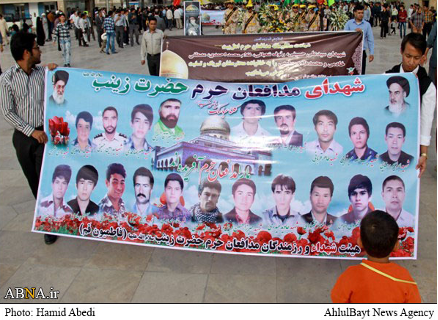
A banner carrying the faces and names of deceased Afghan fighters during a funeral ceremony for two fighters in Qom in October 2014. Along the bottom is the sponsoring committee, called the Committee of Martyrs and Warriors of Hazarat-e Zeynab Shrine Defenders.17
Caskets of two fighters at a funeral ceremony in Mashhad. The casket reads, "We answer your call, oh Husayn. We answer your call, oh Zeynab." A cleric is speaking before the crowd during funeral ceremonies in Mashhad.18 While the caskets are shrouded in green, representing heaven, and religious symbols Iranian fighters' caskets at the time were shrouded in the Islamic Republic's flag.
Both the Fatemiyoun and Zeynaibiyoun used social media platforms like Twitter and Facebook to raise their profile, though at first they lacked cohesive messaging. This occurred even as Iran stepped up its censorship of social media platforms like Facebook and Twitter in the wake of the 2009 post-election protests, when protesters used these platforms to coordinate protests.19 IRGC-backed groups like the Fatemiyoun and Zeynabiyoun used these platforms to advertise themselves and create an online community.20 The pages were run by affiliated accounts or individuals. They would announce fatalities that sometimes had not been covered in Iranian media.21 In 2015, Facebook took down their pages.22
When Instagram surged in popularity in early the 2010s in Iran, the Fatemiyoun’s presence on the platform quickly followed, increasing in fall 2015. Fighters would post photos from the battlefields of Syria.23 In 2018, Instagram shut down the group's page, but current and former fighters continue to use the platform and hold personal accounts, in part because Instagram is one of the rare Western social media platforms not censored by the Islamic Republic.24 Instagram accounts include those dedicated to fallen fighters.25 The Fatemiyoun's reach beyond their online community was small compared to the Islamic State, however, which had achieved the status of a global household name through its strategic use of social media.
In May 2015, the Fatemiyoun declared that their numbers had expanded. Iranian media said that they officially upgraded from a brigade to a division, which is nominally a unit of more than 10,000 fighters.26 Iranian media and officials have said that the group numbers between 10,000 and 20,000 fighters at any given time.27 A report in the Judiciary's news agency Mizan, however, said that the Fatemiyoun made the upgrade after the number of forces surpassed 3,000 fighters.28 Changing the name from brigade to division and disseminating news of the change through formal and social media helped project a stronger presence on the ground.
The actual number of Fatemiyoun fighters, however, is contested. The late Fatemiyoun commander Hosseini said that Fatemiyoun reached 14,000 fighters in Syria in 2016.29 Other analysts like Ali Alfoneh, on the other hand, have estimated that the number of fighters at any given time has been below 10,000.30 A former Fatemiyoun deputy commander told analyst Ahmad Shuja Jamal that about 50,000 Afghans deployed to Syria between 2013 and the end of 2017.31 Whatever the actual number there is little debate that Afghan fighters changed facts on the ground in Syria.
The Islamic State's declaration of the caliphate in 2014 fed into the IRGC's narrative of defending Shiism. Here was a viciously anti-Shiite group with genocidal intentions.32 Massacres of Shiites, for instance, the notorious execution of about 1,700 Shiite cadets at Camp Speicher in June, made the threat clear.33 IRGC-linked news agencies and pro-IRGC social media accounts on Telegram republished uncensored videos of Islamic State atrocities.34 The Guard Corps could not have asked for a better enemy to justify its intervention abroad. The Islamic State magnified the narrative of defending the shrine. A particularly potent narrative would be that fighters in Syria were there to prevent Zainab being "taken captive again."35 The Iranian public overwhelmingly supported the fight against the Islamic State in Iraq.36 Support for Assad, on the other hand, was contentious.37 From then on, Iran justified its presence in both Syria and Iraq as an effort to fight against the Islamic State menace, even though it was in Syria well before the group grew and became a key player on the battlefield.
A Telling Change of Emblems
An early Fatemiyoun insignia.
An early Fatemiyoun emblem.
First official Fatemiyoun emblem.
Latest official Fatemiyoun emblem.
The Fatemiyoun Division has had several unofficial emblems since 2013, as can be seen from Figures 6 through 9. The changes in these emblems over time reflect the unit’s growth and the rising significance of the mission of defending the shrine for Iran’s proxy warfare strategy. More recent logos emphasize the defense of the shrine and a more global agenda with imagery that did not appear in earlier logos.
An emblem that was not widely adopted, Figure 6, shows a rising fist, symbolizing masses rising up; an AK-47, a cheap and common rifle long associated with third world struggles; and a leaf, which represents the desire for peace. The three symbols are also found in the IRGC's logo itself, drawing from the Marxist-Islamist Mujahedin-e Khalq (MKO), from which it split in the 1970s.38 "Indeed, we have given you, [O Mohammad], a clear conquest," reads the top verse that is from Quran 48:1, a revelation that marks the Prophet's conquest of Mecca. Figure 7 has appeared on social media channels. It shows an outline of the country of Afghanistan on a map of the world, with big letters that say "Afghanistan Hezbollah."39 Letters also read, "Shrine defenders of the Fatemiyoun Battalion," and "fighters without borders."
Afghan fighters adopted the image in Figure 8 on a wider scale from around the time the Fatemiyoun officially formed in late 2013 and early 2014.40 The symbol shows the globe, which reflects their growing emphasis on internationalism. In the middle reads “Fatemiyoun” written in Persian. Part of the verse from Quran 3:160 on top reads, "If God should aid you, no one can overcome you." The rest of the verse reads, "but if He should forsake you, who is there that can aid you after Him? And upon God let the believers rely." The verse prior to this recommended the faithful to have trust in the divine, and this verse explains the result of that. The various interpretations of these verses agree that only the Almighty has the power to determine victory and defeat. This full trust and realization would allow the faithful to fear no one else but God, and to ensure that they perform their religious duties. If a mujahid, or a warrior fighting for God, faces defeat, then there is wisdom in that. This theme probably applies better to the ebbs and flows of combat.
The latest logo, shown in Figure 9, was unveiled in late 2015. It is an homage to the group’s IRGC roots with an update reflecting its official raison d'etre of defending shrines in Syria.41 The book on the bottom represents the Quran, with two AK-47 assault rifles. These represent the group's religiosity and willingness to take up arms. The globe from the IRGC's logo remained in the new logo. A new feature is the shape of the dome of a shrine around the name of the Fatemiyoun in the front, which represents its declared mission to protect Shiite shrines. The number on the bottom represents the paramilitary group's founding year in the Islamic calendar, 1435, or 2013-2014.
Early Zeynabiyoun insignia.
Latest Zeynbiyoun insignia.
The Zeynabiyoun Division's emblem has likewise changed. Its early symbol, seen in Figure 10, bears a striking resemblance to Lebanese Hezbollah's symbol, which was adopted from the Guard Corps. The globe, leaves, hands, and AK-47 rifles are all present. Zeynabiyoun is written in the middle. "Is there any defender to defend the household of the Prophet of God," reads the writing on top, which is attributed to Imam Hossein during the heat of the battle of Karbala when dust settled and he looked upon the remains of his dead soldiers.42 The symbol below the hand appears to a pen, which suggests knowledge, and a book, which probably suggests the Quran. On the bottom is written "Islamic Resistance in the World." Resistance refers to the alliance of state and non-state actors led by Tehran. The motto reaffirms the Zeynabiyoun's transnational Shiite identity. That is also adopted from Hezbollah, though the Lebanese organization has "Islamic Resistance in Lebanon." This Zeynabiyoun emblem was the official representation until at least 2016.43
Toward the end of 2016 and early the following year, the Zeynabiyoun adopted a new emblem, shown in Figure 11, which is remarkably similar to the previous one. The hand, AK-47, globe, pen, leaves, and name of Zeynabiyoun are present. One difference is the change in the writing, which is replaced with a verse from Quran 61:13: "victory from God and imminent conquest." The full verse is: "And [you will obtain] another [favor] you love – victory from God and imminent conquest; and give good tidings to the believers." The open book on the bottom represents the Quran. Like the Fatemiyoun, the number on the bottom is the group's founding year in the Islamic calendar, 1435, or 2013-2014.
Soleimani, the Shadow Commander, Steps Out of the Shadows
The story of the Fatemiyoun and Zeynabiyoun cannot be told without Qassem Soleimani, the famous commander of the Quds Force who met his end in the land where his legend began, Iraq. Soleimani’s own history is an example of the links between Iran’s mobilization of Afghan and Pakistani networks in the Iran-Iraq War and during the 1990s and the conflict in Syria. However, over the course of Iran’s involvement in Syria, its war against ISIS, and escalating tensions with the United States, Soleimani took on an increasingly public role. This public role would eventually connect to and help fuel the growing narrative of Iranian support for the Fatemiyoun.
Born in 1957 to a poor family in a remote village in a tribal area in Kerman Province close to the Afghan border, Soleimani left his job as a construction contractor for the Kerman Water Organization and joined the Guard Corps following its establishment in 1979.44 He rose to command a division and form close ties with commanders during the Iran-Iraq War.45 After the war, he fought smugglers in southeast Iran in the 1990s, continuing his post as commander of the Sarallah Division. He assumed command of the Quds Force in 1997 or 1998, to lead Iranian efforts against the Taliban, a top security concern at the time.46
Soleimani’s profile among the Iranian leadership rose after his direction of the Iranian war effort against American and coalition forces in Iraq following 2003.47 Khamenei bestowed a medal to Soleimani for his role during Hezbollah's war against Israel in 2006 (known in Iran as the 33-Day War), which was not publicized at the time.48 In 2011, Khamenei promoted him to Major General, making him the only general among the five branch Guard Corps commanders below the overall commander who held that rank.49 At that time, Soleimani mostly kept a low public profile, but was well known to experts on Iran and Iran's adversaries.
Western media helped cultivate the perception of Soleimani as a mastermind, even as he committed errors and failures. In 2013, a New Yorker profile cultivated—at least in the imagination of many Western—the image of the grey-bearded shadow commander who has been "reshaping the Middle East."50 Syria was the highest profile operation he was associated with at that time. In other words, Soleimani reaped the rewards of the strategy Hamedani designed. Soleimani, however, failed to predict or prevent the Islamic State's 2014 incursion into Iraq, capture of Mosul, and march to the vicinity of the Iranian border.51 While Iran prevented Assad's fall, there was no end in sight to that war. Furthermore, Iran's ties with Arab states had plummeted. Rumor and speculation spread that Soleimani might be sidelined or replaced.52 Even though the media reported that he was in Iraq to fight the Islamic State, he continued to largely keep a low profile.
That changed around September 2014, when Soleimani's use of social media propelled him to celebrity status. Photos, selfies, and videos of Soleimani at the front lines with fighters in Iraq, and meetings with commanders began to surface and be shared by users on social media platforms like Facebook, Twitter, and YouTube at a high rate (See Figures 12-14).53 Ostovar has linked Soleimani's use of social media to his desire to maintain his prime position.54 Here was the shadow commander on the front lines to combat the Islamic State, which was also using social media to inspire tens of thousands of followers. The Islamic State was the perfect enemy for Soleimani, whose presence on the front lines against this hated enemy commanded attention. He became a viral sensation. That increased his influence and power on the ground, as well. Footage at recently conquered areas fed his public perception as a mastermind. That in turn fed into even more attention, creating a momentum that grew his legendary persona. His presence became a morale booster for allies, and a menace for his adversaries. The social media revolution allowed Soleimani and the Islamic State to not only spread their messages but change geopolitics.
Soleimani transformed the face of Iran’s influence in southwest Asia. He became the message and the medium. The IRGC and the Islamic Republic enthusiastically started to promote a cult of personality around him. His public persona is that of a charismatic, humble, and pious general committed to the Islamic Revolution, loyal to Supreme Leader Ali Khamenei, and to Iran’s revolutionary cause of challenging American hegemony and power projection in the Middle East.55 While the anti-Islamic State coalition pushed back the Salafist jihadist group in Iraq, the Syrian war was becoming more desperate for Iran.
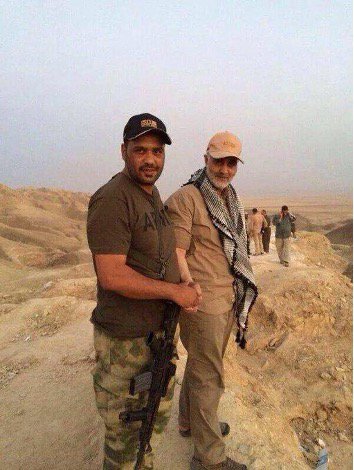
Qassem Soleimani near Amerli, September 2014.56
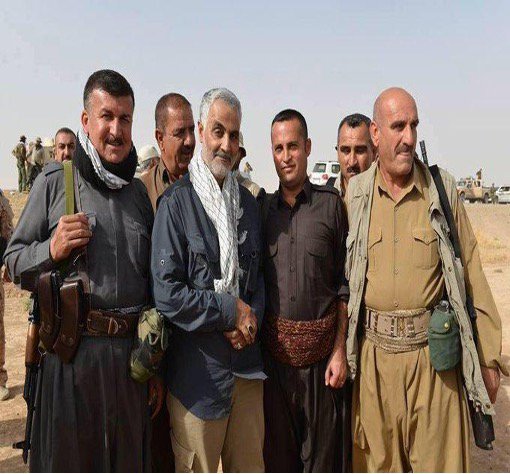
Soleimani with Iran-linked Patriotic Union of Kurdistan (PUK) fighters near Tuz Khurmatu, October 2014.57
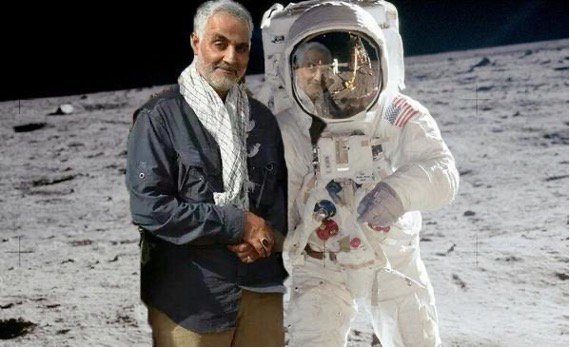
A viral meme of Soleimani with astronaut Neil Armstrong on the moon parodying the photos Soleimani was releasing in public in a number of areas, which through social media became an internet sensation.58
Putin Steps In: 2015 as Watershed Moment for Iran’s Proxy War Strategy and Narrative
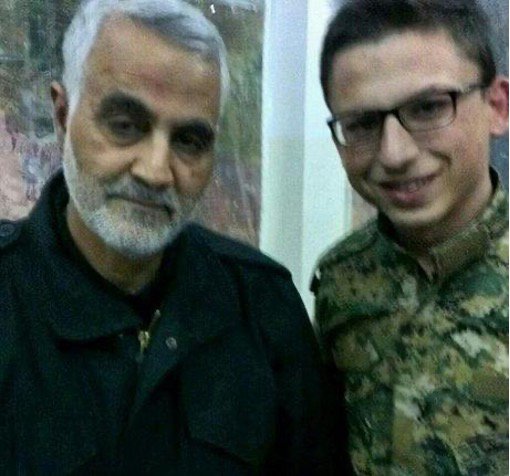
Selfie of Soleimani with a Russian soldier that circulated widely on social media in February 2016.59
Early 2015 was grim for Damascus and Tehran. A jihadist-led coalition conquered Idlib Governorate, which could act as a launching pad for further territorial gains including in the Alawite heartland in the west.60 Damascus controlled small patches of Syrian territory. Iran had already deployed thousands of its foreign legion. Tehran had two options: cut its losses and concentrate on securing the territory stretching from Latakia in the west and down the Lebanese border to Damascus, or escalate to turn the tide of war.61 The latter would mean the deployment of tens of thousands more Iranian and Shiite paramilitary boots. That carried high costs and the risk of war with outside powers that, at that time, would have found a full-scale Iranian invasion of the Levant intolerable. Iran was already facing the threat of attacks against its nuclear facilities and was under crushing sanctions over its weapons program.62 Tehran's adversaries had the leverage of destroying Iran's air bridge to Syria, its primary supply route, to cripple Iranian operations. The Guard Corps had no answer for their superior air power and air defense systems.
Iran needed the intervention of another power on its side: Russia. In 2015, Soleimani personally traveled to Moscow with a proposition for President Vladimir Putin: Russia and Iran could save Assad, the Kremlin's long-time ally, and turn the tide of the war.63 In a meeting that is said to have lasted over two hours, Soleimani told Putin that "the last trench of the eastern bloc is Syria, and if you lose this, Westerners would no longer value you."64 In this deal, Iran would provide the bulk of ground forces, and Russia would provide its airpower, as well as some Russian ground troops.65 Iran could inject Iranian boots into its Shiite expeditionary forces and escalate without the high risk and cost of a solo Iranian intervention. Putin also saw an opportunity to flex the Kremlin's muscles abroad and escalate militarily without the burden of significant Russian casualties.66
Coordination between Russia and Iran has endured despite mutual mistrust.67 Tehran and the Kremlin mobilized following the signing of the Joint Comprehensive Plan of Action in July 2015, which removed international sanctions in exchange for a temporary freeze on the nuclear program.68 That deal allowed Iran to de-escalate tensions with the West. In September, Putin announced in a press conference that Russia would escalate its involvement in Syria.
After the Russian announcement, Iran stepped up its military presence, but continued to obfuscate the level of its involvement. Commanders acknowledged they were coordinating with Russia in Syria.69 Iran, however, continued arguing that its military personnel were advisers, the narrative it has used since 2012.70 The facts on the ground, however, proved otherwise. The most senior commander killed during this period was Hamedani, an event that grabbed headlines across the world, and the Guard Corps held a massive funeral for him.71 The Islamic Republic deployed thousands of Guard Corps personnel drawn from the Ground Forces, an unprecedented scale in its proxy warfare history, though the quality of Iranian soldiers atrophied compared to the early phases of the war due to casualties.72 Many Iranian fighters and Basij paramilitary members who died during this time were not professional soldiers, and received three months of basic training before deploying to Syria.73 Many were members of Basij who were deeply influenced by ideological programs and training courses that instilled a desire for martyrdom.74
Across Syria, the Fatemiyoun and Zeynabiyoun participated in virtually every major battle. The Fatemiyoun had pronounced roles in the battles for Palmyra in 2016 and the next year for a second time after the Islamic State wrestled control of the area again. Both battles became the subject of documentaries, like the “Battle for Palmyra,” and “On the Line of Fire,” which was about the second battle.75 These paramilitary groups have been instrumental for Tehran's gains in Syria and shape regional geopolitics without these paramilitary groups.
Iran’s Proxy War Narrative Goes Viral
While the IRGC maintained that it was in an advisory role, it capitalized on the increased presence of Afghan and Pakistani fighters in Syria to augment its cultural production activities. Stories about Fatemiyoun and Zeynabiyoun fighters began appearing more frequently in Iranian state-backed media along with more and more online and offline memorials. In time, he combined the impact of Russia’s entry into the war, and Soleimani’s efforts to build up his own mythic status made Iran’s sectarian narrative go viral. The IRGC further exploited the moment by cranking up its production of documentaries and viral videos.
The October 2015 coordinated assault on rebel positions across Syria by Russia and Iran coincided with Muharram, the mourning of the Master of Martyrs, Imam Hoseyn. The Guard Corps capitalized on that, calling the assault Operation Muharram.76 The Syrian battlefield was thus the latest reenactment of and the continuation of Karbala. In this act, the new Yazid were foreign powers like the United States, Saudi Arabia, and Israel that Tehran said wanted to overthrow Assad as well as all Syrian opposition to Assad, who were called ISIS, Saudi mercenaries, or followers of "American Islam,” a derisive term used to describe a depoliticized version of the true faith.77 State-linked news agencies typically served as a primary pipeline, running videos, photos, and interviews that appealed to religious and nationalist emotions to justify the presence in Syria.78
Those productions spread on social media and received many reactions, particularly among pro-IRGC groups.79 On social media, such as Instagram, channels dedicated to shrine defenders, especially those that provided exclusive coverage, became popular.80 A ritual that evokes a lot of emotion is videotaping and photographing families' mourning when they receive and embrace the remains of their loved ones; the caskets remain closed if the injuries are too grievous (See Figure 16).81 These events are held at places called Ascension of Martyrs, or me'raj-e shohada, which have their own professional studios.82 The publication of memoirs of deceased fighters by IRGC-linked and pro-IRGC publication centers also increased.83
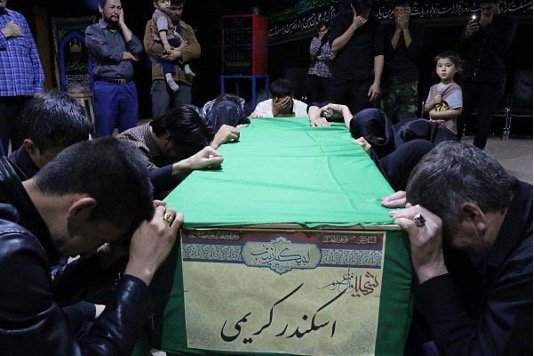
Family of Fatemiyoun fighter Eskandar Karimi mourn as they receive his casket, October 2016. The Guard Corps has flown in close family members of deceased fighters if they are in Afghanistan.84
The Islamic Republic helped drive the cultural production of the Afghan and Pakistani groups. Afghans and Pakistanis were equal to Iranian soldiers as "shrine defenders,” at least as far as narratives went.85 While the numbers of funerals increased due to the spiking fatality rate, not all the dead were announced or given funerals in order to control public perception about death rates.86 Iranian media have explicitly said that Zeynabiyoun funerals have a lower profile because of Pakistan's sensitivities and ISI's concentration on Shiites.87 That is an example of Tehran's concern about blowback in its proxy wars, as it fears Islamabad more than Kabul (the Guard Corps runs Fatemiyoun training camps in Afghanistan, according to an official who disclosed the information under Chatham House rules).
Most Afghans and Pakistanis were buried in cities home to a substantial number of migrants, such as Mashhad, Qom, and Varamin, which is outside the capital Tehran.88 The Fatemiyoun and Zeynabiyoun also became subjects of memoirs. Ebrahim Hadi Cultural Group has compiled a number of memoirs on the Fatemiyoun as well as shrine defenders in general.89 Zeynabiyoun Commander "Meysami", which is probably a nom de guerre, writes in the introduction to a memoir of slain fighter Mohammad Adil that Pakistani fighters began on their own initiative to write their memoirs in 2015 or early 2016, and that, despite challenges like the language barrier, the group eventually started the publication of series called "Children of Ruhollah [Khomeyni]."90 Meyasmi, who is probably Iranian since he referred to Iranians as compatriots with whom he shared the same language, unveiled the memoir on Adil alongside three others in a ceremony in 2019.91 Iranian media has not published a photo of Meysami.
The Guard Corps has had a high tolerance for losses in these groups. The Fatemiyoun were often used as cannon fodder.92 The Zeynabiyoun are praised as line breakers.93 Afghans fought in the most dangerous situations and battles. Entire units would sometimes be wiped out.94 A former fighter said that Iranians would shoot at Afghans trying to retreat, but that Afghans eventually earned respect.95 At least one unit refused the order of an Iranian officer to deploy to a high-risk situation and beat him up.96 At the same time, there are Afghans who are proud of their service in the Fatemiyoun on their social media accounts, and say so to expatriate news agencies.97 That means that the abuses were probably not systematic and depended on individual cases.
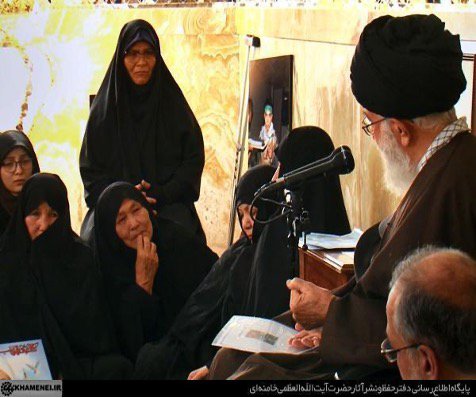
Families of deceased fighters meeting with Supreme Leader Ayatollah Ali Khamenei.98
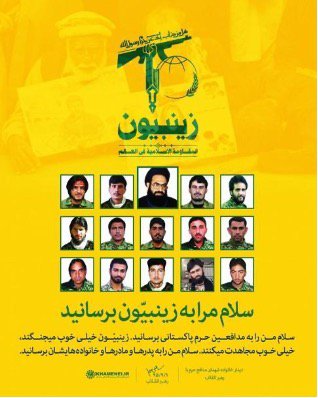
Poster with the Pakistani Zeynabiyoun logo on it, and the faces of fallen fighters as well as the group's "spiritual father" Aref al-Husayni, who was assassinated in Pakistan in 1988. The below text quotes Khamenei, who said "give my regards to Pakistani shrine defenders. The Zeynabiyoun fight very well. They engage in jihad very well. Give my regards to their fathers, mothers, and families."99
As a result of participation in combat and more transparency about the war, Khamenei recognized the fighters (See Figure 18). In what has become an annual tradition, Khamenei received the families of deceased fighters during the Iranian New Year holidays in late March 2016 at Imam Reza shrine in his hometown of Mashhad, where he spends his new year holidays every year (See Figure 17). Some families of deceased fighters had passed along a request to Khamenei's representative while opening a sports complex named after shrine defenders, according to a documentary called Father produced by the Fatemiyoun Media Center about that meeting between Khamenei and the families.100 Hailing the participation of Afghans in the 1979 revolution against the Shah and the Iran-Iraq War, Khamenei told the families that "your children put their lives as shields so that these ill-wishers and wicked do not reach the shrine of Ahl-e Bayt [Household of the Prophet]…may your dear martyrs be in the company of the martyrs of the early days of Islam, the revolution, and Karbala."
The families interviewed in the documentary Father said that the meeting was a dream come true. Line of Hezbollah, a weekly publication by the Supreme Leader's Office, wrote following the meeting that "the Afghans of Fatemiyoun have now blossomed to the flowers of the spring who continue the basiji thought of Khomeyni the great in the region and the world with their jihad and martyrdom."101 Khamenei has received poets and religious singers who have praised the Fatemiyoun and martyrs.102 "The cloudy air after you, in the silence of sunset/has mounted my shoulder of sorrow," read a line by Afghan poet Hassan Mobarez. With regards to the Pakistani fighters, Khamenei in 2016 told the family of a deceased fighter, "the Zeynabiyoun fights very well…give my regards to their fathers, mothers, and families."103
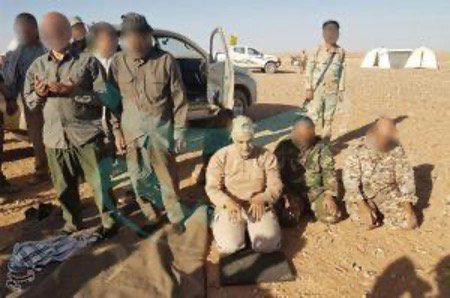
Soleimani giving a supplication prayer alongside Fatemiyoun Division fighters in Syria close to the Iraqi border. 104
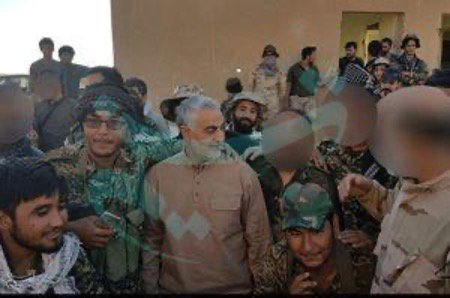
Soleimani alongside Fatemiyoun fighters. The text in the middle says "Tasnim," referring to the IRGC-linked news agency, June 2017. 105
Soleimani also tried to cultivate in public a close relationship with Fatemiyoun fighters linking his increasingly public role and the narrative of his influence and control to that of the Fatemiyoun. Fighters have posted photos and selfies with Soleimani, and Soleimani's social media accounts have also posted such photos (See for example Figures 19 and 20).106 After Tavassoli's death in 2015, Iranian media carried a photo of the deceased commander and Soleimani together, as well as Soleimani's statements that praised him.107
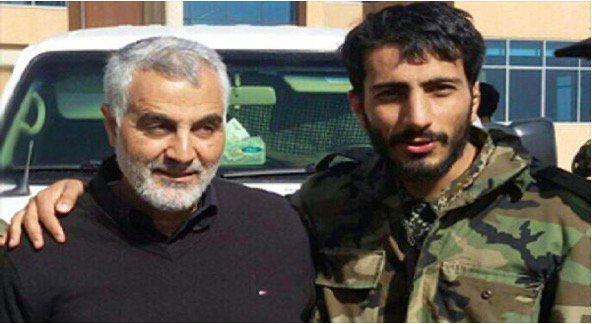
Qassem Soleimani, left, with fabled Iranian commander in the Fatemiyoun, Mostafa Sadrzadeh. 108
Later that year, Soleimani spoke at the commemoration of an Iranian commander in the Fatemiyoun, Mostafa Sadrzadeh, whose death in October 2015 coincided with Tasu'a, which marks the day before Imam Husayn's death in Karbala. Soleimani's speech, which was released in November, marked one of the instances in which Soleimani's remarks about the Fatemiyoun were made public.109 Sadrzadeh has a central role in Fatemiyoun hagiography, described as an Iranian who disguised himself as an Afghan to join (See also Figure 21).110 In a video of Soleimani among Fatemiyoun fighters, he praised Sadrzadeh for going through the trouble to disguise himself.111 He is not the only probable Quds Force member in the Fatemiyoun who was described as joining on his own but is the most famous among them.112
The death of an Iranian in Fatemiyoun ranks caught the attention of many in pro-IRGC circles, who elevated Sadrzadeh into a prominent figure in Fatemiyoun lore. "I loved him," Soleimani has said about Sadrzadeh.113 Sadrzadeh's death coincided with rising fatalities in the fall of 2015.114 In 2016, Soleimani-affiliated social media accounts released photographs with Fatemiyoun fighters at the front line.115 IRGC-linked and state media publicized Soleimani's meeting with Tavassoli's family in that summer.116 Soleimani hailed Tavassoli, saying that he "left us too soon," gifting a ring to Tavasoli's son. That is remarkable considering that at least some Fatemiyoun members believe Soleimani ordered Tavassoli's assassination. Soleimani continued that the "oppressed and humble Afghans" voluntarily went to defend "the oppressed in another part of this cruel world," adding that the Fatemiyoun had been "very effective on the battlefield." He then said that the Fatemiyoun have caused a "transformation" within Iranian society's views about Afghans, acknowledging long-standing discrimination. He noted that "graves of Afghan martyrs have become like [shrines of] Imamzadehs [offspring of Shiite Imams]," meaning that the graves were attracting visitors, and that they were becoming religious symbols.
In October 2016, Soleimani publicized a meeting with Sadrzadeh's family on the first anniversary of his death, continuing a ritual that predates the Syria war and further solidifies Sadrzadeh's position in the pantheon of holy warriors, as well as his own perception as a general who truly cares about his men.117 Soleimani continued releasing photographs with fighters, for instance in the campaign in the eastern Syrian desert in 2017.118 In contrast, Soleimani publicized fewer photos and statements with the Zeynabiyoun, probably in order to not raise Islamabad's ire. Iranian officials and commanders have also heaped praise on the Fatemiyoun and Zeynabiyoun. Guard Corps commanders and officials, such as the Supreme Leader's representatives to provinces and Friday Prayer leaders, have visited funerals of fighters, as well as families of deceased fighters.119 A retired commander who had fought in Syria said in 2016 that the Fatemiyoun would help constitute the "Shia Liberation Army."120 That was controversial, particularly in the Arab press, because it suggested the IRGC had ambitions beyond Iran's sphere of influence in the northern Middle East.121 Iranian media retracted the interview.
Speaking at a commemoration of fighters at the shrine of Imam Reza on the anniversary of Fatimah's martyrdom, then-Quds Force deputy commander and the current force chief Esma'il Gha'ani said the Fatemiyoun represents "a new culture" within the Islamic resistance culture who are fighters continuing the path of Fatima "who do not recognize borders to defend Islamic values."122 "The liberation of Aleppo was not a joking matter," he declared, adding that the Fatemiyoun "hit America in the mouth" in Syria.123
Religious singers have played crucial roles in mobilizing fighters and producing the culture. Known as Maddah, religious singers in recent years have increasingly supplanted the clergy in retelling the stories of Karbala and have grown into political and cultural icons. Mixing with elements of modern music, the singing, lyrics blend with mysticism, and the congregation's rhythmic chest beating and chorus elevate the crowd into a trance-like state.124 During the Iran-Iraq War, religious singers mobilized for combat and to raise morale at home, extolling values like martyrdom. The singers' political and cultural popularity grew in the 2000s, aided by mass media and communications.
War in Iraq and Syria provided fresh material for singers, who would publicize via their social media channels going to Syria to sing for fighters, or extol them at home, including at congregations before the Supreme Leader. Leading a congregation of Fatemiyoun fighters in Syria in 2019, prominent figure Ahmad Vaezi sings, "We are the Fatemiyoun, Allah is with us…We are the Fatemiyoun, used to love we are. It has enamored us, the excitement for martyrdom."125
Fatemiyoun also set up in-house courses to teach religious singing.126 Fighters in Syria themselves would hold sessions of singing before and after combat to raise morale. In one instance, fighter Yaser Ja'fari leads a congregation before battle while artillery is heard in the background.127 He dedicated the song to Hazrat-e Zeynab, who is often called "bibi," meaning mother, Zeynab: "oh hope of my mournful heart, I have a last will with you, oh my Zeynab, I leave the house to you."128 Later that night, Ja'fari died in action. Another religious singer in Fatemiyoun lore is Iranian Hamed Bafandeh, the subject of a 2018 Fatemiyoun Media Center documentary called The Last Chapter of Life.129 Killed a year earlier by an improvised explosive device (IED) near Hama Governorate's Halfaya, the documentary says that Bafandeh deeply impacted Afghan fighters, inspiring fighters with his eulogies and religious singings before and during battle, as well as in commemorations of deceased fighters.130
Citations
- Mohammadi, Syria: a Spider Hole, 138.
- Mohammadi, Syria: a Spider Hole, 138.
- Jamal, op.cit., 2018, 16.
- "از جنگ مقابل طالبان تا جنگ دربرابر داعش" ("az jang moqabel-e taleban ta jang dar barabar-e da'esh," "From War Against The Taliban to War Against The Islamic State"), IranWire, October 2, 2018. ; "آموزش آمریکا در خدمت لشکر فاطمیون ایران" ("amuzesh-e amrika dar khedmat-e laskhar-e fatemiyoun-e iran," "America's training at The Service of Iran's Fatemiyoun Division"), IranWire, April 25, 2018. .
- Ibid.
- Ibid.
- "Iran: Afghan Children Recruited to Fight in Syria," Human Rights Watch, October 1, 2017, ; "روایت کودکسربازان لشکر فاطمیون از جنگ در سوریه؛ شانس آوردیم نمردیم" ("revayat-e kudak sarbazan lashkar-e fatemiyoun az jang dar suriyeh; shans avordim namordim," "Account of Child Soldiers of The Fatemiyoun Division From War in Syria; We Were Lucky We Did Not Die"), IranWire, April 26, 2020. .
- Sune Engel Rasmussen & Zahra Nader, "Iran covertly recruits Afghan Shias to fight in Syria," The Guardian, June 30, 2016. .
- Fatemiyoun1434, 2019, “گزارش صدا و سیمای استان یزد از غرفه فاطمیون در نمایشگاه طریق الحسین" (Broadcasting Yazd Province Report from Fatemiyoun Kiosk in Tarigh al-Hossein Exhibition)," Telegram, .
- The group has not had a prominent website or social media presence in order to verify these claims. The individual could be telling the truth, or may have reflected a recognition of the Guard commander that he could mobilize Afghan Shiites to fight later.
- "خیلی دور، خیلی نزدیک؛ مقدمه داستان بلند «ایرانیها» و «افغانها»" ("kheyli dur, kheyli nazdik; moqaddame-ye dastan-e boland-e 'irani-ha' va 'afghan-ha,'" "Very Far, Very Close; Introduction to The Long Story of 'Iranians' and 'Afghans'"), Tasnim News, 1 July, 2014. .
- "گلایههای ما مهاجرین افغانستانی، انتقاد به جمهوری اسلامی نیست؛ به موانع تحقق انقلاب است" ("gelayeha-ye ma mohajerin-e Afghanestani, enteqad be jomhouri-ye eslami nist, be mavane'-e tahaghogh-e enghelab ast," "We Afghan Migrants Have No Criticism of the Islamic Republic, it is Â鶹¹û¶³´«ý Obstacles to Fulfilling Revolution"), Tasnim News, July 19, 2014, .
- "حجتالاسلام ابراهیمی: مقام معظم رهبری دستور دادند، مهاجرین افغانستانی را «تکریم» کنید" ("hojjat ol-eslam ebrahimi: maqam-e mo'azzam-e rahbari dastur dadand, mohajerin-e afghanestani ra 'takrim' konid," "Hojjat ol-Eslam Ebrahimi: The Supreme Leader Have Ordered to 'Honor' Afghan Migrants"), Tasnim News, November 30, 2014. .
- "گفتگو با مدافعان حرم حضرت زینب(س)" ("goft-o goo ma modafean-e haram-e hazrat-e Zeynab," "Interview With Defenders of the Shrine of Hazrat-e Zeynab"), Hamshahri Online, June 9, 2014. .
- Ibid.
- "اروج لاله های سرخ زینبی در عملیات محرم" (“orouj-e laleh-ha-ye sorkh-e zeinabi dar amaliat-e moharram," "Ascendance of Red Tulips of Zeinab in the Muharram Operation"), Modafe-e Haram, October 30, 2015. ; Surging in popularity in the 2000s, blogging declined toward the mid-2010s thanks in large part to state censorship, which left pro-system blogs alone, as well as the rise of social networking sites like Facebook, Instagram, Telegram and WhatsApp. (Fred Petrossian, Arash Abadpour & Mahsa Alimardani, "The decline of Iran’s Blogestan," Washington Post, April 11, 2014. .
- "تشییع پیکر دو شهید مدافع حرم حضرت زینب (س) در مشهد مقدس" (tashi-ye peykar-e do shahid-e modafe'-e haram-e hazrat-e zeynab (s) dar mashhad-e moghaddas," "Burial of Two Martyred Shrine Defenders of Hazrat-e Zeynab (pbuh) in Holy Mashhad"), Isaar, August 21, 2014. .
- Ibid.
- Mehdi Fattahi, "Iranians manage to surf the web despite tide of censorship," Associated Press, July 26, 2019. .
- U.S. Congress, House of Representatives, House Committee on Foreign Affairs, Iran’s Islamic Revolutionary Guard Corps: Fueling Middle East Turmoil, 114th Cong., 1st sess., 2015, 25-49.
- Ibid..
- Ibid.
- Interview with researcher, Washington, D.C., 2021.
-
The official Fatemiyoun Instagram page had more than 46,000 followers, the largest on any social media platform, before shutting down. According to IRGC-linked Mashregh News, Instagram took action after Fatemiyoun teased portions of a documentary called “Shadow of Destruction” about the paramilitary group’s campaign against ISIS in eastern Syria. Instagram shut down the official Fatemiyoun page after the group set up another page. The biggest moves against the Fatemiyoun and some popular affiliated pages or fan accounts was in March 2019; the platform continued to shut down pages after others were being set up. The platform has cited that page’s “support for a violent and/or criminal organization and group” as the reason for shutting it down. U.S. officials may have nudged the social media platform to enforce this rule.
“حذف صفحه رسمی فاطمیون از اینستاگرام”
(“hazf-e safhe-ye rasmi-ye fatemiyoun az Instagram,” “Fatemiyoun’s Official Instagram Page Took Down”), Mashregh News, May 23, 2018, ;
"حذف-صفحه-رسمی-فاطمیون-از-اینستاگرام; “صفحه رسمی فاطمیون مجدداً توسط اینستاگرام مسدود شد” (“safhe-ye rasmi-ye fatemiyoun mojaddadan tavassot-e Instagram masdud shod,” “The Official Instagram Page Was Blocked Against by Instgram”), Tasnim News, July 17, 2018. ; “حذف چند صد پست متعلق به شهدای مدافع حرم از اینستاگرام و فیسبوک!” (“hazf-e chand sad post motealleq be shohada-ye modafe’-e haram az Instagram va facebook,” “Several Hundred Posts Belonging To Martyred Shrine Defenders Eliminated From Instagram and Facebook!”). Ahl-ul-Bayt News Agency, March 6, 2019. . - A series of popular or fan accounts were taken down in 2019. “حذف چند صد پست متعلق به شهدای مدافع حرم از اینستاگرام و فیسبوک!” (“hazf-e chand sad post motealleq be shohada-ye modafe’-e haram az Instagram va facebook,” “Several Hundred Posts Belonging To Martyred Shrine Defenders Eliminated From Instagram and Facebook!”). Ahl-ul-Bayt News Agency, March 6, 2019, .
- "تیپ فاطمیون به لشکر ارتقا یافت" ("tippe fatemiyoun be lashkar erteqa yaft," "Fatemiyoun Division Upgraded to a Division"), Taghrib News Agency, May 20, 2015. .
- Ahmad Majidyar, "Iran Recruits and Trains Large Numbers of Afghan and Pakistani Shiites," Middle East Institute, January 18, 2017.
- "لشکر فاطمیون؛ از آغاز تا امروز/ بازوهایی برای دفاع از حرم و خدمت به مردم" ("lashkar-e fatemiyoun; az aghaz ta emruz/ bazuhay-i baray-e defa az haram va khedmat be mardom," "Fatemiyoun Division; From Beginning to Now/ Arms To Defend the Shrine and Serve the People"), Khabar, May 12, 2019. .
- Tobias Schneider, "The Fatemiyoun Division in the Syrian Civil War," Middle East Institute, October 2018, 5.
- Rasmussen & Nader, "Iran covertly recruits Afghan Shias to fight in Syria," The Guardian.
- Jamal, "The Fatemiyoun Army," 7.
- Ranj Alaaldin, “The Isis campaign against Iraq’s Shia Muslims is not politics. It’s genocide,” The Guardian, January 5, 2017. .
- Patrick Cockburn, "Camp Speicher massacre: Retracing the steps of Isis's worst-ever atrocity," The Independent, November 7, 2017. .
- Mohammadi, Syria: a Spider Hole, 35-36.
- "مستند دوباره اسیر نمی شوی" ("mostanad-e dobar-e asir nemishavi," "You Will Not Be Captured Again Documentary"), Aparat, June 18, 2014. .
- Ali Alfoneh, "Maximal Exposure, Minimal Presence: Iran's Military Engagement in Iraq," The Washington Institute For Near East Policy, August 25, 2015. .
- Ibid.
- Ostvoar, op.cit., "Vanguard," 2016, 52.
- “Liwa al-Fatemiyoun: Martyrdom Graphic,” Jihad Intel, accessed March 3, 2020. .
- "عکس خبری/ مدافعان افغانی حرم حضرت زینب(س) و حضرت رقیه(س)" ("ax-e khabari/modafe'an-e afghani-ye haram-e hazrat-e zeynab (s) va hazrat-e roqayya," "Photo Report/Afghan Defenders of The Shrine of Hazrat-e Zeynab (pbuh) and Hazrat-e Roqayya (pbuh)"), ABNA, November 1, 2014. .
- "آرم رسمی «لشکر فاطمیون» رونمایی شد +عکس" ("arm-e rasmi-ye 'lashkar-e fatemiyoun' runamayi shod + aks, "The Official Logo of 'Fatemiyoun Division' Unveiled + Photo"), Jam News, November 3, 2015. .
- "شرح کامل واقعه عاشورا از مقتل لهوف" ("sharh-e kamel-e vaqe'ey-e Ashura az mofatel-e lahuf," "Full Description of Ashura Incident From Lohoof [Sighs of Sorrow]"), Tabnak, November 14, 2013. .
- "تشییع پیکر مطهر دو شهید تیپ زینبیون برگزار میشود" ("tashi-ye peykar-e motahar-e do shahid-e tipp-e zeynabiyoun bargozar mishavad, "Funeral To Be Held for Two Pure Remains of Zeynabiyoun Division Martyrs") Basij Press, January 18 2017. .
- Ali Alfoneh, "Iran’s Most Dangerous General," American Enterprise Institute, July 13, 2011. .
- Alfoneh concluded that Soleimani during the war gained experience to become a tactical general, but that he never managed to become a strategist: Alfoneh, "Iran’s Most Dangerous General," American Enterprise Institute; Ali Alfoneh, "Brigadier General Qassem Suleimani: A Biography," America Enterprise Institute, January 24, 2011. ; Former IRGC chief commander Mohammad Ali Ja'fari, who was a senior commander in 1982, wrote in his memoirs that Soleimani during his first major command post at Operation Fat'h ol-Mobin (Manifest Victory) was unable to properly secure the flanks of two units, which bore the brunt of Iraqi pressure. Other biographies called Soleimani's first major operation a success: Gol-Ali Baba'i, "کالک های خاکی: خاطرات شفاهی سرلشکر پاسدار محمدعلی جعفری" ("kalakha-ye khaki: khaterat-e shafahi-ye sarlashkar pasdar mohammad-ali ja'fari," "Dusty Overlays: Oral Memoires of Major General Guardsman Mohammad-Ali Ja'fari"), Sureh-ye Mehr Publications, 2011, 365; Ehsan Mehrabi, "Ghasem Soleimani: The Mythical Commander," IranWire, April 11, 2019, .
- Alfoneh, "Brigadier General Qassem Suleimani."
- Ostovar, "Vangard," 3.
- "مدال سردار سلیمانی پس از جنگ 33 روزه +عکس" ("medal-e sardar soleimani pas az jang-e sio-se ruz-e +asks," "Commander Soleimani's Medal After The Thirty-Three Day War + Photo"), Mashregh News, March 12, 2019. ; "نگاهی به فرماندهی «حاج قاسم» از زاویهای متفاوت" ("negah-i be farmandehi-ye 'haj qassem' az zaviye-i motefavet," "A Look at The Command of 'Hajj Qasem' From Another Angle"), Mashregh News, March 13, 2019. .
- "۱۳ سرلشکر جمهوری اسلامی ایران" ("13 sarlashkar-e jomhuri-ye eslami-ye iran," "13 Major Generals of The Islamic Republic of Iran"), Radio Farda, January 26, 2011. .
- Dexter Filkins, "The Shadow Commander," September 30, 2013. .
- Ostovar, "Vanguard," 225-226.
- Ibid.
- Ibid. 226-227
- Ibid.
- “قاسم سلیمانی؛ مردی که قدرت ایران را به رخ آمریکا کشاند” (“qasem soleimani; mardi ke qodrat-e iran ra be rokh-e amrika keshand,” “Qasem Soleimani; The Man Who Touted Iran’s Power to America”), Ahlul Bayt News Agency, November 30, 2014. ; “ویژگیهای اخلاقی حاج قاسم سلیمانی به روایت همراه دیروز و امروز” (“vizhegiha-ye akhlaqi-ye haj qasem soleimani be ravayat-e hamrah-e diruz va emruz,” “Ethical Characteristics of Haj Qasem Soleimani According to the Companion of Yesterday and Today”), ·¡³ٳٱð±ô²¹’a³Ù, October 16, 2016. .
- Josh Weinberg, "Wow…#Iran IRGC Qods Force commander Qasem Soleimani on #Iraq frontlines in Amerli via @dgtlresistance," Twitter, September 3, 2014. .
- Golnaz Esfandiari, "Soleimani is everywhere RT @SumerRising: #Iraq; #Iran IRGC commander Qassim Soleimani with PUK fighters in Tuz," Twitter, October 6, 2014, .
- Nabih Bulos & Patrick J. McDonnell, “Iran’s ‘Supermani:’ fabled general, Internet sensation,” Los Angeles Times, March 4, 2015, ; Austin Bodetti, “Even Iranian Military Generals Can Become Dank Memes in This Brave New World,” Vice, January 27, 2017. .
- "عکس سلفی سرباز روس با سردار سلیمانی" ("ax-e selfie-e sarbaz-e rusi ba sardar soleimani," "Russian Soldier's Selfie Photo With Commander Soleimani"), Shahid News, February 20, 2016. .
- Thomas Joscelyn, "The Consequences of Russia’s ‘Counterterrorism’ Campaign in Syria," Combating Terrorism Center Sentinel, Volume 9, Issue 11, December 2016. .
- Fulton, "Iranian Strategy in Syria," 27.
- Kenneth Katzman, "Iran Sanctions," Congressional Research Service, October 15, 2012.
- "Iran Quds chief visited Russia despite U.N. travel ban: Iran official," Reuters, August 7, 2015. .
- This statement was made by Brigadier General Mohammad-Ja'far Assadi, the former commander of Iranian advisory forces in Syria: "جزئیاتی از دیدار مهم و ۱۴۰ دقیقهای پوتین با سردار سلیمانی" ("Details From The Important and 140-minute Meeting Between Putin and Soleimani"), Parsine, July 15, 2019, .
- Rondeaux, op.cit., 2019.
- Ibid.
- Dmitri Trenin, "Russia and Iran: Historic Mistrust and Contemporary Partnership," Carnegie Endowment For International Peace, August 18, 2016. .
- Paul K. Kerr & Kenneth Katzman, "Iran Nuclear Agreement and U.S. Exit," Congressional Research Service, July 20, 2018.
- Amir Toumaj, "Commander: IRGC supplies intelligence to Russia for airstrikes in Syria," FDD's Long War Journal, September 27, 2016. .
- "در صورت حمله جایی در اسراییل سالم نمیماند" ("dar surat-e hamle jay-i dar esra'il salem nemimanad," "In Case of Attack, No Where in Israel Will Be Left Unscathed"), Farda News September 16, 2012. .
- Ali Arouzi, "Iranian Revolutionary Guard Commander Hussein Hamedani Killed in Syria," NBC News, October 9, 2015. .
- Mohammadi, Syria: A Spider Hole, 194.
- Ibid.
- Ibid.
- "مستند کامل نبرد پالمیرا" ("mostanad-e kamel-e nabard-e palmyra," "The Full Documentary of The Battle For Palmyra"), Rasekhoon, December 13, 2016, ; "جدیدترین مستند فاطمیون تحت عنوان «روی خط آتش» رونمایی شد" ("jadidtarin mostanad-e fatemiyoun that-e onvan-e 'ruy-e khatt-e atash' runama-yi shod," "Latest Fatemiyoun Documentary Called 'On The Line of Fire' Was Unveiled"), SNN, October 8, 2017. .
- "تصاویر/ آخرین «مدافعان حرم» که در «عملیات محرم» جاودانه شدند" ("tasavir/ akharin 'modafe'an-e haram' ke dar 'amaliyat-e moharram' javdan-e shodand, "Photos / Latest 'Shrine Defenders' Who Reached Eternity in 'Operation Muharram'"), Nasim-e Sarkhs, October 27, 2015. .
- Behnam Ben Taleblu, "Iran's Greatest Fear: 'American Islam,'" .
- Mohammadi, Syria: A Spider Hole, 31, 51-52.
- Ibid, 52.
- Ibid.
- Ibid, 51-52.
- Ibid, 52.
- “100 جلد کتاب برای مدافعان حرم چاپ شده است” (“100 jeld ketab bara-ye modafe’an-e haram chap shod east,” “100 Books Have Been Published For Shrine Defenders”), Defa Press, September 20, 2017. .
- "وداع با پیکر شهید مدافع حرم اسکندر کریمی" ("veda' ba peykar-e shahid-e modafe'-e haram eskandar Karimi," "Farewell With The Remains of Martyred Shrine Defender Eskandar Karimi"), Hamso, October 25, 2016. ; “دو پسرم را در راه دفاع از حرم حضرت زینب قربانی کردم” (“do pesaram ra dar rah-e defa’ az haram-e zeynab qorbani kardam,” “I sacrificed my Two Sons In The Path of Defending The Shrine of Heer Excellency Zeynab”), IranWire, October 18, 2018. .
- “فاطمیون؛ لشکر سرداران بیادعای مدافع حرم” (“Fatemiyoun; lashkar-e sardaran-e bi edde’a-ye modafe-e haram,” “Fatemiyoun; Army of Humble Shrine Defender Commanders”), Keyhan, December 26, 2015. . Archived at: .
- Ali Alfoneh, “Tehran’s Shia Foreign Legion,” Carnegie Endowment For International Peace, January 30, 2018, ; Iranian commanders and media have said that Fatemiyoun deaths are higher than publicly announced, see: “شهدای فاطمیون از غریبترین شهدایی که بعد از شهادت هم نام آشنا نمیشوند” (“shohada-ye Fatemiyoun az gharibtarin shohada-yi ke ba’d az shahadat ham nam ashna nemishavand,” “Fatemiyoun Martyrs Are Most Unknown Martyrs Whose Names Not Known After Martyrdom”), Tasnim News, December 20, 2017. ; “لشکر فاطمیون چگونه تأسیس شد؟” (“Lashkar-e Fatemiyoun Chegun-e Ta’sis Shod?,” “How Was The Fatemiyoun Division Formed?”), Tasnim News, May 12, 2019. .
- "لشکری که سختترین عملیاتها را در سوریه انجام میداد" ("lashkar-i ke sakhttarin amaliat-ha ra dar suriyeh anjam midad," "The Division That Did The Most Difficult Operations in Syria"), Islam Times, May 18, 2019. .
- “Visual Pilgrimage of Unknown Martyrs and Martyrs of Shrine Defenders; Behesht-e Ma’sumeh Cemetary; Qom Province Municipality,” Azm Ziarat, accessed May 8, 2020. ; Lars Hauch, "Understanding the Fatemiyoun Division: Life Through the Eyes of a Militia Member," Middle East Institute, May 22, 2019. .
- Ebrahim Hadi Cultural Group, “Fatemiyoun Book,” accessed February 3, 2020. .
- Zohreh Shari'ati, "عاشقان ایستاده میمیرند" ("asheqan istadeh mimirand," "Lovers Die Standing"), Shahid Kazemi Publications: Qom, 2019, 7.
- "مجموعه کتاب های «فرزندان روح الله» رونمایی شد" ("majmu'eh ketabha-ye 'farzandan-e ruhollah' runamayi shod," "The Book Series 'Children of Ruhollah' Was Unveiled"), Iranian Students' News Agency, December 31, 2019. .
- Ali Alfoneh, "Four Decades in the Making: Shia Afghan Fatemiyoun Division of the Revolutionary Guards," Arab Gulf Institute, July 25, 2018.
- "لشکری که سختترین عملیاتها را در سوریه انجام میداد" ("lashkar-i ke sakhttarin amaliat-ha ra dar suriyeh anjam midad," "The Division That Did The Most Difficult Operations in Syria"), Islam Times, May 18, 2019. .
- "Iran Sent Them to Syria. Now Afghan Fighters Are a Worry at Home," New York Times, November 11, 2017. .
- "یک عضو سابق لشکر فاطمیون: ایرانیها از پشت به ما شلیک میکردند تا فرار نکنیم" ("yek ozv-e sabeq-e lashkar-e fatemiyoun: irani-ha az posht be ma shellik mikardand ta farar nakonim," "A Former Member of Fatemiyoun Division: Iranians Would Shoot at Us From Behind So We Would Not Escape"), IranWire, December 9, 2019. .
- Ahmad Shuja Jamal, The Fatemiyoun Army: Reintegration into Afghan Society, Special Report No. 443, United States Institute of Peace, March 2019, 5.
- “نشر هادی” (“nashr-e hadi,” “Hadi Publications”), ebrahimhadi.ir, Martyr Ebrahim Hadi Cultural Group, accessed September 15, 2020. .
- "دیدار خانواده شهدای افغانستانی مدافع حرم لشکر فاطمیون" ("didar-e khanevadeh-ye shohada-ye afghanestani-ye modafe-e haram-e laskhar-e fatemiyoun." "Meeting of Families of Martyred Afghan Shrine Defenders"), Office for the Preservation and Publication of the Works of Grand Ayatollah Khamenei, March 27, 2016. .
- "سلام به زینبیون" ("salam be zeynabiyoun," "Hello to Zeynabiyoun"), Reza Holy Precinct, December 7, 2016. .
- "مستند پدر | دیدار خانواده شهدای فاطمیون با رهبری" ("mostanad-e pedar | didar-e khanevade-ye shohada-ye fatemiyoun ba rahbari," "Father Documentary | Martyred Fatemiyoun Families Meeting With Supreme Leader"), Aparat, March 20, 2019. .
- "فاطمیون، امتداد نسیم تفکر بسیجی" ("fatemiyoun, emtedad-e nasim-e tafakkor-e basiji, "Fatemiyoun, Continuation of the breeze of Basiji Thought"), Office for the Preservation and Publication of the Works of Grand Ayatollah Khamenei, May 23, 2016. .
- " دیدار شاعران ۹۶ | شعرخوانی آقای سید حسن مبارز از کشور افغانستان" (Meeting of Poets 96 | Poetry of Mr. Seyyed Hassan Mobarez From the Country of Afghanistan)," Office for the Preservation and Publication of the Works of Grand Ayatollah Khamenei (Iran), June 10, 2017. ; "مرثیهسرایی جناب آقای میثم مطیعی" (Requiem Singing By Mr. Meysam Moti'i)," Office for the Preservation and Publication of the Works of Grand Ayatollah Khamenei (Iran), March 2, 2017. .
- The Division That Did The Most Difficult Operations in Syria, Mashregh News.
- Amir Toumaj, "Qassem Soleimani allegedly spotted in Syria near the Iraqi border," FDD's Long War Journal, June 14, 2017. .
- Ibid.
- “سردار سلیمانی در حلقه رزمندگان فاطمیون + عکس” (“sardar soleimani dar halqe-ye razmandegan-e fatemiyoun + aks,” “Commander Soleimani in The ring of Fatemiyoun Warriors + Photo”), Iranian Labor News Agency, May 9 2016. .
- “صحبت های سردار سلیمانی درباره شهید صدرزاده + فیلم” (“sohbatha-ye sardar soleimani darbare-ye shahid sadrzadeh,” “Commander Soleimani’s Statements Â鶹¹û¶³´«ý Martyr Sardzadeh + Film”), April 2, 2016. .
- “سردار سلیمانی در حلقه رزمندگان فاطمیون + عکس” (“sardar soleimani dar halqe-ye razmandegan-e fatemiyoun + aks,” “Commander Soleimani in the ring of Fatemiyoun Warriors + Photo”), Iranian Labor News Agency, May 9, 2016. .
- "متن سخنرانی سردار سلیمانی در جمع مدافعان حرم" ("matn-e sokhanrani-ye sardar soleimani dar jam-e modafe'an-e haram," "Transcript of Commander Soleimani's Speech Among Shrine Defenders"), Iran Diplomacy, November 2, 2015. .
- Ali Alfoneh, "Shia Afghan Fighters in Syria," Atlantic Council, April 19, 2017. .
- "صدر عشق" ("sadr-e esghq," "Sadr of Love"), Sima Documentary Channel, 2015. .
- Ibid.
- Ibid.
- Ibid.
- "سردار سلیمانی در حلقه رزمندگان فاطمیون + عکس" ("sardar soleimani dar halqe-ye razmandegan-e fatemiyoun," "Commander Soleimani Among Fatemiyoun Warriors + Photo"), Iranian Labor News Agency, May 9, 2016. .
- "نظر حاج قاسم سلیمانی درباره فاطمیون" ("nazar-e haj ghasem soleimani darbare-ye fatemiyoun," "Hajj Qasem Soleimani's Opinion Â鶹¹û¶³´«ý The Fatemiyoun"), Al Waght, August 2, 2016. . Archived at: .
- "دیدار سردار سلیمانی با خانوادههای شهیدان مدافع حرم صدرزاده و آژند (تصاویر)" ("didar-e sardar soleimani ba khanevadeha-ye shahidan-e modafe'-e haram sadrzadeh va azhand (tasavir)," "Commander Soleimani's Meeting With Families of Martyred Shrine Defenders Sadrzadeh and Azhand (Images)"), Harim-e Haram, October 27, 2016. .
- "لشکر فاطمیون با سردار سلیمانی به مرز عراق و سوریه رسید+عکس" ("lashkar-e fatemiyoun ba sardar soleimani be marz-e araq va suriyeh resid+ax," "Fatemiyoun Division With Commander Soleimani Reached The Iraq and Syria Border + Photo"), Jam-e Jam Online, June 12, 2017. .
- Golnaz Esfandiari, “Increasing Number Of Afghans, Pakistanis Killed In Syria Buried In Iran,” Radio Free Europe, April 25, 2015. .
- Amir Toumaj, "IRGC commander discusses Afghan militia, ‘Shia liberation army,’ and Syria," FDD's Long War Journal, August 24, 2016. .
- Afshon Ostovar, "Sectarian Dilemmas in Iranian Foreign Policy," Carnegie Endowment For International Peace, 2016. .
- "سردار قاآنی : رزمندگان 'فاطمیون' در سوریه در دهان آمریکا زدند" ("sarda qa'ani: razmandegan-e 'fatemiyoun' dar suriyeh dar dahan-e amrika zadand," "Commander Gha'ani: 'Fatemiyoun' Warriors Hit America in The Mouth in Syria") Fatemyoun.com, September 19, 2017. . Archived at: .
- "سردار قاآنی : رزمندگان 'فاطمیون' در سوریه در دهان آمریکا زدند" ("sarda qa'ani: razmandegan-e 'fatemiyoun' dar suriyeh dar dahan-e amrika zadand," "Commander Gha'ani: 'Fatemiyoun' Warriors Hit America in The Mouth in Syria") Fatemyoun.com, September 19, 2017. . Archived at: .
- "مستند «سربازان رهبر» فیلمی از وحید پوراستاد" ("mostanad-e 'sarbazan-e rahbar' filmi az vahid pur-ostad," "'Soldiers of The Leader' Documentary, a Film by Vahid Pur-Ostad"), Radio Farda, September 17, 2018. .
- Fatemiyoun1434, 2019, "مداحی حاج احمد واعظی در جمع رزمندگان #فاطمیون" ("maddahi-ye haj ahmad-e va'ezi dar jam'-e razmandegan-e #fatemiyoun," "Religious Singing of Haj Ahmad Va'ezi Among #Fatemiyoun Warriors), Telegram, September 14, 2019. .
- "کلاس مداحی رزمندگان فاطمیون در سوریه" ("kelas-e maddahi-ye razmandegan-e fatemiyoun dar suriyeh," "Religious Singing Class For Fatemiyoun Warriors in Syria"), Aparat, July 23, 2019. .
- "نوحه افغانستانی لشکر فاطمیون در مقام بی بی حضرت زینب(ص)" ("nohe-ye afghanestani-ye lashkar-e fatemiyoun dar maqam-e bi bi Hazrat-e Zeynab," "Afghan Religious Singing For Bi Bi Her Excellency Zeynab (pbuh)"), Aparat, 2016. .
- Ibid.
- "مستند آخرین فصل زندگی" ("mostanad-e akharin fasl-e zendegi," "Last Chapter of Life Documentary"), Aparat, April 23, 2018. .
- Ibid.
VII. The Future of the Fatemiyoun Division
Much has changed since the confluence of the Syrian civil war’s escalation; the rise of ISIS and Russia’s entry into the Syrian war helped make the Fatemiyoun, Zeibaniyoun, and Iran’s narratives of transnational religious duty go viral. Iran has rhetorically ended its war against ISIS, the Assad regime has substantially degraded the armed Syrian opposition, and the United States killed Soleimani. Despite these changes and some level of demobilization, the Fatemiyoun and Zeibaniyoun continue to play a significant role in the Middle East. Their cultural production has continued and expanded, they have played a role in domestic Iranian politics, continue to operate in Syria, and have been touted as a potential actor in a projected future war with Israel. The networks and organizations mobilized to defend the Assad regime and the narratives used to mobilize them are unlikely to disappear from the region’s politics anytime soon.
End of the Islamic State, Drawdown
In November 2017, after a months-long campaign in eastern Syria, Tehran declared victory against the Islamic State, claiming the credit. By that time, the caliphate had lost its strongholds in Iraq to a coalition of U.S.-, Iraq-, and Iranian-led paramilitary groups.1 In Syria, pro-Assad forces and U.S.-backed Syrian Democratic Forces (SDF), separated by the Euphrates River, were progressing down the valley toward the border with Iraq.2 IRGC-led forces led the offensive in capturing the border town of Al Bukamal, re-opening a viable land supply route from Iran to the Levant that had been lost since the middle of 2012.3 After that operation, Soleimani published a letter to Supreme Leader Khamenei, declaring the end of the Islamic State.4 Afterwards, with the end of major operations, the number of IRGC forces including Fatemiyoun and Zeynabiyoun has been reduced, though they have continued deployments to Syria.
The Fatemiyoun and Zeynabiyoun reaffirmed their allegiances and vowed they would be ready to fight for the Islamic Republic, anytime, anywhere. In a statement attributed to Fatemiyoun commanders and rank-and-file, the paramilitary group congratulated Soleimani for commanding forces in the defeat of the "Zionist Da'esh [ISIS] terrorist group," and that the "blood of the martyrs is still watering the tree of the pure Muhammadean Islam."5 The statement warned that the "masters of Da'esh in Tel Aviv and Washington" would stoke sectarianism among Muslims, that Fatemiyoun would fight until the destruction of global Zionism." Although Khamenei is not widely acknowledged as an imam outside of his hardcore supporters in Iran the statement also called for Fatemiyoun to rally behind Iran‘s Supreme Leader.
The Zeynabiyoun echoed the Fatemiyoum message in a subsequent letter attributed to its commanders, fighters, and families of martyrs.6 The statement said that Zeynabiyoun fighters, who have "experience of defense against Wahabbis in Pakistan answered the call of the commander of Muslims worldwide [Khamenei] and under Soleimani command, followed the "valuable teachings of the eight years of Sacred Defense [Iran-Iraq War]" to defend the shrine of Zeynab. The group vowed to help build an Islamic world and affirmed readiness to fight for "parts of the Islamic world under attack by Global Arrogance [West] and international Zionism."
After claiming the end of ISIS, Fatemiyoun's cultural deputy Hojjat Gonabadinejad said the group would draw down its forces and focus on cultural activities.7 In another instance, Gonabadinejad said that a Fatemiyoun Basij base formed in Mashhad, where there is an exclusive base for Fatemiyoun fighters in the Golshahr neighborhood.8 While there were reports that the Fatemiyoun has stopped recruitment, the paramilitary group has since publicly touted its deployments to Syria.9
The IRGC for the most part sat out major Assad offensives in Idlib until early 2020 after Soleimani's death by a U.S. drone strike. Soleimani's successor Esma'il Gha'ani deployed the Fatemiyoun and Zeynabiyoun as a show of strength, and more than a dozen were killed.10 While the Quds Force and Russia helped Assad make significant and strategic territorial gains, Turkey put a stop to the offensive after dozens of its forces died in an airstrike.11 Hezbollah fighters were confirmed killed in Turkish retaliations, and a number of Iranians also died but their deaths were not made public.12 The decision to not publicize the deaths reflects the fact that the Iranian public and the IRGC are more willing to accept Pakistani and Afghan deaths than Iranian deaths.
The Fatemiyoun have paid a heavy price for their service. Then-Fatemiyoun Cultural Affairs Director, Hojjat ol-Eslam Zahir Mojahed, said in 2018 that 2,000 fighters died and 8,000 were injured.13 That may not be the full figure of the dead, either. A report in IRGC-linked Tasnim in 2019 said that Fatemiyoun had the highest number of "martyrs in the Resistance Front," and that more than triple the amount of Afghans than Iranians were killed.14 There are no official figures about Iranian deaths. Researcher Ali Alfoneh has documented 571 Iranian deaths between 2012 and February 2020 based on publicly released information.15 The real fatality rate is probably higher because Iranian media continues to censor deaths in Israeli airstrikes. Former IRGC commander and prominent pundit Hassan Abbasi said in 2019 that there were 2,300 Iranians killed in Syria.16 Whatever the actual figures, the Guard Corps has controlled the flow of information about fatalities in order to minimize public blowback, while also using the release of information about deaths and rituals of martyrdom, such as funerals and commemorations, in order to advance its narratives.
The Zeynabiyoun was practically silent between late 2017 and early 2020. A noteworthy incident was the Iranian police's brief March 2017 arrest of Zeynabiyoun Brigade commander Abbas Musavi and a companion because of expired permits, which raised the ire of some pro-IRGC supporters on Telegram.17 After the eastern Syria campaign, there was no evidence of continued Zeynabiyoun deployments. A blog called "Voice of the Defenders," which claims to be run by former IRGC fighters, lamented in August 2019 that Iranian officials were ignoring Pakistani fighters who had returned to Iran, and that fighters who returned to their home countries were being watched by Pakistani intelligence services, and that "various reports are published about [their] arrests or going missing."18
However, in early 2020, during the offensive in Idlib, Iranian media declared that about a dozen Zeynabiyoun fighters died and were being returned to Qom for burial (See Figure 22).19 Fatemiyoun also released photos in March 2020 that showed Zeynabiyoun members hoisting the paramilitary group’s flag (See Figure 23).20 It is possible that the Zeynabiyoun, like its big brother group, demobilized a large number of fighters after the end of 2017, possibly the entire fighting force, and that fighters were remobilized in early 2020. The paramilitary group has also paid a heavy price. Alfoneh documents 130 fighters killed, though that figure is an absolute minimum.21
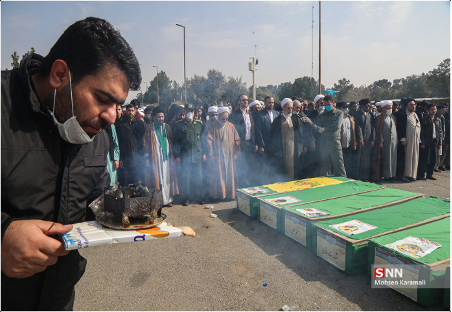
Mourners in Qom attending the funeral ceremony of Zeynabiyoun Brigade fighters in March as news of the COVID-19 pandemic in Iran was spreading. Some of the mourners wear masks.22
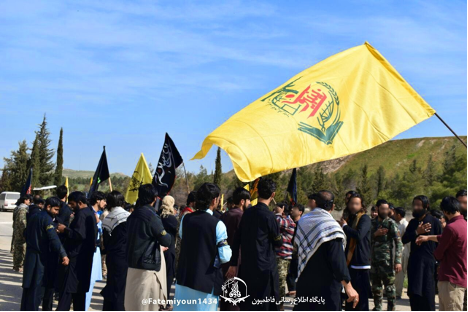
Zeynabiyoun flag hoisted, with the Fatemiyoun in the back, during a mourning ceremony to mark the anniversary of Hazrat-e Zeynab's death in the vicinity of Aleppo, March 2020.23
Building Cultural Influence and Deepening Ties
Two years into Syria’s civil war, building influence among Afghan and Pakistani Shia constituents became a fixation for the IRGC. The formation of the Fatemiyoun Division's Cultural Directorate in 2017 centralized the group's cultural and outreach activities. The Fatemiyoun had cultural bases in Syria that predated the directorate.24 But the directorate’s consolidation represented an effort to bring more coherence to cultural programs such as trainings for clerics, religious ceremonies, and memorials.25
When discussing the directorate's formation, Mojahedi said that "there is no difference between the cultural trench and the front line," because "the enemy in its media war is attacking us in our own backyard."26 He referred to a belief popular with the Supreme Leader and the Guard Corps that the U.S. government is using American cultural products like Hollywood as tools of foreign policy to undermine Iranian religiosity and the Islamic Republic's values.27 Mojahedi also said that the directorate would coordinate cultural activities related to the Fatemiyoun and prevent individuals from taking advantage of the Fatemiyoun's name when they've had no official ties.28
A multi-billion dollar religious foundation has deepened its involvement with the Fatemiyoun. The current Cultural Directorate chief is Hojjat ol-Eslam Hojjat Gonabadinejad, who is also the Director of the Cultural Organization of the Holy Reza Precinct, a multi-billion dollar, Vatican-like institution that oversees the Imam Reza Shrine in Mashhad, and has conglomerates and business interests in industries like pharmacy and agriculture.29 The religious precinct only answers to the Supreme Leader.30 Media sources cited Hojjat Gonabadinejad as the Fatemiyoun Cultural Deputy as early as March 2017.31
The Fatemiyoun referred to Mojahedi as cultural directorate deputy in that year, though Iranian media cited him as cultural affairs director in January 2018.32 Mojahedi left the directorate sometime after that point. The precinct's involvement with the Fatemiyoun grew under the tenure of former trustee Ebrahim Raisi, 2017 presidential candidate whom Khamenei appointed as judiciary branch chief in 2019.33 Raisi has met with families of deceased fighters several times including in his post as judiciary chief.34 Raisi's successor at the Precinct, Hojjat ol-Eslam Ahmad Marvi, has continued meeting with families of "martyrs."35 Since Raisi's tenure, the precinct has increased its involvement with the Fatemiyoun. Its media directorate has helped produce several documentaries about Fatemiyoun fighters.36 The precinct in 2017 handed over 36 housing units at low rent to families of deceased fighters in Baqer Shahr, on the outskirts of the capital Tehran.37 The latter included a workshop to teach tailoring in the "housing-cultural complex," in which there is also a prayer room.38
Although Instagram and Facebook shut down the outlet's official channels, its Telegram channel today has the widest audience. The group continues to have a small presence on Twitter. It also uses Iranian Sorush, which is supposed to be the alternative to Telegram. The center produced at least 30 documentaries, which involve the group's exploits, and profiles of deceased fighters and commanders.39 The first documentaries on the Fatemiyoun were produced by state outlets like the Islamic Revolution Documentary House, which produced a documentary on Tavassoli in the spring of 2015.40 The Fatemiyoun's media center started producing content the following year.41 The 2017 documentary War, Camera, I explored a Fatemiyoun cameraman who said that if there are no cameras to record "the children of Khomeini," then the group would allow others to write its history.42
During a televised panel discussion, Pouriya Najafi, the director of a documentary on the Fatemiyoun called The Commander of Palmyra, praised the Fatemiyoun Media Center for "taking up a weapon in hand" and portraying the "bravery of the shrine defending warriors." In that panel, film critic Ne'matollah Sa'idi said that "he who narrates the war wins the field."43 To fill technical gaps, it produced documentaries with state- and IRGC-linked media shops like Islamic Televisions and Radio Association, Ofogh TV, Cheshmeh Documentary Center, and Haghighat Documentary Center.44
Mysticism and the special relationship between martyrs and God appear as themes in the narratives about Fatemiyoun and Zeynabiyoun. By implementing values such as the desire for martyrdom and piety, a mujahid may develop a closer relationship with the divine. There are numerous accounts of fighters including in the Iran-Iraq War seeing Imams in their dreams, or family members having a premonition that they would achieve martyrdom.45
One example is a video circulated on IRGC-linked news agencies and social media in which slain Fatemiyoun commander Sadrzadeh told the camera, "God willing, I’ll be with Abbas on Tas'ua."46 The interpretation of that video was that he predicted his own death, which is a common story in the narrative about martyrs. Other narratives involve family members having premonitions about his death, often saying that an Imam visited them in a dream.47 Qom Municipality has set up a website for a "virtual pilgrimage" of the graves of fighters buried in Qom's cemetery (See Figure 24).48 In one documentary narrative featured on the site, an Afghan fighter always wanted to visit Karbala to see Imam Hossein's Shrine.49 He died in Syria before he could. His remains were mistakenly sent to Karbala instead of Iran. God fulfilled his wish after he sacrificed his life for the righteous cause.
Screenshot from the website launched by government authorities in the Iranian city of Qom where visitors can conduct a "virtual pilgrimage” to the graves of Afghan and Pakistani fighters buried in Qom's cemetery. The website plays a somber religious song. 50
Like the IRGC, the Fatemiyoun have also fused their activities into a religious-based calendar to sustain their culture and spread their message. The Fatemiyoun also held group activities in Iran and Syria for 24 birthdays and deaths of the Imams. They advertise these events on social media. Pro-IRGC social media accounts, and IRGC-linked news agencies echo Fatemiyoun activities. Events include anniversaries of the death of fighters, the most important of which is Tavassoli's. Other cultural activities included theater and art competitions.51 IRGC Chief Commander Hossein Salami issued a statement on the 2020 anniversary of his death praising Tavassoli and the paramilitary group.52 Shiite religious events are also important ceremonies.
One of the most important ones is Arba'een, or the fortieth day after the death of Imam Husayn, during which millions of Shiites go on pilgrimage to Karbala, with long treks on foot. Along the way, volunteers set up aid stations, known as movakkeb, to give away food and water. Iran has overseen the distribution of propaganda material in these aid stations with the goal of tying the Islamic Republic to Shiism. Similarly, the Fatemiyoun have also set up aid stations for pilgrims at various religious sites, distributing propaganda material and showcasing documentaries about the group and posters to martyrs under Fatemiyoun banners. Other religious and ideological activities sponsored by the Imam Reza shrine in Mashhad and the Hazrat-e Ma'sumeh shrine in Qom include shrine volunteers, known as servants (sing. khadem), visiting the families of fallen Fatemiyoun fighters or distributing aid during the COVID-19 pandemic.53
Flood Relief is Like Defending the Shrine
To boost their image in Iran, the Fatemiyoun have participated in humanitarian aid efforts. In March and April 2019, unprecedented floods struck Iran's northeast and southwest regions.54 Soleimani encouraged the Fatemiyoun to deploy to Iran's southwest to help flooded areas. The Islamic Republic's failure to appropriately respond to the flood raised blistering public criticism.55 Soleimani stepped in, declaring in a statement that he would deploy to help with flood relief efforts in the hard-hit southwest for a month, and called on Guard Corps commanders and veterans to do the same.56
Arriving in Khuzestan, he announced through his social media accounts that helping in flood relief efforts is like "defending a shrine."57 Shortly after, a poster circulated on social media requesting volunteers. That poster was claimed by the Fatemiyoun Division Warriors Committee, a veterans group, and the IRGC Basij Fatemiyoun Division Martyrs Area 6 Meysam, a paramilitary Basij base stationed in Mashhad that named itself after the Fatemiyoun and is active in organizing events for the group.
IRGC-led paramilitary groups deployed to help in flood relief efforts in the southwest, a move that proved controversial in the Iranian public. After reports and footage appeared of Fatemiyoun and Iraqi paramilitary groups helping with flood efforts, many Iranians on social media called it a move to crack down on people fed up with the poor government response. The short documentary From Defense to Aid, released in 2019, chronicles the Fatemiyoun's flood aid effort, pushing back against the perception that the fighters deployed to crack down on Iranians, arguing they did so to demonstrate solidarity.58
The debate came on the heels of a warning by the Tehran Islamic Revolution Court Chief Prosecutor Hojjat ol-Eslam Musa Qazanfarabadi in March 2019 that "if we don't help the revolution, Iraqi Hashd al-Sha'bi [PMF], Afghan Fatemiyoun, Pakistani Zeynabiyoun, and Yemeni Houthis will come and help the revolution."59 He made the remarks at Qom's Ma'sumiyeh Seminary School, a top institution for training clerics who graduate to the Islamic Republic's military and security services. While it stirred controversy on social media, no official rebuked or pushed back against him. His statements followed the 2017-2018 nationwide protests.
During the COVID-19 pandemic, the Fatemiyoun has heavily publicized its aid efforts, both in Iran and Syria. In Iran, it showed volunteers helping disinfect areas, as well as giving aid packages to the families of deceased fighters.60 The group showed a factory in Syria in which fighters produced masks for distribution to Syrians, and said that a number of masks were exported to Afghanistan.61 They called themselves "defenders of health," connecting the anti-COVID-19 effort today to defending the shrine.62 IRGC-linked news agencies and media have reported on these activities in positive terms. The aid efforts have not proven to be as controversial as the deployment during flood relief just a year earlier.
Syria, Afghanistan, and Preparation for War with Israel
Despite the Fatemiyoun's earlier announcement that its military operations were over, the group continues to have a military presence in Syria. It continues to promote fighters stationed in various bases including Aleppo, Deir Ezzor, and Palmyra.63 Fighters frequently hold religious ceremonies and attend addresses at the shrine of Hazrat-e Zeynab. Many demobilized fighters have, nonetheless, returned to Iran and Afghanistan often to communities that are openly hostile to them. Those who have returned to Afghanistan hide in secret amid the fear of prosecution, and remain closeted about their tours of duty in Syria for fear of being cast as profit seeking mercenaries.64 Yet, even in secret, returnees represent a possible reserve force that the IRGC can call up again in the event that Iran enters into a conflict with a major regional rival like Israel. Indeed, Iranian Foreign Minister Javad Zarif suggested in late 2020 that the Fatemiyoun could help Afghan government forces in the future, raising the prospect of a Fatemiyoun deployment post-U.S. withdrawal should Tehran’s ties with the Taliban deteriorate.65
As can be seen from the Fatemiyoun propaganda poster in Figure 25 below, the Guard Corps is drilling the destruction of Israel as an ideological objective into Fatemiyoun fighters. Khamenei, Khomeini, and many officials and commanders consider Israel's existence as fundamentally illegitimate.66 Tehran has incurred significant costs in order to continue supporting Palestinian factions like Hamas. Foreign Minister Mohammad Javad Zarif declared to a gathering of foreign ambassadors in Tehran in 2019 that "we are proud to be pressured for our support to Palestine."67 Khamenei declared in 2015 that Israel would be destroyed by 2040.68
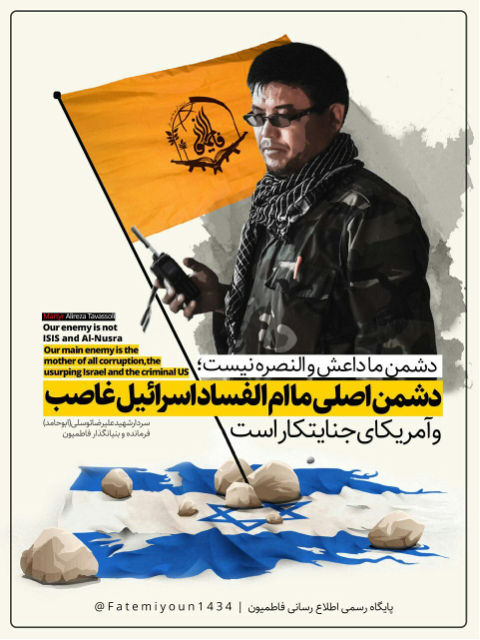
Poster of deceased Fatemiyoun co-founder Alireza Tavassoli, with text in Persian and English that reads: ”Our enemy is not ISIS and al-Nusrah. Our main enemy is the mother of all corruption, the usurper Israel and the criminal U.S.” The poster was distributed on Fatemiyoun's social media channels in May 2020 to mark the anti-Israel Quds Day, held on the last Friday of every Ramadan since 1979.
Many Guard Corps commanders, including those who deployed to Syria, have declared that they expect an eventual war with Israel. In the documentary Time of Being about the Fatemiyoun, the narrator showed footage of Tavassoli overlooking the Golan Heights, promising that the Fatemiyoun would go to fight Israel soon.69 The narrator in the documentary blamed Israel and the United States for stoking war in Syria to "help Israel's security and weaken the resistance," but that "we will not stop until ending the lives of Zionists."
Israel has launched hundreds of airstrikes against Guard Corps positions in Syria in recent years, most of which are not claimed.70 Israel's declared objectives have been to prevent "game changing" Iranian weapons transfers, such as advanced air defense systems.71 A September 2019 Israeli strike on the Fatemiyoun position near Al Bukamal in eastern Syria, for instance, sent a strong message that Israel considered all IRGC positions, including proxy positions, to be fair game for targeting.72 The Fatemiyoun compound would have probably helped consolidate the IRGC's position near the border crossing, which is perceived as constituting the "land corridor." In response to the strike, the Fatemiyoun's Imam Sadeq Division stationed in Palmyra held a drill. Neither the Fatemiyoun nor the IRGC has the means to counter Israeli strikes, and Russia has not intervened to prevent such Israeli strikes. Nor are they able to retaliate in a way that does not invite more strikes. The aim of the drill was to raise morale following strikes for which the group had no answers.
Citations
- "Timeline: the Rise, Spread, and Fall of the Islamic State," The Wilson Center, October 28, 2019. .
- Ibid.
- David Adesnik, Behnam Ben Taleblu, H.R. McMaster, "Burning Bridge: The Iranian Land Corridor to the Mediterranean," Foundation for Defense of Democracies, June 18, 2019. .
- "Gen. Soleimani Congratulates Ayatollah Khamenei and Muslims on ISIS termination," Office for The Preservation and Publication of the Works of Grand Ayatollah Khamene'i, November 21, 2017. .
- Ahmad Majidyar, "After ISIS, Fatemiyoun Vows to Fight with “Axis of Resistance” to Destroy Israel," Middle East Institute, November 22, 2017, ; "بیانیه مهم «لشکر فاطمیون» خطاب به سرلشکر سلیمانی" ("bayani-ye mohemm-e 'lashkar-e fatmiyoun' khatab be sarlashkar soleimani," "Important Statement by 'Fatemiyoun Division' Addressed to Major General Soleimani"), Farda News, November 21, 2017. .
- "نامه فرماندهان و خانواده شهدای زینبیون به سردار سلیمانی" ("name-ye farmandehan-e va khanevade-ye shohada-ye zeynabiyoun be sardar soleimani," "Letter of Zeynabiyoun Commanders and Families of Martyrs to Commander Soleimani"), Jam-e Jam, November 25, 2017. .
- Ahmad Shuja Jamal, "Mission Accomplished? What’s Next for Iran’s Afghan Fighters in Syria," War on the Rocks, February 13, 2018. .
-
“سوریه فداکاریهای گردان فاطمیون را فراموش نخواهد کرد”
(“Syria Will Not Forget The Sacrifices of The Fatemiyoun Battalion”), Astan News, November 23, 2017. ;
“رزمندهای که مبارز میدان «کرونا» شد/ از «فاطمیون» تا «گلشهر»” (“razmandeyi ke mobarez-e meydan-e ‘corona’ shod/ az ‘fatemiyoun’ ta ‘golshahr,’ “The Warrior Who Became Combatant in Field of “Corona”/ From “Fatemiyoun” to “Golshahr”), Mehr News, April 11, 2020. . - Ibid.
- “21 از نیروهای تیپ فاطمیون و زینبیون در ادلب سوریه کشته شدند" (“21 nafar az niruha-ye tipp-e fatemiyoun va zeynabiyoun dar idlib-e suriye koshte shodand," "21 Fatemiyoun and Zeynabiyoun Brigade Forces Killed in Syria's Idlib"), Radio Farda, March 1, 2020. .
- "Eight fighters with Lebanon’s Hezbollah killed in Syria," Associated Press, February 29, 2020. .
- Ibid.; "تحولات جدید در سوریه و لزوم بازگشت به تاکتیکهای حاج قاسم" ("tahavvolat-e jadid dar suriyeh va lozum-e bazgasht be taktikha-ye haj qasem," "New Developments in Syria and The Necessity of Returning to The Tactics of Haj Qasem," Seda-ye Modafe'an, February 29, 2020. .
- "مسئول لشکر فاطمیون در ایران: نیروهای افغان 'دو هزار کشته' دادهاند" ("mas'ul-e lashkar-e fatemiyoun dar iran: niruha-ye afghan 'do hezar koshte' dadehand," "Fatemiyoun Division Official in Iran: Afghan Forces Have Given 'Two Thousand Dead"), BBC Persian, January 16, 2018. .
- "نخستین شهید فاطمیون چه کسی بود؟" ("nokhostin shahid-e fatemiyoun che kasi bud?," "Who Was The First Fatemiyoun Martyr?"), Fash News, September 14, 2019. .
- Alfoneh, "Iranian combat fatalities in Syria since January 2012: IRGC (563); Regular Military: (8). February 2020: 3.” Twitter, February 29, 2020. .
- "IRGC Strategist Hassan Abbasi Praises Iranian Parents Who Handed Over Their Oppositionist Children For Execution: Educating People To This Level Is The Pinnacle Of The Islamic Republic's Achievement; Adds: 2,300 Iranians Have Been Killed In Syria War," Middle East Media Research Institute, March 13, 2019. .
- “بازداشت فرماندهان لشکر زینبیون در قم” (“bazdasht-e farmandehan-e lashkar-e zeynabiyoun dar qom,” “The Arrest of Zeynabiyoun Division Commanders in Qom”) Zeitoons, March 3, 2017. .
- "از زینبیون چه خبر؟" ("az zeynabiyoun che khabar?," "What News of The Zeynabiyoun?"), Seda-ye Modafean, August 14, 2019. .
-
"تشییع و تدفین پیکر 12 شهید مدافع حرم در قم" ("tashi' va tadfin-e peykar-e 12 shahid-e modafe'-e haram dar qom," "Burial of The Remains of 12 Martyred Shrine Defenders in Qom"), SNN, March 1, 2020. . - @Fatemiyoun1434, "دسته عزاداران جبهه مقاومت در سوگ حضرت زینب کبری(س)" ("dast-e azadaran-e jebhe-ye moqavemat dar sowg-e hazart-e zeynab-e kobra (pbuh)," "Mourners of The Resistance Front in Mourning"), Telegram, March 11, 2020. .
- Ali Alfoneh, “Shiite Pakistani combat fatalities in Syria since November 22, 20214: 174. February 2020: 12.,” Twitter, March 1, 2020. .
-
"تشییع و تدفین پیکر 12 شهید مدافع حرم در قم" ("tashi' va tadfin-e peykar-e 12 shahid-e modafe'-e haram dar qom," "Burial of The Remains of 12 Martyred Shrine Defenders in Qom"), SNN, 1 March, 2020. . - @Fatemiyoun1434, "دسته عزاداران جبهه مقاومت در سوگ حضرت زینب کبری(س)" ("dast-e azadaran-e jebhe-ye moqavemat dar sowg-e hazart-e zeynab-e kobra (pbud)," "Mourners of The Resistance Front in Mourning"), Telegram, March 11, 2020. .
- "مستند آخرین فصل زندگی" ("mostanad-e akharin fasl-e zendegi," "Last Chapter of Life Documentary"), Aparat, April 23, 2018. .
- "مسئول هیئت رزمندگان فاطمیون در سوریه چه کسی بود؟+ عکس" ("mas'ul-e hey'at-e razmandegan-e fatemiyoun dar suriyeh che kasi bud? + ax," "Who Was The Head of the Fatemiyoun Warriors Mourning Group in Syria? + Photos"), Rouz News, March 1, 2020. .
- "معاونت فرهنگی فاطمیون : از اقدامات خودسرانه جلوگیری میکنیم" ("mo'avenat-e farhangi-ye fatemiyoun: az eqdamat-e khodsarane jelogiri mikonim," "Fatemiyoun Cultural Directorate: We Will Prevent Unauthorized Actions"), Fatemiyoun, September 19, 2017. .
- Amir Toumaj, "Iran's Economy of Resistance: Implication For Future Sanctions," AEI's Critical Threats Project, 2014, 2.
- "معاونت فرهنگی فاطمیون : از اقدامات خودسرانه جلوگیری میکنیم" ("mo'avenat-e farhangi-ye fatemiyoun: az eqdamat-e khodsarane jelogiri mikonim," "Fatemiyoun Cultural Directorate: We Will Prevent Unauthorized Actions"), Fatemiyoun, September 19, 2017. .
- Mike Saidi, "Supreme Leadership, Economics, and Clout in Iran," AEI's Critical Threats Project, June 17, 2019. .
- Ibdi.
- "ابوحامد و فاتح، زینت بخش محفل یادواره شهدای لشگر فاطمیون هستند" ("abu hamed va fateh, zeynat bakhsh-e mahfel-e yadvare-ye shohada-ye lashkar-e fatemiyoun hastand," "Abu Hamed and Fateh Decorate The Circle of Fatemiyoun Division Martyrs"), Mehr News, March 1, 2017. .
-
"معاونت فرهنگی فاطمیون : از اقدامات خودسرانه جلوگیری میکنیم"
("mo'avenat-e farhangi-ye fatemiyoun: az eqdamat-e khodsarane jelogiri mikonim," "Fatemiyoun Cultural Directorate: We Will Prevent Unauthorized Actions"), Fatemiyoun, September 19, 2017. ;
"مسئول لشکر فاطمیون در ایران: نیروهای افغان 'دو هزار کشته' دادهاند" ("mas'ul-e lashkar-e fatemiyoun dar iran: niruha-ye afghan 'do hezar koshte' dadehand," "Fatemiyoun Division Official in Iran: Afghan Forces Have Given 'Two Thousand Dead"), BBC Persian, January 16, 2018. . - "Ebrahim Raisi Appointed Judiciary Chief," United States Institute of Peace, March 8, 2019. .
- Fatemiyoun1434, "آخرین شب از اجتماع بزرگ وارثان ولایت برگزار شد" ("akharin shab az ejtema'-e bozorg-e varesan-e velayat bargozar shod," "The Last Night of the Great Gathering of The Inheritors of Guardianship Was Held"), Telegram, October 16, 2018. ; "جهلزدایی از منطقه و جهان از برکات خون شهدای مدافع حرم است" ("jahl-zodayi az mantaqeh va jahan az barakat-e khun-e shohada-ye modafe'-e haram as," "Eliminating Ignorance From The Region and The World is One of The Blessings of The Blood of Martyred Shrine Defenders"), Islamic Azad University News Agency, January 23, 2020. .
- Hamid Farshbaf, "دیدار جمعی از علما، اساتید، نخبگان و فعالان فرهنگی افغانستان با تولیت آستان قدس رضوی" ("didar-e jam'-i az olama, asatid, nokhbegan va fa'alan-e farhangi-ye afghanestan ba towliat-e astan-e qods-e razavi," "The Meeting of a Gathering of Afghan Scholars, Teachers, Intellectuals, and Cultural Activists With The Trustee of The Reza Holy Precinct"), Reza Holy Precinct. .
- “مستند آقا سلمان (شهید محمد حسینی)” (“mostanad-e aqa salman,” “Mr. Salman Documentary (Martyr Mohammad Hosseini)”), Aparat, December 3, 2018. ; “مستند حبیب (شهید محمد اسحاق نادری)” (“mostanad-e habib (shahid mohammad es’haq naderi,” “Habib Documentary (Martyr Mohammad Es’haq Naderi”), Aparat, December 28, 2018. .
- "تحویل واحدهای مسکونی آستان قدس رضوی به خانواده شهدای لشکر فاطمیون + گزارش تصویری" ("tahvil-e vahedha-ye maskuni-ye astan-e qod-se razavi be khanevadeh-ye shohada-ye lashkar-e fatemiyoun + gozaresh-e tasviri," "Handing Over Housing Units of Reza Holy Precinct to The Families of Martyred Shrine Defenders"), Ghased News, February 28, 2017. . Archived at: .
- "اولین کارگاه مشاغل خانگی ویژه خانواده شهدای فاطمیون افتتاح میشود" ("avvalin kargah-e mashaghel-e khanegi-ye vizhe-ye khanevadeh-ye shohada-ye fatemiyoun eftetah mishavad," "The First House Works Worskhop Dedicated to Families of Martyred Fatemiyoun Will be Inaugurated"), Bagher Shahr News, July 1, 2017. .
- @Fatemiyoun1434, “ مستند پیشنهادی از تولیدات مرکز رسانه فاطمیون" (“30 mostanad-e pishnehadi az tolidat-e makaz-e rasane-ye fatemiyoun,” “30 Suggested Documentary Productions From The Fatemiyoun Media Center,” March 13, 2020. .
- "مستند بسیار زیبای فاتحان فردا/رشادت بی نظیر مدافعان حرم" ("mostana-e besiar ziba-ye fatehan-e farad/reshadat-e bi nazir-e modafe'an-e haram," "The Very Beautiful Documentary Conquerors of Tomorrow/Unparalleled Bravery of Shrine Defenders"), Aparat, September 7, 2015. .
- "جنگ، دوربین، من" ("jang, durbin, man, "War, Camera, I"), Tebyan, November 25, 2017. .
- Ibid.
- "سعیدی : کسی که جنگ را روایت میکند پیروز میدان است" ("Sa'idi: kasi ke jang ra vevayat mikonad piruz-e meydan ast," "Sa'idi: He Who Narrates The War Wins The Field"), Ammar Film, September 22, 2019. .
- "جنگ، دوربین، من" ("jang, durbin, man, "War, Camera, I"), Tebyan, November 25, 2017. ; Fatemiyoun1434, "کلیپ اختصاصی | صد حیف که نتوانستیم ابعاد وجودی #ابوحامد را بیشتر درک کنیم" ("clip-e ekhtesasi | sad heyf ke natavanestim ab'ad-e vojudi-ye #abuhamed ra bishtar dark konim," "Exclusive Clip | So Unfortunate That We Were Unable To Understand #AbuHamed's Character More"), Telegram, February 28, 2020.
- “Greetings Upon Ebrahim,” 109.
- Fatemiyoun Media Center Official Channel, “ایشالا تاسوعا پیش عباسم – شهید مصطفی صدرزاده” (“ishallah tasu’a pish-e abbasam – shahid mostafa sadrzadeh,” “God Willing I’ll be With Abbas on Tas’ua – Martyr Mosfata Sadrzadeh”) , Aparat video, 1:41, September 19, 2018. .
- "مادرم خواب زینب (س) را که دید، گفت: "پسرم عاقبت به خیر شد” (“madaram khab-e zeynab (s) ra ke did, goft: ‘pesaram aqebat be kheyr shod,” “When My Mother Saw Zeynab (pbuh) in a Dream, She Said: ‘My Son Faced a Good Destiny”), Tasnim News, December 14, 2015. .
- “Visual Pilgrimage of Unknown Martyrs and Martyrs of Shrine Defenders; Behesht-e Ma’sumeh Cemetary; Qom Province Municipality,” Azm Ziarat, accessed 8 May, 2020. .
- “روایت ابوذر بیوکافی از کربلایی شدن شهید فاطمیون+فیلم” (“revayat-e abuzar bivkafi az karbala’i shodan-e shahid-e fatemiyoun+film,” “Abuzar Bivkafi’s Account of a Fatemiyoun Martyr Going to Karbala+Film”), Tasnim News, November 15, 2019. .
- “Visual Pilgrimage of Unknown Martyrs and Martyrs of Shrine Defenders; Behesht-e Ma’sumeh Cemetary; Qom Province Municipality,” Azm Ziarat, accessed May 8, 2020. .
- “نخستین کنگره بزرگداشت شهدای جبهه مقاومت در قم آغاز شد” (“nokhostin kongere-ye bozorgdasht-e shohada-ye jebhe-ye moqavemat dar qom aghaz shod,” “The First Congress To Commemorate Martyrs of Resistance Front in Qom Began”), Haraa, January 12, 2019. .
- “پیام فرمانده کل سپاه به همسر فرمانده فاطمیون” (“payam-e farmande-ye koll-e sepah be hamsar-e farmande-ye fatemiyoun,” “The Message of the IRGC Chief to The Spouse of Fatemiyoun Commander”), Khabar Online, February 27, 2020. .
- “دیدار خادمیاران رضوی با خانواده شهدای تیپ فاطمیون” (“didar-e khademin-e razavi ba khanevade-ye shohada-ye tipp-e fatemiyoun,” “Meeting of Razavi Servants With The Families of Fatemiyoun Brigade Martyrs”), Astan News, September 8, 2019. .
- “Southwest Iran hit hard by flooding, evacuation underway in Ahvaz,” Reuters, April 10, 2019. .
- “Iranian Officials Criticized As Severe Flooding Wreaks Havoc,” RadioFreeEurope/RadioLiberty, April 3, 2019. .
- "سردار سلیمانی به مدت یک ماه به مناطق سیل زده میرود” (“sardar soleimani be moddat-e yek mah be manateq-e seyl zadeh miravad,” “Commander Soleimani Will Go To Flooded Areas For a Month”), International Quran News Agency, April 5, 2019. .
- “پیام ویژه سردار سلیمانی به مشتاقان دفاع از حرم” (“payam-e vizhe-ye sardar soleimani be moshtaqan-e modafean az haram,” “Special Message of Commander Soleimani to Those Excited To Defend Shrine”), Al-Alam, .
- Fatemiyoun Media Center Official Channel, “از دفاع تا امداد | مستند حضور فاطمیون در مناطق سیل زده” (“az defa’ ta emdad | mostanad-e hozur-e fatemiyoun dar manateq-e seyl zadeh,” “From Defense to Aid | Documentary on Presence of Fatemiyoun in Flood-Stricken Areas”), Aparat video, 11:06, May 14, 2019. .
- Amir Toumaj, “Senior Iranian official: foreign Shiite militias to fight in Iran if Islamic Republic in danger,” FDD’s Long War Journal, March 8, 2019. .
- "کمک به قطع زنجیره سرایت کرونا توسط نخبههای فاطمیون+فیلم" (“komak be qat-e zanjireh-ye serayat-e corona tavassot-e nokhbegan-e fatemiyoun+film,” “Helping Cut Chain of Corona’s Spread by Fatemiyoun Elite+Footage”), Tasnim News, July 25, 2020. .
- "تولید و توزیع ماسک فاطمیون برای مردم سوریه+ فیلم” (“tolid va tozi-e mask-e fatemiyoun bara-ye mardom-e suriyeh,” “Production and Distribution of Fatemiyoun Mask For The Syrian People+Footage”), Tasnim News, April 7, 2020, ; “نیروهای فاطمیون در بحران «کرونا» آستین همت بالا زدهاند” (“niruha-ye fatemiyoun dar bohran-e ‘corona’ astin-e hemmat bala zadand,” “Fatemiyoun Forces Got To Work During The ‘Corona’ Crisis”), Fars News, May 9, 2020, .
- "'فاطمیون'؛ مدافعان حرمی که 'مدافعان سلامت' شدند + تصاویر" (“’Fatemiyoun’: modafe’an-e harami ke ‘modafe’ean-e salamt’ shodand + tasavir,” “’Fatemiyoun’; Shrine Defenders Who Became ‘Defenders of Health’ + Footage,”) .
- Amir Toumaj, “IRGC-led Afghan group releases Syria training camp video,” FDD’s Long War Journal, August 15, 2020, ; “برپایی دورههای آموزشی ویژه رزمندگان فاطمیون در سوریه+ تصاویر” (“barpayi-e doreha-ye amuzeshi-e vizhe-e razmandegan-e fatemiyoun dar suriyeh + tasavir,” “Special Training Courses For Fatemiyoun Warriors in Syria + Images”), Defa Press, November 15, 2020. .
- Jamal, “The Fatemiyoun Army,” 19.
- Tamim Hamid, “Armed by Iran, 2,000 Afghans Still in Syria: Zarif,” Tolo News, December 22, 2020. .
- Ehud Yaari, “How Iran Plans To Destroy Israel,” The American Interest, August 1, 2015,
- “افتخار میکنیم به خاطر فلسطین تحت فشار هستیم” (“eftekhar mikonim be khater-e felestin taht-e feshar hastim,” “We Are Proud To be Pressured Because of Palestine”), Jahan News, February 13, 2019. .
- Elliott McLaughlin, “Iran's supreme leader: There will be no such thing as Israel in 25 years,” CNN, September 11, 2015. .
- "مستند وقت بودن" ("mostanad-e vaqt-e budan," "Time of Being Documentary"), Aparat, 2019. .
- Yaniv Kubovich, “Israel Attacked 1,000 Iranian and Hezbollah Targets in Syria Since 2017,” Haaretz, August 13, 2020. .
- Judah Ari Gross, “Netanyahu: Israel acts to keep game-changing arms away from Hezbollah,” Times of Israel, January 9, 2018. ; Suleiman al-Khalidi, “Israel launches major air strikes on Iran-linked targets in Syria,” Reuters, January 12, 2021,..
- "حمله موشکی رژیم صهیونیستی به مقر فاطمیون در البوکمال+عکس” (“hamle-ye mushaki-ye rezhim-e sahynist-i be maqarr-e fatemiyoun dar albu kamal + aks,” “Zionist Regime Missile Attack Against Fatemiyoun Position in Al Bukamal + Photo”), Khabari, September 15, 2019. ; Felicia Schwartz &ÌýNazih Osseiran, “Israel Strikes Iran-Related Targets in Syria,” Wall Street Journal, January 13, 2021. .
Conclusion: Soleimani’s Legacy and What it Means for the Future of Proxy Warfare
Paramilitary groups like the Fatemiyoun have sought to stress that they could continue the path of Soleimani's legend following his death. The Fatemiyoun and the Islamic Republic have stressed the bond between Fatemiyoun and Soleimani, affectionately known as the "commander of hearts," because of his perceived ability to win over hearts and minds.1
Yet, Soleimani as a cultural and political icon is irreplaceable. The circumstances that led to his legend, starting from the Iraq war, Syria, and the war in Iraq against the Islamic State cannot be replicated. This helps explain why Islamic Republic officials have sought to reassure their followers and warn adversaries that the Quds Force would continue in Soleimani's path.2 In the order appointing former Deputy Commander Esmail Ghaani as the force chief, Khamenei declared that Soleimani's path must proceed.3 While the Islamic Republic and its myriad factions and organizations have wrangled over Soleimani's legacy, there was a general consensus within the system about how to respond to Soleimani's death, a term coined harsh revenge.4
Leading up to and after Iran’s retaliatory missile strike against U.S. forces in Iraq, IRGC commanders and officials gave different ideas of how to fulfill that revenge, such as a sustained asymmetric campaign against U.S. forces in the Middle East. Eventually, Tehran agreed on launching missile launches against U.S. forces in Iraq's Ayn al-Assad, which resulted in no fatalities but dozens of traumatic brain injuries. Iranian propaganda said that dozens and even over a hundred U.S. forces were killed.5 That was meant to provide cover for an option that, at least compared to other options, minimized the risk of U.S. retaliation while saving face.
Sometime after Soleimani's death, the unnamed commander of the Fatemiyoun defined what it means for the Fatemiyoun to continue Soleimani’s path. Speaking at a commemoration ceremony in Kerman, Iran, the commander called the formations of paramilitary groups Soleimani's largest legacy, and that he left the groups' management to the people.6 The commander said that Soleimani, on the day of his death, convened a meeting in Syria in which he invited the leaders of IRGC-led groups there. He laid out a five-year plan for the Fatemiyoun, that "may be his last will," but the Fatemiyoun commander did not discuss the details of that. The commander also said that the Fatemiyoun would exact vengeance by driving the United States from areas like Afghanistan. While that was probably posturing for the moment and the United States will exit Afghanistan in 2021, it does underscore the probability of Fatemiyoun deployment into Afghanistan.
The Fatemiyoun's commemoration of Soleimani has reflected that of the Islamic Republic and other paramilitary groups, projecting a narrative that Soleimani led a unified transnational Shiite-Islamist force. At the same time, Soleimani and Fatemiyoun had a strong bond. The group and Iranian officials have credited Soleimani with establishing the group and forming a strong bond with fighters. Ali Shirazi, the Supreme Leader's representative to the Quds Force who also acts as the force's chief ideologue, said during an interview that Soleimani loved the Fatemiyoun and other groups.7
The Fatemiyoun have participated in major ceremonies commemorating Soleimani, for instance, a prayer station near Khomeyni's Mausoleum in Tehran on the 40th day of Soleimani's death, which in Shiism is a significant milestone.8 The Fatemiyoun said that the station was reminiscent of prayer stations held during Ashura ceremonies, further stressing the spiritual and religious nature of the event. He then said that Soleimani's formation of the Fatmeiyoun drove a cultural shift in Iranian society, improving the "dignity" of Afghans in their eyes.
Since Soleimani's death, the Fatemiyoun have reiterated their oaths to the revolution, participated in a revolution anniversary march, and reiterated their commitments to fighting Israel. The new IRGC chief commander Hossein Salami has paid attention to the Fatemiyoun, releasing a statement addressed to the group on the anniversary of the death of Tavassoli in February 2020.9 IRGC Khatam ol-Anbiya Construction Base, the Guard's engineering arm, has announced the construction of a tailoring factory to help create jobs for the Fatemiyoun’s families.10
The recruitment and deployment of thousands of Afghan paramilitaries at the knife’s edge of Iran’s proxy wars by the Islamic Revolutionary Guard Corps (IRGC) represents a watershed moment in the evolution of Tehran’s information warfare capabilities. Fatemiyoun fighters were the first forces to be deployed by Tehran at the peak of the age of militarized online astroturfing, and the IRGC has accordingly used social media to build and grow the Fatemiyoun brand online. Along the way, Iranian-financed propaganda about Afghan foreign fighters in Syria and Tehran’s support to Fatemiyoun’s media center and cultural affairs unit has played a vital role in making the IRGC’s proxy strategy a success. The Iranian support for the units’ media production illustrates the increased Iranian reliance upon and use of strategic narratives that bind together transnational mobilizations in the wake of the Arab Spring. How these narratives will figure in future iterations of Iran’s proxy warfare calculations is anybody’s guess, but there can be no doubt that keeping an eye on Fatemiyoun’s media channels will be a must for understanding where escalation risks may come up next.
Citations
- “چرا حاج قاسم را سردار دل ها می نامند؟” (“chera haj qasem ra sardar-e delha minamand,” “Why Do They Call Haj Qassem The Commander of Hearts”), Defa Press, June 2, 2016. .
- “انتصاب سردار سرتیپ قاآنی به فرماندهی نیرو قدس سپاه پاسداران انقلاب اسلامی” (“entesab-e sardar sartip qa’ani be farmandehi-ye niru-ye qods-e sepah-e pasdaran-e enqelab-e eslami,” “Appointment of Commander Brigadier General Qa’ani to Command of Islamic Revolution Guard Corps Quds Force”), Office for the Preservation and Publication of the Works of Grand Ayatollah °³¾±ð²Աð’i, January 3, 2020. .
- “انتصاب سردار سرتیپ قاآنی به فرماندهی نیرو قدس سپاه پاسداران انقلاب اسلامی” (“entesab-e sardar sartip qa’ani be farmandehi-ye niru-ye qods-e sepah-e pasdaran-e enqelab-e eslami,” “Appointment of Commander Brigadier General Qa’ani to Command of Islamic Revolution Guard Corps Quds Force”), Office for the Preservation and Publication of the Works of Grand Ayatollah °³¾±ð²Աð’i, January 3, 2020. .
- Alexander Smith, “Iran vows revenge and 'harsh retaliation' after U.S. kills its top general,” NBC News, January 3, 2020. .
- “Iranian state TV says 80 'American terrorists' killed in Iran missile strikes,” Reuters, January 8, 2020. ; “کشته شدن بیش از ۱۰۰ نظامی آمریکایی در حمله موشکی ایران به پایگاه عینالاسد” (“koshte shodan-e bish az 100 nezami amrika-yi da hamle-ye mushaki-ye iran be paygah-e ayn al-asad,” “More Than 100 American Military Personnel Killed in Iran’s Missile Strike on Ayn al-Asad Base”), Hamshahri Online, January 18, 2020. .
- “فرمانده یگان فاطمیون: حاج قاسم در آخرین دیدار برنامه مدون ۵ ساله تیپ فاطمیون را دادند” (“farmande-ye yegan-e fatemiyoun” haj qasem dar akharin didar barname-ye modavvan-e 5 sale-ye tipp-e fatemiyoun ra dadan,” “Fatemiyoun Unit Commander: Haj Qasem Gave 5-Year Plan To Fatemiyoun Brigade in Last Meeting”), Tasnim News, January 15, 2020. .
- “مصاحبه نماینده رهبری در نیروی قدس سپاه با وبگاه لبنانی؛ تأکید بر حمایت از مقاومت تا آزادی قدس” (“mosahebe-ye namayande-ye rahbari dar niru-ye qods ba vebgah-e lobnani; ta’keed bar hemayat az moqavemat ta azadi-ye qods,” “Leader’s Representative Speaking With Lebanese Website; Emphasis on Supporting Resistance Until Jerusalem’s Liberation”), Al-Alam, May 21, 2020. .
- “حضور موکبهای اربعین حسینی و لشکر «فاطمیون» در مراسم چهلم شهادت حاج قاسم سلیمانی + تصاویر” (“hozur-e movakkebha-ye arba’een-e hoseini va lashkar-e ‘fatemiyoun’ dar marasem-e chehellom-e shahadat-e haj qasem-e soleimani + tasavir,” “’Fatemiyoun’ Division and Hossein-Like Aid Stations at Fortieth Ceremony To Commemorate Haj Qasem Soleimani + Footage”), Defa Press, February 13, 2020. .
- “پیام فرمانده کل سپاه به همسر فرمانده فاطمیون” (“payam-e farmande-ye koll-e sepah be hamsar-e farmande-ye fatemiyoun,” “Message of IRGC Chief Commander To Spouse of Fatemiyoun Commander”), Khabar Online, February 27, 2020. .
- “اشتغالزایی قرارگاه خاتم برای خانوادههای شهدای فاطمیون” (“eshteghalzodayi-e qarargah-e khatam baray-e khanevadeha-ye shohada-ye fatmeiyoun,” “Khatam ol-Anbiya Creating Jobs For Families of Martyred Fatemiyoun”), Fars News, November 29, 2019. .
Appendix I-Timeline: The Rise of Iran’s Afghan Shia Cadres
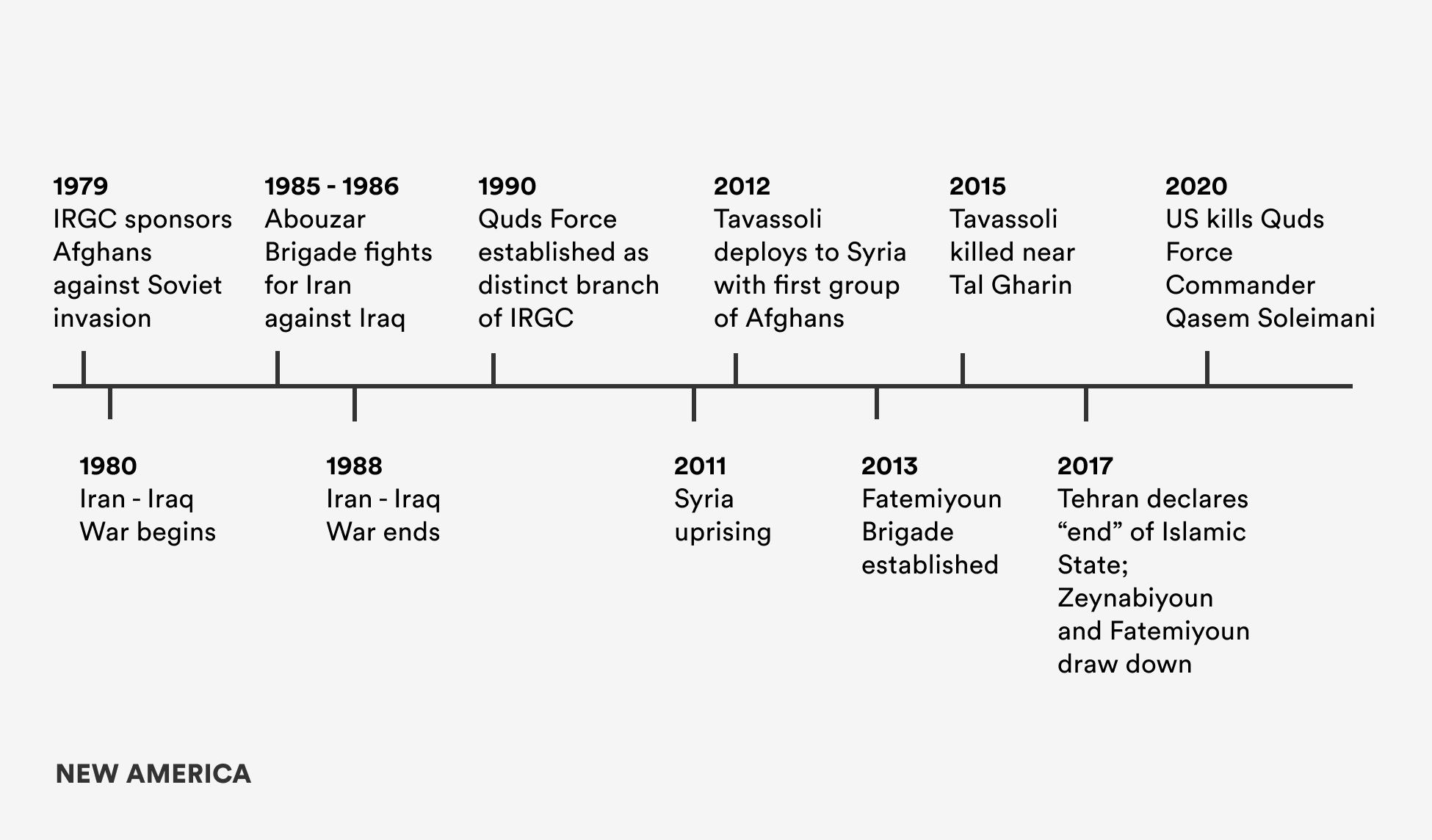
Appendix II-Prominent Fatemiyoun Propaganda Organizations and Groups
@Fatemiyoun1434 (Telegram channel, 9,000 followers)
Al Waght
Arsh Cultural Institution
Ava Studio
Cheshmeh Documentation Center
Dar Masir-e Aftab
Fars News
Fatemiyoun Media Center
Haghighat Media Center
Harim-e Haram
Islamic Republic of Iran Broadcasting (IRIB) Basij Center
Islamic Televisions and Radio Union (state-linked, sanctioned by the U.S. in 2020)
Mashregh News
Meyghat Radio
Ofogh TV
Oveys News Agency
Revayat-e Fath Documentary Group
Reza Holy Precinct
Rouyeh Documentary Center
Tasnim News
Ya Zahra Publications
- Executive Summary
- I. Introduction
- II. The Origins of Iran’s Afghan and Pakistani Shi’a Networks
- III. Crossroads in Khuzestan: Afghan Shi’a Mobilization During the Iran-Iraq War
- IV. The Arab Spring: A New Phase of Iranian Proxy Warfare Strategy
- V. Keeping the Faith in Sacred Defense
- VI. Spinning the Fatemiyoun: Raising an Army of Disposable Afghan Diaspora Online
- VII. The Future of the Fatemiyoun Division
- Conclusion: Soleimani’s Legacy and What it Means for the Future of Proxy Warfare
- Appendix I-Timeline: The Rise of Iran’s Afghan Shia Cadres
- Appendix II-Prominent Fatemiyoun Propaganda Organizations and Groups
More Â鶹¹û¶³´«ý the Authors
Issues
Programs/Projects/Initiatives
Related