Allison Comport
Senior Consultant, Child Care and Early Education, Public Consulting Group
How do states account for the true costs of early intervention and early childhood special education in their child care systems?

If you鈥檝e ever wondered why early childhood programs struggle to hire staff, expand access, or support children with diverse needs, the answer often comes down to one thing: understanding the true cost of care. An early childhood cost model is a tool or framework used to estimate the true cost of delivering early care and education services. When applied to children with disabilities and developmental delays across early intervention (EI) and (ECSE), these models can inform key policy decisions and funding allocations. The different factors that affect the cost of providing services, such as staffing, classroom size, materials, and the level of support each child needs, are increasingly important as cost modeling is gaining momentum as an approach to rate setting across the country. With accurate cost models, states can better understand what it truly takes to fund early childhood systems, forecasting workforce needs, setting competitive wages, designing sustainable inclusion funding, and coordinating services across early childhood and disability systems.
Cost models for children with disabilities give legislators clear, defensible numbers to guide appropriations and long-term planning. They inform subsidy and preschool rate-setting that covers actual service delivery; to support highly specialized educators and therapists; aligned with IDEA mandates; and expansion by estimating the true cost of inclusion supports.
Cost models聽have the potential to聽support equity and inclusion. Children with disabilities face persistent disparities in educational access and quality compared to children without disabilities.聽Explicitly聽including special education聽variables and associated聽 improves the accuracy of funding models aimed at closing inequities.聽Cost modeling can make clear to legislators聽and policy makers聽where disparities lie, and how extensive they might be.
State and local leaders are increasingly recognizing how essential special education inclusion costs are in early childhood in order to ensure accurate planning for long-term system stability.聽 It has become a priority as states expand mixed鈥慸elivery pre鈥慿 that aligns with IDEA requirements, and build more accurate financing systems. Inclusive preschool, where children with and without disabilities learn together, stronger developmental and social outcomes, which can reduce later, more costly interventions. Studies show that inclusive preschool models often cost the than traditional, segregated special education programs when measured annually or per instructional hour. This provides an opportunity for cost models to incorporate real-world data demonstrating that inclusion is not inherently more expensive.
Cost models that ignore inclusion risk underfunding states鈥� ability to meet this legal obligation. Many states report that current ECSE funding formulas do not reflect actual program costs, especially for inclusive placements. When models exclude the true cost of inclusion (e.g., incorporating therapies, staff time, planning time, accessible materials), states risk funding at levels that fail to reflect , leading to limited access and ongoing challenges for providers and families. Examples include classrooms that are understaffed to meet the individualized needs of children with disabilities in their classrooms, programs that turn children with disabilities and their families away, and classrooms that lack appropriate materials to ensure quality care and learning experiences for children.
Cost models help states plan for the costs associated with specialized, legally mandated services for children with disabilities that can be intensive, individualized, and expensive to deliver. With accurate cost models, state leaders can improve policy decisions, classroom quality, and equitable access, and identify where inequitable access is tied to funding levels, workforce shortages, or outdated rate structures. For instance, incorporating market wage data can address staffing shortages and improve the recruitment and retention of qualified staff. Information about where children with disabilities are currently served, existing service options, and capacity constraints (e.g., shortage of inclusive classrooms or qualified staff) can inform resource allocation, target investments to areas of greatest need, and guide decisions about expanding inclusive capacity.
States increasingly rely upon cost models to achieve the following:
Cost models for inclusive early care and education settings often calculate the following:
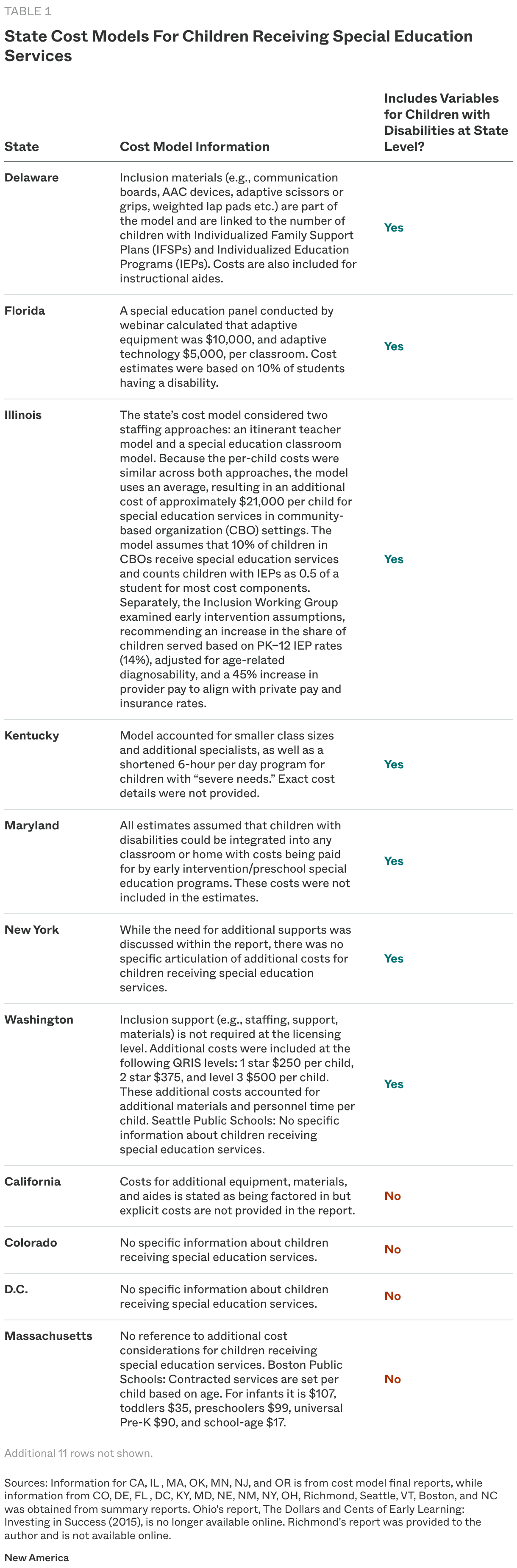
However, as evidenced by the table below, the degree to which states and localities include the various costs associated with special education services and make this information transparent within their model and model reports is highly variable.
A final reports and summary reports conducted between summer 2024 and spring 2025 found that there were widely varying approaches to how services for children receiving special education and related services were estimated within models. Some models included no costs for these children or no mention of how these services were incorporated into the calculation. Nine models included variables for children with disabilities.
鈥檚 ECSE funding redesign, for example, was driven by provider dissatisfaction with outdated formulas that did not reflect the real cost of providing services. Cost modeling enabled the state to design a funding approach grounded in actual service delivery needs and to redesign the state鈥檚 ECSE funding formula. Major cost drivers included:
‘听2025 cost model identified what it would take to expand EI provider supply, given rising caseloads and workforce shortages. The model examined 16 federally required EI services and quantified workforce and access challenges that have grown since 2018.
Cities and states have a clear opportunity, and responsibility, to invest in cost models that reflect the true cost of delivering high-quality, inclusive early childhood services for children with disabilities. By doing so, they can move beyond underfunded systems and take actionable steps to expand access, strengthen the workforce, and better serve young children. The question is no longer whether cost modeling matters, but whether states will act on the data to build systems that truly meet children鈥檚 needs.
Senior Consultant, Child Care and Early Education, Public Consulting Group