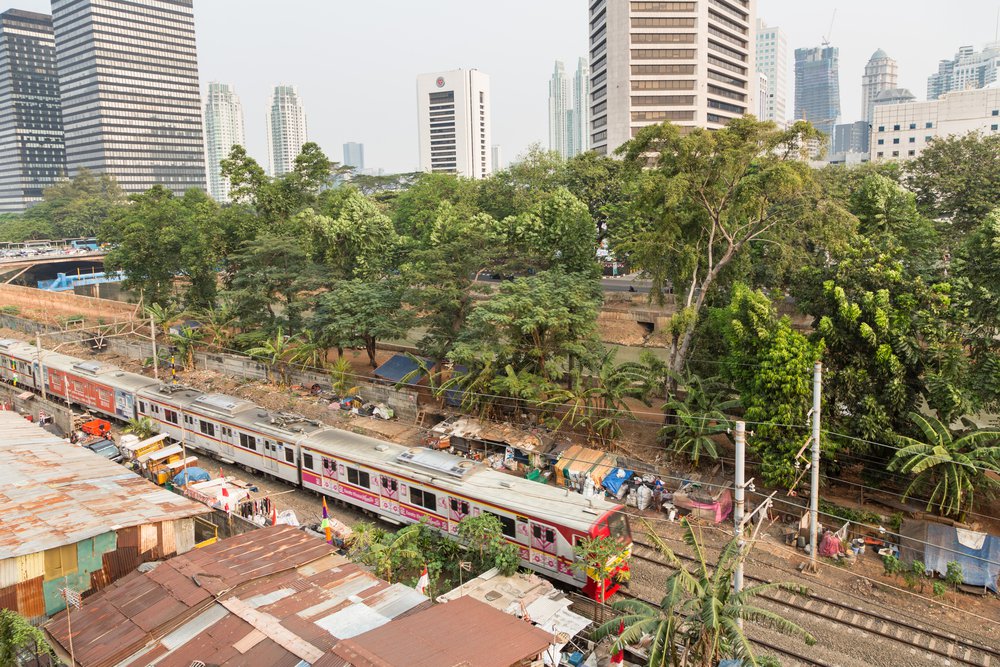
Property rights – the clear articulation of who has what rights to which property –聽are indispensable for prosperous societies. Throughout history, the implementation of property rights formalization has led to increased economic prosperity, security, societal resilience and environmental protection. While not a panacea for every development challenge, property rights formalization, when implemented appropriately, bolsters human prosperity in many forms.
The first step toward prosperity is security. If an individual or family enjoys formal claim to their land which is protected by the rule of law, then they don鈥檛 have to guard it physically. While it may seem unthinkable to leave one鈥檚 home to return and find it razed or occupied, that is often a reality for of the world鈥檚 citizens who reside in a property to which they have no formal claim. Being tethered to property means the property owner must make a living within proximity to his or her property, leaving little room to enter the formal economy. Secure property rights allow landowners to travel from their land for employment, and to let their land work for them.
Property rights formalization is, appropriately, often linked with economic prosperity. 聽Having a formal claim to one鈥檚 property — whether it be land or a home — allows that individual to benefit economically in three ways. 聽First, she or he can monetize the asset via a sale. 聽Second, she or he can move from one location to another to pursue employment opportunities, instead of being bound to an informal asset. 聽Third, she or he can raise capital, at reasonable rates, by having collateral. Having a formal claim to property also incentivizes the owner to invest in the property, confident that they will be able to capture the investment via sale or rental.
Here is an example from Landesa鈥檚 work in India:
Property rights have a direct impact on agriculture & food security. When subsistence farmers have a formal claim to their land, they are more likely to invest in it with sweat equity, by installing irrigation systems and using higher quality seeds. There is a growing body of evidence of the direct positive impacts of land rights on food security, with significant findings like how "in Ethiopia, land certification led to in the Tigray Region." 聽When locals farmers demonstrate they see value by investing scarce resources in land formalization it is clearer that we are on the right track. 聽This is exactly what was seen in Ghana where there are formalization services聽available聽for a modest fee and聽. 聽When claim to the land is in question, however, farmers often turn to the 鈥溾�� technique, which has contributed to widespread deforestation and pollution.聽
Property rights formalization is linked to other environmental benefits as well. When individuals and communities have formal property rights, they are more likely to look after their land. One example from Indonesia illustrates this. 聽When to villagers in Indonesia鈥檚 Sembungan region. Deep in the rainforest, villagers immediately worked to protect their recently titled property. Like many areas of Indonesia, the Sembungan region was the victim of deforestation. In 2008, Sembungan villagers started a reforestation program to preserve and restore the forest. As of 2011, they have operated their ecotourism sites with many villagers working as tour guides. The region鈥檚 ecotourism is registered under Indonesia鈥檚 Ministry of Laws and Human Rights and has .
Property rights formalization acts to make communities more resilient. 聽聽Formal property rights are both prevention and cure regarding crises. 聽With rights formalized, communities can more easily recover when things go wrong. Whether it be forced displacement, a natural disaster or war, formal property rights are integral to community recovery. Consider Haiti after the 2010 earthquake ravaged the nation. Here a calamity and weak land tenure system to the detriment of the people of Haiti. 聽聽Thousands of people were displaced as the disaster destroyed their homes. Many of the displaced had no formal rights to their property, which allowed developers to seize the property, leaving as of 2015. Five years after Katrina in New Orleans, by way of comparison, the cadastral maps remained the most sought after documents as recovery efforts continued.
The absence of formal property rights can lead to violence. According to the NGO Global Witness, more than defending property from encroaching industries. Frequently, this is聽because of聽property granted to commercial investors is already occupied or in use. A stark example of this has been seen recently in India, where large public infrastructure projects displace millions of people. . 聽Formal property rights would have increased the chances of thousands of displaced and threatened people to either reclaim their property or聽receive聽appropriate compensation. 聽Displacement as a result of infrastructure disproportionately affects marginalized communities. 聽Part of that聽marginalization is weak property rights, another example from North America is the .
Property rights are a critical tool for women's empowerment. 聽There are a showing how land rights have a positive impact on women. 聽One recent publication based on stated that in Tanzania, "women with strong land rights were 3 times more likely to work off-farm, earned up to 3.8 times more income, and were 1.35 times more likely to have individual savings." 聽 As the issue of gender receives increasing attention in the development community, expect land rights to emerge as a powerful tool for empowering women.
The international community is increasingly recognizing the importance of property rights formalization. The United Nations鈥� Sustainable Development Goals, announced in 2015, explicitly address land in of the 17 listed . 聽Land issues are increasingly arising in development literature and .
While the benefits of property rights formalization are numerous, it is not a societal panacea. While the aforementioned benefits can all be achieved through property rights formalization, reforms must be thoughtful. 聽Do the reforms make sense in the context of the cultural norms and customs of the area in question? 聽With that said, are the customs in place all desirable? 聽For instance, are there gender inequities that can be addressed by selectively establishing new norms? 聽Is what is being formalized likely to strengthen society or seed conflict? Mindful of these concerns, property rights formalization remains an important goal which will lead to more prosperous societies.
For more perspectives on the importance of land rights, see these articles/infographics from , , , , ,听, devex "" & .
More 麻豆果冻传媒 the Authors
Patrick Kelley
Issues
Programs/Projects/Initiatives
Topics
Related

Principles of Identity: An FPR Synthesis

Update: Mapping the Property Rights Community
Help Us Map the Property Rights Community