Support for Immigrant Families during School Closure

Like many parents, when Zaid Gebrekidan heard that schools would close in an attempt to reduce the spread of COVID-19, she wasn鈥檛 sure how the next few weeks would unfold. Initially, she thought, 鈥渋t鈥檚 just an early Spring Break鈥� and was excited about the extended time that she would get to spend with her children. But as news came out about social distancing, distance learning, and business closures, she became more worried about her family鈥檚 physical and mental health and how she could meet everyone鈥檚 academic needs.
Zaid and her husband, Bessrat, have three children between three and ten years old who all attend school in Washington, DC. But Zaid isn鈥檛 just any parent of school-age children, she鈥檚 also a student herself. She attends , a unique two-generation school for parents and children where she is improving her English and completing her high school diploma. At Briya, immigrant families enroll in early childhood, adult English as a Second Language, or workforce classes. The school鈥檚 robust student services department, partnership with , and relationships with other community-based organizations allow families to simultaneously address their physical health, mental health, employment, and social service needs to ensure that they can fully access and benefit from their education.
Briya was quick to respond to the school closure announcement. Immediately staff prepared home learning materials. On the last day of classes, early childhood students went home with a bag of 鈥渓oose parts鈥� (Briya鈥檚 early childhood program is Reggio Emilia-inspired), art supplies, as well as math and literacy activities. In the days that followed, children鈥檚 teachers mailed additional materials, checked-in with families over the phone, and shared videos of storybook readings, songs, and links to online activities. Distance support was established for children with special needs to receive therapy and communicate with other service providers. Briya staff also set up a to raise money for additional art supplies to send to families鈥� homes.
The school also leveraged its student-facing website to post online and distance learning activities for all students which can be accessed from a cell phone or computer. Any students unable to access this site received hard copies of materials. Adult education teachers check in with families at least twice a week about their schoolwork and any other needs their family has. Briya鈥檚 communications team shares daily family learning resources such as free e-books, online field trips, and yoga to the school鈥檚 and accounts. They also share important citywide communication about families鈥� rights, free meals, and public benefits. Almost all communications are shared in English, Spanish, French, and Amharic, the most commonly spoken languages amongst Briya families.
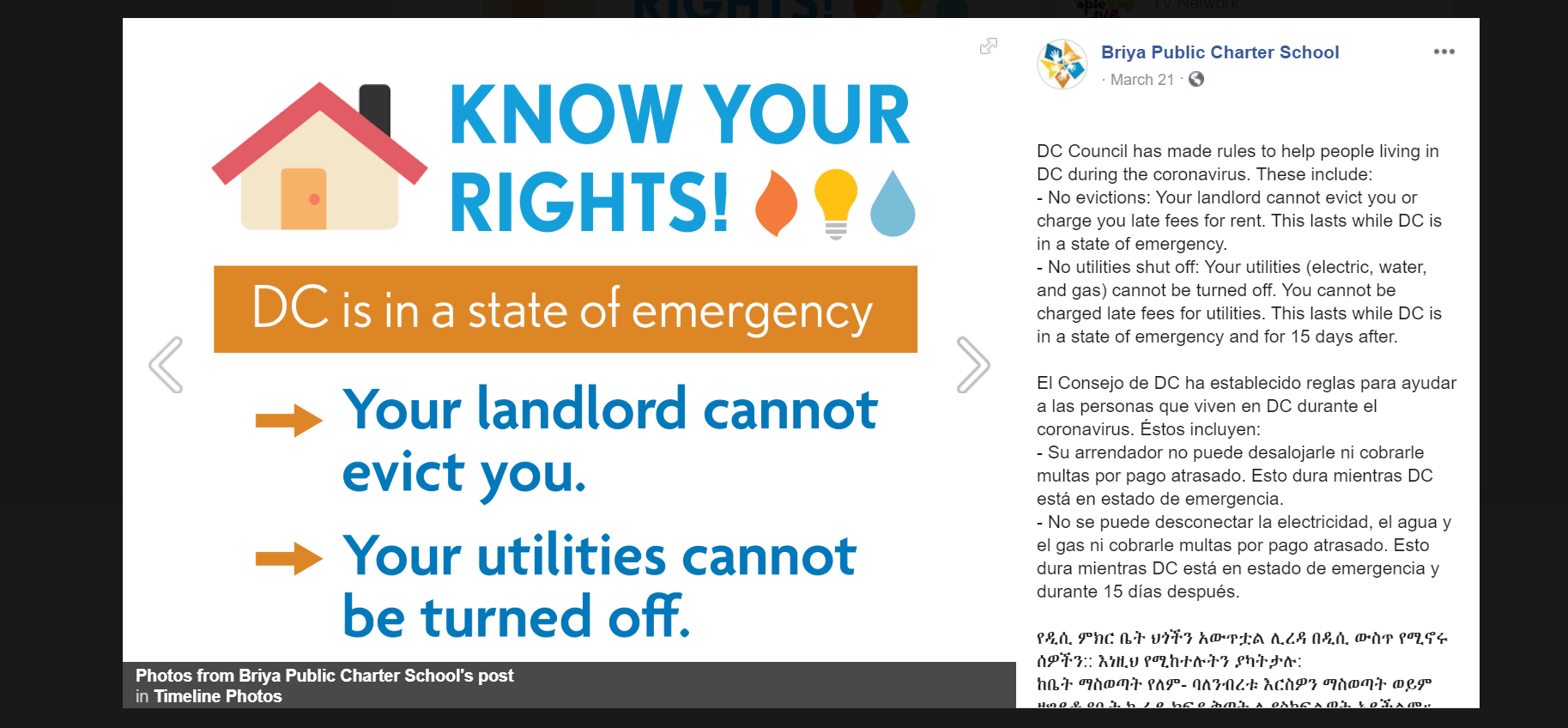
The global pandemic brings added stress and fear to all families, but for many immigrant families, the impacts are . Briya鈥檚 student services team provides individualized support to families on a case-by-case basis. As Briya鈥檚 Director for Student Services, Stephanie Mintz, put it, 鈥渨e are in overdrive when it comes to student support.鈥� Families have requested assistance related to food, mental health support, Internet access, legal assistance, paying cell phone bills, transportation, and employment.
Briya鈥檚 student services team is able to connect families to resources in the city. In DC, families can access free meals, get reduced cost or free internet connections, and access mental health providers. passed by DC City Council provides protections from eviction and utility shutoffs as well as removes the requirement to renew public benefits during the state of emergency. Yet despite these efforts, there are still many families鈥�those from Briya included鈥�who struggle just to meet their basic needs. When non-essential businesses were required to close, many immigrants suddenly and are unable to qualify for unemployment benefits. Briya is responding in every way it knows how. Staff are working on obtaining external funding from foundations and Briya students are organizing with other groups in the city to advocate for local unemployment benefits for immigrant workers.
Briya families have also found tremendous ways to encourage one another. Via , adult students share recipes, videos for Zumba classes, and answer each other鈥檚 questions about their children鈥檚 schoolwork. Adult ESOL teacher, Kirsten Wittkowski, recognizes that this medium is crucial for students to maintain their community and social connections, and as an added benefit鈥�they also practice English in an authentic context.
Zaid knew that she would need to get creative to keep her children (and herself) happy, healthy, and learning during school closure, but it took some time to shift into their new routines. In the process, Zaid shared pictures, her family鈥檚 daily schedule, videos, and stories of her successes (and failures) with her classmates on WhatsApp. She鈥檚 grateful that her community is still there during this time of social distancing.
While most schools wouldn鈥檛 say that closure and the sudden shift to distance learning were seamless, the transition was smoothest for schools, like Briya, that already had a few key features in place. Principal among them are strong instructional programs that include technology integration, effective communication with families, and creative, dedicated staff who can innovate and respond to students鈥� needs quickly and effectively. In addition, Briya鈥檚 partnerships with other community organizations are invaluable during this crisis.
But what鈥檚 remarkable about Briya鈥檚 work during closure is that none of it is remarkable鈥�it鈥檚 what Briya does every day鈥�listens to families, understands their strengths and needs, and communicates in languages they can understand. Briya鈥檚 response to their community has been swift and efficient because of how connected and supportive they were prior to the pandemic.
We are collecting stories from the field about the impact of COVID-19 on your lives. Want to share your story about coping with COVID-19? Please click . For more stories about overcoming the challenges of COVID-19, check out 麻豆果冻传媒鈥檚 Strengthening Child Care and Early Education: Learning from COVID-19 page.
Interested in staying up to date on education and workforce policy? Subscribe to our newsletter to receive updates on the latest from our experts.
More 麻豆果冻传媒 the Author
Issues
Programs/Projects/Initiatives
Related

Prenatal Connection to Early Intervention: A Snapshot of Current and Future State
High Quality Pre-K Starts with Supported Teachers: Strengthening Curricula for Students with Disabilities
Deeper Learning in Kindergarten