Abbie Lieberman
Senior Policy Analyst, Early & Elementary Education

Shirts tucked in at all times. Students sitting up straight, eyes tracking their teacher, using silent hand motions to express their thoughts. Quiet hallways with students walking in straight lines as they follow the duct-tape on the hallway floors. When one thinks of (the Knowledge Is Power Program), or other 鈥渘o excuses鈥� charter schools, some of these images might come to mind. The nationwide charter school chain, which now has over 200 schools, is widely known for high expectations, strict discipline measures, and strong student outcomes.
But walking into KIPP DC鈥檚 Connect Academy, which serves 324 students for pre-K (three- and four-year-olds) and kindergarten, feels different. It鈥檚 warm and inviting, with hallways covered in artwork by some of the District鈥檚 youngest students. Pre-kindergarteners, some as young as two-years-old at the beginning of the school year, spend their days playing with building blocks, drawing self-portraits, and using their imaginations through dramatic play at various student-led centers. There are multiple teachers in each classroom guiding small group lessons, reading stories, and playing with their students.
A recent by Mathematica Policy Research found that 鈥淜IPP pre-K programs have positive, persistent impacts on student achievement.鈥� The study analyzed the cumulative academic impact of KIPP programs after five years. The study included eight KIPP schools, a total of 472 students in the pre-K cohort and 624 students in the kindergarten cohort. (Though one of the schools in the study is located in DC, KIPP DC鈥檚 Connect Academy was not a part of this particular study.)
After five years, Mathematica Policy Research found that KIPP pre-K combined with KIPP early elementary school has significant impacts on academic achievement, particularly in math and reading. Students attending KIPP schools that offered pre-K saw larger gains than those in schools that didn’t. Additionally, the impact on reading skills such as letter-word identification persisted longer for KIPP students. By second grade their peers were mostly caught up on reading comprehension skills.
What are some elements that may account for KIPP鈥檚 academic success?
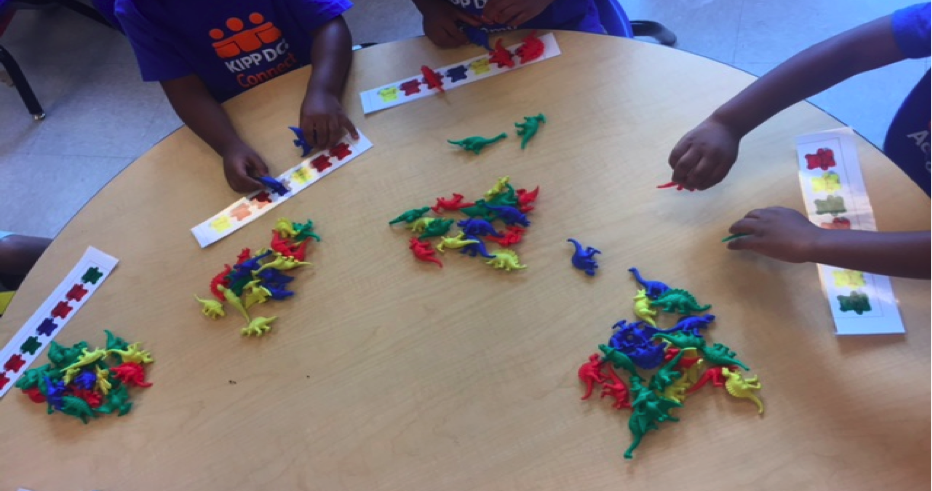
Last month we spent a morning visiting Connect Academy to see for ourselves. Walking into a 聽three-year-old鈥檚 pre-K classroom we saw youngsters at multiple stations working on early math skills. Two teachers were at separate tables each leading small group lessons on classification. In the middle of each table was a pile of toy dinosaurs of various colors and students each had a small sheet of paper depicting teddy bears of the same colors. The teacher began by asking the small group how to match the red dinosaur to the picture of the red teddy bear. They did the first set together as a group and then she helped them with the matching on their own. They used this opportunity to show off their counting skills too. Children who weren鈥檛 working with a teacher were on the carpet constructing with legos or solving puzzles in another station. When it came time to transition, the students at the table excitedly cleaned up their dinosaurs and headed to their next activity.
Connect Academy provides an academic environment that is largely supported through . shows that 聽play is an important vehicle for developing self-regulation as well as for promoting language, cognition, and social competence in early childhood. The Mathematica study noted KIPP鈥檚 heavy focus on academic skills, primarily math and reading. Stacie Kossoy, Managing Director of Early Childhood Schools for KIPP DC, says 鈥淲e have been trying to expand our definition of academic.鈥� Since the time of the study, KIPP pre-K has been focusing more on social-emotional learning and less on rote memorization to better align practices with the research on early learning. Connect Academy now uses an evidence-based pre-K curriculum called Tools of the Mind. Since the Mathematica study, KIPP has been moving away from teacher-created curricula and relying instead on evidence-based curricula.
鈥淥ne-third of the school day is spent in play for pre-K students,鈥� explains Kossoy. Kossoy and the principal of Connect Academy, Amy Witherspoon, both have strong backgrounds in early childhood education and instructional leadership. Kossoy was previously principal of another KIPP early learning school and Witherspoon was a kindergarten instructional coach. It’s聽essential聽for pre-K leaders to understand how young children learn and what high-quality instruction looks like in these grades.聽KIPP DC Connect Academy is among the top ten highest performing schools in the city, according to annual DC Public Charter School Board
One of the most important findings from the Mathematica study is that much of the gains made in KIPP pre-K did notas students progressed through elementary school, as they sometimes do. What drives the difference of impact between KIPP and non-KIPP schools? Some would argue the longer school days might be a contributor to its success. In KIPP DC, even pre-K students are in class from 8:00 am to 4:00 pm. They also have an extended school year, meaning shorter summer breaks, which could limit summer learning loss. Research shows that students benefit from more exposure to pre-K. However, in the Mathematica study, the hours in pre-K varied by program.
Others may attribute KIPP鈥檚 success to strong alignment between grades. Staff at the schools in the Mathematica study noted KIPP鈥檚 shared leadership and supported alignment across schools as an important component. Connect Academy鈥檚 staff similarly highlighted that the alignment of lesson plans, sharing of student data, and communication between pre-K and kindergarten teachers were key to their success. At Connect Academy and its adjoining elementary school, which serves 1st through 4th graders, the structure of the school day remains consistent from kindergarten to 1st grade. Both schools also use the same social-emotional curriculum from pre-K to 4th grade. This type of meaningful alignment between years helps to ease the transition from one year of school to the next. The Mathematica study noted that whether pre-K was part of the KIPP elementary school or on the same campus, 鈥渟taff reported that the co-location of the pre-K and elementary grades contributed to students and parents feeling comfortable and familiar with the students鈥� school.鈥�
The study also highlighted that KIPP prioritizes relationship building among parents and students. This tends to begin with home visits, which many KIPP leaders believe is a critical component in KIPP鈥檚 success. For example, at Connect Academy, home visits occur in the summer, accompanied with multiple parent-teacher conferences throughout the school year.
Establishing behavioral foundations and KIPP values early in pre-K was another contributing factor, according to the staff at study schools. Parents can play a key role in reinforcing KIPP鈥檚 values at home. The Mathematica study found, 鈥淭hese values and expectations were also explicitly communicated explicitly to families through home visits and regular communications; staff at one program reported that parents often reinforced its values and expectations by using the language of KIPP values in their interactions with their children. These relationships reinforced the idea of the schools as an extended family for students.鈥�
In regards to behavior, it is important to note that KIPP schools have been scrutinized for their . With suspension and expulsion in DC significantly higher than those of other schools, it has been argued that KIPP and some other charters are choosing not to serve the District’s more challenging students. KIPP CEO Richard Barth these concerns in an interview with Education Week.
Through the years, this criticism has led KIPP and other leading charter schools to rethink their disciplinary practices. KIPP DC 聽has been shifting its disciplinary culture toward practices, a non-punitive approach aimed at repairing the harm done through relationship and community building, rather than assigning blame or punishment.聽School leaders say the approach has positively impacted relationships and the overall school culture at KIPP.聽聽In 2015, the DC Council also responded to the high suspension rates by passing a聽that bans pre-K expulsion or suspensions under most circumstances.聽
The Mathematica study looked at pre-K students during the 2012-2013 school year and found positive and lasting results. Since then, KIPP鈥檚 highly structured and punitive school environment has been evolving to better serve its youngest students. With new evolving approached to discipline and a broader definition of academic, the future seems bright for the students at KIPP DC Connect Academy and other KIPP schools alike.
Senior Policy Analyst, Early & Elementary Education