Recommendations to Build Civic Infrastructure
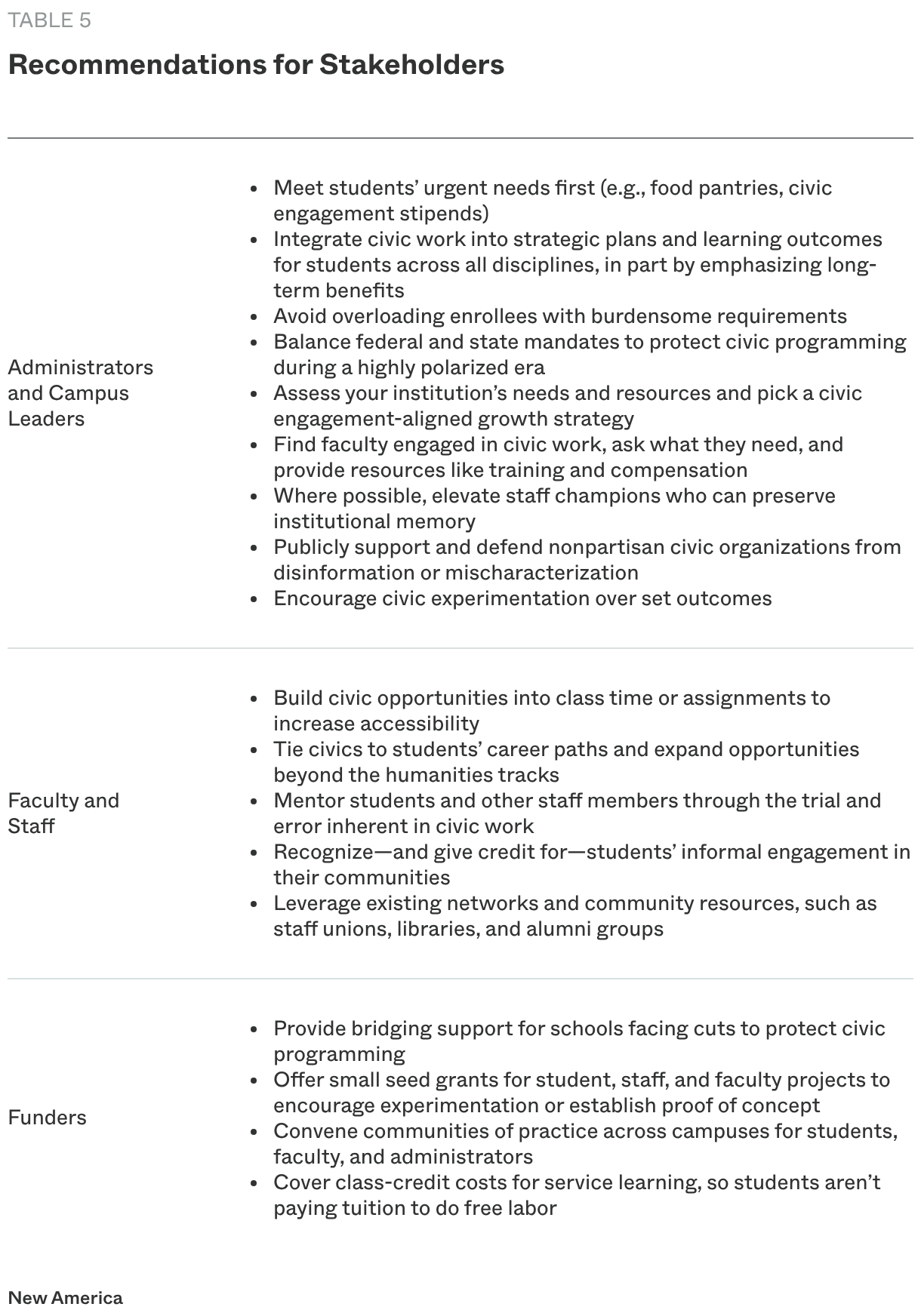
This work will look markedly different for every institution. There is no one-size-fits-all model. Whether schools are expanding existing civic capacity or looking to take small steps to grow their civic programming at a time of intense financial or political pressure, the recommendations below might help students, staff, and administrators think through courses of action. Here, funders will also find recommendations on where their resources might be particularly helpful for furthering stronger civic opportunities on community college campuses. (See Table 5 for a summary of these recommendations.)聽
In an interview, Professor Mathew Oakes of Rock Valley College offered guiding questions for how he thinks about this work on his campus: What will help? What can I get done that is meaningfully connected to what we鈥檙e already doing? And what will actually make some change?1 This simple framing can act as a clarifying launching point from which to outline and prioritize civic efforts.
As campus leaders work on the specific decision points of their own initiatives, they might keep the following few additional best practices in mind.
1. Address Urgent Needs
For many institutions, the most important place to start might be investing in their foundational capacity. As the cost of living continues to rise, job growth slows, and artificial intelligence reshapes the workforce, more students may feel additional financial pressure. Some must work additional jobs, cut back on their course load, or forgo higher education altogether. At the same time, skilled trades programs may see increased enrollment as people seek to enter blue鈥�collar fields that are unlikely to be automated in the near future. Institutional leaders navigating these complex forces鈥攚hile also adjusting to a new funding landscape鈥攎ay need to focus on their campuses鈥� strength and stability first.
Still, responding to these urgent challenges does not require abandoning civic efforts. Helping enrollees meet basic needs through on-campus food pantries, for example, can also tackle a common barrier that may limit some students鈥� ability to participate in civic initiatives.2 Similarly, providing food, class credit, or paid stipends to students who participate in civic programming may encourage engagement while also supporting those facing economic hardship.
Funders may choose to respond to this moment by providing bridging support to schools grappling with funding cuts. Here too, offering essential resources to keep institutions functioning should be a top priority, but this grant-making can also be done in a way that encourages or protects civic programming.
2. Focus on Outcomes and Academic Requirements
Student success and retention are chief concerns for everyone in the community college ecosystem, from students to administrators. A senior research associate at Columbia University鈥檚 Community College Research Center, Susan Bickerstaff, emphasized the importance of tying civic initiatives to strategic plans and learning outcomes so that early programming can gain traction. One way to do this is to emphasize the soft skills that students will gain as well as the connection between engagement and graduation rates.3
Connecting civics to concrete, actionable experiences that relate to students鈥� professions will be even more helpful鈥攂oth for ensuring program longevity and for encouraging enrollees to prioritize civic opportunities. Imagine, as one example, that a student is pursuing an electrician certification. If her professor brings city officials from the local department of buildings to meet with the class as they learn about the permitting process, that student will gain skills useful to both her career and her lifelong role as a democratic constituent.聽
In recent years, administrators may have also tied civic opportunities to federally supported grants or programming, such as those focusing on diversity, equity, and inclusion. While school leaders adapt to a new political environment, Oakes stressed the importance of embracing the federalized elements of the education system. State laws or accreditation mandates might still require equity considerations, for example. As he put it, 鈥淚f we don鈥檛 [keep our] accreditation, we can鈥檛 do anything鈥he Trump Administration is like an 800-pound gorilla, but there are also 200-pound gorillas鈥And] it doesn鈥檛 matter if it鈥檚 the 800-pound or the 200-pound gorilla that takes us out.鈥�4 So in places where there are discrepancies between federal and state requirements, administrators can balance competing mandates to bolster civic initiatives.
3. Dig Deep鈥攐r Go Wide
Once an institution has decided to invest in its civic mission, there are many different approaches that it can take. Administrators can decide to 鈥渄ig deep,鈥� focusing on building a well-established program with staff and infrastructure, such as by codifying civic requirements into curricula or creating a designated civic engagement center. Alternatively, institutions might find that 鈥済oing wide鈥� is a better strategy, in which they seed small civic initiatives in as many parts of the college as possible, knowing that they might not all survive but that some may eventually take root.
The first approach will likely work best for schools with clear mandates and significant resources. While a large number of schools have already incorporated civic engagement into some form of their mission, learning outcomes, or strategic goals, administrators might decide to build more specific civic components into their degree or certificate programs. In this process, leaders should avoid creating too many requirements: Furlett has found that if students have a negative experience with a mandated civic exercise, it might make them less likely to pursue those opportunities in the future.5 Additionally, centers can offer powerful homes for civic initiatives, especially if they are connected to the president鈥檚 cabinet or another high-level component of the administration, receive direct funding, and emphasize student leadership.6 Oakes emphasized, though, that these centers are most effective when they鈥檙e tied to solid civic commitments. He said he often finds himself wondering, 鈥淎re [centers] indicators of a deeply held institutional value? Or are they substitutes for that deeply held institutional value?鈥�7
For schools that don鈥檛 have the necessary funding or high-level buy-in to invest in concrete civic infrastructure, staff may choose to 鈥済o wide鈥� and grow smaller civic engagement initiatives across campus. Oakes summed up this grassroots strategy as developing an environment where 鈥渢here鈥檚 just so many of them, it鈥檚 hard to pull them all up.鈥�8 This approach still prioritizes meaningful engagement over superficial initiatives, but it aims to encourage local stakeholders to build as many discipline-specific opportunities as possible within existing campus frameworks and infrastructure. One tactic might be incorporating more student engagement into existing events: When a school in the Midwest hosted a forum for mayoral candidates, it allowed students to decide on the moderator鈥檚 questions, with a political science class leading the survey and data-cleaning process.9 This approach turned a low-participation event into one in which students had a concrete role, guiding and shaping the outcomes.聽
Oakes and Bickerstaff also highlighted the power of creating a 鈥渃oalition of the willing鈥濃�攚ith as few as three to five faculty members鈥攁nd establishing a clear proof of concept. Bickerstaff has found that when faculty members lead these kinds of initiatives, they become the most credible source for recruiting and convincing other faculty members, especially when they can point to clear outcomes.10
In either case, administrators play a critical role in supporting these efforts and elevating the faculty, staff, and students who carry them out.
4. Secure Buy-In, Identify Champions, and Provide High-Level Support
One consistent theme in interviews and our convening was a wariness of top-down efforts and a recognition of initiative fatigue that is persistent across many community college campuses. Still, without high-level commitment and support, civic initiatives are unlikely to succeed.聽
To find the right balance, Bickerstaff encouraged administrators to 鈥�find faculty who are already doing this work, make them superstars, and ask them what they need to bring other faculty on board.鈥� Administrators should also be steadfast in their support of faculty and students who participate in engagement work.11 That requires providing the training that organizers need to carry out civic initiatives well. Making civic initiatives a clear part of a staff or faculty member鈥檚 job, or providing compensation, is essential. As one professor put it in an interview, initiatives with a lot of interest often fizzle because it always 鈥渃omes down to, 鈥極K, who鈥檚 actually going to do the work?鈥欌���12 While supporting civic efforts, administrators should be sure to incorporate adjunct faculty, who are more likely to be left out of institutional processes.
Identifying and elevating staff champions in this way can contribute to initiative longevity. If only one faculty member is organizing civic initiatives as a passion project and leaves for another institution, the program will suffer. Staff champions can also help civic initiatives overcome what Jones called 鈥渢he tyranny of the semester.鈥� Because community college students are often on campus for shorter periods of time than their peers at four-year institutions, she observed that 鈥渢he slate is constantly getting wiped clean鈥� as semesters start and end.13 The institutional memory and guidance that faculty and staff members can provide are therefore essential and should be prioritized by college leadership.聽
Finally, in today鈥檚 political climate, leaders should be willing to provide public statements that clarify and defend civic engagement efforts on their campuses. For example, if an appropriate, nonpartisan event triggers unreasonable public pushback鈥攕uch as an outcry over a professor inviting an elected official to speak to a class about how local government works鈥攁dministrators can make statements pushing back against disinformation, putting the details into context, and stressing that the event fits into the school鈥檚 commitment to civic study. Ultimately, one professor said that what he needs most from institutional leaders is 鈥渕oney and chutzpah.鈥�14
5. Build on What Already Exists Across鈥攁nd Beyond鈥擟ampus
When putting civic initiatives into practice, experts consistently mentioned the importance of drawing on existing opportunities and resources from a wide range of partners on and off campus.15
Doing so may require taking what Furlett called an 鈥渆xpansive view of how we look at community engagement, how we define community engagement, and how we bring people to the table.鈥�
For example, student life and public affairs offices might act as natural homes for new civic initiatives because these teams often provide a front door to the university that is accessible to both students and outside community partners. Given this position, staff members can merge the needs of students and the broader neighborhood and identify cross-cutting opportunities.16 Campus libraries play similar roles鈥攇iven their work with students, municipal library systems, and members of the public鈥攂ut they are often underutilized in civic programming.17 Additionally, faculty and staff unions can provide deep knowledge and expertise in civic engagement and political work.18
Other untapped resources are the connections that individual students, alumni, and staff members have with local businesses and organizations.19 An enrollee might serve on a local nonprofit board, or a faculty member might have a side project consulting with a small business. A school might start by conducting a voluntary inventory process and coordinating with the career services center to get a broader picture of what connections already exist within the college network.
Building partnerships with external organizations can be mutually beneficial. If a four-year institution has the capacity to invite community college students to join civic initiatives on its campus, that both expands access to civic opportunities and opens up new recruitment channels for potential transfer students. One professor has encouraged community organizations to host events on campus in partnership with a class or student club by highlighting the fact that doing so means he can waive the space rental fee.20
6. Embed Experiential Learning
Another area of widespread agreement was on the importance of building civic initiatives into class time and coursework, leveraging the scheduling and work commitments that students and faculty have already made. Since the emergence of COVID-19, Jones has found that 鈥渢he most effective way to engage students is in the classroom.鈥� So she brought a get-out-the-vote event to her class. That way, students didn鈥檛 have to find time in their schedules to register to vote.21 As Bickerstaff put it, 鈥渋f something is not happening inside the context of a credit-bearing course, it鈥檚 just a harder sell [for everyone].鈥�22
However, classroom-based experiences are often siloed in humanities courses. To help civics content expand to other disciplines, Oakes recommended that professors adopt a systematic framing鈥攆or example, educating biology students on how the Environmental Protection Agency works so they can better understand the broader structure of the field they hope to enter. Additionally, he suggested cross-listed courses as a potentially promising model, in which a class is taught by two faculty members from different departments. With this format, the professors can share their expertise and divide the work of adding civic components to the course.聽
Though civic education concepts offer a vital foundation for long-term engagement, several experts also stressed the importance of moving beyond theoretical concepts and embracing experiential learning. Ramirez believes in inverting the standard education model, in which professors impart wisdom to students who then apply those concepts to the 鈥渞eal world.鈥� Instead, he tries to embrace the application process and support hands-on opportunities that go beyond the kind of one-time volunteering projects that often characterize service learning. To him, that work is important, but he also believes in 鈥渟etting up programs where students鈥� actual views and experiences can provide real value to the community.鈥�23 This might involve students serving on a commission or conducting research that informs a local organization鈥檚 programming.
In this way, experiential learning opportunities should employ a wide definition of civic engagement to recognize and amplify what students are already doing in their communities. One person might take care of an elderly parent and regularly share what he鈥檚 learned with his neighbors facing similar situations. Another might run a support group for families affected by addiction on top of her day job. Furlett said that these forms of engagement are often overlooked by institutions because they are informal but that schools have an opportunity to give students class credit for their contributions. Practically, this could involve assigning a reflection paper, for example, in which students can deepen their understanding of the roles they can play to change their communities for the better.24
7. Encourage鈥攁nd Support鈥擡xperimentation
Because there is no one right way to bring a Participatory Campus approach to a community college, students, staff, and administrators should experiment. With their diverse student bodies and broad networks of local ties, these schools can offer promising homes for bold civic engagement experiments, like adapting civic assemblies to inform administrative decision-making. On a smaller scale, students or faculty members may have new ideas they want to bring to their clubs or classrooms. To Furlett, the process is more important than the outcome. In an interview, she said, 鈥淣ot all experiments work鈥�; that shouldn鈥檛 be the expectation. The question is, 鈥�How do we learn from what happened and keep building on it?鈥�25
To make these initiatives possible, civic leaders need financial, logistical, and social support. Administrators, faculty mentors, department heads, foundation officers, and nonprofit leaders can all play different roles in providing this kind of assistance. For example, , in partnership with program funders, has been able to offer small grants of $2,000 to $5,000 for higher education students, staff, and faculty who want to build projects on their campuses. Foundations could also provide small stipends to cover the costs of students earning class credit through extended service learning. That way, students aren鈥檛 being charged tuition for the opportunity to provide free labor.聽
One professor mentioned that this kind of funding would have made it possible for his institution to create a community-based learning program. The school proposed a partnership with a local organization that would host students completing semester-long internships. In exchange for their work, the students would each earn one credit, but there was still a concern that this program would effectively require students to pay tuition to become interns. However, the organization couldn鈥檛 afford to pay the students directly or cover the approximately $1,500 that their class credits would have cost. The partnership did not move forward.26
Mentor or peer support networks can also help students and faculty members who are carrying out the difficult work of civic experimentation. In addition to providing seed funding, Campus Compact creates communities of practice, bringing together students from different schools who can brainstorm and share lessons learned as they grapple with similar challenges. Administrations or foundations could play a similar role, bringing together civic champions or coordinating joint efforts. Within individual campuses, faculty, staff, or union representatives can play a similar role in guiding and encouraging civic leaders. At Elgin Community College鈥檚 Center for Civic Engagement, Ramirez sees his role, in part, as supporting students through the trial-and-error process. He helps them set real and attainable goals, push beyond their comfort zones, and build on their success. As he put it in an interview, he approaches this work thinking, 鈥淟et鈥檚 try this, even though chances are really strong that it won鈥檛 work the way we want it to鈥f it doesn鈥檛, we鈥檒l expect that, reflect on it, and then make adjustments.鈥�27

Citations
- Oakes, interview.
- Soniy Alamdari et al., Student Design Fellows鈥� Vision (Campus Compact, 2025), .
- Susan Bickerstaff (senior research associate, Community College Research Center), interview with Elena Souris, October 30, 2025.
- Oakes, interview.
- Furlett, interview.
- Ramirez, interview.
- Oakes, interview.
- Oakes, interview.
- Jones, interview.
- Oakes, interview; Bickerstaff, interview.
- Bickerstaff, interview.
- Jones, interview.
- Jones, interview.
- Oakes, interview.
- 鈥淏est Practices,鈥� National Center for Free Speech, .
- Jones, interview; Furlett, interview.
- Furlett, interview.
- Ramirez, interview.
- Oakes, interview; Furlett, interview.
- Oakes, interview.
- Jones, interview.
- Bickerstaff, interview.
- Ramirez, interview.
- Furlett, interview.
- Furlett, interview.
- Oakes, interview.
- Ramirez, interview.