5 Myths 麻豆果冻传媒 Blockchains
Moving the conversation past current confusion so we can bring the best technology to land and property registries

Interest in blockchain is growing at a rapid pace. The World Bank Land and Poverty Conference had one on Blockchain, the conference had three sessions with . There is a considerable amount of information to digest from those sessions, but what struck me was the curious confusion present in the audience鈥檚 questions. If we fail to address this confusion and remind ourselves of some first principles, it will be a mistake.
Confusion is like soft clay, it can be formed into understanding or left to harden into resistance. Society will not enjoy the benefits of this technology if we don鈥檛 understand it, let alone if we fear it. At the practical level, none of this will happen without laws changing to accommodate the technology being applied to registries, so public confusion must be addressed.
Here are five specific misconceptions that came through in questions I heard at the conference. While our examples pertain to land registries, these myths may apply to many other likely of blockchain technology.
5 misconceptions about blockchains:
- This is going to happen soon.
- This is just a new hammer looking for a nail.
- Some say it鈥檚 safe but it鈥檚 not, it鈥檚 been hacked, or forked, or something.
- THE blockchain…
- If we put our registry on a blockchain, smart contracts will make everything automatic, and we will lose control.
Myth 1: This is going to happen soon.
Fact: This is happening, right now.
The of land projects currently using blockchain technology keeps growing. Are complete blockchain based solutions yet in place? No, but governments, firms, and investors are racing to set up systems and pilots with registries at national and regional levels. In addition to the examples listed, it is reasonable to assume there are a few others hard at work but choosing not to publicize anything until doing so is unavoidable.
As I , Georgia and Sweden are the largest public examples of national registries using blockchain – following these two projects closely will be instructive for others in the community of practice. Georgia鈥檚 and presentation at the recent World Bank conference confirmed that as of 20 February 2017, land records are being recorded on a private blockchain and they are now thinking about smart contracts. Sweden is also making progress with the entering a new . According to Quartz, however, they at the earliest. Dubai has also announced efforts that will touch all aspect of government including land administration. In addition to numerous pilots and partnerships, Dubai has set a clear goal of having all government documents on blockchain based platforms by .
Myth 2: This is just a new hammer looking for a nail.
Fact: Many land registries do suffer from fraud and inefficiency that blockchain-based tech can address.
Before addressing the tool analogy, let鈥檚 discuss the need. It is real. Current tools are allowing corruption in land registries . In Kenya, a ranked the national registry offices by levels of perceived corruption. Avi Spielman, in his MIT Thesis , quotes an executive who 鈥渃harges that fraud is rampant in the real estate title industry,鈥� (p. 23) in the US. If there is a better tool that significantly addresses corruption, it should be adopted.
Blockchain is more than a new database, it鈥檚 a completely different use of resources which allows the network to become distributed (). BCG鈥檚 Philip Evans and colleagues that as resources (compute, communication and storage) become cheap it becomes possible to use them – not just inefficiently – but 鈥渨astefully,鈥� to create something radically new and powerful. Blockchain is that new and powerful creation from the 鈥渨asteful鈥� use of storage. The Bitcoin Blockchain is a decentralized network, that has a full record of every transaction, since the inception of the entire blockchain, on every node. At the time of writing, that鈥檚 approximately . Each node requires a of 125 GB of disk space and 2 GB of RAM. (For comparison, the Ethereum Blockchain has over nodes.)
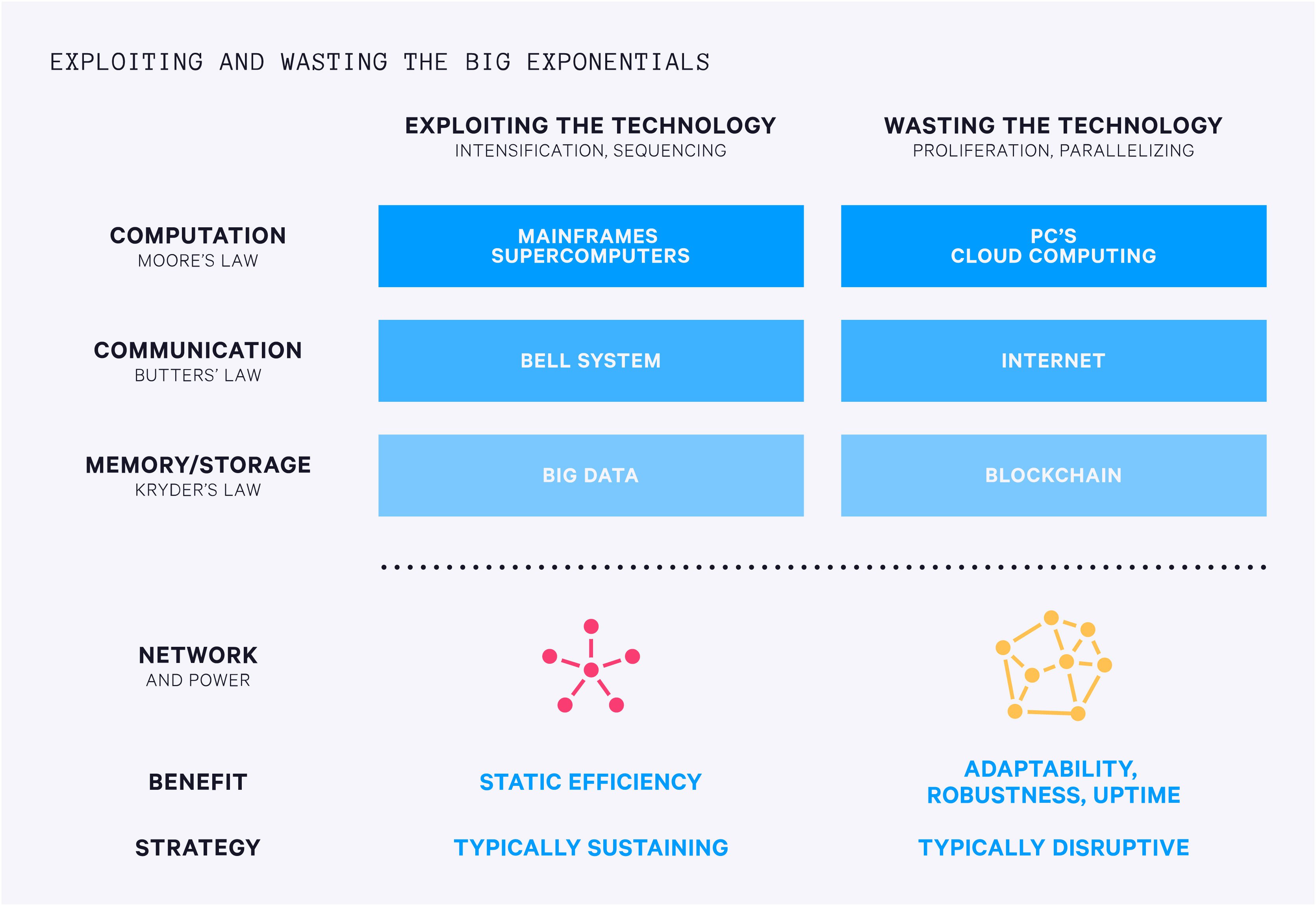
This extravagance creates three of the benefits of blockchain that are often mentioned but not fully appreciated — maybe because they seem hyperbolic. First, disaster proof, with the full record on all nodes, it鈥檚 next to impossible to lose the data. Second, immutable and highly secure, the Bitcoin blockchain expands by a new block approximately every minutes. That block is verified by at least 51% of the chain. So, to corrupt the current record, someone would have to hack 51% of all nodes around the world inside same ten minutes. Once a block is published and replicated to all nodes, it is secure. Third, accessibility and auditability. Every single node has a full copy of the chain, making it much more available to check what happened and when.
These qualities: disaster-proof, immutable, secure, accessible, are all highly desirable in a registry of who owns what land. This is not a hammer looking for a nail, is the ability to put a hammer next to every single nail, so they are there when you need one.
Myth 3: Some say it鈥檚 safe but it鈥檚 not, it鈥檚 been hacked, or forked, or something.
Fact: Despite a small number of hacks, the core technology behind the largest public Blockchain has never been successfully hacked and remains significantly more secure than other options
In each of the two major public blockchains — and — there has been a security event. In each case, the community identified and cleaned up the issue quickly. In the case of the Bitcoin, the issue was identified in 2010 and the community corrected the issue with no loss. Bitcoin remains unhacked and the is over $19 billion at the time of writing. The hack of 鈥溾�� in 2016 hack was , and significant funds were lost. This hack resulted in a fork, which means the chain split into two, not everyone was happy, but the issue was found quickly and addressed.
There is also the famous hack of , a Bitcoin exchange. A digital currency exchange or () is a platform that allows you to buy digital currency with fiat money. The fact Mt. Gox, or any exchange, was hacked does not indicate that the blockchain was hacked, rather their specific service had weak security and which left them vulnerable.
While no system is perfect, the security of the blockchain is significantly more secure than any other technology. Keep in mind both of these hacks were on public blockchains, and involved the loss of digital assets. When applying this powerful technology to land registries, all of the solutions who have shared any technical details are suggesting they will incorporate private blockchains, which will make access and hacks considerably harder. Also, before a registry can be put on a blockchain, it needs to already be digitized and likely resides in a database. So the appropriate question is not, 鈥渋s this blockchain based system perfectly secure?鈥� but rather, 鈥渋s this private blockchain based system significantly safer than the database technology it is replacing?鈥� By virtue of the multi-node nature, the answer is likely affirmative.
Further, in the context of registries, what鈥檚 at stake is real assets: land and buildings. Any blockchain solution will derive authority from the prevailing legal system and will have recourse options. Even if there is a hack — which is less likely with blockchain based solutions than any other available technology– recourse would be available through the courts and the ledger based nature of blockchain would facilitate rapid discovery of what happened when.
Remember, if there was a transaction added to the chain that was deemed illegal — for example someone if forced or blackmailed into selling a home — if it is a private/permissioned chain, the court will have the power to add another transaction to the chain reversing it and returning property to the rightful owner. Tim Swanson of R3 makes the same point that where legal action is possible, a permissioned chain is the right tool in his presentation .
Myth 4: THE Blockchain…
Fact: There is no longer just one Blockchain, but there are many blockchain based tools
In common parlance, if someone said: 鈥渢he Blockchain鈥� they were referring to the Bitcoin Blockchain which was launched in 2009 and is the most established. Bitcoin advocates are comfortable with this simplification, but recently it is fair to ask if the expression isn鈥檛 becoming dated. Especially two years after 2015 — when Ethereum and Hyperledger were launched. As the New York Times , 鈥渢here have been many so-called alt-coins that have tried to improve on Bitcoin, but none have won the following of Ethereum,鈥� So there are now two well-established cryptocurrencies, each on their own public blockchains, . But there are blockchains and more under development. The is cryptocurrency, but a project founded by the Linux Foundation with a membership list (of companies) that reads like a Who鈥檚 Who of modern industry. The project鈥檚 goal is to 鈥渄evelop an enterprise grade, open-source distributed ledger framework, and free developers to focus on building robust, industry-specific applications, platforms and hardware systems to support business transactions.鈥� People are still saying 鈥渢he Blockchain鈥� though. This is a problem not just because it isn鈥檛 obvious which one they are talking about.
It is a problem because they are assuming 鈥渢he Blockchain鈥� is like 鈥渢he Internet.鈥� This weak, if not faulty, analogy is both limiting use of the technology and seeding confusion. George Bennett鈥檚 , in Fast Company, of how defining the new in terms of the old is limiting our ability to create radical value well articulates how this analogy limits our potential use of the blockchain.
The confusion is well illustrated with the often used one line explanation of blockchain as 鈥�.鈥� While it is true that what we did for information we can now do for value, there are multiple blockchains. The technology is not analogous to the Internet. A better analogy might be SSL, the tech that allows secure data transmission on the internet. (Both SSL and blockchains secure data via .) 鈥淭he SSL of value鈥� is far less catchy, but a more accurate analogy. SSL is used for both intranets and the Internet. Similarly, blockchains can be . Public blockchains (Bitcoin, Ethereum, .) are open to the Internet, but private blockchains have managed access, similar to intranets. The two types of blockchains have different advantages. As Alison Berke recently concluded in ,
Just as a business will decide which of its systems are better hosted on a more secure private intranet or on the internet, but will likely use both, systems requiring fast transactions, the possibility of transaction reversal, and central control over transaction verification will be better suited for private blockchains, while those that benefit from widespread participation, transparency, and third-party verification will flourish on a public blockchain.
All of this to say, when someone says 鈥渋t鈥檚 not safe to put that deed, record, name, transaction, vote, etc. on 鈥榯he Blockchain鈥�.鈥� An appropriate first response is: Which blockchain?
Myth 5: If we put our registry on a blockchain, smart contracts will make everything automatic, and we will lose control
Fact: This is going to take a while and it doesn鈥檛 mean less control
A smart contract is an algorithm that can execute a pre-defined contract. At least this is the prevailing definition, it has . But for our purposes now, this definition will work. An example would be if Ana created a piece of code on a blockchain that said, 鈥渨hen Bill makes $1M available, give Bill my house in exchange.鈥� Think digital escrow agent. The blockchain based solutions allow tokens (representing ownership of property, cryptocurrencies, potential national e-currencies) to transfer from Ana to Dino in fractions of a second. So who goes first? And what happens if the other party has a change of heart. The same valid questions exist today and are why we have escrow, but the millisecond nature of things raises the need for a digital version. This is why smart contracts are the next logical step once a country has put its registry on the blockchain. But it is a distinct next step and if for no other reason than allowing the respective laws to catch up, it will take some time before this happens, even if the technology will be ready sooner.
Georgia and Sweden are in the (public) lead having both announced they are looking into smart contracts. We will have to wait and see what Georgia does, but looks like they are creating more of a 鈥淪mart Workflow鈥� where all existing parties use the private blockchain solution they are creating to register their work. This may be an interim step to build confidence in the process and to allow time for various legal issues 鈥溾�� to be addressed.
The other issue is how to pay. At the moment, there are not blockchain-based USD, EUR, or . (Although, the Swedes are .) To pay for a property on a blockchain, until nations issue e-, what do you use? Cryptocurrencies are unlikely to be recognized by national governments. The US government has on if Bitcoin can be called money. Until there is clarity on what can be used someone will have to go to a bank to issue a blockchain token for an agreed value. Think blockchain version of a cashier鈥檚 check or mortgage. This again will preclude rampant smart contract manipulation of property markets.
There are times, however, when countries would like to see rapid, efficient transactions that are accessible to a broad audience. For instance, if auctions for real assets could be handled digitally governments would be able to both put the assets back into the economy and enjoy a boost to revenues. Similarly, banks would benefit from such a tool for foreclosures and repossessed assets. , is a blockchain based tool in use by based on this hypothesis.
First principles: A transparent efficient technology is good for land registries and especially useful for the poor.
This last point is here because it is the other thing that struck me as barely audible (if not absent) in the blockchain discussions at the World Bank Land and Poverty conference. A reminder about why this matters. The reason we need to wade through these myths and understand if blockchain based solutions will work is because implementing them could disproportionately benefit the poor.
Transparency International : 鈥淵ear after year, it鈥檚 the same. Our Global Corruption Barometer confirms that corruption hits poor people hardest 鈥� with devastating consequences.鈥� A blockchain based land registry would radically limit corruption in three ways: an immutable registry, reduced transaction costs, and radical transparency. Each of these things is good, but especially for the poor who are most vulnerable to these challenges.
An immutable registry means that with copies of the full history of a blockchain on every node, and every block before the current one unchangeable, it is impossible for a corrupt actor to rewrite history and change who owns which parcel in order to give a relative or corporation land that previously belonged to another person or group.
Reduced transaction costs mean lower fees to register and check on property, as those fees drop it makes more sense for owners of smaller and lower value parcels (the poor) to register their land. In Sweden alone, the prospect of a blockchain registry is estimated to save over 鈥�100 million Euros per year鈥� (p. ) by consultancy Kairos Future.
Radical transparency, when a citizen with access to a national private blockchain or the public bitcoin blockchain can validate a record or transaction by simply looking up a record or hash on their nearest internet connection, the long lines and potential bribes at registry offices are greatly reduced.
Permalink:
More 麻豆果冻传媒 the Author
Issues
Programs/Projects/Initiatives
Topics
Related

Principles of Identity: An FPR Synthesis

Update: Mapping the Property Rights Community
Help Us Map the Property Rights Community