Zahava Stadler
Director, Education Funding Equity Initiative
When one court ruling is overturned, other precedents become targets鈥攊ncluding those protecting school funding.

What do abortion rights have to do with fairly funded public education? More than you鈥檇 think. The U.S. Supreme Court鈥檚 overturning Roe v. Wade, its longstanding precedent recognizing abortion rights, has emboldened challenges to other rulings that were once thought settled. Among these: the cases that guarantee New Hampshire children the right to adequately funded public schools.

31 state legislators recently filed a that cites Dobbs and asks New Hampshire鈥檚 high court to follow the U.S. Supreme Court鈥檚 example by discarding two of its decades-old precedents. The Claremont cases are ordering the state to ensure that every New Hampshire student, no matter where they live, can get a quality public education. If the state supreme court were to overturn Claremont, the legislature would be able to sidestep all responsibility for funding public schools. But the brief doesn鈥檛 mention the inevitable consequence of such a decision, which would be a massively underfunded school system in which the students with the greatest needs get the least support.
The legislators鈥攁ll Republicans, including the Speaker of the House and the chairs of the House education and finance committees鈥攁re making this argument at a pivotal moment for school funding in New Hampshire. In November 2023, a Superior Court judge issued two rulings built on Claremont. found that the state school funding formula was providing too little money to pass constitutional muster. took on unfairness in the school tax system, finding that the state鈥檚 education property tax too heavily burdened residents of poorer towns. As the cases make their way , this new filing is an attempt to halt their progress.
The lawmakers who signed this brief aren鈥檛 claiming that New Hampshire is fairly and adequately funding education. (The state attorney general is .) Instead, they鈥檙e saying that education is a local responsibility. They argue that, despite three decades of New Hampshire case law on the subject and parallel rulings in a , the courts should never have required the legislature to support local public schools.
If the New Hampshire Supreme Court agreed with these legislators鈥� argument, it would let the state step back entirely from supporting public education, leaving the system to be funded almost entirely from local revenues.
Local funding is hugely inadequate to the task of supporting public schools. It currently only of school budgets in New Hampshire, and what districts raise is dependent on their property values. The is meant to top up that amount so that districts have more adequate education funding, and to provide specifically for the greater resource needs of students from low-income homes, English learners, and students with disabilities.

Without state support, students would be entirely at the mercy of what their local school districts can raise from property taxes. Property-poor districts would almost certainly struggle to serve students with disabilities and English learners well. Districts with higher poverty rates would have far less money; that the lowest-poverty districts in New Hampshire raise over $4,000 per pupil more from local sources than the highest-poverty districts do. School funding in the state would be based on local wealth, not educational need.
(Ironically, the legislators鈥� brief not only references Dobbs, but also quotes extensively from the 2010 campaign finance case . Just as that decision expanded the sway of wealthy donors in American elections, a ruling in line with this brief would hugely increase the influence of wealth over another central institution of our democracy: public schools.)
This brief is unlikely to convince the court to abandon three decades of precedent. But the perspective it represents鈥攖hat the state should be off the hook for supporting students鈥� education, inequity be damned鈥攊s only the most extreme version of a view that shows up in baleful state policy across the country. These New Hampshire legislators are talking about leaving all the responsibility for education funding to local school districts (or at least, having the court allow the state to cede that responsibility). That would cause massive and immediate inequities. But nearly every state allows some local inequities to skew school district budgets.
Local revenue comes largely from local property taxes, so school districts with more property wealth can easily raise funding for their schools, while property-poor districts often make do with less. States usually try to help districts reach a budget goal by giving more funding to those with lower property values. But there鈥檚 a catch: most states allow districts to raise additional local dollars on top of that budgeted amount. This tilts the balance in favor of wealthy districts, whose 鈥渆xtra鈥� funding pays for everything from building renovations to state-of-the-art technology to the high salaries needed to snag the most experienced teachers.
Take Reading, Pennsylvania, where 35% of children live below the poverty line and the median home is worth about $83,000. Its school district raises just under $2,500 per pupil from local taxes. Its lower-poverty neighbor, Schuylkill Valley School District, has a median home value of almost $228,000 and raises over $14,000 per pupil locally. The state does provide far more aid to Reading, but it鈥檚 not enough to close the local revenue gap. When all federal, state, and local dollars are tallied, Schuylkill Valley winds up ahead by more than $4,000 per pupil, despite Reading鈥檚 much greater levels of student need. (This data is available in Crossing the Line, 麻豆果冻传媒鈥檚 report and interactive map focused on divides between neighboring school districts.)
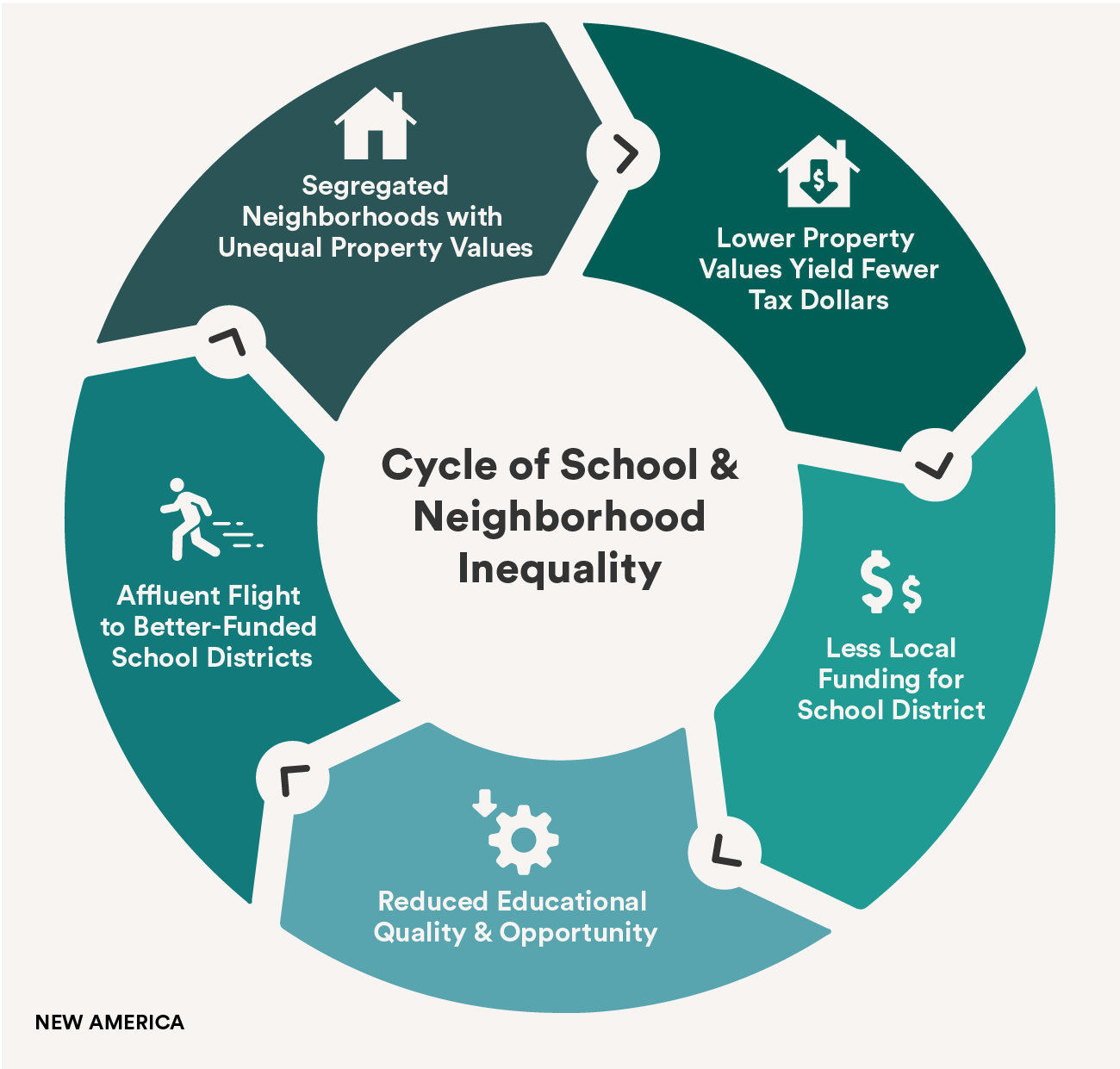
This unfairness in school finance is also part of a cycle of inequality. Disparities in property values make for unequal school budgets. Low school spending can then harm school quality and performance, leading families of means to leave for better-resourced school districts. This worsens neighborhood and school segregation and further lowers property values in struggling areas.
Some states have moved in the opposite direction from the one proposed by these New Hampshire legislators, taking steps to curtail the influence of local property values on school district budgets. Texas and Wyoming each have a 鈥渞ecapture鈥� system that redirects some property tax revenue from wealthier school systems into a state fund that supports districts with smaller tax bases. Vermont collects all property tax dollars for education at the state level, avoiding many local inequities. And New Hampshire advocates should take note: All of these policies came about as the result of the state鈥檚 constitutional obligation to ensure equal educational opportunities for all students.
Legislators shouldn鈥檛 duck their responsibility for ensuring that students in every school district have schools that are funded fairly and well. It鈥檚 good policy, and it鈥檚 the right thing to do. New Hampshire鈥檚 state government should step up in response to the current legal challenges, and so should legislators in every state in the union.
Director, Education Funding Equity Initiative