Technology can be a powerful tool in efforts to save lives and stabilize shaky economic conditions. It can also help preserve vestiges of normalcy amid a global pandemic. During the COVID-19 pandemic, public interest technology tools, like COVID smartphone apps, were intended to augment personal preventative measures, like social distancing and masks. As COVID proliferated in 2020, many governments tried to harness new tools to slow the spread. But all new tools face the same challenge: How do you get people to use them? Efficacy hinges on adoption and, in the case of technology, implementation.
Since the earliest days of the pandemic, California has leveraged technology and policy to become a leader in the fight to slow the transmission of COVID. Other states also used technology to address the public health crisis, but California鈥檚 robust portfolio of pandemic-related apps and software sets the state apart. At the start of the pandemic, California residents could find the latest COVID data in an . Later, they used their smartphones to and download their s. An helped people determine if they鈥檇 been in close contact with someone infected with COVID.
To date, more than 9.6 million cases of COVID have been reported in California and the official death toll has surpassed 91,000. How effective were the Golden State鈥檚 efforts to keep its residents healthy and safe? Were Californians receptive to using the tools and apps developed to help them? Was the effort necessary to roll out these public technology responses worth it? The results are mixed.
Silicon Valley鈥檚 Role in Stopping the Spread
California鈥檚 statewide exposure notification app鈥擟A Notify鈥攚asn鈥檛 the in the United States, that was Virginia鈥檚 . But CA Notify, Covidwise, and the apps of are built upon exposure notification technology developed through a Silicon Valley .
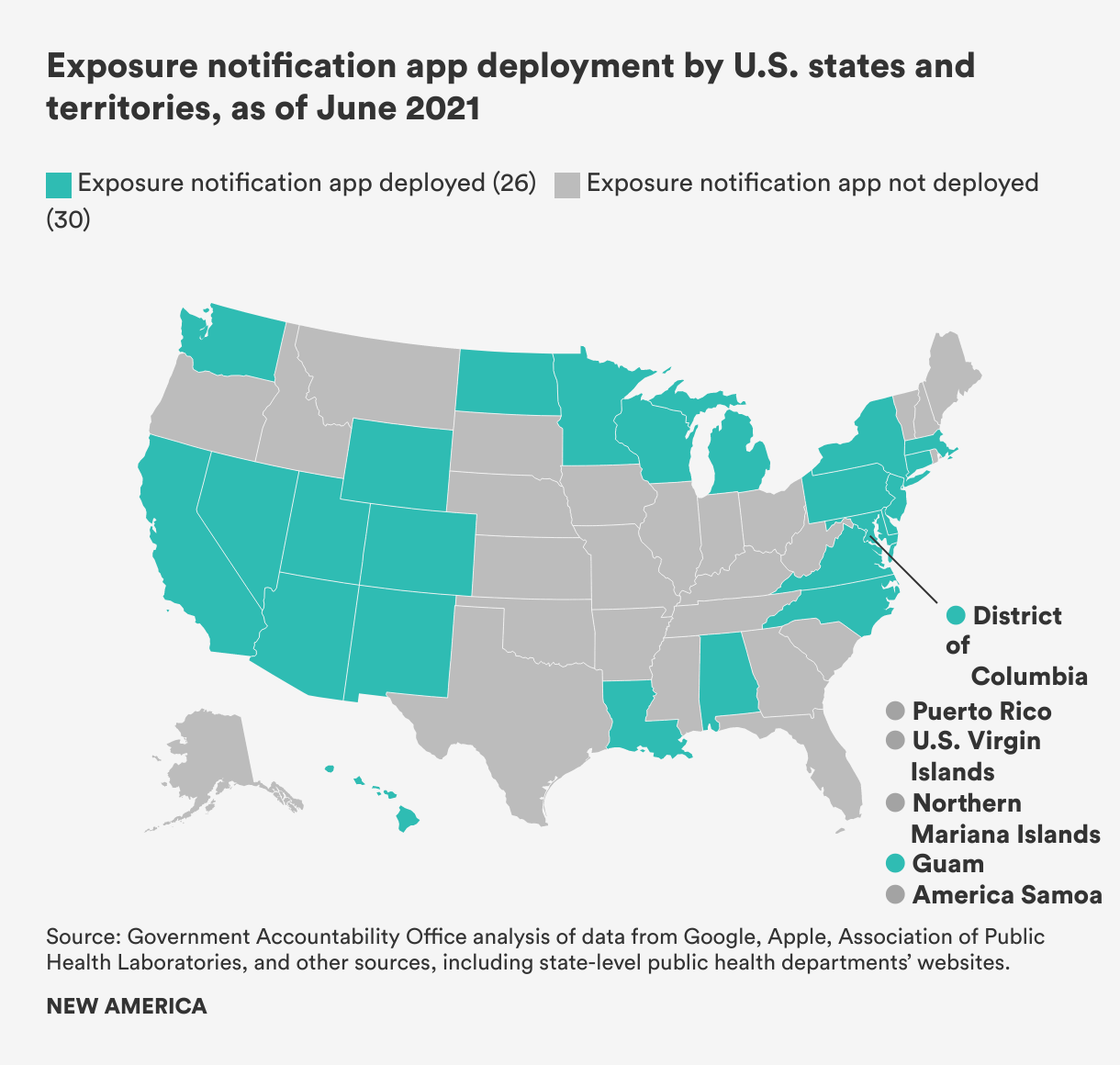
The framework uses a smartphone鈥檚 Bluetooth signal to determine a person鈥檚 potential exposure by measuring how long and how close phones have been near each other. If one phone鈥檚 user later tests positive for COVID, the app notifies the users of the phones that were in proximity to it. Those phones receive a push notification urging users to take steps to prevent the transmission of coronavirus to others, like testing or quarantining.
The California Department of Public Health opted to use the Google/Apple for its CA Notify app. EN Express is a ready-to-use option that allowed for rapid development of the app as COVID ravaged the state. But, once the app launched statewide, privacy and other concerns deterred residents from downloading or using it.
App Uptake Stymied by Privacy Concerns
According to a , Americans鈥� willingness to actually install and use a COVID app hinges on three main factors: benefit, accuracy, and privacy. Researchers from Microsoft and several universities surveyed 4,500 Americans through questionnaires.
鈥淎ll of us at Apple and Google believe there has never been a more important moment to work together to solve one of the world鈥檚 most pressing problems. Through close cooperation and collaboration with developers, governments and public health providers, we hope to harness the power of technology to help countries around the world slow the spread of COVID-19 and accelerate the return of everyday life.鈥�
鈥� press release, April 10, 2020.
Survey results indicate that motivation to use the app is directly linked to the public or personal health benefits of using an app. People who know someone who died from COVID are five times as likely to install an app, even if it鈥檚 not 100 percent accurate. Further, survey respondents were 65 percent more willing to install an app that reports false positives than false negatives.
CA Notify doesn鈥檛 collect or exchange any personal information about its users. Instead, users鈥� phones share anonymous keys鈥攔andomly generated strings of numbers鈥攚hen Bluetooth is turned on. These keys are used to create a log of contacts who came within six feet for more than 15 total minutes over the past two weeks. Keys are frequently changed, never stored on devices, and the identity of a COVID-positive person is never shared. The app automatically deletes information after 14 days, after which it cannot be recovered. But, even with in place for apps like CA Notify, privacy concerns remain.
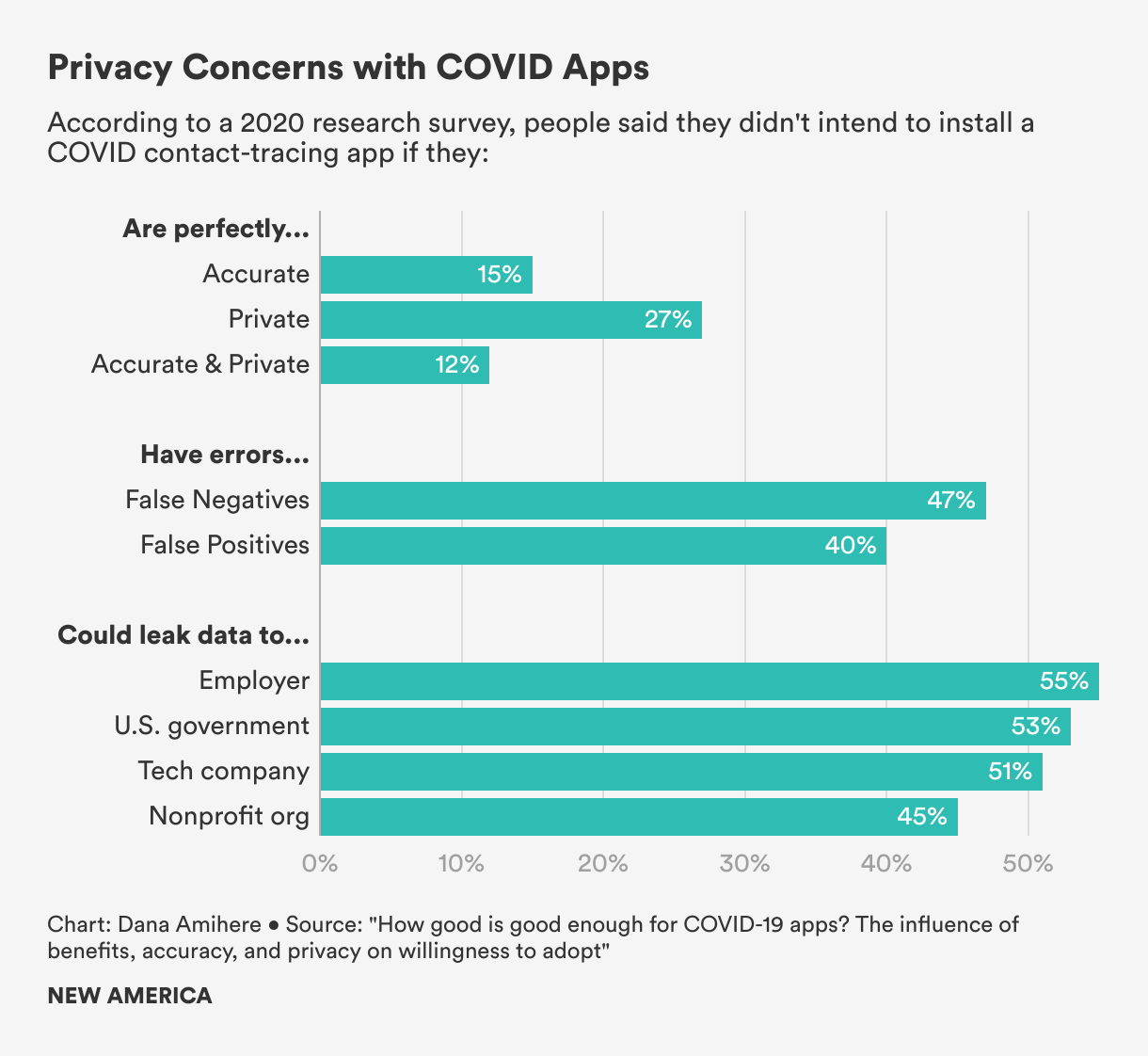
Privacy and doubts about efficacy were also barriers to app usage, according to a 2021 from the Brennan Center for Justice, a nonpartisan policy and law organization. It characterized exposure notification apps in the United States as having 鈥渙ver颅prom颅ised and under颅delivered,鈥� a 鈥渇ailure鈥� primarily stemming from poor uptake. said they wouldn鈥檛 download a COVID app because of concerns about protecting their digital privacy. 鈥淚f Amer颅ic颅ans鈥� concerns about privacy resul颅ted in decreased parti颅cip颅a颅tion in the expos颅ure noti颅fic颅a颅tion apps, it also under颅mined their useful颅ness.鈥�
Bluetooth and GPS Weren鈥檛 鈥淢ade For This鈥�
Apps like CA Notify are interchangeably referred to as 鈥渃ontact tracing鈥� and 鈥渆xposure notification systems,鈥� but they are actually the latter. Exposure notification systems, like CA Notify, don鈥檛 track or trace your personal information to flag a COVID exposure. Rather, they measure how close your smartphone was to another smartphone whose user reported an exposure or infection.
True contact tracing is how public health crises, like outbreaks of sexually transmitted infections such as HIV, are managed. In that case, health care providers personally contact individuals who test positive and ask them for the names of everyone with whom they鈥檝e had intimate contact.
Digital contact tracing apps simplify this process by leveraging GPS location data to notify a smartphone user if they were within close proximity to someone with COVID and where the contact occurred. As a result, contact tracing apps that rely upon GPS have privacy issues around location data that apps using Bluetooth don鈥檛 have. GPS-based apps also drain phone batteries and might not be accurate beyond a distance of 65 feet, according to Wirecutter鈥檚 privacy and security editor Thorin Klosowski, in a November 2020 .
However, Klosowski also argued that exposure notification apps that rely on Bluetooth, like CA Notify and similar apps, aren鈥檛 necessarily any better. Bluetooth measures proximity, but it cannot take into account other factors, such as how people are separated (like by a plexiglass barrier in a grocery store or an apartment building wall) or whether they are masked. 鈥淏luetooth and GPS weren鈥檛 made for this function, so quirks in the technologies may prohibit them from being effective,鈥� wrote Klosowski.
Other experts agree.
The is a San Francisco-based nonprofit that advocates for digital rights and privacy. 鈥淲e don鈥檛 have evidence that this works at scale. We don鈥檛 have evidence that it works in a lot of different places and a lot of different types of communities,鈥� Gennie Gebhart, EFF鈥檚 activism director, said in an interview with Klosowski.
University College London researchers more than 100 studies on automated COVID contact tracing, like smartphone apps, and concluded that the contact-tracing technologies they studied showed no empirical evidence of effectiveness in identifying infected contacts or reducing disease transmission.
Measuring an App鈥檚 Success
The state of California is telling a different story. 鈥淥ur preliminary analyses using mathematical modeling suggest CA Notify may have prevented thousands of new COVID-19 cases and averted hundreds of deaths in California since its launch鈥� on December 10, 2020, according to an email from CDPH鈥檚 communications office.
CA Notify is available to both Android and iPhone users equally, but their ease of use varies. While iPhone users only need to enable exposure notifications in their phone鈥檚 settings, Android users must download the app and activate it. In 14 months, according to CDPH, 16.5 million cell phone users activated the app on both platforms, resulting in 1.19 million exposure notifications being sent out to users in California. By comparison, more than 4.2 million cases of COVID were statewide from December 2020 through December 2021.
By the state鈥檚 estimates, about 52 percent of its residents aged 15 and older eligible to activate CA Notify actually did so. (The app鈥檚 require users to be at least 13 years old.) But state officials said that privacy reasons make them unable to determine how many Android users disabled or deleted the app after downloading it.
Serving the Most Vulnerable
Whether Californians benefited from CA Notify might depend on the type of smartphone they use. PC Magazine estimates that in California, , versus 58 percent for iPhone. Given iPhone鈥檚 significantly higher price than Android until recent years, and the additional labor required to activate the app on an Android device, the findings around who used the app aren鈥檛 surprising.
鈥淭he essential workers at the grocery store or the fast-food restaurant are more likely to be Android users and appear less likely to have activated the system,鈥� Christopher Longhurst, chief medical officer and chief digital officer for UC San Diego Health, the California Health Care Foundation in March 2021. He oversaw a pilot test of CA Notify and its to UC campuses and other UC health systems. Seniors, another vulnerable group, Longhurst said, are less likely to own any kind of smartphone.
Longhurst鈥檚 concerns about vulnerable groups being left behind are backed by research. Age, education, and income are determinants in smartphone ownership. According to a June 2021 from Pew Research Center, people who said they owned a cellphone that wasn鈥檛 a smartphone were more likely to be age 65 and older, have a high school diploma or less, or live in a household with an annual income of $30,000 or less. 鈥淲hile [the survey] couldn鈥檛 explain why someone owned a smartphone, it painted a clear demographic picture as to who did, and didn鈥檛, own a smartphone,鈥� said Monica Anderson, associate director of research at Pew Research.
鈥淲e cannot 鈥榯ech鈥� ourselves out of this pandemic.鈥�
鈥�, activism director with the Electronic Frontier Foundation
and related systemic inequities have been linked to in Indigenous, Black, and Latina/o communities. These groups鈥� overrepresentation among essential workers is one reason.
According to , more than half of Black, Indigenous, and Latina/o workers have jobs that must be done in person, compared to 41 percent of white workers. Black, Indigenous, and Latina/o workers are more likely to have jobs that put them at a greater risk of being exposed to or being infected with COVID, earn less money, and are less likely to have health insurance. In addition, essential workers are more frequently caregivers to children and seniors, and are more likely to be aged 50 and over, according to the .
The very people who were most at risk for COVID exposure were also the least likely to use, or even be able to access, the exposure notification apps that might have protected them.
Battling Mistrust of Both Government and Tech
Aside from accessibility issues, a lack of trust in government surfaces time and again as the primary reason why people did not want to use a technology tool that had the potential to save lives. When it came to CA Notify, Americans distrusted how their personal information would be used, who designed and produced the tool, and the app鈥檚 efficacy.
The , conducted by the nonpartisan Public Affairs Council (PAC), surveys Americans' opinions on business and government. From 2012 to 2017, the tech sector ranked at the top of the list for trustworthiness, but its ranking gradually slipped over the next few years. In 2021, PAC reported that tech fell into sixth place. Of the survey f respondents, 32 percent considered the sector to be less trustworthy than other industries, like banks and auto, and only 16 percent said it is more trustworthy.
Mounting tensions over the tech industry鈥檚 and , of the tech industry and the have led to a steep decline in trust of the sector. 鈥淸We鈥檝e] seen a gradual decline in trust in the technology industry,鈥� PAC鈥檚 report asserts, 鈥渁nd [an accompanying] rise in public appetite for more oversight of tech firms.鈥�
So, what can we learn from CA Notify鈥檚 development and rollout? EFF鈥檚 Gebhart sums it up best: 鈥淲e cannot 鈥榯ech鈥� ourselves out of this pandemic.鈥� The state of California should be applauded for its attempt to work with private sector tech companies to adapt existing technologies鈥攚hile preserving people鈥檚 right to privacy鈥攆or the public good.
But any future apps designed and implemented for public adoption should heed the lessons from CA Notify. It is the government鈥檚 responsibility to serve all residents equitably, regardless of income, location, race, or ethnicity. Technology is not currently accessed in our nation such that tech solutions offer an equitable experience for all. Any government effort that relies on technology must take this reality into account.
Are tech-driven solutions to public health crises鈥攁nd other types of social problems鈥攖he future? Yes. But in order for these solutions to be effective, they must be rooted in better integration of government, technology, and the people being served by both.
More 麻豆果冻传媒 the Author
Issues
Programs/Projects/Initiatives
Topics
Related

Striking Balance between Public Procurement and Innovation
Political Ideology Slows Emergency Help for Renters