Tiffany Thai
Policy Analyst, Center on Education and Labor

State community college associations occupy a quiet but consequential place in American higher education. Operating behind the scenes, they convene college leaders, provide technical assistance on everything from policy implementation to program improvement, and advocate on behalf of their member institutions before state legislatures and agencies. Whether community colleges are organized within a statewide higher education system or governed more locally, associations provide a complementary structure for collaboration and collective action across the sector.
Yet despite the extent to which the infrastructure of community college cohesion runs through them, these state-based associations have received little systematic attention from researchers, funders, or policymakers. As a result, relatively little is known about how these organizations operate and the factors that shape their influence across states. This paper addresses that gap by examining what state community college associations do, how their capacity and influence vary, and why understanding their role matters for anyone trying to strengthen community colleges.
Community colleges occupy a unique position at the intersection of higher education and workforce development. Fulfilling this mission requires them to navigate complex governance environments that often include local governing boards, state higher education systems, agencies, and policymakers. State community college associations help coordinate relationships across these partners, building alignment among institutions and strengthening the sector鈥檚 collective voice.听
The importance of this coordinating role was evident during Community College Day in New York, when leaders from across the state鈥檚 public colleges gathered at the state capitol. In a rare display of unity, trustees and leadership from the State University of New York (SUNY) and the City University of New York (CUNY) advocated for community college funding and other key priorities during the state budget process. Their collaboration reflected ongoing efforts by the state presidents鈥� and trustees鈥� associations to strengthen coordination between the separately governed SUNY and CUNY systems, as well as among institutions within those systems.听
Historically, trustees of community colleges in New York and the state community college presidents鈥� association advocated for internally developed priorities for their respective institutions, approaching policymakers with a separate agenda. In the lead-up to a new state budget, however, members of both groups began meeting bi-weekly, then weekly. Joe Keegan, chair of the New York Community College Association of Presidents (NYCCAP), says the collaboration 鈥渁llowed for relationships to develop,鈥� creating 鈥渁 certain camaraderie that allowed for give and take.鈥� Leaders of the New York Association of Community College Trustees (NYACCT) echoed that sentiment, noting the two organizations are now 鈥渋n lockstep.鈥�
Lawmakers noted that, for the first time in years, trustees and presidents from SUNY and CUNY community colleges came together to advocate for New York鈥檚 community colleges. Rather than speaking on behalf of individual colleges or systems, they advocated as a single coalition. Together, they highlighted the critical role these institutions play in providing accessible, high-quality education and workforce training, while calling for greater state investment ahead of the final state budget.听
The associations laid the groundwork for this unified advocacy effort by creating opportunities for trustees and presidents to build relationships, align priorities, and develop a shared message. By convening institutional leaders around common goals, the associations elevated the visibility of community colleges and strengthened their influence in state policy discussions.
The need for this coordinating role is likely to grow. Community colleges across the country are facing an array of challenges, some old and some new. The acceleration of labor market changes, shifting credential requirements, public skepticism toward higher education, and the looming influence of AI are forcing these institutions to adapt quickly to fulfill their mission of providing accessible, affordable postsecondary education and training. As community colleges navigate these challenges, state associations are well positioned to coordinate across institutions to align advocacy efforts, secure resources, and facilitate peer networks.听
In some states, community college associations are already serving as this kind of connective tissue, a web of support that helps member institutions navigate funding cuts, policy changes, and workforce demands they could not meet alone. In others, that web is thinner, the capacity more limited, and colleges are left to face an overwhelming moment largely on their own. The difference matters enormously. Understanding how these associations operate and what they make possible when properly resourced is important for anyone serious about strengthening community college systems.
We examined all 50 states and identified 35 state community college associations across 28 states. We analyzed the mission and activities of these often-overlooked organizations, with particular attention to the two roles that appear most consistently: convening and advocacy. Our research reveals members鈥� most pressing challenges and illuminates what becomes possible when associations have the resources and capacity to act as infrastructure for colleges that are often underfunded and overextended.听
We implemented a three-pronged strategy to understand the work of state community college associations and ensure comprehensive data collection. First, we limited the scope of our scan to state community college associations that represent trustees, presidents, or general community college membership. With the exception of presidential associations, we excluded associations focused on specific roles within community colleges (e.g., financial aid or student affairs associations within states).听
With this definition in mind, we conducted a web search for state community college associations and scanned their websites for key data points: mission/vision statements, staff numbers and titles, association activities and services, and membership types. We combined information gleaned from this website scan with the state鈥檚 higher education and community college governance types, as defined by 听迟测辫辞濒辞驳测.听
Second, we fielded a brief survey to executives of state associations about their staffing, activities, and priorities to validate information from our web scan. We fielded this survey to 32 association executives in January and February of 2026, which yielded 11 responses.听
Finally, we conducted seven semi-structured, half-hour interviews with association executives to provide additional context and detail on their top priorities, capacity, key activities, and policy advocacy.听
State community college associations largely emerged during the latter half of the twentieth century, coinciding with the rapid expansion of the community college sector in the 1960s. Across the 50 states, we identified 35 associations across 28 states, with most associations founded between 1960 and 2000.1 As community colleges became larger, more interconnected, and increasingly central to state workforce and higher education goals, institutions required new mechanisms for collaboration and advocacy.
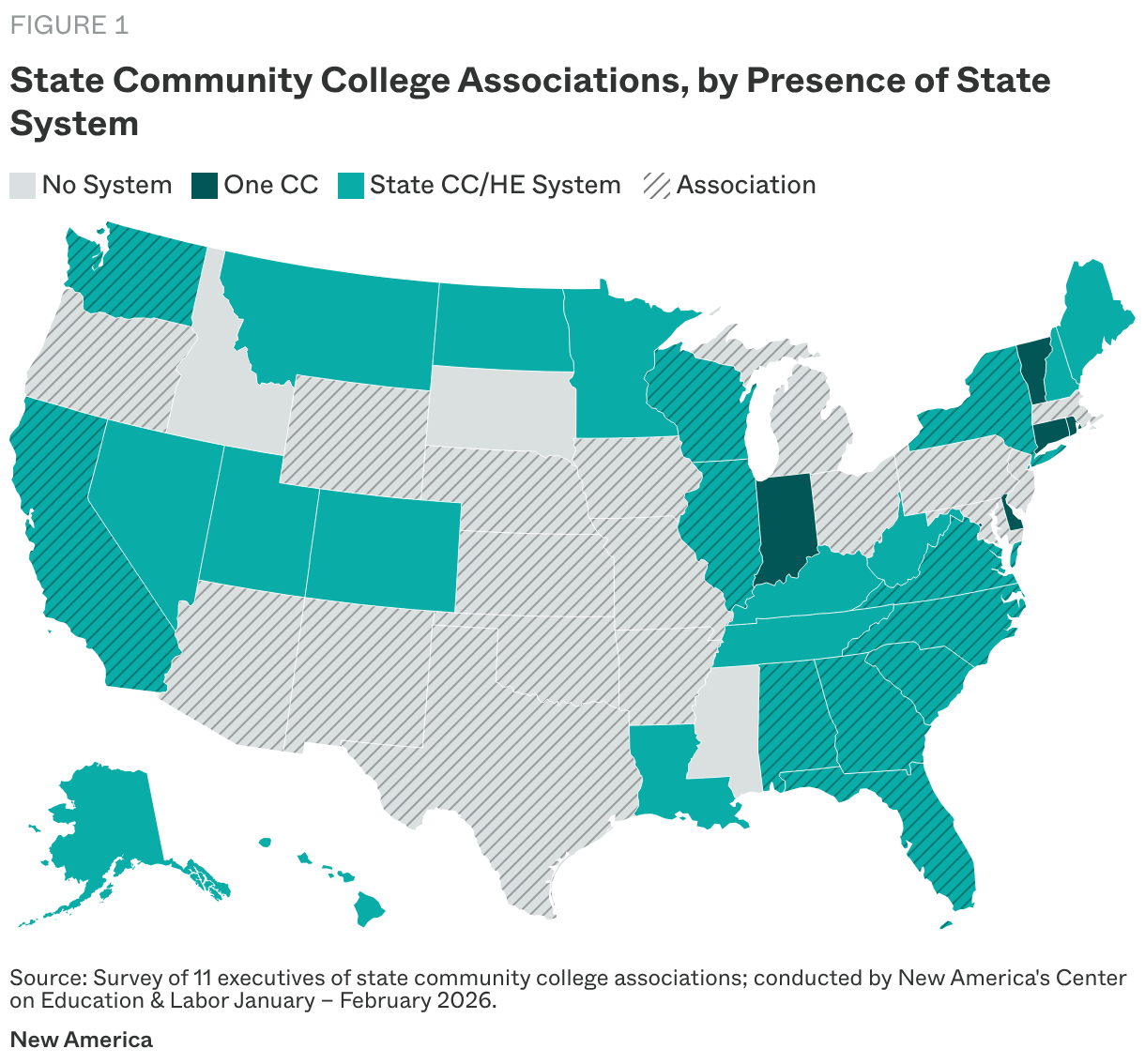
The relationship between state community college associations and statewide governance structures appears to be complementary. Associations are more likely to exist in states without a distinct community college system, a combined higher education system, or a higher education agency, suggesting they help fill statewide coordination and advocacy roles where formal governance structures are limited. As Figure 1 shows, 17 of the 28 states with associations lack a statewide system that includes all community colleges. In these states where community colleges are governed more locally, associations often serve as an important coordinating mechanism. They convene institutional leaders, facilitate collaboration across colleges, develop common policy priorities, and represent the sector in legislative and state policy discussions, providing a unified voice for otherwise independent institutions.
In the remaining 11 states, associations often work alongside or in conversation with state higher education systems and agencies. Unlike associations in states without statewide systems, which are more likely to serve as a primary coordinating mechanism for community colleges, associations in states with statewide systems tend to complement formal governance structures by representing institutional perspectives, fostering collaboration among member colleges, and supporting coordination around shared priorities in statewide policy discussions. Most of these associations were established after the creation of the statewide system, suggesting that they emerged to complement existing governance structures by providing an additional layer of coordination, representation, and support.
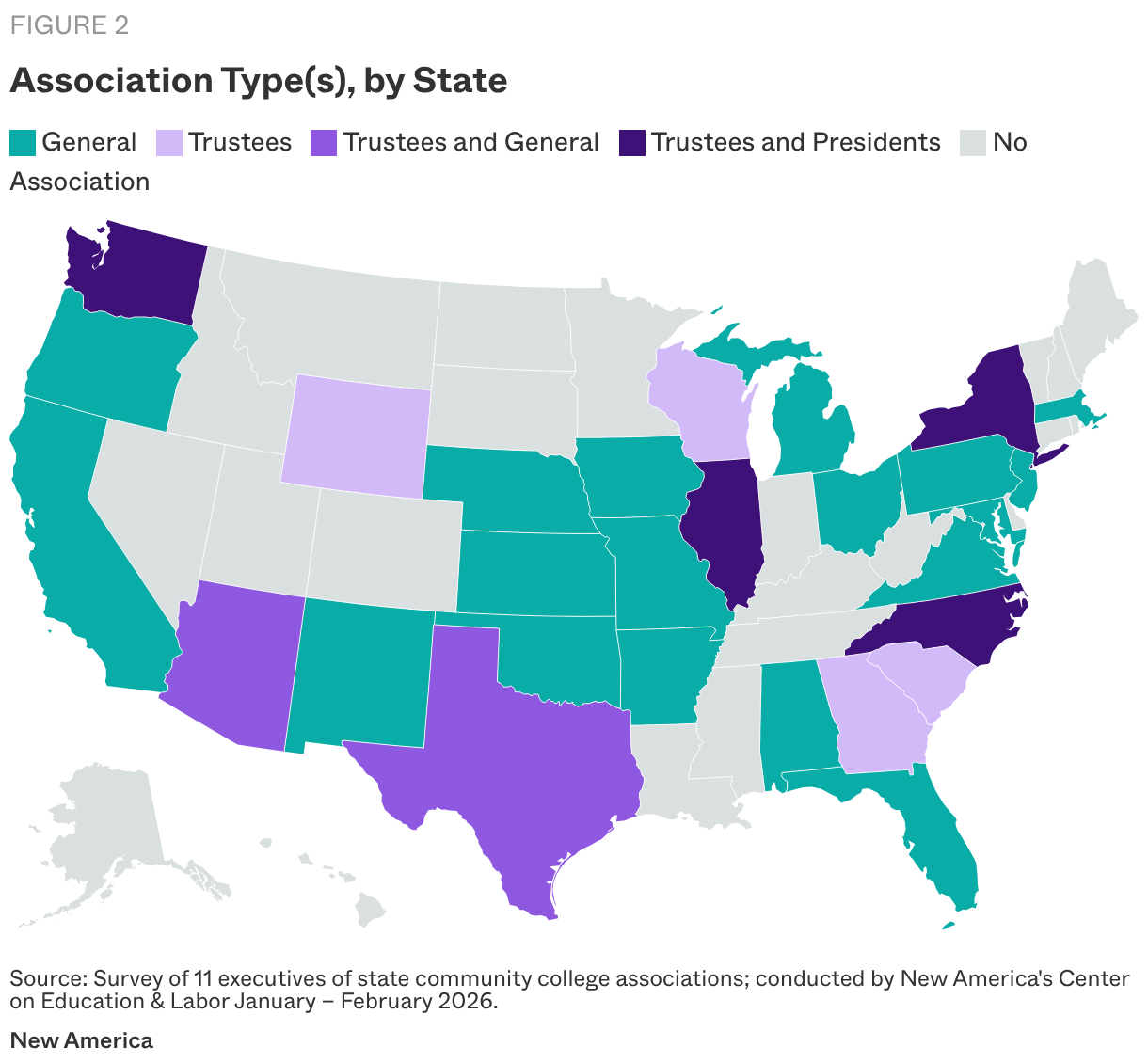
State community college associations also vary considerably in how they are organized. Broadly, we identified four types of statewide association configurations, shown in Figure 2. The most common, found in 18 states, consists of a single statewide community college association with general membership that may include trustees, institutional leaders, and other community college faculty and staff.听
The remaining 10 states are split between six with only a trustees鈥� association (e.g., South Carolina) and those with multiple associations, including four states with separate trustees鈥� and presidents鈥� associations (e.g., North Carolina) and two states with a trustees鈥� association paired with a general association (e.g., Texas). In states with two associations, the organizations may operate as separate entities but still share resources. For example, in North Carolina, they may share staff. In Arizona, they also coordinate branding and activities.
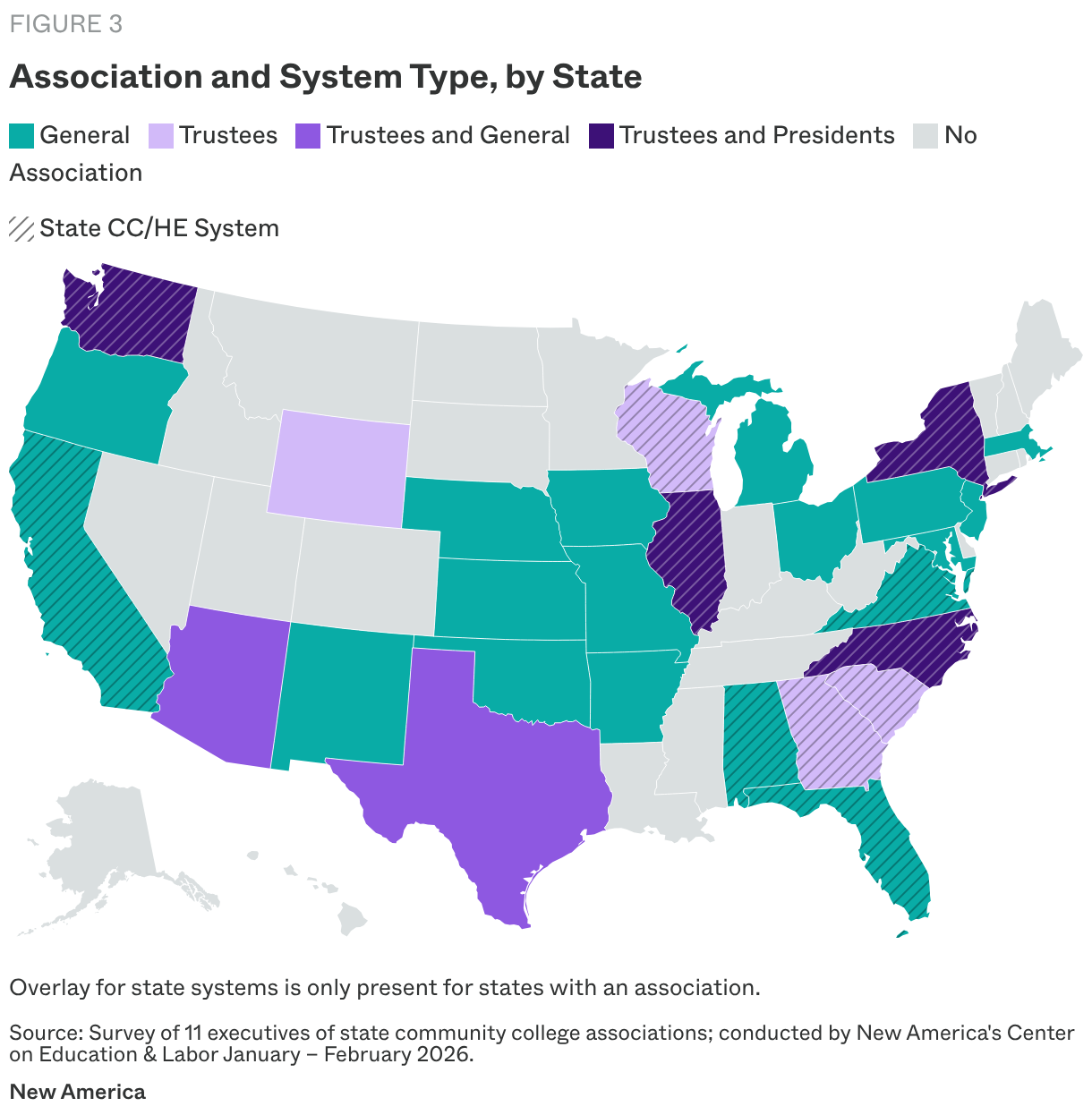
There was some variation in types of associations in terms of the state鈥檚 higher education governance structure, shown in Figure 3. Of the 18 general membership associations, 14 are located in states without a state-level higher education system that includes community colleges. Only Alabama, California, Florida, and Virginia have both a state community college system and a comprehensive state community college association. Conversely, of the 10 states with a freestanding trustees鈥� association, seven were states where community colleges are part of a system. In these states, trustees鈥攕ometimes alongside a presidents鈥� or a general association鈥攑lay a crucial role in advocating for the interests of community colleges. These findings suggest that associations provide an important venue for convening and collaboration, with or without a state system; where formal governance structures are less centralized, associations often become especially important sources of coordination.听
Our website analysis, survey results, and interviews showed that advocacy is the most common association activity (Figure 4). Advocacy includes training members to engage effectively with legislators, tracking legislation affecting community colleges, asking for funding, coordinating policy priorities, and serving as a central source of legislative information. We observed that a majority of the state associations engaged in these activities are located in states without a community college system, suggesting that, in the absence of a centralized system, associations assume key roles in policy coordination, legislative engagement, and agenda-setting for the sector. This function is reflected in their mission statements, where many describe themselves as the unified voice for community colleges. In total, 25 associations explicitly use language such as 鈥渧oice,鈥� 鈥渞epresentative,鈥� or 鈥渁dvocate.鈥�
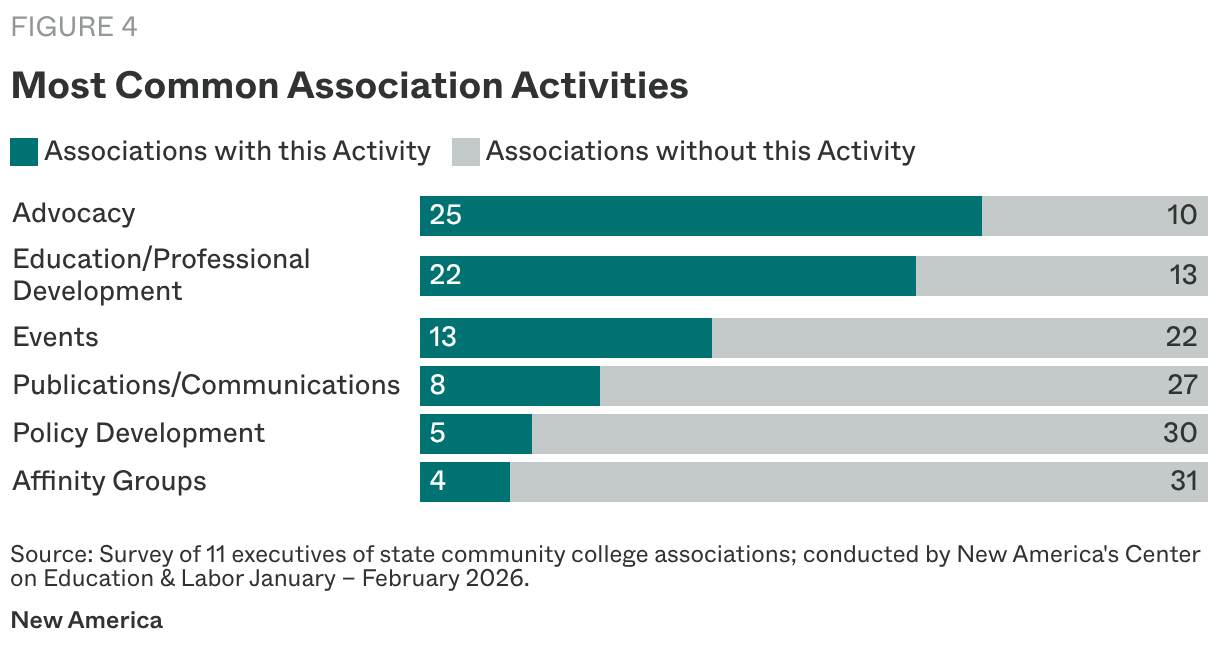
Although advocacy is a more visible function of associations, our research suggests that it is only possible because of the less visible work that comes before it: building relationships, convening and educating members, and creating alignment around shared priorities.听
Education, professional development, and convenings are the next most common association activities. These efforts include orientations, workshops, leadership programs, and statewide gatherings that help members exchange best practices, develop expertise, and respond to emerging issues. For example, the Michigan Community College Association operates a to support professional development among member institutions.听
Associations such as the also use annual conferences and shorter meetings on emerging topics to bring together members around shared challenges and priorities, including an AI summit and events for specific segments of the membership, such as trustees or student affairs professionals.
Many associations also engage in communications, policy development, and affinity group coordination. Communication activities vary widely across associations, ranging from newsletters to long-form publications. The Alabama Community College Association鈥檚 , for example, features institutional updates, messages from association leadership, information on upcoming events, and notices related to association elections.
Policy development often complements statewide governance structures by ensuring that institutional perspectives inform decision-making. One of the core activities of the Washington Association of Community and Technical Colleges, for example, is to 鈥渞eview with and recommend policies and procedures to the executive director of the Washington State Board for Community and Technical Colleges.鈥� Its policy development work complements the role of the state system by bringing presidents鈥� voices into the process in a structured way. The association helps bridge the perspectives of individual colleges and statewide decision-makers, supporting alignment between statewide policies and the realities of institutional implementation.
Affinity groups provide another avenue for collaboration across community colleges. These networks facilitate peer learning, information sharing, and statewide coordination. For example, the Michigan Community College Association coordinates the , a network of Michigan鈥檚 community college professional associations and affinity groups.
Some associations provide technical assistance to member institutions. By directly supporting member institutions and their staff in developing and implementing new policies and programs, associations provide expertise, resources, and guidance that strengthen institutional capacity and enhance colleges鈥� ability to serve their communities effectively. Members of the Oregon Community College Association, for example, benefit from in developing and refining their board policies and procedures.听
The New Jersey Council of County Colleges (NJCCC) provides technical assistance through initiatives such as the (A-TAC), which connects participating colleges and local workforce boards with to develop and expand Registered Apprenticeships. Made possible through support from the New Jersey Department of Labor and in partnership with Jobs for the Future and the American Institutes for Research, A-TAC works across apprenticeship stakeholders, including workforce development boards, One Stop Career Centers, community partners, unions, and the business community. However, the scale of technical assistance remains uncommon: NJCCC has 17 staff members, compared with an average of two across associations in our study. While several associations offer technical assistance, there is significant room to grow in this area.听
While associations carry out a wide range of activities, these functions all help build and strengthen connections between community colleges. These associations provide the infrastructure for collaboration, coordination, and collective action by linking institutions, leaders, policymakers, and other stakeholders across the sector. In some cases, associations extend this connective role beyond traditional higher education relationships by building partnerships with employers, workforce organizations, K鈥�12 systems, and other community stakeholders. While our research found this role to be less consistently developed across associations, examples such as the New Jersey Council of County Colleges鈥� apprenticeship initiatives demonstrate the potential for associations to facilitate cross-sector collaboration. Nevertheless, we identified three primary ways this connective function operates:
The next sections cover how state community college associations carry out these three functions of connection and what enhanced capacity in each area could look like.
In New York, the presidents鈥� and trustees鈥� associations exist independently; however, NYACCT stepped into the role of convener for stakeholders鈥攊ncluding its sister organization, NYCCAP鈥攚ithout a direct mandate to do so. In contrast, other associations explicitly name convening as central to their work. The 鈥渟upports the Commonwealth鈥檚 15 community colleges鈥y convening stakeholders鈥攂oth at the campus level and externally鈥攖o reach shared goals.鈥� The role of bringing members and other aligned partners together is closely interwoven with the associations鈥� advocacy imperative.
However, convening members at all, and doing so effectively, can be challenging. Several survey respondents named member engagement as a barrier their association faces. The chair of one state presidents鈥� association acknowledged the time constraints imposed by institutional leadership. A trustees鈥� association director described geographic factors as limiting. And organizing regular meetings can be difficult if association staff are occupied with other matters.听
Several survey respondents and interviewees told us that, with additional resources, they would prioritize convening more often. Leaders from the Illinois Community College Trustees Association and the Community College Association of Texas Trustees (CCATT) noted the benefit of holding regional convenings for trustees, in addition to statewide meetings, to ensure members farther from the state capital can engage in the work of the association and on behalf of their colleges. CCATT Senior Director Nicole Eversmann described the idea that convening community college trustees with local workforce development boards and school boards could help ensure a locally rooted, cohesive vision for success. CCATT鈥檚 core mission includes advocacy and convening members for professional development and networking, creating opportunities for trustees to build relationships, align around shared priorities, and coordinate strategy.听
Extending the convening role beyond association members to include workforce development boards and school boards would represent a new opportunity for state community college associations. While our research shows associations serving as connectors among colleges, governance structures, and policymakers, this type of regional cross-sector governance convening does not appear to be an established practice in any state. Given the scale of the potential audience in Texas, including 28 workforce development boards, 50 independent public community college boards, and more than 1,000 school district boards, introducing an effort like this would require significant investment in association capacity.
Whether community colleges form a cohesive system or operate independently, they likely engage with a state agency to some degree, whether for institutional control or workforce development. Our analysis found that state associations build on strong internal relationships to engage with state higher education system offices and state agencies. For example, the 鈥� mission statement says, 鈥淭he Association shall provide a mechanism and process for involving the presidents and institutions in making system-wide decisions.鈥� This type of relationship forms another layer of consensus-building and collaboration, supporting effective advocacy and helping state agencies receive input from the community college sector.听
As discussed, state governance structures vary considerably. In some states, community colleges are part of a coordinated statewide system. In others, they are governed independently or through university systems. Arkansas illustrates the latter model. The majority of Arkansas鈥檚 public two-year colleges are now part of the University of Arkansas system. Of the state鈥檚 22 public institutions whose highest degree offered is an associate degree, eight remain independent. They are members of the state community college association. The association鈥檚 mission statement notes that it serves as 鈥渁 stronger, more unified body,鈥� reflecting its efforts to foster coordination among independent community colleges. The state association鈥檚 relationship with the university system is strong and collaborative, and the association works as a voluntary partner to the system in advocacy efforts. Representatives of both the university system and the state community college association in Arkansas are at the state capitol meeting with policymakers and staff during the legislative session.
Similarly, New Mexico has a combination of locally governed and university-affiliated community colleges. Since Vanessa Hawker became the executive director of New Mexico Independent Community Colleges, she has strengthened the relationship with her counterpart at the Council of University Presidents, helping community colleges and universities shift away from a sense of competing interests and toward early alignment on the core 鈥渕eat and potatoes鈥� of higher education funding. This collaboration has supported joint advocacy for unified higher education budget requests, making the system more responsive to stakeholders across the state.
Of the 11 survey respondents, only five noted working closely with their state workforce development or labor department. One interviewee mentioned working recently to build a relationship with their state apprenticeship agency. Though higher education may provide the primary funding mechanism for community colleges, stronger connections with workforce agencies could help ensure that community college perspectives inform workforce policy and funding decisions.
Advocacy is a key function of these associations, and their mission statements highlight several common policy priorities. The most frequently emphasized priority is student success (13 associations), including completion and retention goals, transfer pathways, and equity initiatives for underserved students. A second major priority is access and affordability (11 associations), emphasizing the role of community colleges in providing open, equitable, and financially accessible higher education. The third most common theme is workforce and economic development (11 associations), highlighting the role of community colleges in preparing students for employment through high-quality training and career pathways.
Advocacy efforts generally center on the state legislature. For instance, the Illinois Community College Trustees Association has worked with the Illinois Community College Board and Illinois Council of Community College Presidents to advance . The association has made this a legislative priority for 2026 by tracking the bill, coordinating advocacy efforts, providing members with advocacy resources and research, and encouraging college leaders to stay engaged with state lawmakers as the bill moves forward.听
Advocacy also extends to the governor鈥檚 office. New Mexico is preparing for a gubernatorial transition next year, and the state association of independent community colleges plans to prepare transition memos for the new administration. It will also prepare information on the return on investment in community college education for both the governor and the state legislature. In New Jersey, the New Jersey Council of County Colleges has worked with the governor and state legislature to sustain investment in initiatives such as , which brings together employers, industry, education institutions, and workforce development partners to provide students and workers with education and career pathways.听
Beyond advancing specific policy priorities, associations also play an important role in shaping policymakers鈥� understanding of community colleges and the value they provide. Part of the advocacy work these associations carry out is narrative in nature, ensuring policymakers have a clear picture of how community colleges serve their students, communities, and employers. As one leader of a state trustees association described it, state advocacy is 鈥減romoting the value of colleges and helping people understand that it isn鈥檛 what they think it is at community colleges.鈥澛�
Misconceptions about who attends community colleges and the ways these institutions serve their communities can be countered through stories and data. One general state association director ensures that member institutions share aggregated data on programs and outcomes, which the association analyzes together, so that legislators and other policymakers have a sense of the return on investment across these institutions. By transforming individual institutional outcomes into a collective story about statewide impact, associations help policymakers see community colleges as a coordinated sector rather than a collection of separate institutions. This approach helps policymakers better understand the role of community colleges in higher education and workforce training. By integrating member colleges鈥� data and sharing findings within a broader narrative, association leaders position community colleges for future resources.
When we asked leaders to describe how they would expand association activities if they had more funding and staff capacity, the most common survey response was 鈥渢o enhance advocacy activities.鈥� Some activities in this vein involve engaging membership in additional advocacy training or meetings to coalesce around an advocacy agenda. Effective advocacy is time- and resource-intensive work. It requires staff who can track legislation, build relationships with policymakers, and help members build consensus around policy priorities. But the associations that do this work most effectively are not doing it alone. They are building coalitions with peer organizations, workforce agencies, and other aligned stakeholders, extending their reach well beyond what their staff size would suggest they can accomplish. Investing in association capacity is therefore an investment in the network of relationships through which community colleges make their case to the people who control their future.
State community college associations are carrying out important work to unite stakeholders around a vision of higher education and workforce development that meets state and community needs. But associations cannot advocate effectively without convening members around a shared agenda, and they cannot build institutional capacity without the relationships that convening creates. Funders and policymakers can help support this work in three ways.
1. Support associations as conveners. State community college associations are often the only entity in a state with both the mandate and the relationships to bring college presidents, trustees, and aligned partners into the same room around a shared agenda. But the staff time, logistics, and travel costs required to convene members regularly, let alone to expand those convenings to include workforce boards, K鈥�12 partners, or policymakers, can be prohibitive.
Philanthropic funders and state agencies should consider direct operational support for convening functions, including multi-year general operating grants that give associations the flexibility to build the relationships that make their advocacy, collaboration, and capacity-building efforts more effective. Convening is the foundation on which advocacy, collaboration, and sector alignment are built. Supporting this function enables associations to build relationships and networks that position the community college sector for long-term improvement.
2. Support associations as capacity-builders. In states without a centralized community college system, state associations are often the closest thing the sector has to shared infrastructure. They support increased college capacity by coordinating the pursuit of grants, facilitating peer learning, analyzing cross-institutional data, and helping colleges access technical assistance they could not afford individually. This is significant, load-bearing work that typically falls to one or two staff members already stretched thin by other responsibilities.听
Funders should consider targeted grants that enable associations to hire dedicated capacity-building staff or develop shared resources such as data dashboards, policy implementation guides, and peer learning networks that individual colleges can draw on.听
Building association capacity represents a multiplier investment: Strengthening one organization can increase the ability of dozens of colleges to learn from one another, respond to policy changes, and pursue shared opportunities. In states without systems, strengthening the association is the most efficient way to strengthen the sector as a whole.
3. Support associations in advocacy. Advocacy is the most common function of state community college associations, and it is also the one most dependent on resources that most associations do not have in sufficient supply, like staff capacity to track legislation, relationships with key policymakers built over time, and the ability to mobilize members around a clear and timely message.听
The current policy environment makes this capacity even more important. Community colleges are navigating simultaneous disruptions: federal funding uncertainty, shifting workforce demands, and state budget pressures that threaten the open-access mission. Well-resourced associations can respond to these pressures in real time by briefing legislators, countering harmful narratives, and making the case for community colleges when it matters most.听
Philanthropic funders have a role here: Advocacy is often excluded from restricted program grants, leaving associations to fund this core function with dues revenue that was never designed to support it at scale. General operating support and advocacy-specific grants would allow associations to build the sustained policy presence that community colleges urgently need.听
In New York, trustees and presidents from SUNY and CUNY community colleges arrived in Albany with a unified message: Investing in community colleges strengthens the state鈥檚 economy, develops its workforce, and expands opportunity for students. Their coordinated presence signaled not only the importance of community colleges but also the power of alignment across historically separate systems.听
That moment reflected painstaking behind-the-scenes work by the presidents鈥� and trustees鈥� associations to build authentic partnerships across institutions and higher education systems. As Wendy Waters, incoming chair of the New York Association of Community College Trustees, explained: 鈥淲e really are the convener. That isn鈥檛 part of our official mantra, but that鈥檚 really what we have become in the last two years.鈥�
The impact of that collective advocacy was reflected in the governor鈥檚 final budget. SUNY Community Colleges received an , including $4 million in unrestricted operational funding鈥攁 priority for the associations. The budget also included the expansion of , advancing shared goals around college access, student success, and workforce development across the state.
These investments reflect the value state leaders place on community colleges and the students they serve. They also demonstrate how associations translate institutional priorities into collective action by creating a stronger, more unified voice for community colleges in state policy discussions.
Through their roles as conveners and advocates, state community college associations build the collective capacity needed to navigate complex higher education governance structures. By fostering relationships, organizing shared priorities, and connecting institutions with various stakeholders, they serve as critical intermediaries between colleges and decision makers. They are not simply support organizations; they are the connective mechanism through which community colleges function, collaborate, and articulate their values and needs.
We are grateful to Lumina Foundation for supporting this work on the foundation that state community college associations provide to their members and all who benefit from stronger, well-organized advocacy for these institutions. Olivia Sawyer and Iris Palmer provided enormously helpful comments on drafts of this brief. We thank Katie Portnoy, Mandy Dean, Liz Cory, and Lillian Castrillon for their help with production. And we could not have carried out this research without the state association leaders who shared their perspectives with us through survey responses, interviews, and email discussions. We appreciate their contribution to this brief and their work for the nation鈥檚 community colleges.
Policy Analyst, Center on Education and Labor

Senior Policy Analyst, Center on Education & Labor