
In South Korea, Democracy鈥檚 Thumping Triumph
These days, it鈥檚 largely impossible to talk about democracy without also mentioning how it鈥檚 on life support. From the United States to France, democracy鈥檚 defenders are scrambling to protect liberal institutions from the illiberal forces that threaten them. Still, this doesn鈥檛 mean that all’s lost. To see why, though, we ought to look beyond either side of the Atlantic鈥攖o South Korea.
Last Friday, former South Korean President Park Geun-hye was arrested, becoming the country鈥檚 first leader to be put behind bars since the 1990s. Several weeks prior, Park had been to the bribery and corruption scandal that led to her formal removal from office by the Constitutional Court on March 10. Growing up in the Blue House, the official residence of the president, had blurred the lines between public and private for Park, the daughter of military dictator Park Chung-hee, who had previously swapped the country鈥檚 democratic principles in exchange for stability and economic development. Park鈥檚 inability to distinguish between official state business and private matters, at least in part, led to the former president鈥檚 confidence and trust in , a long-time friend, advisor, and shamanic leader who was indicted for bribery, abuse of power, and leaking classified documents.
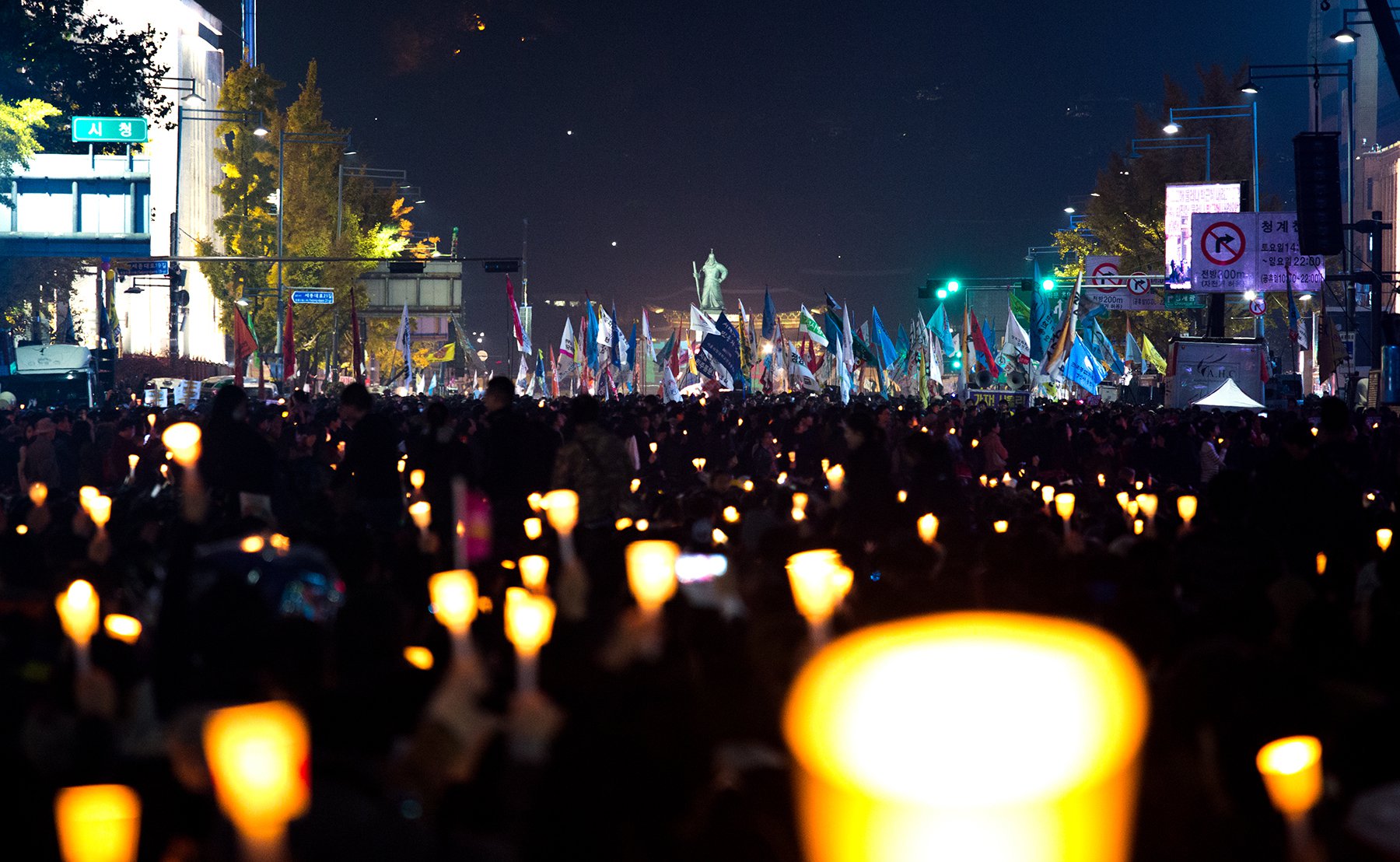
Even after her official ousting, Park took two days to vacate the Blue House and 10 days to . Just days after her arrest, the 聽was finally lifted after聽a disaster claimed 304 lives back in 2014, a symbol of Park鈥檚 aloof presidency. Her removal followed months of popular protest as took to the streets, converging week after week at Seoul鈥檚 City Hall plaza, to demand her resignation. Korean civil society has long used protest as a way to advocate for change. This is because, with a fluid and changing political structure, Koreans are unable to influence policymakers in the same way that, say, their Americans counterparts can. Calling a senator or writing a letter, for instance, doesn鈥檛 have the same weight in Korea. Unlike in the realm of American politics, where the two-party system reigns, South Korea has a parliamentary structure with multiple parties that often splinter, merge, and change names. Park鈥檚 struggling Saenuri (New Frontier) Party, which was created in 2012 for Park鈥檚 election, just in February. And in the 1990s, the conservative parties to create a mega-conservative block.
In important ways, Park鈥檚 presidency, which began in 2012 when she secured a victory with a slim majority of just north of 50 percent of the vote, was a of Koreans鈥� long-held trust in a human rights-economic development trade-off. Initially, citizens wanted a leader who could guide them through the lingering global financial crisis of 2008, and they thought that Park, like her authoritarian father before her, could do that. But over the course of her presidency, there was a change of political heart among the citizenry, who for the past several years now have sought an out from Korea鈥檚 decades-long rule by military dictatorship.
As a result, the recent candlelight protests mark a historic moment for Koreans, who not only succeeded in to vote for impeachment on Dec. 16, but who also saw the Constitutional Court unanimously uphold their decision on March 10. For one of the first times in Korea鈥檚 relatively young and wobbly democracy, protests had been wielded as a peaceful tool to shift public policy. As conservative and far-right populist movements gain traction throughout the United States and parts of Western Europe, many have . In South Korea, however, after 10 years of corrupt conservative rule, Moon Jae-in, the leader of the liberal Democratic Party, 聽on Monday and is the upcoming election.
That said, with only 33 days to go until the snap election on May 9, tensions are running high in Korea and throughout the region. earlier this week in response to US President Donald 麻豆果冻传媒 meeting with Chinese President Xi Jinping. A recent visit by US Secretary of State Rex Tillerson aggravated relations with North Korea when Tillerson stated that US with the pariah state had ended. (Last year, Park鈥檚 conservative party also closed the , which for years had been a key diplomatic initiative between the two Koreas.) And prior to leaving office, Park had approved the deployment of THAAD, an advanced anti-ballistic missile system. to its military operations, which has fueled economic attacks on Korean businesses within China.
The investigation into Park鈥檚 involvement in bribery, extortion, and abuse of office will continue as Koreans prepare to head to the polls, while she and . If indicted, Park will face trial on a corruption scandal that includes $38 million in bribes. Corruption has long been woven into the crony capitalist system of South Korea, so whoever is elected next will hardly have it easy. This person will have to convince the Korean people that they will limit abuse of power within the government and put the country on track for growth, as Park has left her successor with a sluggish economy, soured relations with neighbors, and an impatient population that鈥檚 hungry for change.
Yet while it鈥檚 impossible to predict how a political landscape as robust as Korea鈥檚 will play out in the future, the dramatic end to Park鈥檚 fraught four-year presidency reflects a hopeful shift away from the cold war politics enlisted by her father to spur economic development at the expense of human rights. And there鈥檚 a renewed hope in Korea that citizens will continue to be engaged and informed following the recent candlelight protests. Conservatives noted, smugly, that candles flicker in the wind, hinting at the tenuous power of protest. In response, Koreans started utilizing LED lights. This resilience and stamina reflects a new unity among the majority of Koreans, and the upcoming election will likely reflect the frustrations of the people. But regardless of whom Koreans choose as their next leader, this current political moment already marks a pivotal chapter in the country鈥檚 modern history. Indeed, it鈥檚 proof that liberal democracy isn鈥檛 necessarily dead鈥攖o the contrary, in Korea, we鈥檝e just seen its thumping triumph.
More 麻豆果冻传媒 the Author
Related

New Findings on Student and Public Stances on Higher Ed

Self-Determination or Security: Why Should Gig Workers Have to Choose?
Hiding the Bottom Line: Three Bills That Would Weaken Financial Aid Transparency
