Brigid Schulte
Director, Better Life Lab
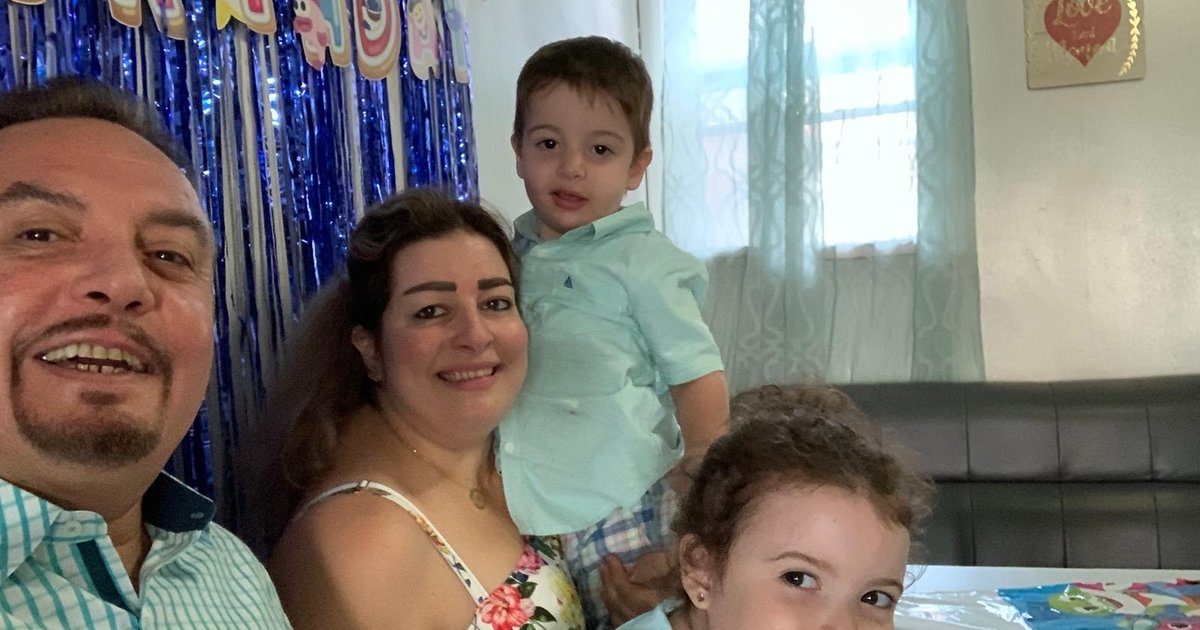
Ruaa Sabek, 40, came to the United States from Syria in 2016. Her husband, a Syrian who was living in Venezuela when they met, works as a manager and cook in a fast food restaurant, King of Wings. They have two children, Perla, who is six years old, and Raam, who is four. The two met on Facebook in 2013 and became engaged when he visited her in Syria in 2014. Because of the civil war there and the complicated paperwork to get her a visa, they weren鈥檛 able to marry, and she wasn鈥檛 able to come to the United States until 2016. They settled in Philadelphia. The move surprised even her.
鈥淚鈥檓 a very practical person. I never really believed in love. But I鈥檇 never met somebody like this. This is the man who I really wanted to be with. And, funny thing, my family didn鈥檛 want me to travel here, but they love him," says Ruaa. "He鈥檚 a good man. I鈥檓 the only girl in my family; I鈥檓 very attached to my mother and father. They didn鈥檛 want me to travel. So it was very hard for us. But my mom was brave, and she told me, 鈥業 want you to be happy. But I don鈥檛 want you to be happy and so far away from me.鈥欌��
For the first few years of her children鈥檚 lives, Ruaa stayed home to care for the children because she had no family nearby to help her, and the family couldn鈥檛 afford child care.
鈥淭his is what we do in my country鈥攊f mom has to go to work, the kids spend a little time in the daycare, then with grandma or grandpa,鈥� she says.
Out of necessity, she began working part-time as a cashier in 2020 when her husband鈥檚 hours were cut in half at the start of the pandemic, but child care costs ate up most of her salary. Child care subsidies and federal pandemic aid saved the family from financial disaster. And it provided enough cushion for Ruaa to complete two workforce training programs. Though she wanted to work virtually so she could be near her children and received a certificate in medical coding, the job offers didn鈥檛 materialize.
In January 2024, she began working full-time in a bank, effectively doubling her salary and reducing the family鈥檚 public benefits. Ruaa dreams about not only financial stability, a good education, and a better life for her children but also time to spend together as a family.
This is Ruaa Sabek鈥檚 story, edited for clarity and length, as told to Brigid Schulte.
When the pandemic hit, there were no jobs. Even my husband, they reduce his hours. He worked at a restaurant, and like all the restaurants, some closed, some just do the pick up, some just reduced hours. It was like a tough time. My husband was working 40 hours a week, and in the pandemic, they just fall down to 24 hours a week. His income was cut almost in half.
But because my husband was still working, we don鈥檛 get any unemployment. They help the people who don't work. But because my husband, his place was open鈥攖hey never closed鈥攋ust reduced his hours, we didn鈥檛 get that. The good thing, we got Medicaid, sorry, or Medicare? Medicaid. I鈥檓 a U.S. citizen, but I鈥檓 a new U.S. citizen, so some things is still not clear for me.
We also have food stamps. And in the pandemic, they increased the amount. And this is really good, because during the pandemic, the prices get very crazy. Like, for example, before the pandemic, I go to any grocery store and for 100 bucks, you buy your stuff for two weeks or three weeks. But now, if you spend 100 bucks, it's for three or four days. So, this was good during the pandemic. They also help us with the rent assistance. They helped us with a three-month payment when we were overdue. They help us. I have a fish memory, but I remember this.
I remember they sent for us $300 or $400 three or four times [in the monthly extended Child Tax Credit], and it was really helpful. We used it for expenses鈥攖he bills, the food, everything at home. The kids were growing up and they need more stuff. Diapers. Milk. More clothes. In the holidays, they need more stuff. There鈥檚 laundry. Cleaning stuff. Like every home, even if you try to reduce your needs, you still need too much stuff.
We have one car. Me and my husband, we share our car, and it just stopped one day and we don鈥檛 know what the problem is. So we take it to the mechanic. And I remember they told us it needed a new transmission and it was going to cost about $2,400. We don鈥檛 have this in the pocket. We can鈥檛 afford a new car. So, they tried to order a transmission for us. I remember the day the [stimulus] check came, and that helped us a lot with this.
We have central heat at home, but for some reason, in the second floor, it doesn鈥檛 work good. So we got two heaters for our room and for the kids room. It cost a couple hundred, so [the payments] helped us with that. I saved a little bit for other years or to take the kids to the beach. So, because I didn't have income by myself [at the start of the pandemic] and my husband had the income for the daily basis stuff and the rent, and it was reduced, [these payments] really helped a lot for us.
When I think about that period, I think without the [government] help, it will be very bad. If I am [just] with my husband, everything will be ok, we can handle it. But with the kids, it was a really tough time.
I started working at the same place as my husband. He鈥檚 the manager of a fast food restaurant for 20 years. They needed a cashier on the morning shift. So I was working 10 to 4, 10 to 5 a few days a week. And on the days I was working the morning shift, my husband worked the night shift. We live across the street from the restaurant. So it was a good position for me. My husband was with the kids while I'm working, and I do the same while he's working.
Usually, I take them with me everywhere鈥攖o do the shopping. To Walmart. To the grocery store. On the weekend, we usually go outside. The kids like to have fun. We go to the playground. Sometimes we go in the summertime to the beach. In the pandemic, I never take my kids out to any place, even when I go to the grocery store. I remember I was wearing a raincoat over my clothes. I was wearing gloves. I put on the mask. And when I come home, on the porch, before I come inside, I take off my raincoat, I take off everything, and put it in a trash bag outside and close it. I have sanitizer. I wash everything with white vinegar. I take a shower and clean myself before I touch my kids. It was a huge thing. Even when my husband came back from his work, he did the same procedure鈥攖ake off all his clothes on the porch. I did his laundry by itself because he was in touch with people every day at the restaurant. We tried to protect the kids as much as we could.
With two kids, it鈥檚 very hard to stay at home for a long time. They feel bored. They draw. They play. We do puzzles. We have all the toys for their age. But they still feel bored. So, if it was a good day, I went outside with them and just walked. We live on a small street. I just go out with them a little bit and go back. I have a friend with two girls. They are like almost in the same age of my kids. So we start to see each other after the three months. We don鈥檛 want any chance to get the virus because when the pandemic started, it was very dangerous. Everything was not clear. A lot of people passed away.
My daughter was crying. 鈥淢ommy, I want to go to Walmart. Mommy, I want to go to Acme [grocery store.]鈥� I had to say, 鈥淣ot now.鈥� It was hard for her.
When they reduced my husband鈥檚 hours, I needed to work. So, I go to the daycare about three blocks from my house and enroll my kids. I enrolled Perla in Philadelphia Head Start. She can go for free. I enrolled my little one, he was to turn two in September, in daycare. I was paying $250 per week for my son, September, October, November, December. And I have to pay for after care hours for Perla, too, something like $15 or $25 per day for after care. I was talking to the director there. I had a balance with them, and I said I need some help to pay. I鈥檓 organized. I know how much comes in and what we need to spend. And I鈥檓 doing the best I can with them. I asked for a payment agreement. She asked me, 鈥淗ow many hours do you work?鈥� I said I work 25 hours. And she told me, 鈥淵ou are eligible for CCIS.鈥� []
I never hear about that. It鈥檚 a program for kids whose parents work, either full time or part-time, and they pay for the daycare. So, I enrolled in December 2020, and they start to pay for my baby in January 2021. After that, I was paying $28 or $30 a week. That鈥檚 it. Oh my God, it鈥檚 a huge help for me. When you talk about paying $1,000 a month for one child and about $300 a month for the other child, $1,300 is not a small amount for me. At my job, they were paying me $11 or $12 an hour. When I enrolled [in CCIS,] this have a good effect, because I have much more money in the pocket. I can manage that for other needs, like bills for the electricity or bills for the gas. It was a good help for us. I feel like, Oh my God, like, peace of mind.
I visited the office just the first time I enrolled the kids with it. I take for them all the documents that they want鈥攖hey want a copy of their birth certificate, their social security, our pay stubs, proof of residence. Oh, this is tough.
It was very stressful. Before, I was thinking I just wanted to be off with my youngest one and sit with him at home, because the oldest one was already enrolled in a free program and I can鈥檛 handle $1,300 per month just for the daycare. It was almost all of my income, and sometimes maybe more.
The director was very helpful. That鈥檚 what I always think about. In the community, we need some people just to make things simple. I am here for eight years now. I am an American citizen. But everything is new for me. You don鈥檛 know about any laws or community resources. I have my church community. Sometimes if I need anything, they recommend something for me. For example, my church recommended this program,, when I was pregnant. A nurse visited my home every two weeks. She helped me a lot with resources. They helped me with WIC [Women Infants and Children.] She actually go with me, I was pregnant with my second baby, and she helped me with all the paperwork to do the application for food stamps. To do that on my own, it will be too much. It鈥檚 not that the language is the problem, just I don鈥檛 know what I have to put there. I just need some instructions to make sure I don鈥檛 put in the wrong information. She was with me step by step. She was very patient. We were there between one and two hours.
During COVID, we start to meet virtual. They help me find clothes for the kids. They have a diaper bank. They are with the kids through age 5. So I learned to always ask for help. If I go to a health center, I ask about it. If I go to school for the kids, I ask about it. At the library. Through that, I find resources. It isn鈥檛 easy. It takes time.
I wanted to enroll my children in a Catholic school, like me and my husband. That鈥檚 how we grew up. I know Catholic school is private school, and it costs a lot of money. So I was a little bit disappointed. I returned to the same director of the daycare. She told me I could apply for a scholarship. The name is CSF [privately-funded.] They pay for school from kindergarten to the eighth grade. You have to be eligible鈥攖hey ask for the taxes for the last three years. They ask for your pay stub or W2 every six months. So I do all the paperwork the year before, and my daughter was accepted for that. They pay almost 75, 80 percent of her tuition. And when one child is enrolled, the other will be enrolled automatically.
I want to recommend this for everybody I see because CCIS is a great program for the moms and dads who really need to work.
In 2023, My husband was still working reduced hours. He doesn鈥檛 have more time, like before the pandemic. So, I needed to work full-time to support our family. Everything, the prices get high for some reason. The kids鈥� Catholic school. I have too much expenses, so we have to do it. At the restaurant, I was there three or four years, and the highest pay there was $16 an hour and they don鈥檛 give benefits. And the thing with being a cashier, I don鈥檛 have a regular schedule. Sometimes, they need me on the weekend.
I was hearing about this program from the social media, Instagram community page鈥擮IC in Philadelphia. [] They have a free program to train people to get a job. They have a bank work program, a nursing program, a cooking program, medical administration. I had to take an English test and a math test. The first month was all virtual training from nine to two p.m., three days a week. So it was good, because I already drop my kids at school at 8 and need to pick them up at 3. And I could adjust my work schedule. Then they start us on resumes and interviews for work. I finished the program and already got some job offers.
I now [work as] a personal banker at PNC Bank. If you want to open an account, if you wanted to get a credit card, if you want to get a mortgage loan or auto loan, if you wanted any other kind of account, I will help you. It鈥檚 a lot of responsibility. It's not easy. But I like to learn. I'm hungry to learn everything. I feel it was a big break with the kids, with my motherhood, with everything. And now, I just want to continue with that. I started January 2, 2024. It鈥檚 8:30 to five. They pay me $45,000 per year. I made about $20 or $21 an hour. I have benefits, like a retirement plan, health insurance, life insurance. The whole package of benefits. This is a good opportunity for my family. This year, I will pay a little bit more child care because I start a new work, and I need to update everything.
I don't worry about my kids. This is a good schedule for me. So that's what I need. I need a stable career with a good schedule and good benefits. I don't have a college degree. I do some college in my country, [I studied English at the University of Damascus] but here actually, I was thinking to do something, because I just heard about the university. You don't have to pay too much money. It will be online. I am interested in administration. takes four years to have the degree. So, but it will be good for me鈥攎y career, my future, because when you have more degrees, it will be good for you.
It鈥檚 not easy to have an easy life. It's not easy to have all what you want. For me, the first thing is education for my kids. I want to give them all what I can, or maybe more. That's what I really focus on. Because they're still very young, and I feel like they need me. So, this is the thing. The other thing, what I was thinking of, the community or the government, they provide a lot of help or assistance to the people. But always I talk about one thing鈥攚e need more program for the kids. For example, more sports, maybe art. I need my kids to enroll in this stuff because we don't have family here. So I need them to be busy with useful stuff. When I was searching for this, all this stuff is really costly. Like if I want football for my son or art or gymnastics classes, all this stuff is really costly. I don鈥檛 know if this is possible. I know that we have a lot of [recreation] centers, at almost every playground. But they don鈥檛 all have programs for kids. Active programs so they don鈥檛 need to be on their phones or tablets. Just like they provide food stamps, cash assistance to pay some of our bills, which is really very important. But the kids, 5 to 12, we need to make them more busy with useful stuff. I can't afford to enroll my kids in many activities鈥攖hey go Saturdays to art class, and it's actually a program with the school. I pay just like a little bit鈥�$100 for three months. I just have to choose. Like for summertime. My neighborhood is safe, but we don't have a lot of kids. It's more like elderly people around us. It鈥檚 an urban neighborhood with a lot of cars.
I need to work a full-time job. My husband needs to work a full-time job if we want a better life for our kids. But before, I picked the kids up at three from school, then spent all afternoon with them, all the evening. I was more engaged. We do all the homework together. We talk. Since I started work full-time, it's a little bit hard, because I have just like two hours. I get home around 5:45, because I need to come by bus. Sometimes that takes 30 minutes. Sometimes 35 minutes. So we change our clothes, then have our dinner at seven. Then we have just one more hour to do everything. The only day that we spend as a family鈥攎e, the kids and my husband 鈥攊t's just Sunday.
So what I try to do, it is just like quality time. Even if we don't have too much time together, I just try to make sure when we get time together, it will be with no phones. We eat together. We play together. Sometimes I feel I'm very tired to jump with my kids when we go out, but I feel I need to.
Director, Better Life Lab