Abbie Lieberman
Senior Policy Analyst, Early & Elementary Education
Before coming into work this morning I made a stop at the Center City Public Charter School Shaw campus, like I do most Tuesdays. Down in the school鈥檚 basement is a small room with approximately 12 desks; the walls are covered with maps, colorful posters, and student worksheets. There are carts full of books and a shelf lined with about 50 student folders.

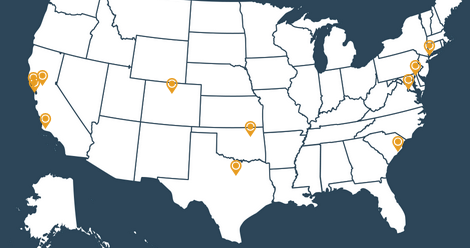
This is the school鈥檚 designated 鈥渞eading center,鈥� where kindergarten through 4th grade聽students who are struggling with reading come once or twice a week to receive 45 minutes of one-on-one tutoring. The tutors are community volunteers who commit at least one hour of their week to work with an assigned student. Reading Partners, which started in northern California and has been quickly expanding across the country, is a nonprofit organization that works with under-resourced schools to improve student literacy, partially thanks to a award.
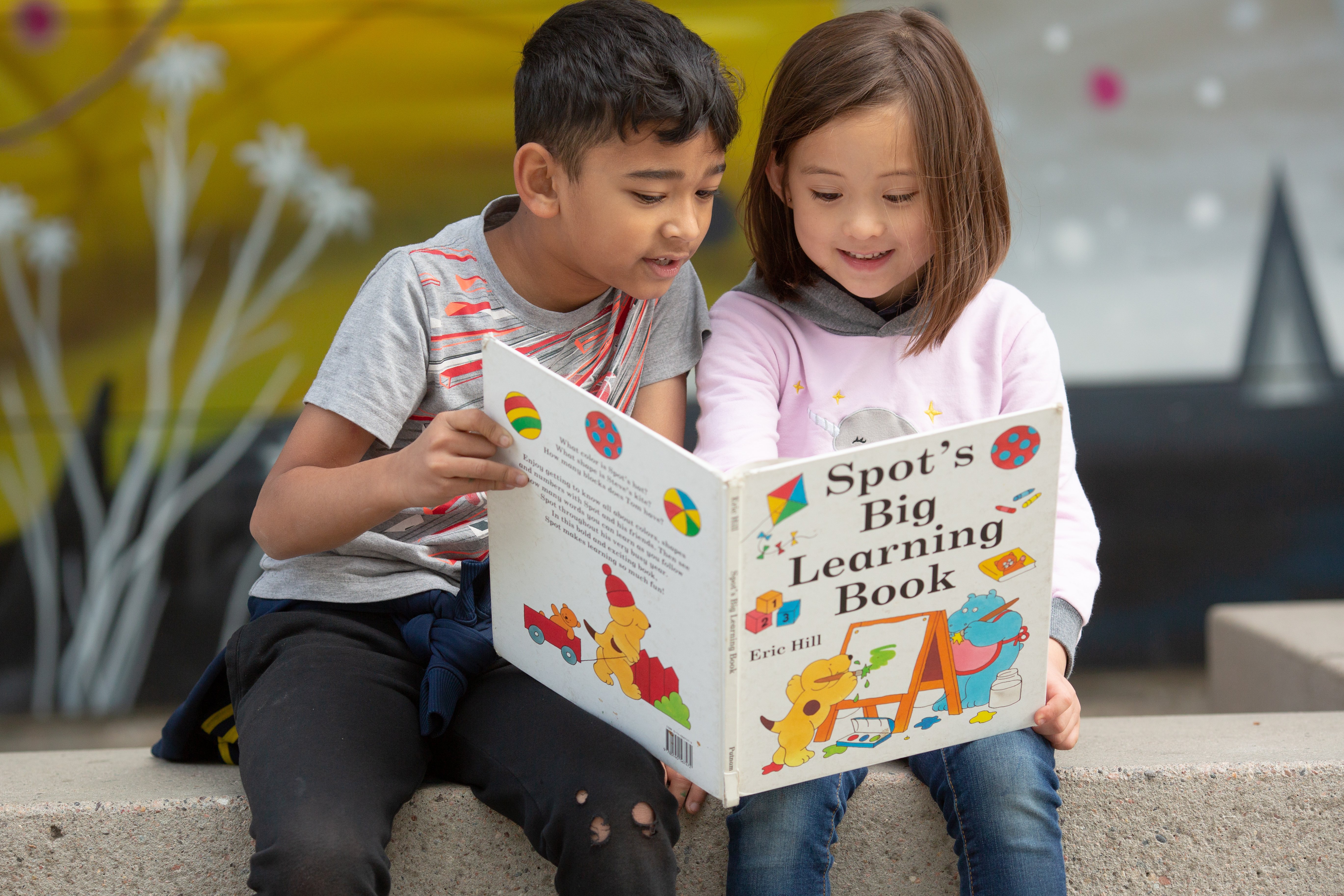
As a Reading Partners tutor, I鈥檝e been working with Joey*, a first grade dual-language learner, since the beginning of the school year. Each week Joey enthusiastically selects a book with a red sticker (which indicates the 鈥淏eginning Reader鈥� level)– there are hundreds of books to choose from. I read to him for ten minutes, asking him questions about the story and discussing any unfamiliar vocabulary words. We then transition to our lesson for the next 30 minutes where I introduce a new concept or skill. Today we completed Lesson 28– the long U sound. We alternated between writing words and sentences on a whiteboard, such as 鈥渢une鈥� and 鈥淭he dog is cute.鈥� Next, Joey read Rude Luke aloud to further practice the long U sound. We discussed the text in detail, and then he read the short story a few more times, trying to increase his fluency rate.
This lesson is part of the very structured and comprehensive Reading Partners curriculum, which spells out almost exactly what tutors should say and do during each session, making it extremely accessible for volunteers with limited time and/or no formal teaching experience.
Throughout the school year, I鈥檝e seen Joey鈥檚 reading improve dramatically. At the end of every tutoring session I note his progress, recording his accomplishments and his areas for improvement, in a folder. My documentation helps both his other tutor and the Reading Partners Site Coordinator to determine his next steps. Over the course of our time together, Joey鈥檚 vocabulary has expanded and his fluency rate has improved; he鈥檚 more comfortable reading on his own and is eager to practice writing new words.
According to a , I shouldn鈥檛 be surprised by Joey鈥檚 progress. MDRC researchers found in a randomized controlled trial, which included over 1,000 students in 19 schools in three states, that the Reading Partners program has a positive impact on three different measures of reading proficiency: reading comprehension, sight word efficiency, and fluency. According to MDRC鈥檚 findings, the 2nd grade through 5th grade students (lower grades were not included in the evaluation) who participated in Reading Partners experienced about one and a half to two months more reading growth than students who received other reading interventions.
So what is it that makes Reading Partners successful? MDRC explains that there are six core components of the program model:
Some combination of these factors likely play a large role in the program鈥檚 success. But there is currently a limited research base on the effectiveness of one-on-one tutoring by volunteers.
I asked Jack Read, AmeriCorps member and Site Coordinator for the Shaw campus, what he thinks makes Reading Partners successful. He said, 鈥淲hether it’s a pair that has been working together for months (or years!), or a student and tutor that are meeting for the first time, I am constantly witnessing a trust that forms when my students recognize the tutors’ commitment. I also firmly believe in the structure of our curriculum; I’ve now trained over 100 tutors to use it, and I’m constantly amazed at how user-friendly and adaptable it is.鈥�
While Reading Partners was found to have a positive impact on students in all of the subgroups regardless of gender, native language, grade level, or initial reading level, it鈥檚 important to acknowledge that the program might not be reaching all students who are behind grade level. Reading Partners doesn鈥檛 serve most special needs students (those with Individualized Education Plans) or students who aren鈥檛 conversationally fluent in English. The Reading Partners curriculum, however, is most likely not intended to reach these populations, as these students likely need more intensive, targeted assistance in early literacy than 45 minutes of biweekly tutoring can provide.
The study concluded that Reading Partners and similar one-on-one tutoring programs with structured curriculums might be a cost-effective way to help under-resourced schools improve student literacy. The program only costs participating schools about $700 per program student on average. To put this in perspective, the other reading interventions used by students in the study鈥檚 control groups cost between $1,050 and $4,890 per student, with an average cost of $1,780 per student. Reading Partners is 鈥渞esource-rich鈥� according to MDRC and is valued at 鈥渁pproximately $3,610 per program group student.鈥� But because of Reading Partners鈥� model, the majority of that cost disappears thanks to聽in-kind contributions and volunteer service.
Research indicates that . With 80 percent of low-income fourth graders in the United States reading below grade level, it鈥檚 encouraging to know that community volunteers can have a measurable, positive impact on student literacy skills. They聽might be an underutilized resource in solving this urgent problem.
Because of the strong reliance on tutors and in-kind donations, programs like Reading Partners are not an ideal long-term solution to closing the achievement gap and improving reading skills for children in under-resourced schools. But MDRC鈥檚 results suggest that such programs聽are a cost effective way for schools to help struggling readers for the time being.
In addition to the academic progress, one thing I find encouraging about Reading Partners 聽is that the students want to be there. As Jack Read explained, 鈥淚t’s safe to say my students consider their tutors a very big part of their lives, and vice versa. 聽Something I’ll never get tired of hearing from anyone that comes into Shaw’s reading center: 鈥楾his is the best part of my week.鈥欌��
*The name of the student has been changed to protect his privacy.
听“
Senior Policy Analyst, Early & Elementary Education