Amaya Garcia
Director, PreK-12 Research and Practice

Last week, Texas鈥櫬犅�(IDRA) held a research symposium titled 鈥�.鈥�
罢丑别听聽was the inaugural event for IDRA鈥檚 Jos茅 A. C谩rdenas School Finance Fellow Program, which supports promising school finance scholars鈥� engagement with research on how to secure equity and excellence for all public school students. The 2014 fellow was Dr. Oscar Jimenez-Castellanos, an associate professor at Mary Lou Fulton Teachers College at Arizona State University, who presented his research on school funding and academic achievement for secondary English language learners (ELLs) in Texas.
Dr. Maria 鈥淐uca鈥� Robledo Montecel, IDRA President and CEO, started the day with some sobering statistics about language learners in the state of Texas. The state has around 800,000 ELLs, who represent about 17 percent of students in the state. For context: there are approximately聽聽in the United States 鈥� so more than one in six American ELLs attends Texas schools. Achievement levels for these students are very low 鈥� 62 percent of 4th grade ELL students read below grade level and less than 10 percent of ELLs in the state are considered college-ready graduates by state standards. Moreover, the achievement gap between English language learners and their native-English speaking peers widens over time.
What can be done to improve outcomes for ELLs in Texas? To start, policies supporting the education of these students need updating. State Senator Jos茅 Rodr铆guez, chair of the Senate Hispanic Caucus and member of the state Senate鈥檚 education committee, shared core components of the collaboratively developed聽. The primary message: schools need to be better funded and funding weights for ELs need to be increased to align with the actual costs of successful programs. Senator Rodr铆guez鈥檚聽, which would increase the weight for ELLs from .10 to .25, would be a step forward in ensuring adequate funding for these students. (For more on how states allocate funding for ELLs, see聽聽from the Education Commission of the States.)
Senator Rodr铆guez emphasized that the education of English language learners provided a challenge and opportunity for the state, 鈥淭hese children, who will make up our future labor force, will be either limited in English proficiency or will be proficient in two or more languages. We have the opportunity to choose and decide which one will serve us, and the state of Texas and the nation better.鈥�
Additionally, the relationship between school funding and ELLs鈥� academic achievement needs more attention. The importance of adequate funding for ELLs was exemplified in Dr. Jimenez-Castellanos鈥� presentation. He began with a frank admission: 鈥淏efore conducting the study I had a perception […] that Texas was at the leading edge of educating English language learners […] I was expecting to find real solutions to national issues related to secondary English language learners.鈥� But, rather, the results of his study revealed that Texas was 鈥渘ot the utopia鈥� he had envisioned.
For starters, only聽twenty聽secondary schools (2.6 percent of all Texas secondary schools) met academic benchmarks for ELLs, which were defined as 75 percent of ELLs passing or exceeding state benchmarks on the 10th grade Texas Assessment of Knowledge and Skills (TAKS) in the areas of ELA, Math, Science and Social Studies. And, only聽two聽secondary schools in the entire state sustained that benchmark level of academic performance for English language learners across three years!
Moreover, about 60 percent of secondary schools in the state had masked or missing data on ELL鈥檚 TAKS performance in 10th grade – meaning that they had less than 5 ELLs tested and thus did not have to report on their performance. In other words,聽the majority of secondary schools in the state are not being held聽.
Jimenez-Castellanos divided schools into five groups in order to draw comparisons between the highest-performing and lowest-performing secondary schools for English language learners. Gaps between the highest and lowest performing schools showed up everywhere – from achievement to demographics to funding. For example, in 2012, 85 percent of ELLs in the highest-performing schools聽graduated 鈥� compared to only 60 percent of ELL students attending schools in the bottom聽quintile. The 10th grade TAKS passing rates in 2010 were 87 percent in the top聽quintile and only 10 percent in the bottom聽quintile. Moreover, the lowest performing聽schools were much larger on average (ranging from 1000 to 750 more students) than the top聽performing schools.
There were also differences in school expenditures between the bottom and top quintile schools. Here’s a chart I’ve made (using Jimenez-Castellanos’ data) to illustrate those relationships:
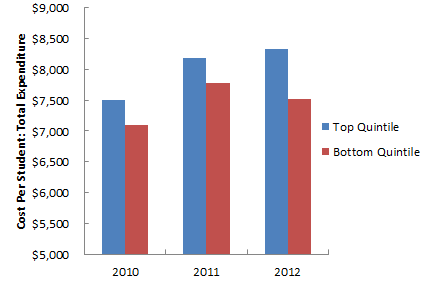
Notably, gaps in per-pupil funding increased between 2010 to 2012 (as did overall funding levels). The significance of these funding gaps was reiterated throughout the presentation: schools that spend more money serve ELLs better. Money matters!
In closing, Jimenez-Castellanos asserted that current funding mechanisms in Texas are inadequate 鈥渢o support and sustain secondary [ELLs] meeting Texas鈥� academic benchmarks鈥� and recommended that the bilingual weight used to supplement ELLs be increased from .10 to .50. If this seems extreme, note that Maryland provides additional weighted funding equivalent to .99. 聽Finally, he argued that the state should do more to increase ELLs鈥� access to rigorous coursework, expand their participation in Advanced Placement and dual enrollment courses, and implement research-based programs to support the learning of secondary English language learner students.
Obviously this research is only a starting point in understanding the relationship between resources and English language learners鈥� academic achievement. Further research is warranted on how better-performing, better-funded schools use their resources to support the education of their ELL students. Is it put towards hiring bilingual/ESL certified teachers? Providing meaningful professional development opportunities? Increasing support staff at the school? Student and parent engagement initiatives? Without those answers it is difficult to discern why and how money matters for English language learner students in particular.
Note: This post is part of 麻豆果冻传媒鈥檚 Dual Language Learner National Work Group.
听“
Director, PreK-12 Research and Practice