Amaya Garcia
Director, PreK-12 Research and Practice
Q: 聽Tell me about how you got started doing this work.
It鈥檚 a personal journey. I was born in Mexico City. My parents are from the United States and I just have聽had the great luck and fortune of having exposure to Spanish and English on a daily basis from birth聽through high school. And that meant I learned how to read and write in Spanish and in English at the聽same time. And it was a really smooth, natural thing. Nobody thought it was a big deal.
When I came to the United States for college, the term bilingual was associated with remedial programs聽and it was a real shock for me especially when I became a Chicago public school teacher in the late 鈥�80s聽and the bilingual kids thought that there was something wrong with them because they were in the bilingual program. That鈥檚 certainly where my passion was born in terms of serving and working with children of immigrants and the population of ELLs and really looking at them through a strength-based perspective as opposed to a deficit based perspective that has been the status quo for so long.
What was interesting to me as I became a professional is that I was taught that sequential literacy was聽the approach to use with all students 鈥� whether they are ELLs in a bilingual program, or native English speakers in a two鈥恮ay immersion program. At the time, in the 鈥�80s and the 鈥�90s, the research we had was based on sequential 聽literacy…the idea that all students have a dominant language and that you needed to learn to read and write in that dominant language. Once you have a strong foundation in that dominant language, then you were ready to transfer your knowledge from your dominant language to your second language and that typically happens at around the second or third grade. And so that鈥檚 the practice I followed as a teacher and as a principal of a DL school in the 鈥�90s. It felt like we were doing the right thing. Then I started on this book project and my colleague Cheryl [Urow] and I started to read about all the latest research and we realized that we were very entrenched in this monolingual perspective.
Q: What does it mean to have a monolingual perspective of language learning versus a multilingual聽perspective?
The monolingual perspective assumes all students have a dominant language and many decisions of聽course follow: assessment is done in one language, you plan for one language, you keep the two聽languages separate. When students do wonderful things like say, 鈥�me han mojado mi sockatines,鈥� you聽know they took socks and聽calcetines聽and made a new word out of it. Or they use U.S. Spanish like 鈥�Estoy estoquiado.鈥� They don鈥檛 know how to stay stuck in Spanish, so they take stuck from English and push it into Spanish. The monolingual perspective looks at students as low in both of their languages when they do that.
On the other hand, the multilingual perspective assumes that students鈥� knowledge is shared across two聽languages and it challenges the notion that all students have a dominant language. That鈥檚 really where聽my understanding of biliteracy was born. It was born in that multilingual perspective. The idea is the聽following: often when students are labelled as ELL, what they know is shared not only in Spanish, but also in English. Therefore the idea of teaching them to read only in one language makes no sense because instead of building on the linguistic resources they have in both their languages, it takes us down that deficit model of only teaching them to read in one language.
And so our work is really firmly anchored in a commitment to social justice and equity for all language minority students, both newcomers to our country who are sequential bilinguals and English Language Learners who are no longer sequential bilinguals, they are U.S. born and are 鈥渆merging bilinguals鈥�. They come to school with a simultaneous bilingual profile 鈥� about 75 percent of all ELLs in elementary school are U.S. born and they walk in with knowledge in both Spanish and English. So in my classes what I get a lot from teachers, especially veteran bilingual teachers is they鈥檒l say, 鈥淸T]hese kids are low in Spanish and they鈥檙e low in English. We鈥檙e just going to confuse them by teaching them to read and write in two languages. We need to just pick one.鈥� My perspective is the totally the opposite and I say, 鈥淸N]o, no, no that鈥檚 the monolingual perspective. Biliteracy is about strength based approach that builds on what students can do already. So we鈥檙e going to teach them to read and write in both their languages from the minute they enter school.鈥�
Q: How do you define biliteracy in your work?
My definition is very simple. I go with the definition of monoliteracy first. 聽Monoliteracy develops the ability to read for understanding. It鈥檚 all about meaning. It鈥檚 all about comprehension. And when I work with teachers, I have them really unpack that. I have them figure out how to use comprehension, reading, writing, word study and listening and speaking (oracy). Those are the fundamental elements of literacy but what I emphasize with them is that just knowing how to decode and knowing foundational skills, does not make you literate. To be literate means to both decode, apply skills and understand. And that鈥檚 really, really, really important because, for example, in this era of accountability a lot of first graders don鈥檛 read for understanding, they just decode and everybody thinks they鈥檙e reading. And we鈥檙e setting ourselves up for a lot of challenges later. So that鈥檚 the definition of monoliteracy.
Biliteracy is the ability to read for meaning using appropriate comprehension, reading, writing and word聽study strategies but in two languages within an academic context. So that takes a while to develop.
Q: Tell me more about the Bridge and bridging.
We came up with these premises ((The three premises for teaching biliteracy are: (1) Spanish is a聽minority language within a majority culture, (2) Students use both their languages for literacy development, and (3) Both Spanish and English are governed by distinct linguistic and cultural rules)) in teaching for biliteracy and they鈥檙e very helpful for practitioners (Note: see Part 2 of this interview for more details on Ms. Beeman鈥檚 鈥減remises鈥�). We learned through research that students need both their languages for literacy development. All students, regardless of what language they speak at home, do not turn one language off when learning a second. We always use what we know. And the research has clearly come out now and said the following: students who understand how their two languages are similar and how their two languages are different do better in school in any language. However, many students on their own don鈥檛 engage in those comparisons. If we keep languages separate 鈥� if we have Spanish time where no English ever goes in and we have English time when no Spanish ever goes into English 鈥恠tudents don鈥檛 realize that informaci贸n and information are cognates with the same suffix pattern, 鈥溾�恡ion鈥� 鈥溾�恈ion.鈥�
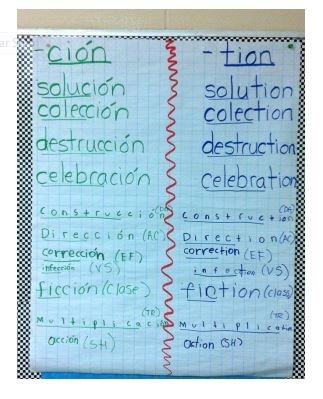
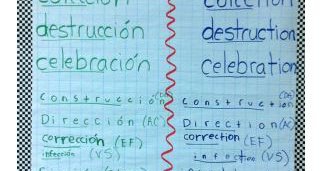
So when Cheryl and I read the research and we came up with the premises, ((The three premises for聽teaching biliteracy are: (1) Spanish is a minority language within a majority culture, (2) Students use both聽their languages for literacy development, and (3) Both Spanish and English are governed by distinct聽linguistic and cultural rules)) it was in the field with teachers that we developed this notion of the聽Bridge and we realized we have to challenge this monolingual assumption that鈥檚 keeping the two languages separate.聽We still have Spanish time, we still have English time and then we added on this third space 鈥� we called聽it the third linguistic space 鈥� called 鈥渢he Bridge.鈥� That鈥檚 the time where there鈥檚 an intentional聽comparison of language.We look at phonology, morphology, syntax, grammar and pragmatics.
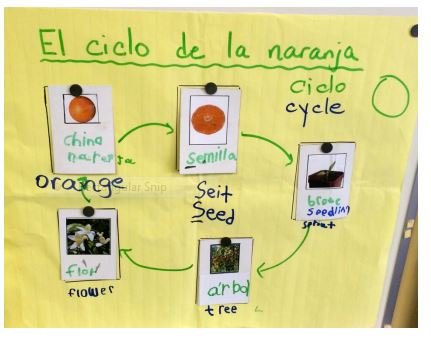
For example, in a kindergarten class, students learned all about the cycle of the orange in Spanish 鈥� I聽always use green to indicate Spanish 鈥� and we used Total Physical Response (TPR) and visuals and read聽about it and we did a lot of Spanish literacy. Then, when it was time to go over the Bridge I used the same realia 鈥� the pictures and the motions, we made a motion for brote, for sprout, and for tree and for flower, etc. I just taught them the English to add on to what they already knew in Spanish. For us it鈥檚聽very important that teachers organize the Bridge, but students actually do it. In our learning, it鈥檚 best to do the Bridge at the end of the unit when students have really learned the concept. It鈥檚 not a daily occurrence. Because the whole premise is that they have deep understanding 聽and then we add the English side. Kids have to understand on the right, in English. If you have a lot of newcomers you have to do a lot of oracy development in English. Because unless they understand both languages they鈥檙e not going to be able to do that metalinguistic comparison.
Q: Why is the Bridge such an important part of developing biliteracy?
So the Bridge comes out of that multilingual perspective. It鈥檚 a true understanding that bilinguals are聽different than monolinguals. The monolingual perspective looks at bilinguals as two monolinguals in one聽and it keeps languages separate. The multilingual perspective looks at bilinguals as very different from聽monolingual people. We鈥檙e just different. There鈥檚 this third space in our use of language that鈥檚 called the聽Bridge and it benefits everything we do. And so it鈥檚 really important for bilinguals to develop their聽knowledge of how their two languages intersect.
In our work with teachers, we鈥檝e actually identified a difference between the Bridge, which we聽capitalize, we鈥檝e made a noun…it comes out of a unit design, and it鈥檚 explicit and it鈥檚 teacher鈥恖ed.聽As opposed to what we call bridging 鈥� and bridging is spontaneous 鈥� it happens all day long, it needs聽context and it鈥檚 when students on their own start to realize how Spanish and English are similar and聽different. It鈥檚 really interesting because teachers report that the more formal Bridges they do, the more聽bridging kids engage in and it becomes a management issue. Kids are finding cognates everywhere! So聽they鈥檒l come back from recess and say, 鈥� 隆Maestra! We found another cognate! Energy and energ铆a! 鈥� And they want to run and put it on the cognate wall. And that鈥檚 such a great problem.
It鈥檚 important because if we do a good job of building on the third linguistic space and really building on聽the multilingual resources of students, they just do better in school. It鈥檚 strength鈥恇ased, it鈥檚 really聽looking at what kids know and can do as a strength. For example, you have a lot of pre鈥怟 and聽kindergarten teachers say, 鈥淚 don鈥檛 know what to do with these kids! They don鈥檛 know when they鈥檙e聽speaking English and when they鈥檙e speaking Spanish! They鈥檒l say things like, 鈥�Voy a una party con mi聽brother.鈥� Right? And I鈥檒l say, 鈥淵eah, that鈥檚 perfect for the Bridge!鈥澛燬o there are a lot of reasons for the Bridge and bridging: it makes learning a lot more fun, it builds on聽student linguistic resources, it鈥檚 strength鈥恇ased, it matches the current research on how important聽translanguaging is, and it just really helps students understand their strengths and then when they鈥檙e聽working in English they can go deeper in English and when they鈥檙e working in Spanish they go deeper in聽Spanish. What teachers tell us is that it really validates students who use U.S. Spanish (puchar / empujar) because that鈥檚 what people talk about during the Bridge and kids just blossom, they鈥檙e so proud of what they can do.
鈥愨赌�
This post is part of 麻豆果冻传媒鈥檚 Dual Language Learners National Work Group. Click here for more聽information on this team’s work . To subscribe to the biweekly newsletter, click here , enter your contact聽information, and select “Education Policy.”
“
Director, PreK-12 Research and Practice