
Girl Talk: Don’t Believe Everything You Hear

In a recent on the Guardian鈥檚 Poverty Matters Blog, Ofra Koffman argued that 鈥淢any development organisations see empowering girls–and enabling them to delay childbearing–as a powerful means to tackle poverty, but the evidence so far doesn’t bear this out.鈥� She makes the observation that delayed childbearing–as evidenced by a country’s adolescent fertility rate–does not correlate with each country’s overall economic state. If you look at the statistics, she notes, despite being one of the most developed countries in the world, the US has a higher adolescent fertility rate than that of such developing countries as Vietnam, Pakistan, Burma, and Jordan. Aside from the fact that she conflates the idea of 鈥渢ackling poverty鈥� with a country鈥檚 GDP, her logic has three other faults. The first is that she undervalues the significance of delayed childbirth in developing countries. Second, zeroing in on delayed childbearing without considering the other important factors of the 鈥溾�� oversimplifies and skews the argument. And third, her articulation of the relationship between delayed childbearing and other important factors, such as education and better economic prospects, is not consistent with that of 鈥済irl effect鈥� proponents.
Despite Koffman鈥檚 claim that delayed childbearing does not necessarily mean that girls are better off, studies show that childbirth, and complications during, are the greatest causes of death among girls aged 15 to 19 in developing countries. And to her point that delayed childbearing does not significantly improve a girl鈥檚 economic situation or educational attainment, she fails to consider that regardless of income, a girl who must provide for not only herself, but for her child as well, is going to have to spread her earnings further than a girl who is childless. What’s more, in developing countries, a girl who already has a family to care for is going to be far less likely to be able to attend school herself. All of these points highlight the significance, rather than the irrelevance, delayed childbearing has on the life of the girl, but it is not the single most important factor.
According to the World Bank鈥檚 , the degree to which a comprehensive girl-centered approach can have on a country鈥檚 overall economy is noteworthy. In Brazil, if young women’s employment was equal to that of their male peers, Brazil’s annual GDP would increase US$23 billion. Annually, four million adolescent girls become mothers in India, which results in the loss of US$383 billion in potential lifetime income. Of course, access to employment is based on a number of factors. It is exactly this comprehensiveness, this holistic approach, that the 鈥済irl effect鈥� articulates. The 鈥済irl effect鈥� is about ensuring the well-being of the girl through education, delayed childbearing and marriage, improved access to health, and HIV/AIDS prevention, among other factors.
In addition, the causal relationship that she describes between childbirth and both improved education and better economic opportunities is an inaccurate representation of the 鈥済irl effect鈥� argument and the research that supports it. According to , education is often the catalyst for the other factors. Girls who attend school are less likely to marry or bear children in adolescence, less likely to contract HIV/AIDS, more likely to have a higher income when they move into the workforce, more likely to have fewer children (and thus, more of an investment in each child), and more likely to be in a better position to ensure the health of her children. An educated woman will reinvest 90% of her higher earnings back into her family, compared to 35 % of her male counterpart鈥檚 income. So while delayed childbearing can, and I would argue, often does have a positive impact on a girl鈥檚 education or economic prospects, the effect that education has on these other factors is perhaps more significant.
Koffman states that, 鈥淓arly childbearing is portrayed as a cause of poverty, but the statistics do not demonstrate such a causal connection.鈥� I, however, would argue that according to the 鈥済irl effect鈥� early childbearing is not necessarily understood to be a cause of poverty, but rather an added barrier that prevents girls from moving out of poverty. If we view it from this perspective, the benefits of delaying early childbirth, and the 鈥済irl effect鈥� in general, are indeed valuable tools to combat poverty.
This is the first in a three-part series on a girl-centered approach to development. Check back next Wednesday for more!
More 麻豆果冻传媒 the Author
Issues
Programs/Projects/Initiatives
Topics
Related
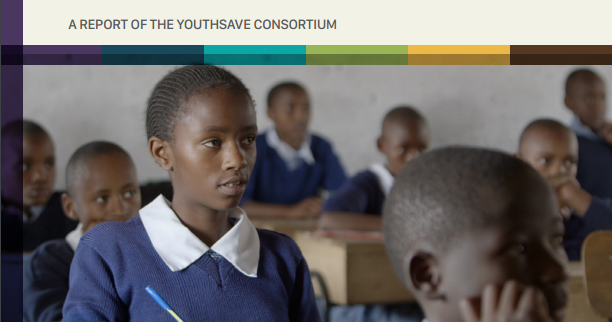
85,000 Low-income Youth Open Savings Accounts through YouthSave
A Conversation on the Weekly Wonk: Should We Bank On It?
Global Anti-Poverty Targets Tepid