Jennifer Thompson
Senior Director, Equal Measure


As PAYA鈥檚 learning and evaluation partner, our team at is committed to providing a comprehensive, evidence-backed review of the field of youth apprenticeship. Using recent data from PAYA grantees, we examined how youth apprenticeship programs can provide access to economic opportunities, specifically reducing gender gaps in workforce participation and wages.
A decade of national data confirms that youth apprenticeship continues to show significant gender disparities in participation, representation, and outcomes. of 10 years of federal Registered Apprenticeship data on youth in Registered Apprenticeships听 (ages 16-24)听 found that young women represented only 11 percent of youth apprentices in 2020鈥攁lthough this was a significant improvement from 5 percent in 2011.
The stark gender imbalance in youth apprenticeship participation can be explained in part by programs鈥� traditional focus on male-dominated trades, although in recent years apprenticeship programs have expanded into non-traditional industries and occupations. Occupational segregation and the significantly higher wages offered in male-dominated fields have translated into large , reflecting similar gaps among adult earners. Young men were most likely to apprentice as electricians, plumbers/pipefitters/steamfitters, and carpenters, earning an average of $31/hour, compared to only $18/hour for female apprentices, most commonly apprenticing as pharmacy technicians, certified nursing assistants, or child care workers.
Equal Measure reviewed and analyzed data submitted by nine PAYA-funded partnerships (with one additional grantee that had no active apprentices) across eight states in 2025. The grantee data showed:听
When the PAYA data were disaggregated, they showed young women were underrepresented in youth apprenticeships. However, female participation in PAYA grantees鈥� apprenticeships was significantly higher than in national data (26 percent versus 11 percent).听
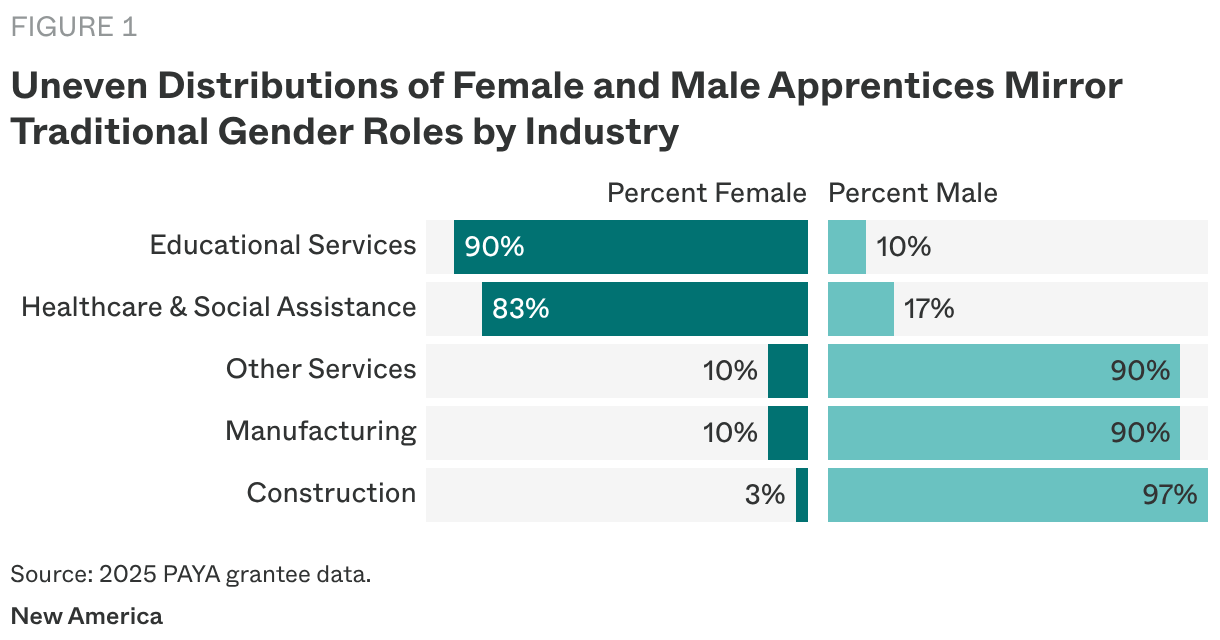
The industries in which PAYA youth apprentices were working showed significant gender segregation (Figure 1). Among the five industries with the most youth apprentices, three were predominantly male (construction, manufacturing, and other services) and two were predominantly female (health care and social assistance and educational services). This distribution closely follows the
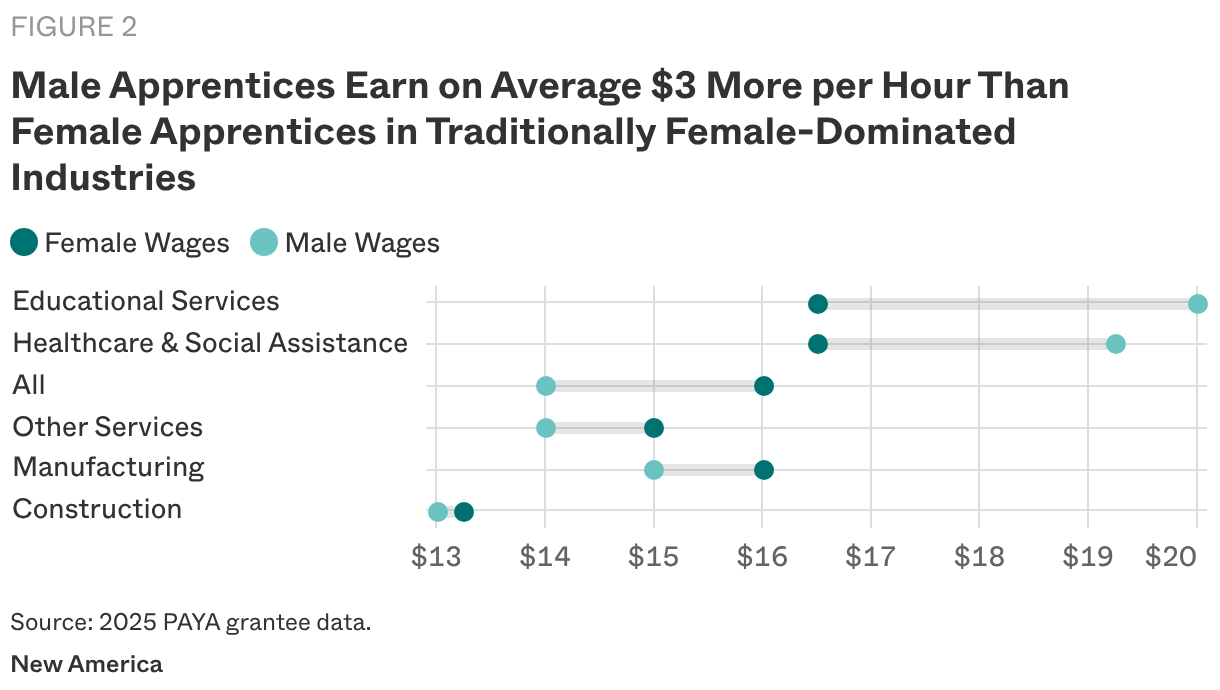
While research has shown that workers (both men and women) in predominantly male occupations are paid higher wages than workers in female-dominated occupations, PAYA grantee data shows a different story regarding gender, industry, and wages.听
Surprisingly, the highest median hourly wages ($16.50/hour) for youth apprentices in PAYA grantees鈥� programs were in predominantly female industries 鈥� health care and social assistance and in educational services. Yet, within those two industries, young male apprentices earned $2.70 to $3.00 more per hour than young female apprentices (Figure 2).
These findings are likely driven by two factors:
As part of its marketing and communications strategy, ApprenticeshipNC has implemented two statewide media campaigns focused on high-demand occupations. These campaigns intentionally highlight female success stories in non-traditional apprenticeship roles.
Increasing gender equity in apprenticeships will require both systemic changes to wage structures, cultural biases about 鈥渨omen鈥檚 work,鈥� and workplace discrimination and harassment鈥攁s well as changes in how apprenticeship programs are designed and implemented. A notes 鈥淎pprenticeships have the potential to increase the number of women in nontraditional occupations because they provide employers with a strategy for hiring and training workers who otherwise might not have been hired.鈥�
Approaches that can help improve gender equity in apprenticeship programs include:
Career Launch Chicago created structured opportunities for career exploration to introduce young people to a variety of career options within health care and advanced manufacturing. Students discover different options on small group tours or in maker spaces that allow them to consider careers they may have not heard of before, including introducing young women to careers in traditionally male fields, in a fun and low stakes environment. Career exploration encourages young people to think about what鈥檚 possible before further committing to an apprenticeship or other job opportunity in a specific field.
Apprenticeships, particularly those in higher-paying fields, are proven to lead to economic mobility and should be accessible to all. Employers will also benefit when a broad cross-section of young people can explore promising career paths without limiting their horizons because of their gender.
Achieving gender equity in apprenticeships will require intentional efforts from a broad coalition of stakeholders. Despite reflecting much of the national data on gender differences in youth apprenticeships, PAYA鈥檚 data on their grantees鈥� high-quality apprenticeship programs showed some improvement in increasing access for young women, indicating opportunities for progress.听
Important questions remain. Sample sizes did not allow us to examine the intersectionality of gender with race and ethnicity, however, the using federal Registered Apprenticeship data found that Black youth were underrepresented in apprenticeships. More research into how gender and race interact to hinder or advance opportunities in apprenticeships and in industries that lead to high-paying jobs can help uncover more strategies to ensure apprenticeship programs offer opportunity for all.
Senior Director, Equal Measure
Senior Director, Equal Measure
Consultant, Equal Measure
Senior Consultant, Communications, Equal Measure