
Richard Davis Jr.
Policy Analyst, Higher Education
New analysis finds that for older parenting students, being enrolled in college is associated with a greater threat of eviction than their non-student peers.


For most people, going back to school as an adult is an act of hope. It is a bet on the future: a decision to invest time, money, and energy toward building a more stable life for themselves. That is especially true for older adults who return to college while working and raising children. They are not fresh out of high school with the support of a guidance counselor to explore education and career options. They have already navigated the labor market and decided that a degree is their best path forward.Â
Once enrolled, these adult learners gain access to financial resources—including grants, loans, and campus-based support services—that should, in theory, provide a buffer against housing instability.
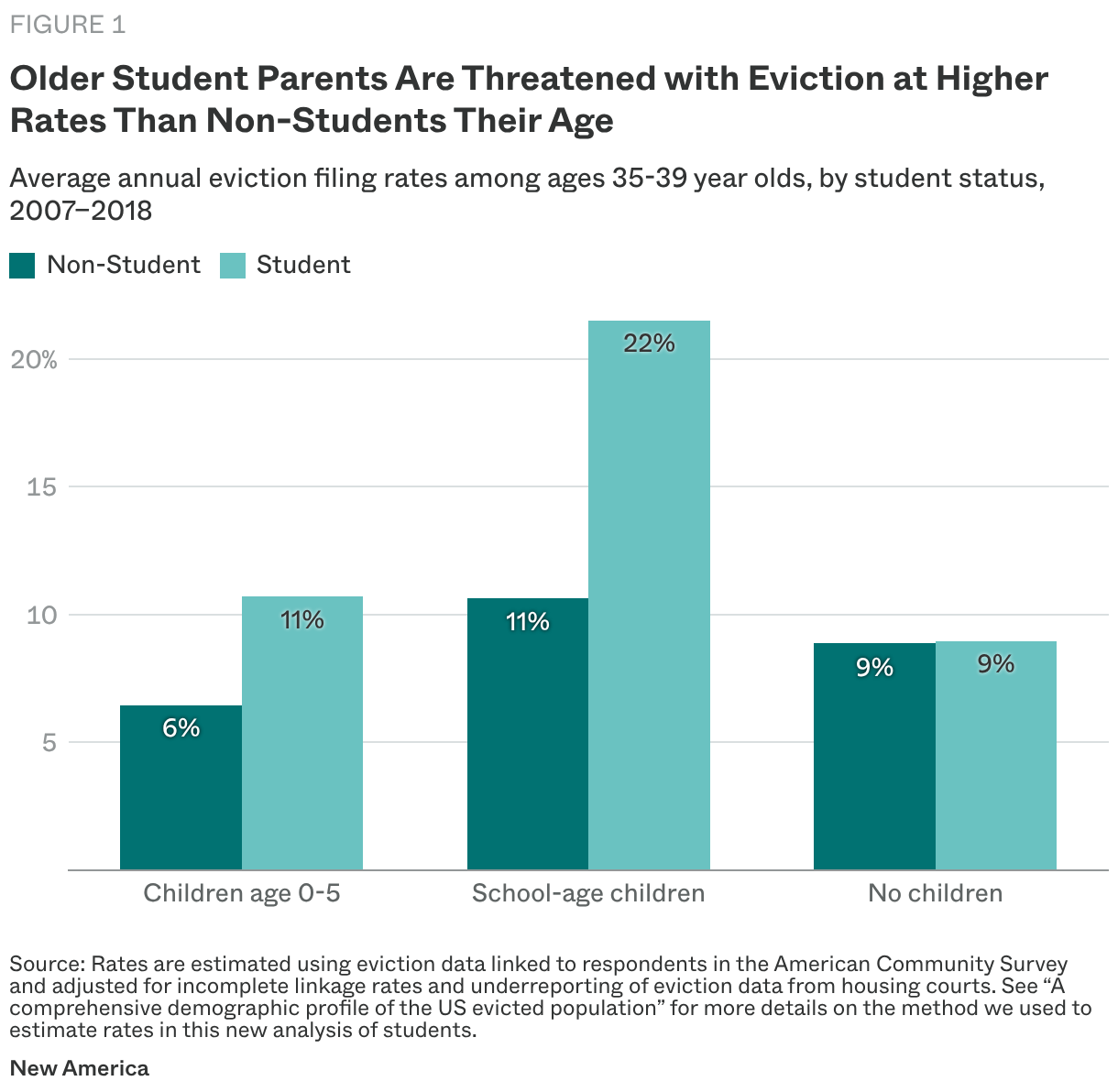
For most renters, . But for student parents aged 35 to 39, the data tell a different story. Being enrolled in college while parenting school-age children is associated with eviction filing rates double that of their non-student peers, 22 percent compared to 11 percent. College enrollment, in other words, is not just failing to protect these adult students from eviction. It is associated with a greater threat of eviction.
This is the second entry in a two-part series with the Eviction Lab, a Princeton University-based research organization that studies eviction and its consequences across the United States, examining eviction filing rates among parenting college students. In our first piece, we found that young parenting students aged 18 to 24 with children aged 0-5 face eviction filing rates nearly as high as non-student parents their age, a troubling finding that suggested enrollment was doing little to reduce eviction filing rates for this group. But we noted that the picture grows more complicated for older parenting students.Â
Our analysis here of older parenting students builds on prior work with the Eviction Lab. In Ousted from Opportunity: Eviction’s Adverse Impact on Parenting College Students, we documented the devastating consequences of eviction threats for parenting students, including sharply lower degree completion rates, reduced post-enrollment incomes, and increased mortality in the decade following enrollment. Those findings applied to parenting students broadly.Â
This new analysis of eviction filing rates by age group allows us to ask a more targeted question: What does the threat of eviction look like for older parenting students?
We built a new dataset linking eviction court records to Census data to understand the extent to which student parents face the threat of eviction. We drew on housing court records comprising 73.2 million defendants in eviction cases from 2000 to 2018, compiled by the Eviction Lab. We linked the defendants in these records to Census Bureau survey and administrative data to determine individual demographics and parenting status. We used this linked data to estimate eviction filing rates by age group, enrollment status, and parenting status, measured using linked data from the American Community Survey (ACS). For parents, we further split rates by whether they had a young child (aged 0-5) in the household or whether all children were aged 5-18. Technical details on the estimation method, which adjusts for incomplete coverage of eviction records, are .
The threat of eviction is used as the point of comparison because it is more challenging to track outcomes after a landlord files an eviction case, and the available evidence shows that the threat alone is immensely disruptive, whether it leads to an eviction or not.
In our first entry in this series, we showed that young parenting students face eviction filing rates nearly as high as their parenting non-student peers. This was a concerning finding, as we would hope that postsecondary enrollment would provide more protection against the high rates of eviction filings in the general rental market for families with young children.Â
But among older parenting students, the pattern shifts. Parenting students between the ages of 35 and 39 with school-age children face eviction filing rates double that of their non-student peers, 22 percent compared to 11 percent (see Figure 1). Among this age group of parenting students with children aged 0-5, eviction filing rates are also higher for students than non-students, at 11 percent compared to 6 percent (see Figure 1).Â
The gap is widest for those with school-age children, but the direction of the finding is consistent: For older parenting students, enrollment is associated with a greater threat of eviction.
What makes this pattern especially concerning is what we already know about the effects of being threatened with eviction on older parenting students, specifically. In Ousted from Opportunity, we found that five years post enrollment, parenting students threatened with eviction had household incomes of $59,000, compared with $126,000 for parenting students who were not threatened. That gap was largely driven by the impacts on parenting students aged 30 and older. The very population this piece examines is the group for whom the income consequences of eviction threats appear more severe.Â
These are not students who can easily absorb a housing disruption and move on. Many are returning to school precisely because they are trying to escape financial precarity, and a housing crisis during enrollment may be associated with outcomes that leave families further behind than before they enrolled.
The finding that enrollment is associated with a greater—rather than lesser—threat of eviction for older parenting students is striking, and it raises an important question: Why? While our data allow us to estimate national eviction filing rates, they do not let us observe the mechanisms behind the gap between student and non-student filing rates. Still, the findings point toward several avenues worth investigating.
Through cost of attendance calculations, the financial aid system is meant to account for the living costs students face while enrolled. For parenting students, those calculations often fall short. has found that when child care is factored in, the out-of-pocket cost of attending a public college runs two to five times higher for student parents than for their peers without children, a gap that financial aid formulas rarely account for.
Older students may also be more likely to have already exhausted their lifetime Pell Grant eligibility from prior college enrollment before returning to school. Some may carry existing loan debt that limits further borrowing. Others may return with from a prior enrollment attempt that limit or block their access to federal aid.
Â鶹¹û¶³´«Ã½ has documented structural gaps in access to financial aid and public benefits for older and parenting students, and this new eviction data raises the question of whether those gaps may be showing up in housing outcomes.
Another possibility is that older parenting students return to school already in financially precarious situations, in hopes of achieving greater economic security, and that the added costs of college along with the costs of raising children tip an already strained budget into crisis.Â
What we do not yet know is which of these factors, what combination of them, or what other causes we have not yet identified, best accounts for what we are seeing.
Future research should explore these mechanisms. The answers matter not just for understanding the problem, but for knowing what interventions can help.Â
However, policymakers and institutions cannot wait for complete answers before acting. The financial aid system’s structural misalignment with older parenting students’ real costs is well documented, and addressing it should not depend on fully understanding why enrollment appears to be associated with a greater threat of eviction for this group.
One limitation of this analysis is that the Eviction Lab national database only goes through 2018. These patterns may have changed post-pandemic, especially given rising rents and costs of childcare in many parts of the country.
This series has surfaced a pattern that demands further attention. For younger parenting students, enrollment offers far less protection from eviction than it should. For older parenting students, the picture is even more troubling: enrollment is associated with a greater threat of eviction, and that pattern holds regardless of whether their children are younger or school-age. What remains unclear is why, and we hope this series prompts researchers, policymakers, and institutions to look more closely at the students whose housing instability may be deepest precisely because they chose to invest in their own futures.
This is part two of a two-part series with the Eviction Lab examining eviction filing rates among parenting college students. For the first part, see “Enrolled but Not Protected: Young Parenting Students Face Eviction at Alarming Rates.”
This series builds on foundational research from Â鶹¹û¶³´«Ã½ and the Eviction Lab published in 2025. “Ousted from Opportunity: Eviction’s Adverse Impact on Parenting College Students” documents the devastating outcomes associated with the threat of eviction for parenting students, including sharply lower degree completion rates, reduced post-enrollment incomes, and higher mortality in the decade following enrollment.
Policy Analyst, Higher Education
Assistant Professor, Department of Sociology and the Institute for Social Research and Data Innovation, University of Minnesota