Caroline Bartlett
PhD Student, Department of Educational Administration, Michigan State University

Michigan is home to a fast-growing English learner (EL) population as the number of ELs enrolled in K鈥�12 schools increased by more than . In 2024 these students represented more than six percent of all Michigan students. Despite this growth, Michigan is known for providing for EL students nationwide despite to increase funding levels. Failure to increase funding to levels that EL students with adequate educational opportunities has left local education leaders short-changed and scrambling to piece together funding to provide services these students need.
Michigan provides EL funding to districts through a grant system called Section 41 that allocates funding based on students鈥� English proficiency levels. Section 41 funding is supposed to be provided in addition to a base amount of funding provided to every Michigan student, also known as foundation funding. In the 2023-24 school year, Michigan school districts received about $39.8 million in state funding in addition to $11 million federal funding to serve nearly 96,000 EL students. Section 41 funds are used with federal funds to purchase resources to expand ELs鈥� learning opportunities, including courses for teachers and staff to earn bilingual or English as a Second Language (ESL) endorsements, bilingual books and curricula, and technology such as online English language development programs. Table 1 shows how much an EL student received from Section 41 according to their English language proficiency (ELP) level for the 2023-24 school year. However, the amount of state funding provided to EL students is dismal compared to the 鈥渁dequate鈥� amount of funding the Michigan legislature intends to provide to EL students.
Following , until Section 41 allocations equal 75 percent of the foundation allowance for students with very early English proficiency, 50 percent of the foundation allowance for students with early English proficiency, and 35 percent of the foundation allowance for students with intermediate English proficiency. Figure 2 shows what these increases would mean in terms of per pupil funding levels according to different ELP levels, and as the table shows, bringing EL funding up to adequate levels will require large investments to Section 41.
Figure 2. Current Versus Adequate EL Funding Levels in Michigan
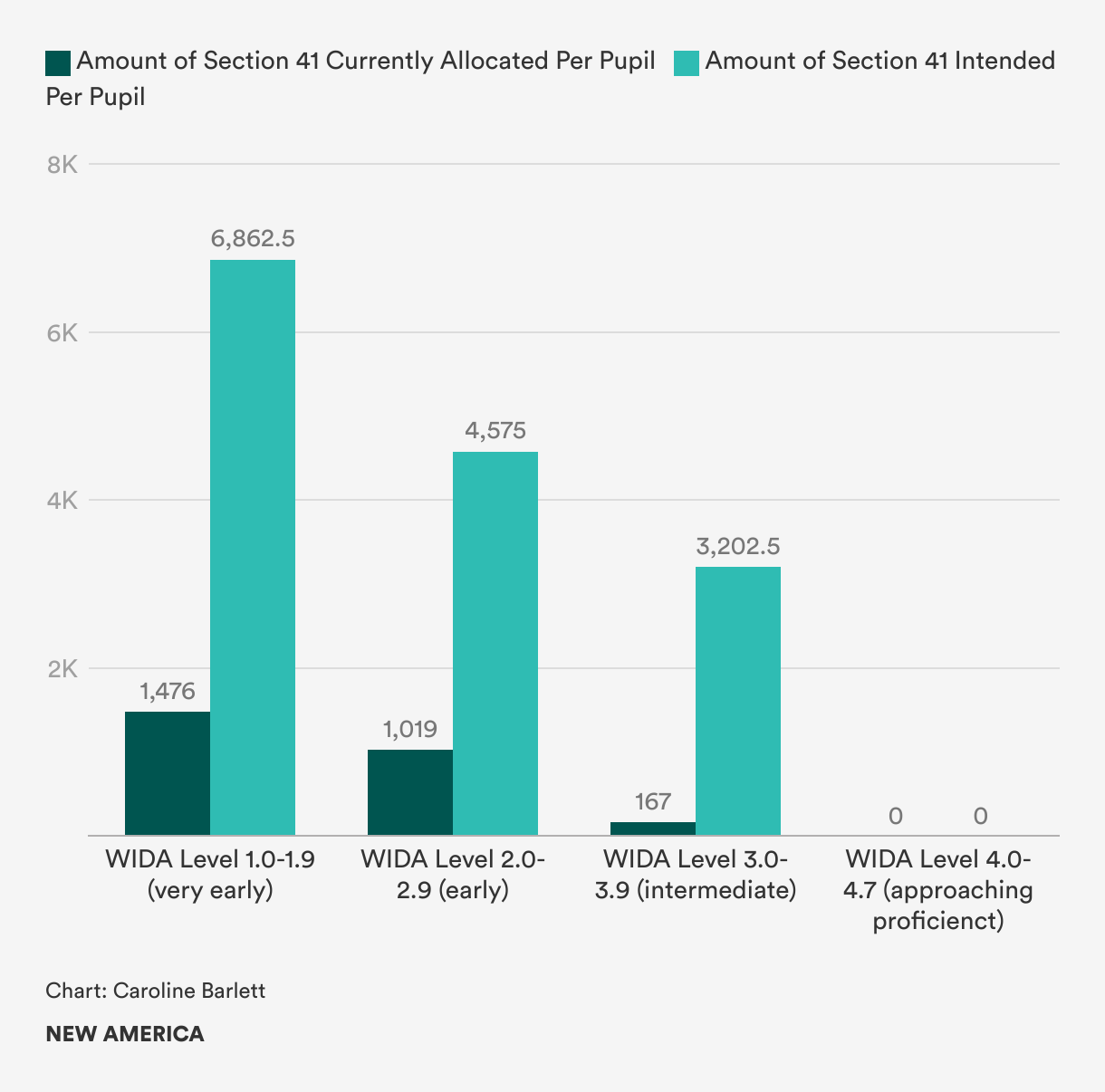
In 2024-25, the state increased total Section 41 funding by $2 million. However, when divided evenly among the state鈥檚 ELs, this increase comes out to roughly $21 per student鈥攁 far cry from intended funding increases.
Despite persistent underfunding, school district leaders must provide EL students with the resources they need to be successful. To better understand how this lack of funding impacts ELs, I spoke with school district superintendents, chief financial officers, and English language development directors across the state. They discussed the resources they must forego due to underfunding of Section 41, and their perspectives of how adequate funding would enhance EL students鈥� educational opportunities.
Consequences of Section 41 Underfunding
Statewide, school district leaders struggle to stretch limited funding to provide ELs with opportunities to succeed. EL programs across the state consist of ESL or bilingual-certified teachers and support staff, translation services, family engagement, and bilingual books and resources. However, given the limited additional funding provided by Section 41, the share of supplemental funding most districts receive falls short of the total cost of their EL programs. As a result, districts lean heavily on their general fund to provide ELs with support services, using Section 41 resources to provide services above and beyond what is considered baseline.
According to a Chief Financial Officer in a district serving a large proportion of ELs, 鈥淲e received around $250,000 in Section 41 funds this year. To put that into perspective, compared to a core EL program that costs us about $4 million, the funding isn鈥檛 supplemental.鈥� This issue is not limited to districts with high EL concentrations. A superintendent in a district with a low EL population also reported, 鈥淭here's nowhere near enough Section 41 money to do anything of substance other than maybe buy a workbook or two.鈥�
Districts reported that with limited Section 41 funding to meet ELs鈥� needs, they must find creative ways to ensure students receive beneficial services. Some districts partner with local nonprofits to raise funds for EL programming. For example, several districts noted the academic benefits of for EL students. Some districts relied on community partners to fund such programs. In a district with a high EL enrollment, the EL director shared that, 鈥淐ommunity businesses provided general donations, recognizing we have a population that needs summer school.鈥� When local donors were unavailable, districts found ways to provide some services by pulling from other funding sources. A superintendent in a rural district shared that, 鈥淪ection 41 isn鈥檛 enough for our parent education night, but I use it up, then supplement the rest with our general education budget.鈥�
Even after piecing together various funding sources to provide EL services, many districts still felt funding was insufficient to provide ELs with adequate learning opportunities. When speaking about the costs of EL programming, one chief financial officer stated, 鈥淲e鈥檙e doing the best we can with what we have and what we鈥檙e doing is so much better than what many other people are doing. But looking at the research, we鈥檙e not close to what we should be doing because we can鈥檛 afford it.鈥�
What Adequate Funding Could Buy
When asked to imagine how EL services would change if Michigan dramatically increased Section 41 funding and met its adequacy goals many districts would prioritize hiring or certifying staff to work with EL students. One EL director emphasized the importance of aligning staffing levels with the number of EL students enrolled in the district, stating, 鈥淎t the elementary level, I鈥檓 two or three EL-certified employees short to make an equity formula work. So I would start with funding supplemental staff.鈥�
Districts also envisioned enhancing summer programs for EL students. Some districts used ESSER funding for summer programs and emphasized, 鈥淲e鈥檝e been able to use ESSER funding to incentivize an added stipend for anyone with ELs in the summer program, but that will be gone. Extra Section 41 funds would allow us to continue that stipend to get our students the best teachers.鈥� With sustained Section 41 funding, districts could expand and improve summer offerings. This would ensure continuity and quality in summer learning opportunities for EL students.
Underfunding of Section 41 poses a significant challenge for school districts striving to provide equitable education opportunities for ELs in Michigan. Despite the state's growing EL student population, funding continually falls short of meeting the needs outlined by legislators, researchers, and school districts. Even with creative solutions and community support, many districts find themselves unable to provide adequate resources for their EL programs. By imagining the possibilities with full EL funding, district leaders highlight the transformative impact that adequate resources can have on EL education. Policymakers and stakeholders must recognize the critical importance of sufficient funding for ELs to have equitable access to educational opportunities and take action to meet the needs of Michigan's diverse student population.
PhD Student, Department of Educational Administration, Michigan State University