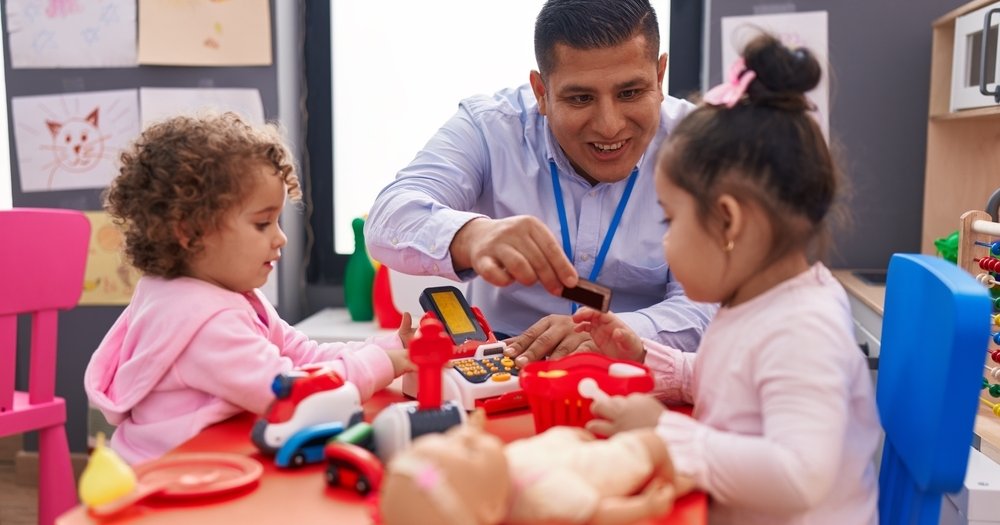
Education: A Family Affair

No matter where you sit in the education universe, it can be easy to lose sight of the broader view of the whole system. When I was a teacher, I found it easy to get cynical about the motivations and competence of the bureaucrats regulating American schools. Now that I conduct policy research for a living, I sometimes struggle to keep the human side of American public education in focus. It can be easy, sitting in Washington, D.C., to lose sight of education as an endeavor that actually boils down to humans, to teachers and students. After dozens of events on education data systems or tweaks in school funding streams, education can start to seem like just another policy field. It gets easy to get in a pattern of thinking that reduces education to a series of budget lines and cogs in a big, complex, impersonal system.
This is why I try to spend a little time each month visiting schools and attending meetings with teachers and administrators who sit somewhere else in that system. Specifically, it鈥檚 why I spent three days this week at the .鈥� During the conference, I spoke with teachers, administrators, academic researchers, community organizers, parents, and education stakeholders with an eye to looking beyond my research 鈥渟ilo鈥� in the education policy world.
As befits the name, the conference focused on strategies for connecting parents, students, and schools鈥攚ith an eye to benefitting all three. Too often, these variables are tackled in isolation, as though student learning, parent engagement, and teacher quality are discrete elements of our educational landscape.
The conference offered a panoply of speakers and panels providing different ways of reconceiving and strengthening relationships between schools and families.
In one discussion, they explored the technical aspects of efforts to coordinate the outreach efforts of community organizations, local and national foundations, and schools that work with diverse families. In another, participants considered the unique assets that Latino families bring to their schools and communities鈥�and how to tailor family engagement efforts to leverage these effectively. In another, a presenter offered examples of how digital media can help parents support student learning in creative new ways.
In one discussion, attendees pondered how to build dual-generation strategies to foster student and family learning in the context of the Common Core State Standards. This was a subject that repeatedly came up during my conversations with conference participants over the three days. Given , I was surprised to find .
On the last day of the conference, I was especially fortunate to participate in 鈥淪trengthening Pre-K School Alignment with Families,鈥� a session with Richmond, Virginia鈥檚 public pre-K program manager Ron Robertson. In his presentation on his efforts to engage parents of Richmond pre-K students, Robertson tied together many of the conference鈥檚 themes鈥攁nd made a compelling case for investing time and energy in school and community efforts with families鈥� priorities and needs. Family engagement starts in the early years, he insisted.
鈥淸We pursue] better linkage between all those players鈥amily engagement is not a single event. It is not something that is just set aside for a special day. It鈥檚 24/7,鈥� said Robertson. 鈥淚f we don鈥檛鈥攂y hook or by crook鈥攊f we don鈥檛 find a way, we鈥檙e going to see poor results in 3rd 驳谤补诲别.鈥�
It鈥檚 natural to think of education policy solely as a function of its constituent terms: education and policy (especially policymaking institutions). But the business of education is, as American philosopher John Dewey put it,
[T]he vocation of education is not and cannot be shut off and shut up within itself… The educator as a human being, as a member of the community and as an educator, whether teacher or administrator, must concern himself with economic interests, conditions, needs, possibilities, plans for reconstruction, if he is to be secure and effective in performing his educational function.
In sum, school improvement is difficult even with parental buy-in. Efforts to boost student learning that do not seek out that advantage are nigh on impossible. Difficult as it may be, meaningful education reform necessarily involves conscious, comprehensive, and consistent outreach to students鈥� families and their communities. This message rang clear at this week鈥檚 conference鈥攖he challenge is to keep it in mind as attendees return to their silos.”
More 麻豆果冻传媒 the Author
Issues
Programs/Projects/Initiatives
Topics
Related

Prioritizing Students with Disabilities in AI Policy

In 2026, States and Congress Will Need to Mitigate the Damage to PreK-12 Education

Inside 2025: A Year of Urgency and the Wins That Mattered Most