Amaya Garcia
Director, PreK-12 Research and Practice
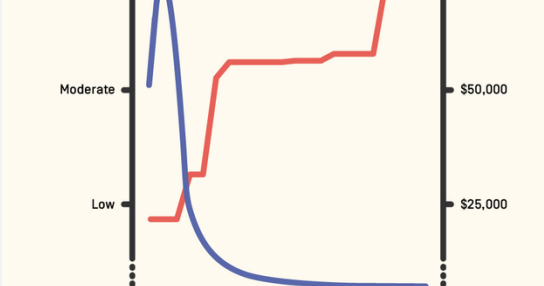

The District of Columbia is聽聽to live in. And our childcare costs live up to that distinction. Consider: parents here pay an average of聽聽(depending on the age of the child and the formality/credentialing of care) per year for child care. But are these high costs reflected in the wages paid to our city鈥檚 child care workers? Not really. Child care workers here聽an average of $12.73/hour, which amounts to a yearly salary of $26,470. That鈥檚 hardly a livable wage in a city where聽.
According to a new Migration Policy Institute report,听,听鈥�75 percent of the total early childhood education and care workforce earns less than $22,000 a year…and 17 percent live in poverty.鈥� Rates of poverty are even higher among immigrant early childhood education and care (ECEC) workers 鈥� 22 percent. These are stark statistics given the professional demands of working with young children who have diverse needs, and increasingly, languages and cultures.
As authors Maki Park, Margie McHugh, Jie Zong and Jeanne Batalova note in the report, children of immigrants now make up one-quarter of the children under the age of 6 in the U.S. Since 1990, the population of children of immigrants in the U.S. has doubled and in some states grown by more than 500 percent. The large share of these children (96%) are U.S. citizens, but only 11 percent speak only English at home. Which is to say that there is considerable linguistic and cultural diversity among these children.
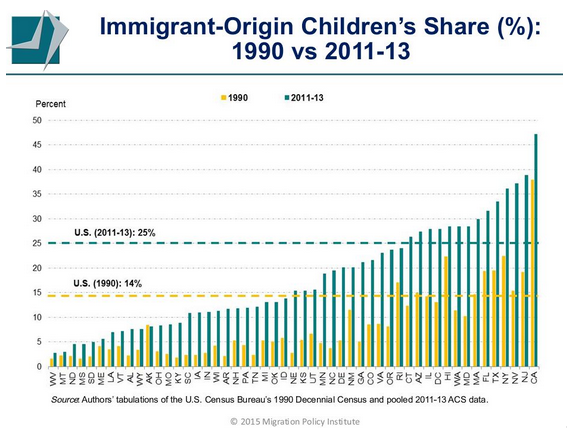
The changing population will clearly require the ECEC workforce to develop new 聽linguistic and cultural competencies. But how well does the ECEC workforce match the demographic shifts seen in our nation鈥檚 youngest citizens? For starters, Park, McHugh, Zong and Batalova point out that:
“The ECEC workforce is more representative of the children it serves than the K-12 teaching force, where only 18 percent of teachers identify as a race other than non-Hispanic White鈥by contrast] minority groups account for nearly 40 percent of the total ECEC workforce, compared with 44 percent among young children.”
Additionally, the rise in the number immigrant-origin children coincides with a 250 percent increase (from 94,000 to 321,000) in the number of immigrant ECEC workers over the same time period.
This growing racial and linguistic diversity in the ECEC workforce should be seen as an asset for serving young children better. Increased diversity among the teacher workforce and additional cultural competency training can lead to better outcomes for students. In fact, some聽聽(mainly focused on upper elementary and middle school children) shows that there is a slight increase in student performance when children are assigned a teacher of the same racial or ethnic background.
However, the diversity in the ECEC workforce often varies in different care settings. Most notably, immigrant ECEC workers are over-represented in informal settings: private homes and family-based care that pay less than schools and centers. As the report puts it: 鈥淓ven with the same level of education, immigrants are less likely than their [native born peers] to be employed as preschool teachers and program directors.鈥� One possible explanation for this finding is that immigrants who have earned a college degree from outside the U.S. must go through many bureaucratic hoops to get those credentials recognized.
To be sure, these findings are also related to the education level and English language proficiency of many immigrant ECEC workers. A full 25 percent of immigrant ECEC workers have not earned a high school diploma and 54 percent are classified as Limited English Proficient (LEP). However, they point to something more important: the need for adult education and workforce programs designed to provide immigrant ECEC workers with the. English language proficiency and low education levels are barriers that can be eliminated if the right programs and policies are in place.
After all, the new linguistic and cultural competence brought to the ECEC workforce by immigrant and refugee workers will mean very little if systems and policies to leverage them are not in place. As such, the report offers up four policy considerations.
First, career pathways must be developed to help immigrant workers gain the training and credentials necessary to get better (and higher-paying) ECEC jobs. The report cites Washington state鈥檚 Integrated Basic Education Skills and Training (I-BEST) program as an example of how to merge 鈥淓SL, basic education, and work skills training into a single accelerated program.鈥� In other words, I-BEST provides students with a fast track to career advancement and higher wages.
Second, Quality Rating and Improvement Systems (QRIS) should include training on racial, linguistic, and cultural diversity as a key component of teacher quality metrics. 聽In addition to requiring teacher credentials and training focused on an early childhood specialization, a state鈥檚 QRIS can require cultural and linguistic competency training for teachers. These requirement should pertain to all early learning settings, including state pre-K programs. Maria Mayoral from聽聽says that QRIS standards should 鈥渇oster high-quality, accessible, inclusive, and culturally and linguistically competent early care and learning services for infants, toddlers, and families.鈥�
Linguistic and cultural skills among teachers should be viewed as an asset to any program 鈥� no matter the student population. Increased teacher diversity and cultural competency is needed throughout K-12, but it is particularly important in early childhood education when children are first learning to trust another adult apart from their primary caregivers. An educator that has the training to appreciate a student鈥檚 entire identity and culture is vital to the development of our youngest children 鈥� and beyond. 聽聽are already beginning to聽聽how their QRIS can be used to create a stronger ECEC workforce.
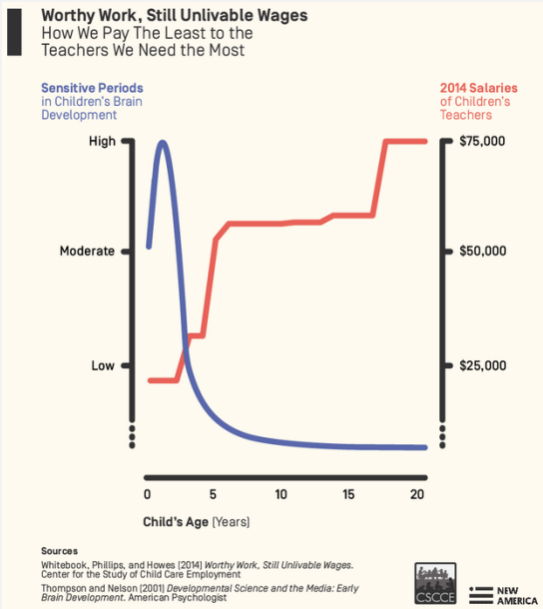
Third, members of the ECEC workforce must be paid a living wage. ECEC teachers set the foundation for children鈥檚 futures by developing key habits and skills. But this powerful work is difficult to do well on a shoestring salary. A聽聽from the Center for the Study of Child Care Employment showed that聽聽have used public supports, such as food stamps or Medicaid. As state policymakers continue to raise quality standards in early education, they must consider how they will raise early care and education workers鈥� wages.
The MPI report recommends a dedicated funding stream to spur an increase in ECEC workers鈥� wages. In the U.S. Senate鈥檚 rewrite of the Elementary and Secondary Education Act, Senator Chris Murphy (D-CT) has filed an聽聽that would allow early learning grant recipients to use funds to grow early childhood teachers鈥� salary levels. State-level policymakers can begin to think about how to incentivize liveable wages for the entire ECEC workforce through QRIS or dedicated funding streams.
Finally, comprehensive statewide data systems should be created that track data on ECEC professional development and preservice training, and demographic data of ECEC workers (including languages spoken and LEP rates). 聽Data should also be collected on young children鈥檚 home languages and on the number of DLLs enrolled in state pre-K programs. As Park noted in a related聽, 鈥淸W]ithout this information it鈥檚 very difficult then to advocate for improved services for dual language learners without simply knowing who they are and where in the system they can be found.鈥�
Note: This post is part of 麻豆果冻传媒鈥檚 Dual Language Learners National Work Group.聽聽for more information on this team鈥檚 work.聽Subscribe to our newsletter (click 鈥淓ducation Policy鈥�)聽on this page.
Director, PreK-12 Research and Practice
Policy Analyst, Early & Elementary Education