Amaya Garcia
Director, PreK-12 Research and Practice
搁别肠别苍迟濒测听迟丑别听at Sesame Workshop released a series of reports on Latino聽. Taken together, the series sheds light on Latinos鈥� use of and access to digital technologies, tackles questions of digital equity, and examines what we do (and don’t) know about how these technologies impact children and their families.
As the聽聽shrinks, and access to digital technologies expands, it will be essential to investigate how those tools are used to promote Latino child and parent learning. After all, Latinos make up an inordinate share of America’s recent population growth鈥攁nd聽. In聽, June Lee and Brigid Barron present survey data that addresses questions about Latino families鈥� access to and use of educational media.
For starters, they found that television was the predominant media platform for parents who reported that their child used educational media. Those parents also indicated that educational media had helped their child learn about reading, vocabulary, math, and science. And 81 percent of bilingual parents and 92 percent of Spanish-only speaking parents believe that their child learned English from educational programming. Whether, and how much, young DLLs are actually learning English from television remains an open empirical question.
Educational media also served as a catalyst for further learning for these children and their families. For example, 78 percent of parents reported that media spurred imaginative play activities and 72 percent reported that their child had taught them something new based on information learned from educational media. Lee told me that these media sparked conversation, play and projects 鈥� all of which are important for a child鈥檚 development.
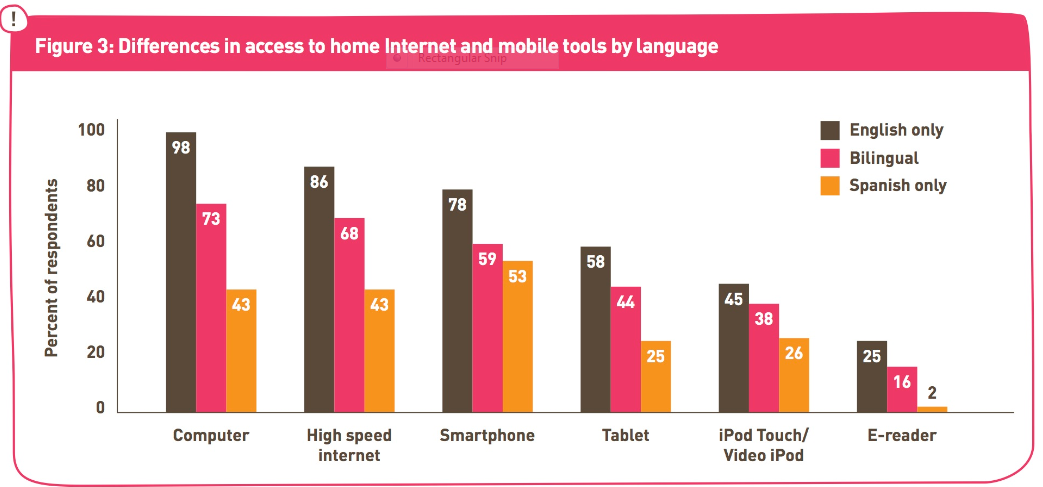
Lee and Baron also uncovered significant 聽differences in technology access and use within the Hispanic population: 鈥淗igher educational attainment, higher family income, being native born, and being English-dominant or bilingual were consistently related to higher rates of technology adoption.鈥� These findings聽聽that demonstrate differences in Internet use based on income and educational attainment: the higher your income or education level, the more likely you are to have broadband at home. Turns out the digital divide isn鈥檛 closing for everyone.
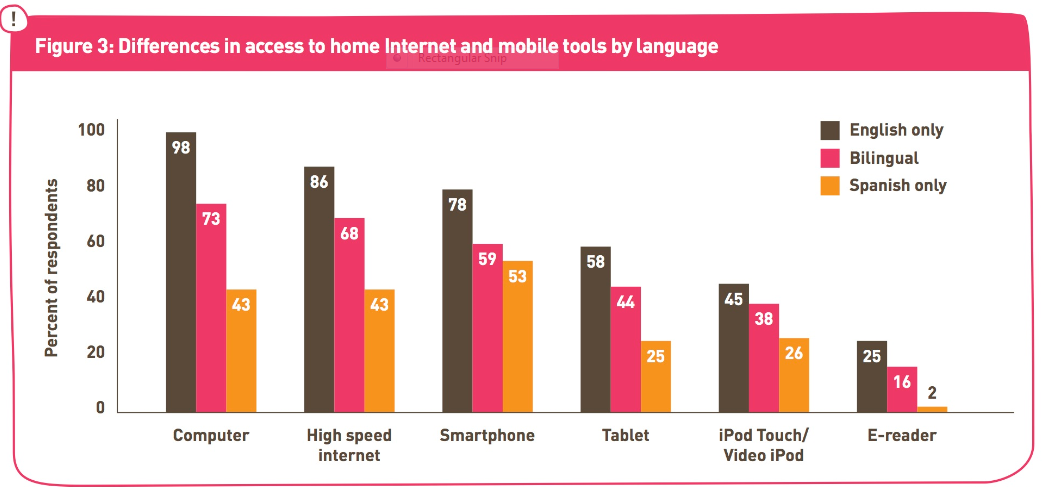
Language plays a key role in differences observed within Latino families. 聽Specifically, Spanish-only households are聽less聽likely to own a computer, have internet access, and to report that their child accessed educational content via a platform other than television or DVDs.
These findings have significant implications for the types of educational activities available to children of particular backgrounds. Lee and Barron highlight several 鈥渋mportant limitations to what users can do on a smartphone compared to a computer.鈥� For example, not all websites are optimized for mobile platforms, which can make it difficult to find content. They also note that 鈥渇or school-aged children especially, sustained activities such as homework or research are not feasible on a mobile device.鈥� So, if Spanish-only households are less likely to have access to computers that means that children and parents may have less opportunities for co-learning or engaging in certain learning activities together.
Parents鈥� learning from media was similarly mediated by access and differed based on language spoken. Around 44 percent of all parents reported using the Internet 聽to learn something new at least once daily. But only 9 percent of Spanish-only parents report using it on a daily basis to learn something compared to 56 percent of English-only parents.
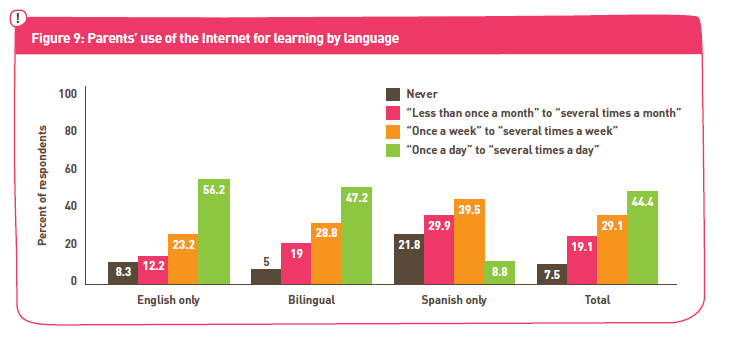
Here鈥檚 why these particular statistics might matter: parents can use media to extend their own learning to help their children with homework and other educational activities. The report spotlights a mother who uses YouTube to learn about the math topics her daughter is studying, 鈥淸A]fter I finish watching the video, then I explain it to her. And if I didn鈥檛 understand, or she doesn鈥檛 get it, then we鈥檒l see the video again. And we do samples.鈥�
Indeed, differential access and use of digital technologies have enormous equity implications. Having access to the Internet matters 鈥� just imagine for a second, fair EdCentral reader, what it would be like to not have regular, reliable access to our site 鈥� and it鈥檚 something we often take for granted. The Cooney Center reminds us that access is far from equal; there is considerable diversity within the group of Hispanics living in the U.S. and their media use (and needs!) vary accordingly.
Education tech expert Karen Nemeth notes that different groups of Hispanics have different national and cultural backgrounds, socio-economic positions, immigrant status, and more. “The quality of [the Cooney Center鈥檚] work is undeniable,” she wrote in an email, “[But] making recommendations about practices, needs, and initiatives without mention of cultural differences among Hispanic groups will be less effective.” To be fair, Lee and Barron鈥檚 report does mention these variations in culture, generational status and education within the Latino community and suggests the need for more research to better tease out 鈥渢he role educational media play in these families.鈥�
Lee and Barron鈥檚 findings also indicate a need for media use studies that include other language groups, said Nemeth. 鈥淭here are about 3.25 million young children who speak a language other than Spanish or English at home.鈥� Additionally, the current study did not examine the language used in the educational content children and their parents were using. Nemeth noted the need to focus recommendations to the 鈥減roducers and developers of Spanish language digital resources鈥� and that change would be hard to achieve without analysis of the 鈥渜uality of programs and apps available in Spanish.鈥�
I asked some of the reports authors to share their perspective on implications of their findings for Dual Language Learners in particular. First, according to Cooney Center Executive Director Michael Levine, 鈥渢here is a need for more resources for both bilingual families and Spanish-speaking families around how to identify media for young children […].鈥� Second, bilingual children must often broker their Spanish-speaking parents鈥� interactions with doctors, landlords or teachers, and even media. Levine suggested that more attention should be paid on how to 鈥渟upport children in this special role in their families.鈥� Finally, Levine pointed out that it was 鈥渢ime for us to consider language as a serious asset! […] If we don鈥檛 get the signals right about what we provide to parents about the right media choices at home […] we鈥檙e going to miss the boat.鈥�
Note: This post is part of 麻豆果冻传媒鈥檚 Dual Language Learner National Work Group. “
Director, PreK-12 Research and Practice