Jenny Mu帽iz
Strategic Advisor and Policy Analyst, PreK鈥�12 Education
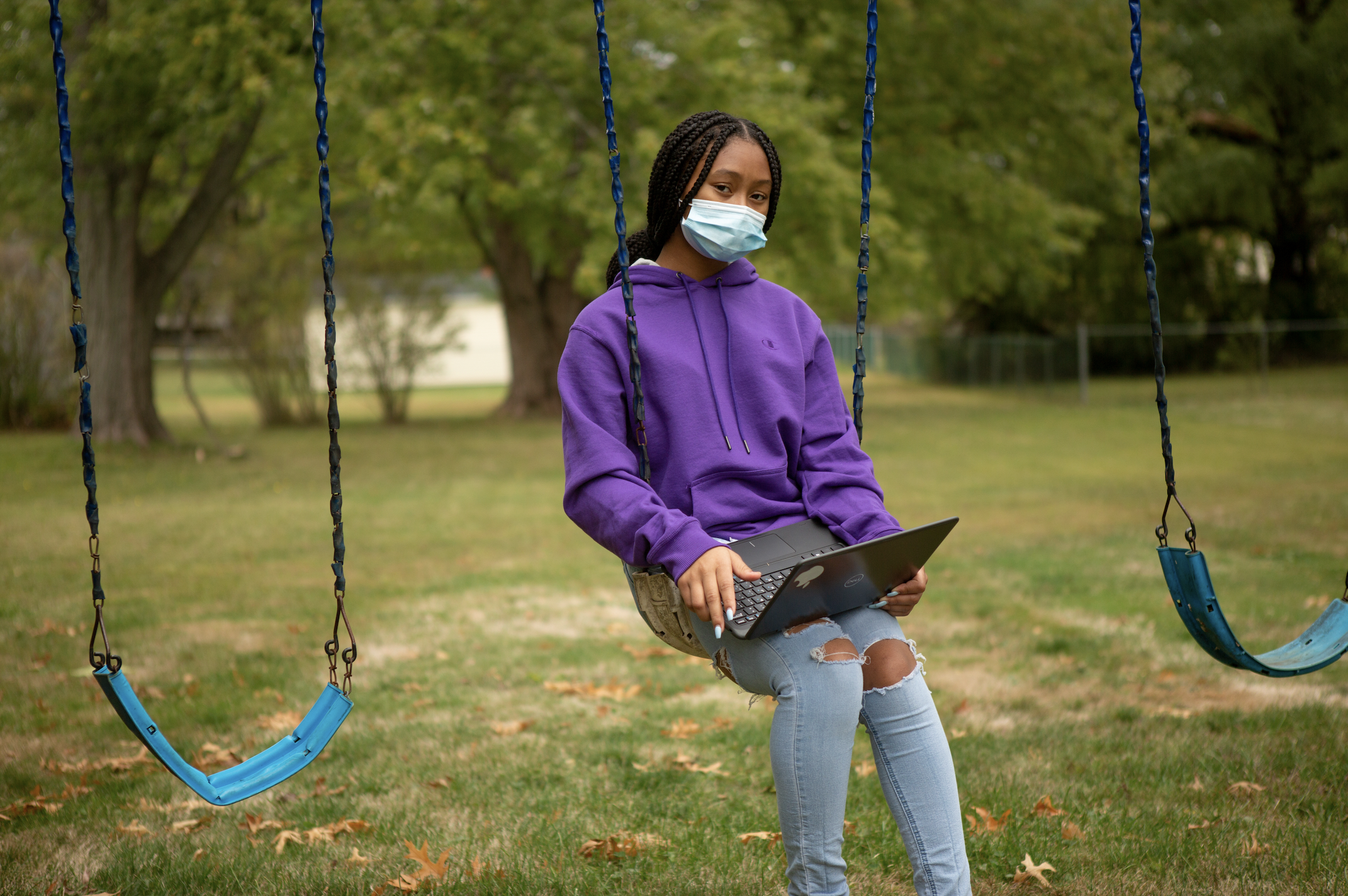
Engaging meaningfully in virtual learning during the COVID-19 pandemic has been difficult for all students, but particularly for students of color, who are but disproportionately lack home internet access, , and . And now, a string of viral news stories reveal these students are also losing critical learning time due to punitive discipline.
Last summer, a Michigan judge made national headlines for sentencing a 15-year-old girl to for not completing her schoolwork. Meanwhile, one fourth grader in Colorado was suspended for five days for during his virtual art class.
Even before the pandemic, school disciplinary policies were administered unequally. In fact, The U.S. Department of Education鈥檚 Office for Civil Rights from the 2015-16 academic year showing that Black students represent only 15 percent of overall enrollment, but nearly a third of all students arrested at school or referred to law enforcement. All too often, Black students receive a harsher punishment for the same or lesser offenses committed by their white or more privileged peers. These disparities start early, with Black students to early care and education due to expulsions and suspensions. Families and students know firsthand the high cost of exclusionary discipline and how the school choices can cause students to be or worse yet, .
What root causes are behind these statistics? And importantly, how can school leaders and educators address them? Published last fall, a by The Education Trust and the National Women鈥檚 Law Center offers answers to these questions. 鈥淓mbedded in school discipline policies, dress codes, or codes of conduct are racial and gender biases,鈥� the authors explain. The good news is that biases can be addressed if school and district leaders are willing to reimagine school safety, according to the guide.
To unpack how students of color, particularly Black girls, experience harsh discipline and what schools can do to create more hospitable climates for them, both virtually and in person, I spoke with one of the guide鈥檚 authors, . Our conversation has been edited for brevity and clarity.
Jenny Mu帽iz: You open your report by saying that schools must rethink their policies and financial decisions, including those that govern exclusionary discipline, in order to 鈥渁ddress the legacy of 400 years of systemic anti-Blackness.鈥� I suspect not everyone understands the connection between school discipline and our country鈥檚 history of racial injustice. Can you elaborate on this link?
Kayla Patrick: I think we got the best example of this link when police on the Capitol behaved drastically differently when white people stormed the Capitol Building than they did during Black Lives Matter protests just months before. This is the same kind of thing that we see in schools. We might see a Black girl suspended for wearing the same shorts as a white peer or even a friend since, as we know, girls like to share clothes. This is a story that I've heard again and again from students. Behavior is monitored and punished differently based on the color of a child's skin.
And policies themselves can also contribute to the disparities. We know that schools where many students of color attend are more likely to have very strict policies because of the belief that Black students are in need of more correction. Why? Because they may not present or behave in the exact same way that white students do. This comparison can be really harmful to students of color.
Jenny Mu帽iz: Your guide gives a good overview of how exclusionary discipline affects girls of color, specifically. Can you briefly describe common exclusionary discipline practices and how they uniquely impact girls of color?
Kayla Patrick: While there is a lot of overlap between girls and boys, there are very specific things that affect girls, especially Black girls. Black girls are often punished for being defiant, for example. Terms like these are very subjective. What we might consider in another realm to be a leadership skill, is seen as a negative from educators who may not have received meaningful anti-bias professional development that we know matters.
Another thing that we see often are girls of color being suspended, or receiving some other exclusionary punishment, for dress and hair code violations. If you take a look at dress code policies, you鈥檒l often see identities being targeted. For example, you may see coded language that prevents girls from wearing head wraps or hoop earrings, which are part of their cultural expression. And there are numerous news articles about Black girls being punished for wearing things like hair braids.
As a result of these policies Black girls are six times more likely to be suspended from school. Suspension may then lead to students falling behind in schoolwork, not graduating, or later being involved in the criminal legal system. But it is not only these students who are affected. Stopping class to tell someone to remove their head wrap can be very disruptive to other students as well. This may lead to disruptions in other students learning as well and produces a poor school climate.
Jenny Mu帽iz: We know that the move to remote learning did not mark the end of exclusionary disciplinary practices. How is exclusionary discipline playing out in the virtual space?
Kayla Patrick: We hoped that exclusionary discipline wouldn't play out virtually, since students are in the comfort of their own home where they are unlikely to jeopardize the safety of their classmates. However, we saw policies carried over into the virtual learning world. Some schools, for example, have decided that students cannot log on to their own computers wearing pajama pants. In California, a young child had her email privileges taken away because she sent too many emails to tech support (read that story,). Instead of talking to the child about how best to request the support she needed, she was excluded. We have to make sure that students are getting the support that they need to be successful and are given space and opportunity to learn and grow from inevitable mistakes.
Jenny Mu帽iz: Another story, this one of a fourth grader being suspended for showing a Nerf gun on camera, also made national news headlines. What do you think went wrong there?
Kayla Patrick: In different states there are different mandatory reporting laws. I would place responsibility on school leaders and district leaders who have to make sure that they're changing discipline policies for the virtual setting, so that teachers know what they should and shouldn't report and who they should be reporting issues to. Educators should also receive training on preventive measures like relationship building. It is even more important now that teachers know how to build trusting relationships with students and families before a problem arises.
Jenny Mu帽iz: The matter of adult biases comes up several times in your report. Can you elaborate on how biases contribute to discipline policies and practices that differentially affect girls of color. Can anything be done to change those mindsets?
Kayla Patrick: We all have biases and it鈥檚 really important to address them head on. I think it's on school leaders and district leaders to make sure that their educators are receiving pre-service and ongoing professional development to address those biases. One bias may be that you think a student is too loud or too defiant鈥攖hese are terms that we often hear associated with Black girls 鈥揵ecause a girl is assertive or asking critical questions. Too often we hear about the trope of the angry black girl in school settings because educators sometimes believe there is only one way to behave, and that girls of color should behave and speak more like white girls. I think this comparison and erasure, is where much of the problem lies.
Jenny Mu帽iz: You and your co-authors spotlight Oakland and Chicago Public Schools as two districts taking steps in the right direction when it comes to discipline reform. What lessons can we learn from these districts?
Kayla Patrick: The biggest lesson is that these districts have opened up space for advocates and students to come to the table and create policies together. In Oakland, girls of color were allowed to co-write the harassment policy, which is wonderful. In Chicago, there was recently a forum that allowed advocates, parents, and community members to talk about the impact of school resource officers. The first step is inviting people to the table and the second step is actually listening to what they're saying. So, these districts have taken the first steps in the right direction.
The other thing that is important, which Oakland does, is making discipline data publicly available by race and gender. If I'm a parent there and I'm curious about suspension rates in my district or in my school, I can look that up pretty easily online. That鈥檚 an important accountability factor, for community members but also teachers who may have to face the music and make necessary changes.
Jenny Mu帽iz: What role should states play in addressing exclusionary disciplinary practices?
Kayla Patrick: States can include school discipline data, disaggregated by race and gender, in their school report cards or somewhere else on their website. That's data that they're probably already collecting, and they should make that available to families and community members. There's professional development that schools and districts need, and states can support them in accessing that. It is critically important that everyone who is in the classroom receives anti-bias training, for example.
In some states, you can no longer suspend students for 鈥渨illful defiance.鈥� Students shouldn't be suspended for this kind of behavior because it鈥檚 not typically serious enough to warrant a suspension and it is also extremely subjective. And when you take suspension off the table, teachers find other strategies for dealing with behavior. One state to highlight is Virginia, which passed legislation that prevents schools from suspending students for dress code violations (passed in 2020, the aims to safeguard religious and culturally specific styles from discrimination). We suspect that we will see less suspensions for girls and Black girls, specifically, as a result of that law.
Jenny Mu帽iz: California is another place considering . Why is getting rid of suspension important in the early grades?
Kayla Patrick: I'm glad to see that California and other districts across the country are starting to pursue that. Inequitable discipline starts as early as infant programs which shows how big of an issue this is. At these young ages, suspension is not developmentally appropriate, it鈥檚 not evidence based, and it is not an effective practice. Younger students aren't old enough to understand why they're being suspended in many cases. Students should get an opportunity to learn and grow from their behavior in a way that meets their age level. A key part of early childhood education is building interpersonal and social skills, suspensions take away from that critical skill building. The bottom line is, suspending students doesn鈥檛 help them to learn and grow. What it does do is make students feel like school isn't a place for them. That鈥檚 a really early age to develop that kind of mindset and it's terribly detrimental to both students and schools.
Jenny Mu帽iz: In your view, what are the common stumbling blocks schools and face when they attempt to reform discipline disparities?
Kayla Patrick: One thing that educators are always concerned about is having supports in place for teachers. If you take away suspensions, you need to make sure that there are other supports in place so that teachers have what they need to teach. For example, two years ago D.C. passed a law around discipline and one of biggest hurdles for them were teachers who didn鈥檛 know what to do if they couldn't suspend kids (passed in 2018, the aims to ensure students can not be suspended for minor infractions).
In those cases, it's important to put restorative justice coordinators, counselors, nurses, and other support people in school buildings who can support teachers. We find that once teachers have access to that kind of support system, they feel better about the policy changes that need to be made. It's really our job to make sure that teachers feel they are getting what they need.
Jenny Mu帽iz: You provide a checklist for schools and districts that offers suggested changes to improve school climates. How should your guide be used?
Kayla Patrick: We created the guide with districts and state leaders in mind and we hope it works as a roadmap towards improvement. We suggest that you print it out along with the student code of conduct, the dress code policy, and anywhere else discipline policies live in your district. Then, answer the questions based on what is true in your district. Maybe your district says that K-3 students shouldn't be suspended鈥攜ou can check that off in our checklist. We know that there are many things on that checklist and everything cannot be done with a strike of a pen but moving in the right direction is critically important, especially in this moment.
So far, states have reached out and said they're including it in their material to their districts and schools. We've heard that it has been a helpful conversation starter. And we hope districts and schools are using it to think critically about what they're doing inside of school buildings, and what policies they are enforcing, to ensure that they have all students in mind, not just one group of students. It鈥檚 heartening to hear that people are actually starting to talk about these issues and look for ways to address them.
Black, Indigenous, and other students of color will return to in-person learning at an enhanced risk of exclusionary discipline. These students will be asked to quickly adapt to at a time when many are experiencing heightened. Policies and practices must evolve quickly to meet the moment. While recent statements by districts, superintendents, and teachers鈥� unions reveal a desire to reckon with institutional racism in our schools, as my conversation with Kayla Patrick conversation affirms, only bold steps to heed existing guidance will ensure schools deliver safe and inclusive learning environments for all students during and after the pandemic.
Enjoy what you read? Subscribe to our newsletter to receive updates on what鈥檚 new in Education Policy!
Strategic Advisor and Policy Analyst, PreK鈥�12 Education