
Sarah Gilliland
Senior Policy Manager, New Practice Lab
Thoughtful implementation will be critical to delivering much needed supports

Care infrastructure still needs support. The caregiving crisis- specifically, the gap between people in need of affordable, high-quality care and the ability to actually access it- calls for investment that only Congress can provide, but the Care Executive Order leverages the powers of the executive branch to clear the path for families and workers to access benefits.
On April 18, 2023, President Biden with a one overarching goal: to increase access to high-quality care and support caregivers. It was the most sweeping set of executive actions to address caregiving needs undertaken by any administration. Despite over forty past proclamations to declare a 鈥淣ational Family Week,鈥� and four more proclamations specifically promoting child care awareness, it was only the third executive order to ever mention the words 鈥渃hild care,鈥� and it was the first to ever mention the word caregiver. This, despite the fact that one in five Americans are caregivers in 2020- , and despite the fact that child care conflicts alone may cost an .
The order is an acknowledgment of the caregiving crisis that American families and care workers face daily, and a strong example of the President using the tools at his disposal in the absence of Congressional action. It comes not a moment too soon.
That said, executive orders are not always well understood by the American public. They aren鈥檛 mentioned in the Constitution, and no clear definition exists in statutes.There is no School House Rock for , and it鈥檚 not always clear how executive orders really work, especially to people outside the government. Sometimes they鈥檙e , usually at the political convenience of critics with short memories.
Yet, presidential directives (and since 1905, formally recorded executive orders) . They give direction to federal agencies, set administrative priorities, and establish national policies. Think of them as a carefully worded memo from the CEO or boss about a new plan to meet the company鈥檚 goals. Managers may not be getting new staff, or a bigger budget- but it鈥檚 still very much a part of their job to come up with an implementation strategy.
So what is the 鈥淐are Order,鈥� and what is it not? By the numbers, it is 54 directives aimed at each and every federal agency- including 14 explicitly named- that directly affect people needing care, as well as the paid and unpaid care workforce. While it doesn鈥檛 carry the force of law and expends no new money, it has the potential for great impact, depending on how the affected federal agencies implement it. The rest of this blog will explore the care order along some of the most basic dimensions- the 鈥渨hos鈥� and 鈥渨hats鈥� set forth in the language of the order.
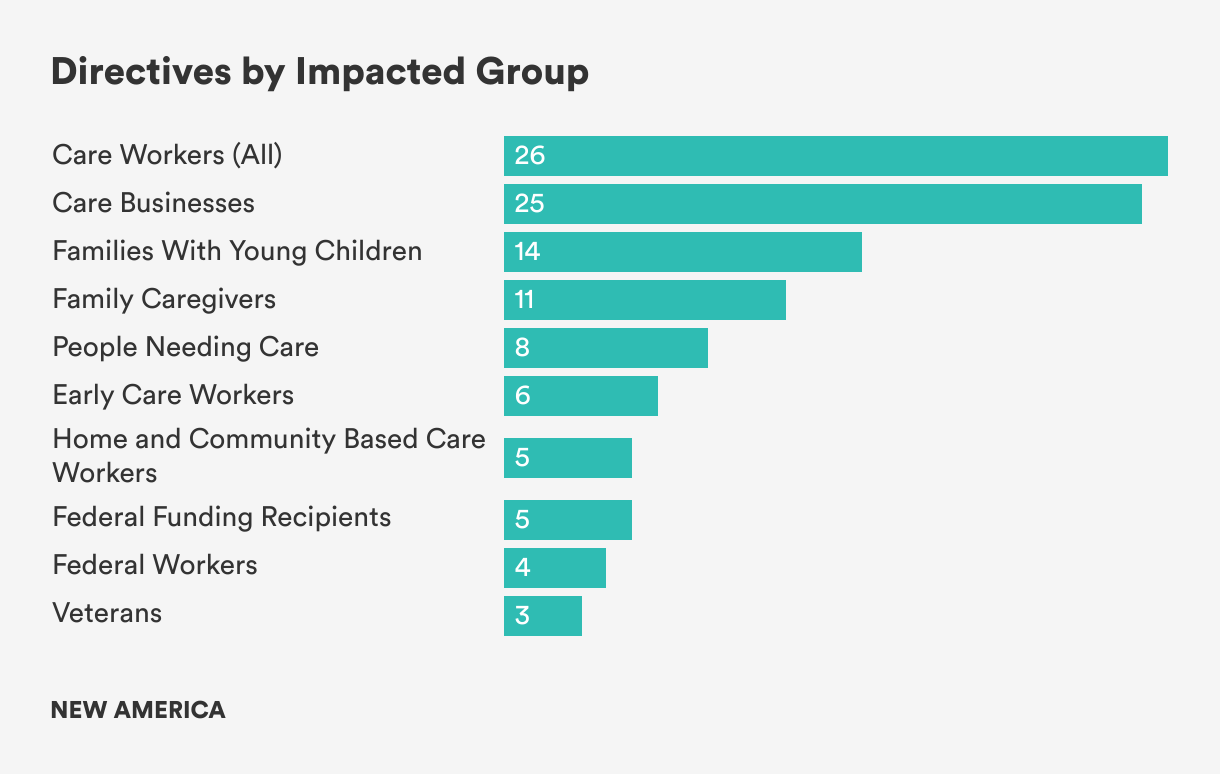
According to our analysis, about half of the directives are targeted towards improving conditions and job quality for the care workforce. Of worker focused directives, roughly half apply to the care workforce writ large, while the remainder focus on care workers in specific categories: those primarily working with older adults and people with disabilities, or those working with young children.
Almost a quarter of all care order directives aim to improve access and/or quality of care for families with young children, while a slightly lower number focus on family caregivers to older adults and people with disabilities. Directives focusing on the disabled, veterans, tribes, care businesses, and federal workers (permanent and project funded) are less frequent but together represent a notable segment of important populations.
Note: Given the 鈥渋ntersectionality鈥� of populations- such as adults with disabilities who are raising children, or families caring for children with disabilities, so called 鈥渟andwich generation鈥� families with multiple care needs, and care workers who themselves are in need of care, these directives will likely crosscut multiple populations.
The Care Order directs agencies to take a number of administrative actions aimed to help American families and care workers access and deliver high quality care. The language is sometimes direct and emphatic, for example agencies 鈥渟hall issue guidance鈥� or 鈥渟hall jointly conduct a review,鈥� while other directives leave more room for interpretation: 鈥渃onsider issuing guidance鈥� or 鈥渃onsider additional actions.鈥� While no directives carry the enforceability of law, it鈥檚 safe to say that agencies will be expected to demonstrate some measure of progress across all directives. The point of an executive order is to focus the attention of federal agencies, and give them tasks for which they are accountable to the President.
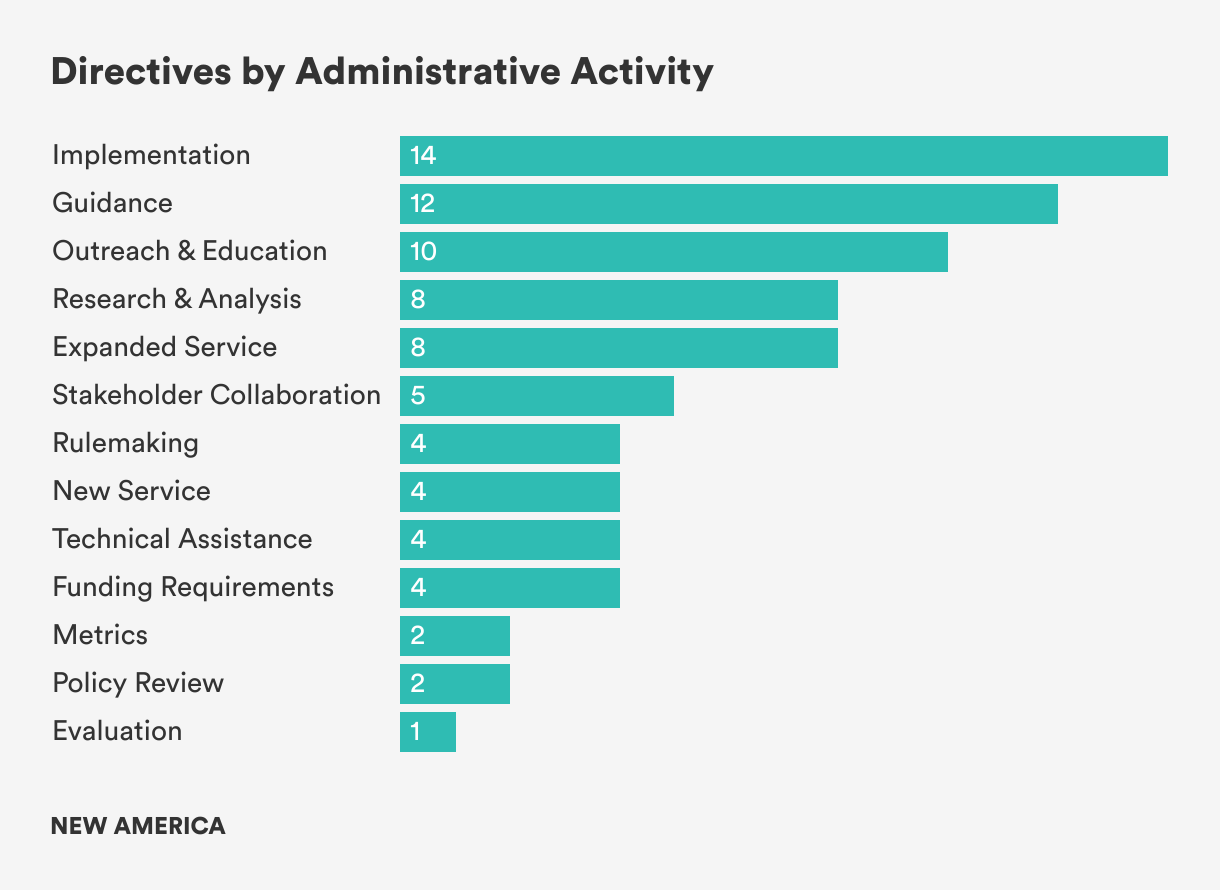
The actions prescribed by the Care Order fall into several major categories: general implementation (14), issuing guidance (12), expanding current services (8), developing new services (4), conducting outreach and education (10), as well as research and analysis (8).
Less frequent but important directives request that agencies engage with stakeholders, issue formal rules, provide technical assistance, collect data, review policy, and conduct evaluations. Each of these activities will require differing kinds of expertise within agencies, and coordination across multiple departments within agencies, and even across multiple agencies.
The care order can be considered a in that it involves multiple agencies reorienting themselves around tackling a complex and cross cutting problem. While the order calls upon Congress to enact laws to address the growing crisis, the order calls on all executive departments and agencies to 鈥渄o what they can within their existing authorities to boost the supply of high-quality early care and education and long-term care and to provide support for family caregivers鈥� and further directs these agencies to 鈥渕ake all efforts to improve jobs and support for caregivers, increase access to affordable care for families, and provide more care options for families.鈥�
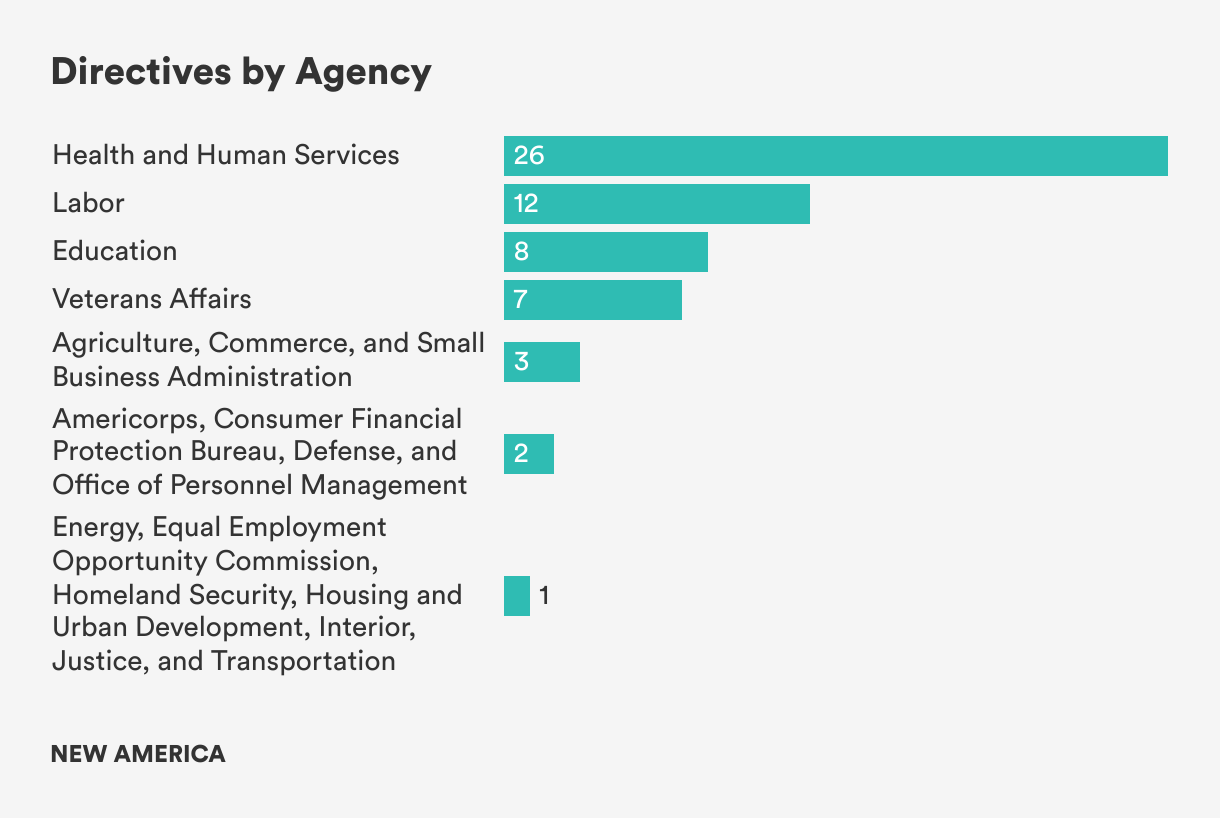
Given that the U.S. Department of Health and Human Services is responsible for administering numerous care programs across generations and types of care needs, it is not surprising that half of the order鈥檚 provisions are directed at them. The Department of Labor is named in eight directives, and Veterans鈥� Administration shows up in six. Departments of Education, Commerce, Treasury, and the Small Business Administration, Consumer Financial Protection Bureau, Americorps, and Office of Personnel Management all appear in more than one. Nine provisions are not directed at any particular agency at all, and six involve more than one agency- both signaling the administration鈥檚 view that improving care will be a whole-of-government approach, with many opportunities for government alignment.
A little over half of the directives specifically relate to improving the experiences of paid and unpaid caregivers, while the remainder focus on internal processes that will help government be more responsive to caregiving populations, and care recipients. Directives aimed at helping the care workforce- all sectors- are primarily concerned with increasing pay, ensuring fair and safe working conditions and benefits, and providing training opportunities. For people requiring care, directives focus on increasing access to services, improving quality of care, and reducing costs. To a lesser degree, directives are aimed at expanding choices and eligibility, reducing administrative burden, or providing other types of support like assistance with care planning.
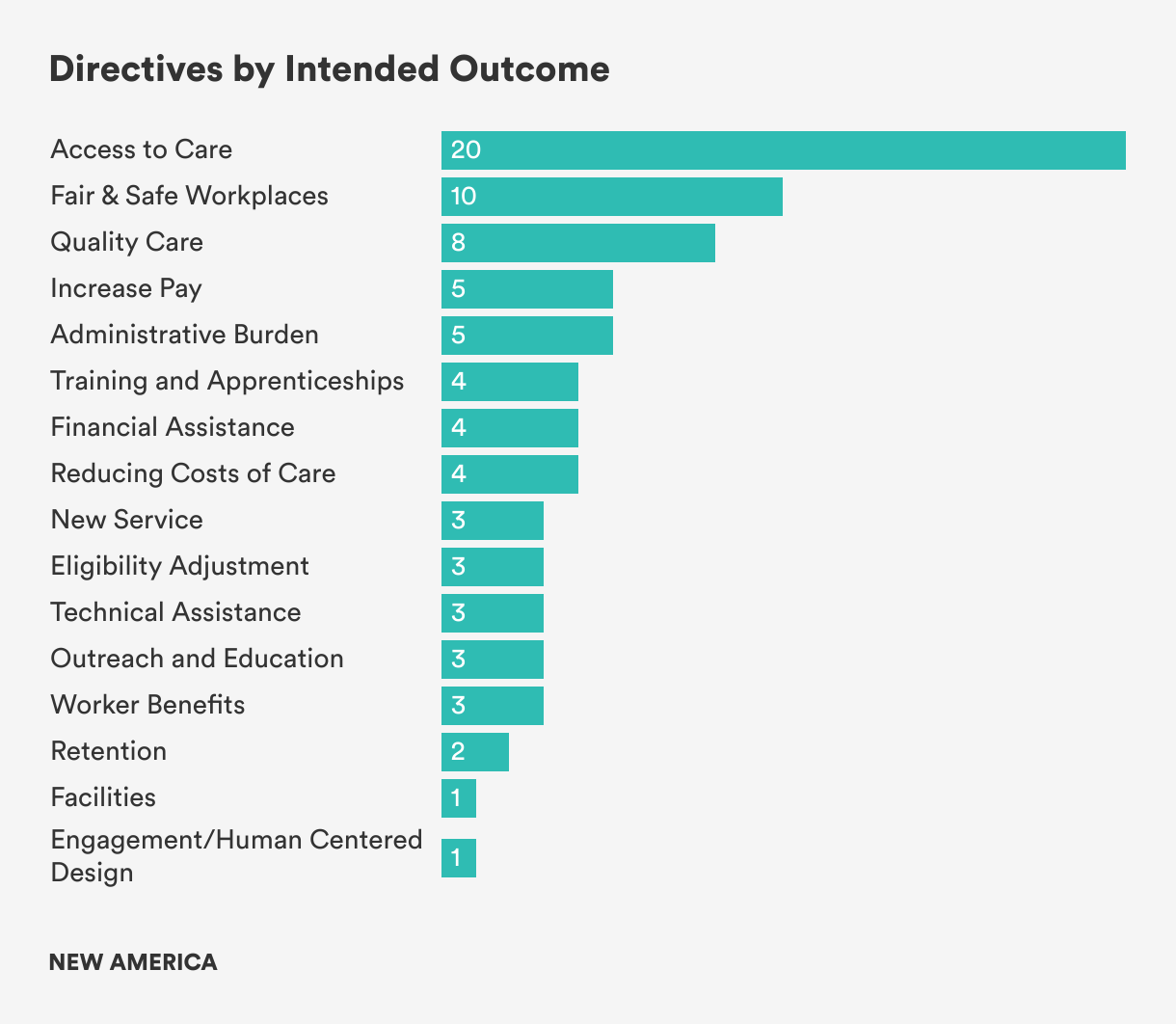
Given the breadth of populations impacted, ordered activities, agencies involved, and intended outcomes, the potential reach of the Care Order is extensive, but much is yet to be determined about how it will be implemented and what actual outcomes might look like. The White House recently released updates about agency actions that relate to caregiving, including:
The White House also published a summary of .
Plenty of implementation details have yet to be hammered out. Some of the potential impacts to child care and early learning have already been addressed by our 麻豆果冻传媒 colleagues in education policy in an earlier blog post. However, it may be possible to forecast some implementation possibilities by reviewing strategies stemming from another order framing a whole-of-government approach to problem solving: , as well as the being led by the Office of Disease Prevention and Health Promotion at the U.S. Department of Health and Human Services. Furthermore, there are also intriguing examples of innovative care programs being funded by state and local fiscal recovery that align with some of the Care E.O.鈥檚 provisions. We鈥檒l summarize some of the implementation strategies and lessons learned from those ongoing efforts in future posts.
Senior Policy Manager, New Practice Lab