Erica Meade
Policy Director, New Practice Lab
Aligning payment practices with private sector norms could encourage child care providers to participate in federal child care subsidy programs.


The New Practice Lab's theory of change centers on designing public goods and services the same way we design the most successful private goods and services鈥攊n partnership with the people who use them, and suited to the digital age in which we live. We study not only the way that programs are designed, but how they are delivered, and what this actually means for families with young children.
Recently, the Administration of Children & Families (ACF) introduced , as unpopular payment practices in the administration of the Child Care and Development Fund (CCDF) discouraged child care providers from participating. This can result in fewer child care spots for the families who need them.
The Child Care Development Fund (CCDF) is an important federal program for low income families who depend on it to make child care more affordable so they can work or attend school. Families who qualify can use their voucher to enroll their children with providers who agree to accept program dollars. The care services provided through this program have the potential to improve outcomes for low income families in two critical ways: enabling more stable household finances and self-sufficiency by helping parents work, and increasing access to environments that can contribute to early childhood development. A 2016 study from the Office of the Assistant Secretary for Planning and Evaluation at the Department of Health and Human Services showed that a Early care and education programs, especially when the programs are high quality.
Nationwide, and their families rely on this program for child care that enables them to work or get the training that helps them achieve economic stability. But unfortunately, many more miss out due to chronic underinvestment coupled with multiple barriers to entry, also known as 鈥渁dministrative burdens.鈥�
鈥淎dministrative burden鈥� refers to the way that There are learning costs (figuring out if you are eligible for benefits), psychological costs (stress while waiting to be approved), and compliance costs (filling out all the paperwork). In previous research with families, the New Practice Lab found that families with young children are experiencing far too much burden when trying to access the programs that are intended to help them.
For families trying to enter the workforce with the help of the subsidized child care program, there is yet another step: 鈥�. These 鈥渓ast mile鈥� barriers to redeem occur when someone has applied, been deemed eligible, and received a public benefit but is then left stranded in the private market to actually use the coupon, voucher, or cash on their own. This means finding groceries, apartments, and yes, child care, with a lot more rules, fewer choices, and little flexibility. Most families know that it鈥檚 hard enough to find a child care provider you like and trust, with the hours you need, and a location you can commute to. Add to the list of to dos: finding one that accepts your voucher. This is a critical tension as the CCDF program strives to empower parents with more choice in selecting the appropriate care settings for their children.
The result is that families with vouchers are squeezed out, particularly when they are hoping to access high quality child care. According to the , 鈥�275 of the 490 licensed child care facilities in DC (56 percent) accept a subsidy voucher, and among those, 102 (37 percent) have a quality designation of Quality or High-Quality.鈥� Acknowledging that quality of early care and education programs is a critical factor in delivering long term benefits for children鈥攏ot just labor supports for working parents鈥攖his is an unfortunate flaw within the current system that needs correction. When it comes to quality level, families receiving child care subsidies have more limited options and less choice in selecting providers that meet their needs.
What makes it so hard to find providers who will accept subsidies? A combination of factors are to blame: lots of paperwork, low reimbursement rates, and payment practices that don鈥檛 align with private paying families. A prime example: the common practice of paying CCDF providers 鈥渋n arrears,鈥� delaying payment sometimes weeks after services are rendered. The Administration for Children & Families estimated that this practice impacts . This represents a sharp difference in payment practices for private paying families. According to a survey from the National Association for the Education of Young Children (NAEYC), . While most families pay for child care in advance of services, at the beginning of the month, reimbursements for subsidized care can come up to 60 days after care has been provided. Child care businesses鈥斺�攁re paying their staff and overhead costs like rent, food, and supplies without seeing a dime for their efforts for several weeks. As of June 2024, when , only six states paid providers in advance: Hawaii, Kansas, Maryland, North Dakota, Utah and Wisconsin.
Another payment practice that disadvantages providers who accept subsidies is paying by attendance, rather than enrollment. Again, most families pay for a full week or month of child care regardless of how often their child attends. This helps child care businesses stay open and staffed continuously, even as families keep their children out of care due to intermittent illnesses, appointments, or vacations. According to , 21 states and the District of Columbia pay providers based on enrollment rather than attendance. Both of these payment practices鈥攑aying in arrears rather than prospectively, and paying by attendance rather than enrollment鈥攎ake participating in the program financially unattractive, and create solvency issues for participating child care businesses that are struggling to keep their doors open to families.
Throughout 2024, ACF sought to revise payment policies to tackle these barriers. now require lead agencies (usually state departments of health and human services, workforce, or early childhood) to improve payment practices to providers, namely by shifting to paying providers based on enrollment and in advance. These changes responded to public input both leading to the rulemaking effort and in comments once posted, which pointed out that In theory, this should level the playing field and increase choice for families in the subsidy program by increasing provider participation. According to the NAEYC survey cited above, 鈥�80 percent of child care center directors/administrators and family child care owners/operators who responded鈥� would be more likely to serve families using subsidies if the state paid based on enrollment rather than attendance, and 73 percent said they would be more likely if the state paid prospectively.鈥�
However, these changes to payment practices were met with some skepticism as well. Commenters noted that prospective and enrollment based payments are not generally accepted practices for all provider types, particularly who may not be working full time, regular hours. How to handle prospective and enrollment based payment for these providers is no small question, as Family, Friend, and Neighbor providers (FFNs) are the largest type of providers in the United States, . Given the feedback, states were granted flexibility to exclude FFN providers from the payment practice changes if it is consistent with the way FFNs are paid outside the subsidy system.
Comments on the rulemaking also raised for children who may switch providers in mid-month. Ostensibly, the state鈥檚 lead agency would be alerted to the change by a request for reimbursement from the child鈥檚 new care provider鈥攂ut it may not be feasible to recoup funds from the original provider for the period where care services were not provided. It is not clear how frequently this happens, but it is something to learn more about as a new set of implementation challenges may arise through these new policies.
As with any operational change, there were also comments that for implementation, given that even small tweaks can have unintended impacts to behind-the-scenes administration. Some specific examples about how shifting to new payment practices could be difficult in communities included:
In other words, states don鈥檛 have magic wands, and implementing changes to payment systems could include any combination of state-level statutory, regulatory, budgetary, or technical fixes. In most or all cases, vendors are critical stakeholders who will have to be engaged to tweak or overhaul payment systems. This reality is what led some commenters to request a two-year delay in implementation to ensure successful rollout. In response, ACF expanded the implementation timeline to two years through transitional and legislative waivers. States were asked to document the payment practices that were in effect as of October 1, 2024, and to describe the steps they would take to implement payment changes in their three year plans covering the period 2025 – 2027.
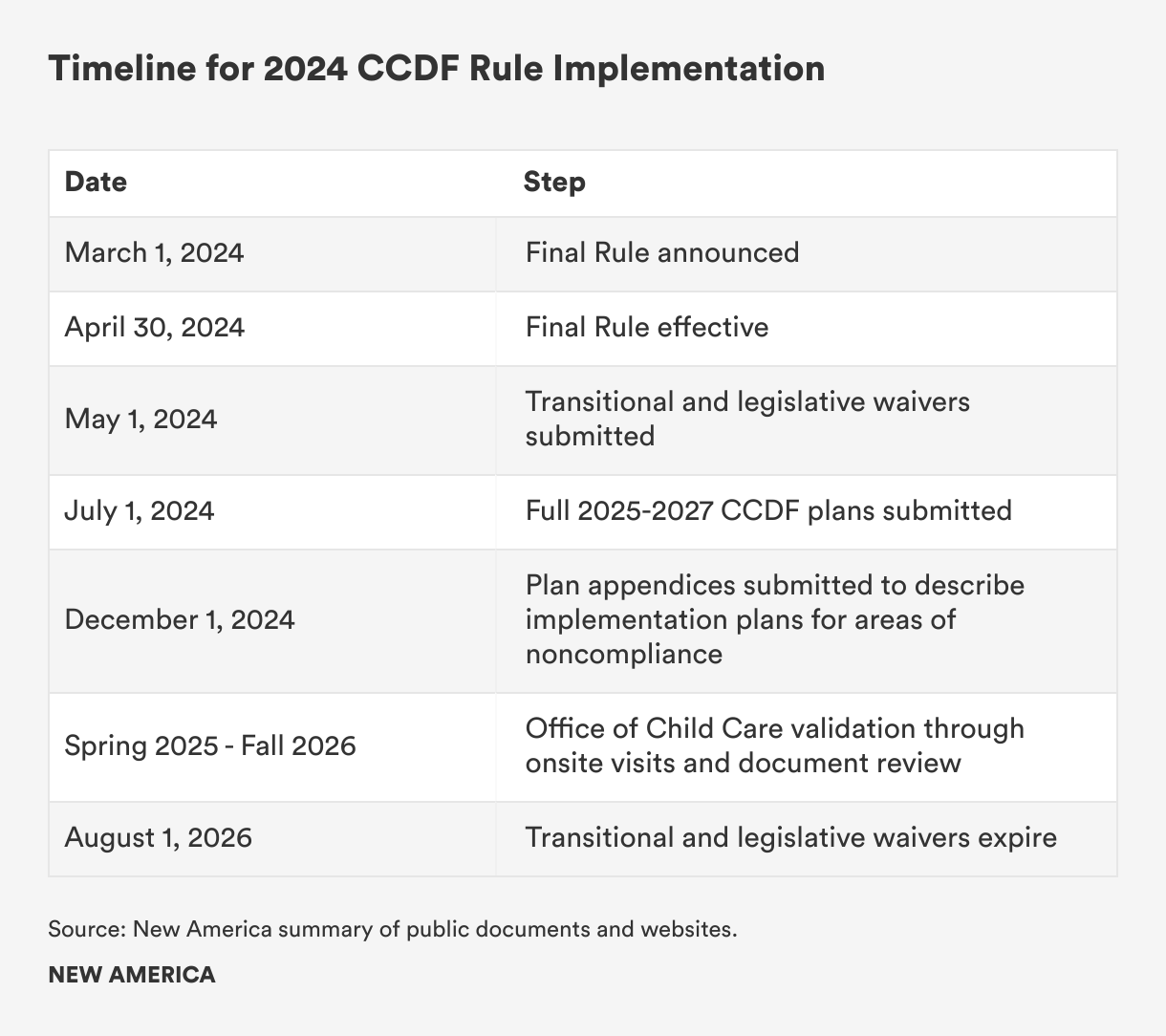
The New Practice Lab team scanned the submitted last year to get an initial understanding of how states are approaching the implementation of these new policies, particularly prospective payment. We wanted to understand what fixes are necessary (statutory, regulatory, budgetary, or technical) to enable this implementation, and get a sense of the timelines required. We were also curious to see how states proposed working with stakeholders, like vendors, to design processes that work well for both providers and families. Our early findings show wide variance in the way states are currently delivering prospective payments, and for states with waivers, in their strategies to implement prospective payments going forward.
In keeping with how the New Practice Lab operates, we are also looking to partner directly with states in different stages of prospective payment implementation: early/not yet started, in progress, and established. Though our implementation work is geared towards replicability and scaling lessons more broadly, this is not a 鈥渙ne size fits all鈥� endeavor. Our goal is to work with a broad group of states representing diverse political and operational environments as they implement these changes. What is working (or not) for state administrators? For different types of providers? For families? Are we seeing an increase in spots available? In participating children? If you have something to share, we have something to learn.
The New Practice Lab plans to release substantive analysis of our scan of CCDF state plans and waivers in the near future, along with any high level lessons we can share from state partners in accordance with agreed upon parameters. To that end, we welcome outreach from states in early, middle, or late stage implementation work on prospective payments. Please contact us at [email protected] to speak with our project team about your experiences implementing CCDF payment changes, or if you may be interested in one of our (no cost) implementation teams working with you on this effort.
Note: Recent and widespread reductions in force have been announced at the U.S. Department of Health and Human Services, including offices that oversee federal child care and early learning programs. This will impact technical assistance and other services to state lead agencies charged with administering the CCDF program.
Policy Director, New Practice Lab
Senior Policy Manager, New Practice Lab