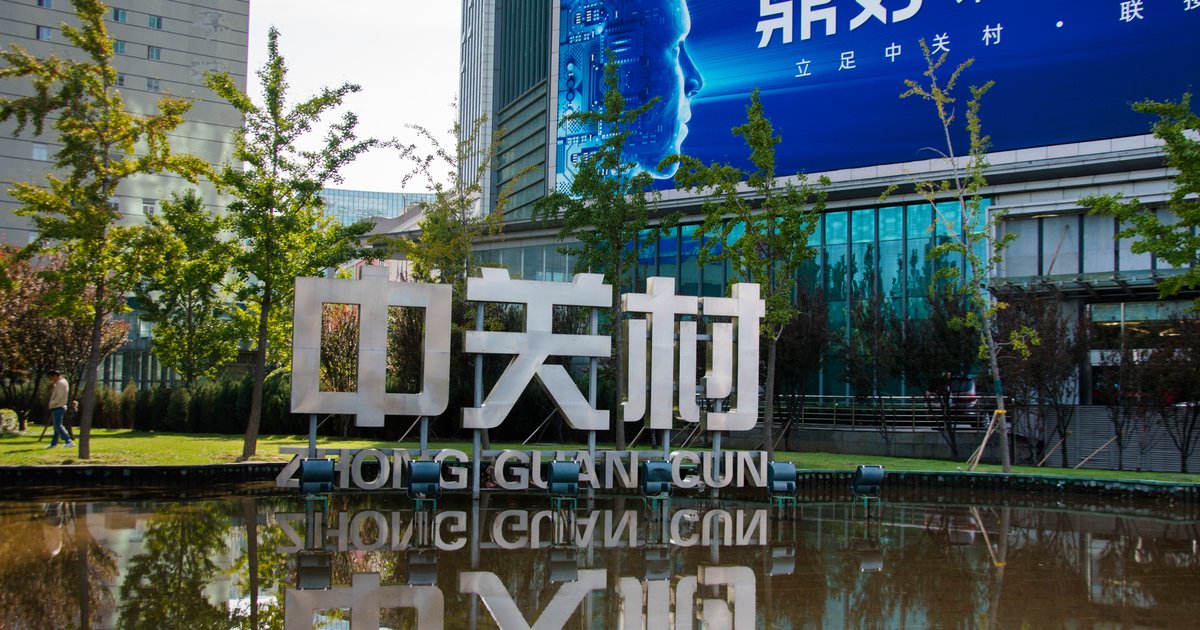
AI Politics Is Local
Municipal and central authorities dream up a model AI cluster in Beijing

This article was published as part of the Stanford-麻豆果冻传媒 DigiChina Project's first special report, AI Policy and China: Realities of State-Led Development. Read this article and the others in PDF here.
China鈥檚 central government plans for national advances in AI industries call for widespread efforts across numerous industries and in academia. The 2017 New Generation AI Development Plan (AIDP) further calls for encouraging 鈥渓ocal industry chains and innovation chains around AI鈥� and building 鈥淎I industry clusters.鈥� Local institutions across the country have announced such efforts, and the Beijing area, already home to prominent companies and research institutions, is perhaps a prime example.
In November 2018, China鈥檚 Ministry of Science and Technology and the Beijing Municipal Government announced the Beijing Zhiyuan Action Plan (the 鈥淶hiyuan Plan鈥�) and established the Beijing Academy of Artificial Intelligence (BAAI). BAAI was formed from a coalition of academic and private sector leaders, with backing from some of Beijing鈥檚 most influential institutions and corporations in AI, including Peking University, Tsinghua University, the Chinese Academy of Sciences, Baidu, ByteDance, Megvii, Meituan-Dianping, and Xiaomi.
Here, we provide profiles of Zhiyuan Plan and BAAI, two local initiatives that stand out from the pack because of central government support and location in one of China鈥檚 best technologically endowed cities.
Beijing Zhiyuan Action Plan
The Zhiyuan Plan is a response to a comprehensive web of central and municipal science and technology development policies and initiatives. Where the AIDP provided broad guidelines and goals for the AI industry, the Zhiyuan Plan makes the central government鈥檚 directives more concrete.
According to Beijing Municipal Science and Technology Commissioner Xu Qiang, the Zhiyuan Plan is meant to carry out the following :
- Create an innovative AI ecosystem, build Beijing鈥檚 open source platform, and promote open source algorithms through the use of public data, smart computer programming frameworks, and computing infrastructure;
- Construct a high-level joint lab to address core basic ethics questions, launch integrated and collaborative research, and promote indigenous innovation;
- Identify, convene, and cultivate elite AI talent; and
- Establish Beijing as a global hub through strengthening corporate, academic, and institutional cooperation, as well as holding global AI summits.
No major publicly released document is attached to the Zhiyuan Plan, but correlated projects have included the establishment of and initiation of the , the ( the 鈥淧ilot Zone鈥�), and the (the 鈥淛oint Lab鈥�). The Pilot Zone is the first of its kind in China, while the Joint Lab is part of an evolving institutional domestic model. Over two years, an increasing number of corporate and academic joint AI labs have been established around China, as well as between China and other countries.
Despite this activity, measurements of success are not yet available. The AIDP set out timelines and goals around core AI and AI-related industry scales over the next 15 years. Other measurements of success are likely to be number of citations, share of global markets, winning international AI R&D competitions and contracts, and a prominent role in structuring AI governance, regulations, and standards. However, without specific stated goals set by the Zhiyuan Plan, it will be difficult to tell if its approach is or will be a success.
Beijing Academy of Artificial Intelligence
From the outset of the Zhiyuan Plan, BAAI has played a central role in establishing the complementary institutions and initiatives mentioned above. For its part, BAAI is to serve as an experimental hub for cooperation between the academic and corporate sectors while also receiving support from the government including funding and government data.
BAAI has announced four research focuses and houses two centers. The four research focuses are: mathematical foundations for AI, machine learning, intelligent system structures and chips, and intelligent information search and extraction. Its is led by Tang Jie, an AI expert and Tsinghua University computer science professor. The Center鈥檚 priorities are listed as: establishing open data standards, researching core open data technologies, and building an open data shared platform. Zeng Yi, one of China鈥檚 most internationally engaged AI experts, leads the . That center鈥檚 work is to involve the exploration of ethics and safety or security principles, as well as the concrete implementation of those principles.
In May 2019, BAAI鈥檚 Center for AI Ethics and Safety released the covering research and development, governance, and usage of AI. The Principles are among the first guidelines for AI use in regards to privacy, freedom, and rights, raised by a Chinese government鈥揵acked organization. They have the potential to guide future regulation and shape Chinese discourse on new processes for creating rules and standards for emerging technologies.This new to AI development aims to move in lockstep with the advancements of leading AI companies and platforms, which emerge as regulatory stakeholders in the process.
Finally, one of BAAI鈥檚 most prominent campaigns to date has been the initiation and implementation of the Beijing Zhiyuan Scholars Plan, which is to induct 300 of the top Chinese AI experts over a period of three years. Scholars receive a generous stipend, as well as discretionary financial and data support to carry out their research. BAAI dean Huang Tiejun also that beyond this support, the recipients have the freedom to pursue whatever AI project they choose, except those appearing on a non-public negative list.
To this point, the acceptance of 65 experts to the program: 47 established and 18 rising AI experts. Only four currently work in the private sector, while all others are professors, researchers, and leaders of academic and research institutions. Their research and program focuses include a vast range of topics, including fundamental principles of machine learning, small-sample machine learning methods, and deep neural networks.
BAAI鈥檚 strategy appears to be: Provide space, provide funding, and let the experts handle the rest, while setting certain parameters for areas of research. If success in AI fields is to come from experts unleashed from the pressures of the market, this would seem an ideal environment for building a strong domestic ecosystem and leadership abroad. It is yet to be seen whether this government funding model, and the selection of individual researchers, will bear fruit.
Beijing鈥檚 Efforts as an Example
The Zhiyuan Plan and BAAI are emblematic of several important trends that also appear in AI development initiatives across China.
The Zhiyuan Plan represents one model for responding to broad central government guidance plans. Typically, national development plans released by the State Council point out a general direction for economic and political priorities but often lack detail regarding concrete steps. Central government departments and local governments are therefore left to determine the concrete measures to advance broader goals. The implementation of the Zhiyuan Plan is an example of the Chinese bureaucracy鈥檚 recurring pattern of top-down directives and bottom-up execution.
The Zhiyuan Plan serves as a model for AI ecosystem development that other municipalities could emulate. Beijing鈥檚 AI ecosystem is unique. It has one of the friendliest innovation regulatory environments and some of the world鈥檚 most advanced companies and institutions in AI R&D. Not all cities boast the same resources, but other municipalities are showing signs of incorporating elements of the Zhiyuan Plan to advance the national AI ecosystem. Already, China鈥檚 second AI Pilot Zone opened in Shanghai in May 2019. In September, plans were announced for by 2023. Not all municipal strategies and actions will be the same. They will vary based on each city鈥檚 perceived advantages and individual officials鈥� choices. For example, the annual World AI Conference held in Shanghai is quickly becoming a prominent forum for global AI innovation exhibition and debate. Organized by the Ministry of Science and Technology and the Shanghai municipal government, the conference was attended by people in its 2018 inaugural year, and in 2019 was headlined by Elon Musk and Jack Ma.
The Zhiyuan Plan is intended to shore up weaknesses in China鈥檚 AI ecosystem. Despite the rapid pace at which China鈥檚 AI ecosystem is developing, there are still between China鈥檚 achievements and its ambitions. These include gathering and retaining top AI talent, building a strong discourse on ethics, governance, and technical standards, and developing a widely-used machine learning framework. BAAI is emblematic of the steps the Ministry of Science and Technology and Beijing municipal government are taking to shore up these areas given their critical role in furthering the State Council鈥檚 AIDP.聽While elevating status and resources for engineers will help with talent, the other two gaps are far more complex. Open source framework development is a complex endeavor, and a framework is only truly successful if it is widely adopted. A strong discourse on ethics, governance, and standards would also require a careful balance of government incentives eliciting corporate buy-in, coupled with freedom for independent research and opinion.
The Beijing AI Principles are a potential map for future China AI regulation and governance. Among the goals AIDP set for China鈥檚 domestic AI ecosystem and global footprint by 2025 one was the 鈥渋nitial establishment of AI laws and regulations, ethical norms and policy systems, and the formation of AI security assessment and control capabilities.鈥� Playing a central role in the development of international standards, governance practices, and regulations is one way to help secure Chinese prominence in future markets. The Beijing AI Principles demonstrate China鈥檚 focus on the topic and intention to collaborate internationally on AI governance and standards.
At the same time, the Beijing AI Principles likely have significant potential to guide future regulation of the field domestically. BAAI boasts collaboration among academics, the government, and industry. It therefore has the potential to work with companies to identify how to concretely work these still vague principles into actual AI research, development, and application. The future development of these or other principles could lay out a map for legal regulation, R&D, governance, and application of AI tools. 鈼�
Joseph Michaels contributed to this article.
More 麻豆果冻传媒 the Author
Issues
Programs/Projects/Initiatives
Topics
Related

Visit digichina.stanford.edu for new and updated DigiChina publications
How will China鈥檚 privacy law apply to the Chinese state?

Personal Data, Global Effects: China鈥檚 Draft Privacy Law in the International Context