A Chapter of: Unpacking Inequities in Unemployment Insurance
Introduction
Since the start of the pandemic in mid-March, more than 50 million people have lost work and unemployment rates have reached levels not seen since the Great Depression. Still, the economic devastation has not been colorblind, and neither are the financial support systems meant to buoy workers. COVID-19 has wreaked havoc in Black and Latinx communities at an inordinate level鈥� both from a and standpoint. COVID-related death rates have soared higher among people compared with white people, Black and Latinx-owned businesses , and the pandemic has in our school systems as students have transitioned to remote learning. All of these factors tell the story of a deeply inequitable pandemic and subsequent recovery that could be even more devastating than the last economic recession.
At the onset of the pandemic, unemployment peaked at 16.8 percent for Black workers and 18.9 percent for Latinx workers; and as of August, those rates have dipped to 13 percent and 10.5 percent, respectively, according to a report from the . Among white workers, unemployment peaked at 14.2 percent settling at 7.3 percent as of August. Across the board, the numbers are unsettling. People everywhere are suffering, and are finding it difficult to access benefits they are owed, such as unemployment insurance. Unemployment Insurance (UI) websites have crashed under the weight of unprecedented traffic and call centers have hours-long wait times. One aspect that has become clear鈥攁pplying for and receiving UI is a painful and complicated process for everyone. Still, Black and Latinx workers faced a greater challenge receiving unemployment benefits compared with their white counterparts: white workers make up 50 percent of unemployed workers but 78 percent of UI recipients, while Black and Latinx workers made up 40 percent of unemployed workers but . That troubling reality has remained consistent as unemployment levels have spiked to new highs for these communities. And while people of color are less likely to apply for unemployment insurance, they are also more likely .
If Black and Latinx workers were losing their jobs at higher rates than white workers, why were they receiving UI benefits at lower rates than white workers? This is what we sought to investigate.
In June and July 2020, our team interviewed 25 Black and Latinx workers who were laid off, furloughed, or were self-employed and lost income due to COVID-19. All 25 interviewees had also attempted to, were in the process of, or had already applied for unemployment benefits. We wanted to understand their experiences going through the application process and how they were making ends meet when benefits didn鈥檛 arrive. We also spoke with 15 experts who cover race, employment, and the economy.
Many of the experts we spoke with pointed to a long history of exclusionary policies that have kept jobs held primarily by Black and Latinx workers from receiving unemployment insurance, such as gig and self-employed workers. Others pointed to increasingly difficult-to-navigate applications and tightening eligibility requirements that kept many low-wage workers or part-time workers out or, in the cases where they did get through, resulted in severely diminished benefits. Many workers of color that are eligible for benefits choose not to apply, either because they believe they are not eligible or that they won鈥檛 successfully get through. But speaking directly with people who had lost their jobs about their experiences navigating the unemployment insurance system highlighted something else: UI is not a system unto itself, but a component of a 鈥渟ystem of systems鈥濃�攁ll of which exhibited patterns that disfavor workers of color. So that even when one piece of the web has been untangled, workers find themselves presented with yet another obstacle they must overcome.
UI was created as part of the New Deal in 1935. From its inception, it excluded (compared to 27 percent of white workers) and the administrative details of implementing UI were left to the states, a concession to the Southern Democrats, providing few controls for ensuring equity in UI benefits and duration between states.
Though the system has changed over time with some modifications and reforms, its foundation is inherently racist and classist鈥攃reating access barriers for workers of color and low-wage workers. Another way to view the creation of the unemployment insurance system is through the lens of DNA, examining its 鈥済enetic makeup.鈥� So if the UI program was birthed out of a system that excluded occupations largely held by the Black population, that system is racist鈥攁nd racism is part of the system鈥檚 DNA.
Something in our DNA does not just go away. Evolution happens slowly; and there are internal and external factors that influence your genes and DNA. What we found in our research is that the genetic makeup of UI includes all sorts of internal and external factors that are at-once impacting its design and implementation. Therefore, fixing what鈥檚 broken about UI means looking outside and within UI to first identify these various influencing or interrelated factors, and then begin to take them apart.
In this report, we attempt to unpack the many programs, policies, and systems that make up or interact with UI, making it prone to a complex web of interactions characterized by racism. Before we begin, we should make clear two assumptions that the authors of this paper believe to be true:
- Systemic racism is real. Our institutions have evolved from colonization, slavery, and the discriminatory policies of Jim Crow that were in effect when the New Deal was passed and unemployment insurance was created.
- The unemployment insurance system exists within the context of a larger society that punishes the poor and criminalizes people of color.
With those assumptions in mind, below we are sharing an overview of how we鈥檙e thinking about the genetic makeup and evolution of unemployment insurance, and what that has meant for Black and Brown workers.
The Result of the Way UI is Designed is Racism.
All systems are a reflection of the time in which they were designed, showing us what, or who, society valued when that system was being created. The Indian Removal Act of 1830 forcibly and brutally displaced Native American communities to make room for white settlers, while in 1936 the Home Owners Loan Corporation's residential security maps made government-backed mortgages鈥攁nd therefore homeownership鈥攊naccessible to Black communities. Both are examples of policies that favored white people over others and whose effects continue to harm indigenous and Black people today. The unemployment insurance system, like other New Deal programs, could only garner the support they needed to pass by excluding entire parts of the population and workforce from accessing those same programs. In the time since, policymakers have cashed in on myths about poor and BIPOC (Black, Indigenous, and People of Color) workers to justify a gradual decimation of critical benefits and programs.
This research has left us asking: who are these benefits meant to serve? If UI was designed in response to the Great Depression, what will we design in response to this current crisis? What values will we center? Below, we work through the framework that has given us the unemployment insurance system we have today. It鈥檚 just the beginning, but if we don鈥檛 ask these questions or root out these inequities, we will continue to perpetuate racism in the name of 鈥減rogress.鈥�
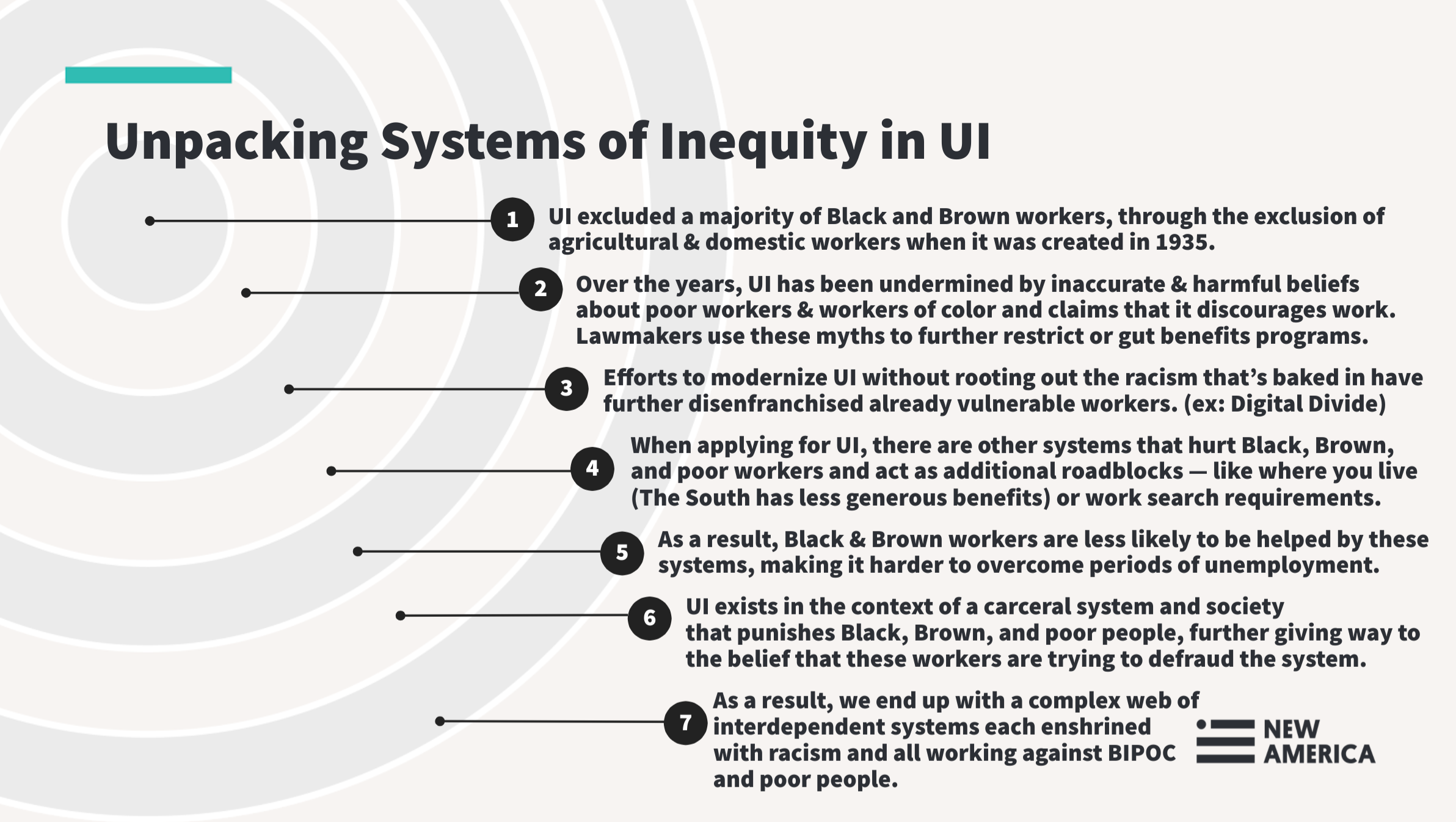
Each section of the report dives further into the many internal and external factors that influence UI and make it difficult for people of color to access.
A few final notes before we begin: Throughout the report we use the terms 鈥渨orkers of color鈥� or 鈥淏lack and Brown communities鈥� interchangeably, but for the purposes of this report we spoke only with Black and Latinx workers, whose names have been changed to protect their identities.
We鈥檇 be remiss not to mention that we understand there鈥檚 a difference between race and ethnicity and that ultimately, Black people, regardless of ethnicity are most negatively impacted by inequity. We understand that Afro-latinx communities face compounding inequities, as do members of the Black LGBTQ and Black disability community (and that people exist in all of these intersections). There are limitations and clear shortcomings in how data is collected today that do not allow us to accurately or respectfully distinguish between race and ethnicity. The people with whom we spoke had varying experiences and exist across the income spectrum. Some work in finance, others in service jobs, and many were essential workers. And while they all expressed frustration with the UI system, none expressed feelings of helplessness. Instead, our interviewees are the protagonists in their stories, resilient and finding ways to work through and around a system intent to keep them out.
We also cannot ignore that the Native American community is suffering disproportionately as a due to insufficient infrastructure, high rates of poverty, and negative health outcomes鈥攖he result of broken promises and negligence on behalf of the federal government. American Indian and Alaska Native (AI/AN) populations are often undercounted, miscounted, or excluded entirely from data collection that is necessary for federal funding, directing resources, and even reports such as this one. Still, we recognize that we must do more to support and better serve Native American communities and ensure that their voices are heard.
Our hope for this report is that it might open people鈥檚 eyes to the deeply rooted, interconnected systems that hurt Black and Brown workers and their families. We also hope that policymakers might use it to broaden the type of experts they invite to the table when creating policy鈥攆rom user researchers, designers, and data scientists to, most importantly, the people themselves that these policies are intended for. Our bet is that, if UI is part of a 鈥渟ystem of systems,鈥� so are other critical government programs. Decision makers and subject matters experts would do well to cross-pollinate with experts in other areas鈥攅ven, and especially when, they seem entirely unrelated鈥攂ecause odds are, they are not. It was designed that way.

Unpacking Inequities in Unemployment Insurance
- Introduction
- 鈥淣ot Designed for Us鈥�: Navigating a System that Never Intended to Serve You
- A Focus on Fraud Over Accessibility: The Punitive Design of UI
- 鈥淧eople Don鈥檛 Want to Work鈥� and Other Myths about UI
- Southern Generosity Isn鈥檛 Extended to all Southerners
- The Digital Divide and UI Modernization: States鈥� Moves to Online Applications Worsen Accessibility
- Last Hired, First Fired: Black, Latinx Workers and the Fight for Jobs
- The Power of Employers
- Unemployment Insurance Isn鈥檛 Enough to Keep the Family Fed
- Learning from Past Economic Recessions
- Where Do Workers Turn When the Government Fails Them? To the Community.