A Chapter of: 鈥淭his鈥� 鈥學ar鈥� 鈥宨s鈥� 鈥孫ut鈥� 鈥宱f鈥� 鈥孫ur鈥� 鈥孒ands鈥濃��
The Backdrop: Proxy Rivalries Within a Revolution and Political Contestation, 2011-2014
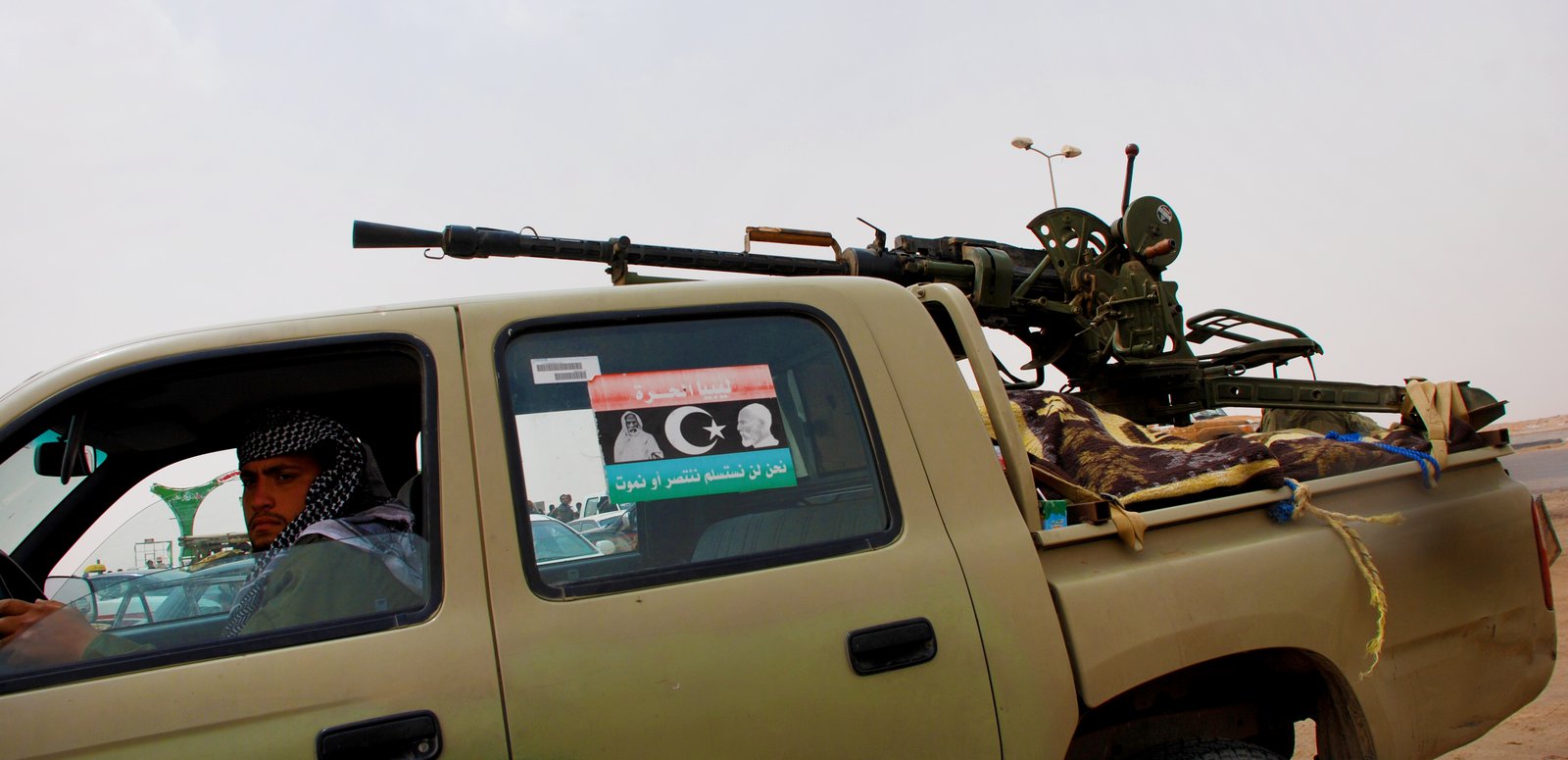
The foreign military rivalries unfolding in Libya today stem back nearly a decade, to the 2011 revolution and the NATO-led intervention. That military conflict was hardly the binary rebels versus regime struggle that media portrayals suggested鈥攊n many senses, it was a civil war with some towns and communities arrayed in support of the regime and multiple local conflicts existing under the superficial rubric of a popular uprising.
Similarly, the NATO-led coalition patrolling the skies was also riven with competing agendas. Tensions were especially visible among countries that put boots on the ground, i.e. intelligence and special operations personnel who managed the flow of weapons shipments, provided training in some instances, and coordinated airstrikes on behalf of local Libya armed groups. The armed groups became, in effect, local proxies for foreign powers, most notably the Emirates (joined by France) and Qatar, who carried out their rivalry in the form of competing 鈥渙perations rooms鈥� through which information, requests for weapons, and intelligence coordination flowed.1 Sudanese forces also played a role on both sides of the conflict: Libyan Islamists leveraged historic connections with Sudan to solicit help from Khartoum in the form of arms shipments and drones.2 At the same time, fighters from a Sudanese opposition group, the Justice and Equality Movement (JEM), fought for the Qadhafi regime.3
Among these players, Qatar proved the most assertive, sending senior officers and special operations forces across Libya. French and Emirati personnel were also involved, and British special operations forces were especially present in the city of Misrata. Here, they were establishing operational linkages that would be reactivated during the battle against the Islamic State five years later, most significantly with the Misratan businessman and current GNA Minister of Interior Fathi Bashagha.4 For their part, Libyan revolutionary leaders buttressed their authority and attracted fighters by demonstrating their access to outside arms streams. 鈥淏ecause there was no formal chain of command, the Libyan commanders had to establish power鈥� and if you had access to Western (or foreign) arms or attention, you got power,鈥� noted one U.S. military officer liaising with the Libyan revolutionary groups at the time.5
The competition started within weeks of the revolution鈥檚 uprising in Benghazi and eastern Libya and quickly spread to other theaters. Yet it was not predetermined, nor was it constructed along secular and Islamist lines; among the revolutionary armed groups, divisions between Islamists and anti-Islamists gradually sharpened and crystallized partly due to Emirati and Qatari intervention. They also overlapped with a complex set of town- and region-based networks and elites inside Libya, as well as Libyan intermediaries residing in Abu Dhabi or Doha who often exerted a significant influence on where the arms went and shaped the preferences of outside patrons.6 The outlines of this conflict and, in some cases, its personalities continue into Libya鈥檚 contemporary civil war.
The U.S. Policy of "No Ownership"
The United States, with intelligence personnel and special operations forces across the country during 2011, was cognizant of these burgeoning divisions. It was not in a position, however, to temper or mitigate them during the revolution especially after the fall of Qadhafi, when its diplomatic footprint was reduced and the Obama administration adopted a policy of having no military personnel on the ground. Crucially, this approach arose from the administration鈥檚 preference to avoid an Iraq-like quagmire but also in response to firm opposition from Libya鈥檚 transitional authorities to having any foreign armed personnel on the country鈥檚 soil. More specifically, with the experience of Iraq on their minds, Libyan officials forbade any armed private military contractors from entering Libya鈥攁n ironic prohibition, given the massive influx of mercenaries into Libya in the coming years.7
Washington鈥檚 ceding of the post-conflict transition to Libyans, backed by the United Nations and the Europeans鈥攚hat one White House official called a policy of 鈥渘o ownership鈥濃�攈ad profound implications for U.S. leverage on what followed. 8 鈥淚f we had had more assets and advisors on the ground, perhaps we could鈥檝e shaped the outcome after the revolution,鈥� lamented another White House official.9 This was especially evident as the fissures that permeated the 2011 revolution sharpened and widened after Qadhafi鈥檚 fall.
Much of the U.S. military and intelligence community鈥檚 initial outreach went through a constellation of defected army officers centered around Colonel Abd al-Salam al-Hasi, a close confidant of the defected Libyan special forces commander Abd al-Fatah Younis. Initially, these defected officers worked closely, if uneasily, with other revolutionary armed groups. But the distrust between the groups widened, partially due to Qatari arms shipments that were routed to Islamist-leaning groups. The rivalries burst into open violence with the shadowy assassination of Abd al-Fatah Younis, allegedly by Islamists as payback for the general鈥檚 role in carrying out Qadhafi-era repression. The splits would continue to haunt Libya鈥檚 post-2011 transition and partly explain the eruption of civil war in 2014.10
Contrary to common assumptions, Doha did not back these groups solely because of their Islamist credentials, but because it assessed them to be among the more cohesive and militarily-competent factions (they included veterans of foreign battlefields).11 Moreover, they were more hardline in their intention to remake the post-Qadhafi political order, which Qatar saw as playing to its advantage. Throughout the revolution, Qatar鈥檚 rise as the most effective foreign sponsor was occasioned by the outsized influence of Libyan power brokers, especially Doha-based cleric Ali Sallabi. Sallabi proved instrumental in steering Qatari aid away from the Younis network, aligned politically with the Libyan technocrat Mahmud Jibril and a Libyan theologian-turned-businessman named Aref al-Nayed, and routing it to Islamist-leaning revolutionary armed groups in eastern and western Libya. From their perspective, the Qataris tilted toward Sallabi鈥檚 network partly because of concerns about the leadership effectiveness and stalwartness of Abd al-Fatah al-Younis and his allies.12 In response, the Younis-Jibril camp leaned more heavily on Emirati and French support, using the Emirates-based al-Nayed as a broker.13
The fissures gradually afflicted nearly every corner of the conflict. The UAE established an operations room and channeled support to the town of Zintan, a tribal stronghold in the western Nafusa mountains. At the same time, Qatar favored another Nafusa town, Nalut, because of the presence of fighters from the Libyan Islamic Fighting Group (LIFG), led by Abd al-Hakim Bilhaj.14 French military aid also shaped local power relations; the French were initially drawn to Qatar (and actually sympathetic to the Islamists) but tilted to the Emirates鈥� side during the summer of 2011, solidifying links to Zintani armed groups through training and air dropped weapons.15
The tensions culminated in competing designs for the liberation and stabilization of Tripoli, with the Emirati- and Qatari-backed Libyan factions each presenting their plans. The August 2011 uprising and attack on the capital proceeded pell-mell, with locally-based Libyan armed groups enjoying various levels of loosely-coordinated external support. This marked another major turning point: During the fall of Tripoli, armed groups attached to towns and neighborhoods and commanded by ambitious personalities seized strategic assets like airports, armories, ports, and ministries, which they tried to convert into political leverage.16
In the ensuing years, from late 2011 to 2014, these networks continued to operate as channels for political influence within the fractured National Transitional Council and its successors.17 The lack of a strong arbiter among these various foreign interests was arguably a pivotal driver for Libya鈥檚 subsequent descent into chaos. This was especially true in the absence of an institutionalized, formal security sector. Mandated, organized, and staffed as a political mission, the UN Support Mission in Libya or UNSMIL, by its own admission, initially neglected dealing with the burgeoning militia problem or trying to build security institutions, focusing in instead on shepherding the country toward its first elections in more than 40 years.18 Multiple foreign countries that had backed Libyan armed groups during the revolution capitalized on those ties to build political clout.19 Meanwhile, successive heads of the UNSMIL complained about foreign states quietly working at cross-purposes with the UN鈥檚 mandate of institutional development, especially on the security sector鈥攁 frustration that would only grow as the proxy war intensified.20
Foreign rivalries played out first as a modest contest to shape the 2012 elections for Libya鈥檚 legislature, General National Congress (GNC). Turkey鈥檚 Islamist government adopted friendly but largely passive relations with the Libyan Muslim Brotherhood-affiliated party, the Justice and Construction Party (JCP), though these ties with the Brotherhood and other Islamists would later coalesce into more robust financial support and safe-haven networks.21 Mahmud Jibril鈥檚 National Forces Alliance (NFA) claimed attention from the Emirates, the United States, and Western media outlets, on the basis of its purported secularist credentials鈥攖hough the NFA included many religiously conservative Libyans and Jibril himself had stated that Libya鈥檚 legal codes should be based on sharia (Islamic law).22
Qatar proved especially assertive during the elections, funding a prominent political party Al-Watan (The Nation), which ultimately failed to gain a single seat鈥攑artly because of perceptions about its links with Doha. The aftermath of the elections saw increased public animosity against Qatar for its alleged links with Libyan Islamists, especially during the GNC鈥檚 passage of the controversial Political Isolation Law, which called for broad lustration, barring future government employment to Libyans who participated even minimally in the Qadhafi regime. Protests in Tripoli against the law and militias that backed it carried derisive depictions of the Qatari flag.23
The rivalry between Qatar and the Emirates and, concurrently, the contest between Libyan Islamists and their opponents, escalated in the summer of 2013 with the Egyptian military鈥檚 ejection of Mohamed Morsi from Egypt鈥檚 presidency, orchestrated by the Emirates and Saudi Arabia and large swathes of Egyptian society. The seismic regional event reverberated across the Libyan political spectrum and heightened tensions between Libyan Islamists and anti-Islamists in an already tense environment.24 More radical wings within Libya鈥檚 Islamist milieu were strengthened, arguing against disarming on the basis that they needed to prevent violent repression by their Libyan opponents, along the lines of the Egyptian military鈥檚 massacre of Morsi supporters at Rabaa al Adawiyaa Square in 2013.25 For their part, anti-Islamists in Libya and abroad felt emboldened by the change of power in Cairo; Qadhafists in particular found a welcoming haven in the Egyptian capital and set up their own media platforms.26 During this period, some anti-Islamist Libyans in the east went so far as to say, 鈥淲e need a Sisi here.鈥�27
Throughout all of this, the U.S. embassy played a supportive role, backing municipal and national elections, encouraging the growth of civil society, and bolstering the media and education sector.28 On the security front, the United States began its own effort to create a local surrogate force by training a Libya special operations unit, at a disused military camp west of Tripoli, known as Camp 27 or Camp Younis.29 The program, which began in May 2012, was plagued with problems from the beginning: the majority of Libyan recruits to the 800-strong Libyan unit hailed from western towns and especially Zintan.30 As a result, according to its U.S. trainer, the program was essentially training a Zintani militia, whose definition of 鈥渢errorists鈥� included Libyan political Islamists.31 The effort collapsed altogether in the summer of 2013 when a rival Libyan militia, tipped off by insiders, stormed the camp and absconded with high-tech, American-provided equipment. The raid and the ensuing collapse partly stemmed from the camp鈥檚 location on the fault-line between two tribes, which the Americans鈥� Libyan interlocutor, Colonel Abd al-Salam al-Hasi, failed to disclose.32
The entire episode demonstrates the hazards of relying on indigenous intermediaries in a fractured landscape and, especially, of identifying local proxies, even for discrete counter-terrorism missions. Such errors were repeated in 2013 when the United States, Britain, Turkey, and Italy agreed to train a much larger Libya conventional force鈥攖he so-called 鈥済eneral purpose force,鈥� under then-Prime Minister Ali Zeidan鈥攚hich fell apart from the lack of Libyan political consensus about its goals and scope, opposition from Islamists, poor vetting, and the absence of an institutional structure for the Libyan trainees to join.33
Taken in sum, these converging trend lines鈥攑olarization between Islamists and their opponents, worsening rivalries across the Middle East in the aftermath of the Sisi coup in Egypt, the growing power and politicization of Libyan militias, grievances over the distribution of Libya鈥檚 wealth and elite corruption, and mounting insecurity in Benghazi鈥攚ould conspire to produce the Libyan civil war of 2014. Yet it is important to note that while foreign powers contributed to Libya鈥檚 tensions through media and political narratives and, in the case of the United States and its allies, through aborted security sector initiatives, foreign military interference did not occur at significant levels during most of 2012 to late 2013. If anything, during this period, oil-rich Libya was itself a military intervener in foreign proxy wars, sending money, weapons and Libyan fighters to Syria, Mali and other conflicts, according to the United Nations.34 This outward direction of arms flow would be quickly reversed with the eruption of civil war on Libyan soil in the summer of 2014.35
Citations
- Frederic Wehrey, 鈥淭he NATO Intervention,鈥� in Cole and McQuinn, eds., The Libyan Revolution and Its Aftermath, 105-125.
- Author interview with revolutionary leaders in Misrata, February, 2012. Alex De Waal, 鈥淎frican Roles in the Libyan Conflict of 2011,鈥� International Affairs 89, no. 2 (March 2013).
- Author interviews with JEM fighters captured by Libyan revolutionary forces, Misrata, Libya, February 2012. Also
- Author interview with Fathi Bashagha, Misrata, Libya, February 2012 and Sirte, Libya, June 2016.
- Author telephone interview with a U.S. military officer involved in the 2011 NATO intervention, October 15, 2016.
- On the Islamists鈥� early role in the revolution and coordination with other revolutionary armed factions, see Mary Fitzgerald, 鈥淔inding Their Place: Libya鈥檚 Islamists During and After the Revolution,鈥� in Peter Cole and Brian McQuinn, eds., 177-204.
- Libya鈥檚 new leaders were so adamant on this front that they scrutinized even small numbers of diplomatic security personnel from the United Nations and the United States. Wehrey, The Burning Shores, 70.
- Telephone interview with a White House NSC official involved with the 2011 intervention, June 2016.
- Interview with a White House NSC official involved with the 2011 intervention, March 15, 2017.
- Wehrey, The Burning Shores, 46-47.
- Ibid., 52-53.
- Peter Cole and Umar Khan, 鈥淭he Fall of Tripoli: Part 1,鈥� in Cole and McQuinn, eds., 73.
- Wehrey, The Burning Shores, 56-58.
- Author interview with Abd al-Hakim Bilhaj, Istanbul, Turkey, December 2016.
- Author interview with Zintani revolutionary leaders involved in liaison with French ground personnel during the 2011 revolution, Zintan, Libya, February 2012. David Jolly and Kareem Fahim, 鈥淔rance Says It Gave Arms to the Rebels in Libya,鈥� The New York Times, June 29, 2011, .
- Peter Cole and Umar Khan, 鈥淭he Fall of Tripoli: Part 2,鈥� in Cole and McQuinn, eds., 94-104.
- Peter Bartu, 鈥淭he Corridor of Uncertainty: The National Transitional Council鈥檚 Battle for Legitimacy and Recognition,鈥� in Peter Cole and Brian McQuinn (eds). The Libyan Revolution (London: C. Hurst & Co., 2015), 31鈥�54.
- Ian Martin, 鈥淭he United Nations鈥� Role in the First Year of the Transition,鈥� in Cole and McQuinn (eds), 127鈥�152.
- Matthia Toaldo, 鈥淒ecentralising Authoritarianism? The International Intervention, the New 鈥楻evolutionaries鈥� and the Involution of Post-Qadhafi Libya,鈥� Small Wars & Insurgencies 27, no. 1, (2016).
- Author interviews with three former UN Special Representatives of the Secretary General (SRSG) in Libya, New York, Beirut, Lebanon, and Tunis, Tunisia, 2016, 2017 and 2019.
- Tarek Megerisi, 鈥淟ibya鈥檚 Global Civil War,鈥� European Council on Foreign Relations, June 26, 2019,
- Wehrey, The Burning Shores, 78.
- Author鈥檚 observations during a Tripoli protest against the Political Isolation Law, Zawiyat al-Dahmani, Libya, May 2013.
- Anouar Boukhars, Nathan J. Brown, Michele Dunne, Raphael Lefevre, Marwan Muasher, Frederic Wehrey, Katherine Wilkens, Scott Williamson, 鈥淭he Egypt Effect: Sharpened Tensions, Reshuffled Alliances,鈥� Carnegie Endowment for International Peace, February 13, 2014,
- In August 2013, the Egyptian military under the command of General Abdel Fattah al-Sisi cracked down on widespread protests across the country, including two encampments of supporters of President Mohammed Morsi in the Egyptian capital of Cairo. The army鈥檚 moves against protesters in Rabaa Square resulted in nearly a thousand deaths and thousands of injuries. Human Rights Watch, 鈥淎ll According to Plan: The Rab鈥檃 Massacre and Mass Killings of Protesters in Egypt,鈥� August 12, 2014.
- Wolfram Lacher, 鈥淢agnates, Media, and Mercenaries: How Libya鈥檚 conflicts produce transnational networks straddling Africa and the Middle East,鈥� Project on Middle East Political Science (POMEPS) Studies 40: Africa and the Middle East Beyond the Divides, June 2020.
- Author interview with eastern tribal leaders, Benghazi and al-Bayda, Libya, November 2013. Also Wehrey, The Burning Shores, 166.
- Wehrey, The Burning Shores, 72.
- Wehrey, The Burning Shores, 158-159.
- Author interview with the Libyan commander of the 22nd LSOF, Tripoli, Libya, November 2013.
- Author interview with a former U.S. military official involved in training the 22nd LSOF, Washington DC, 2017.
- Frederic Wehrey, 鈥淭he Battle for Benghazi,鈥� The Atlantic, February 28, 2014,
- Frederic Wehrey, 鈥淢odest Mission? The U.S. Plan to Build a Libyan Army,鈥� Foreign Affairs, November 4, 2013, ; Frederic Wehrey, 鈥淟ibya Doesn鈥檛 Need More Militias,鈥� The New York Times, June 10, 2013,
- Michelle Nichols, 鈥淟ibya Arms Fueling Conflicts in Syria, Mali and Beyond: U.N. Experts,鈥� Reuters, April 9, 2013, . Importantly, Turkey was an important thoroughfare for these weapons and aid to Syria from Libya factions, including the terrorist group Ansar al-Sharia, which reportedly transited Turkish territory in early 2014. Aaron Stein, 鈥淭urkey鈥檚 Proxy War in Libya,鈥� War on the Rocks, January 15, 2015.
- Andrew Rettman, 鈥淟ibya is Test of EU Geopolitics, Ex-UN Inspector Says,鈥� EU Observer, February 25, 2020,