From Revolution Muslim to Islamic State
Downloads
Introduction
From December 2007 through May 2011, Revolution Muslim, a radical Salafi-jihadist organization based primarily in New York City, brought al-Qaeda’s ideology to the United States. At its inception, many dismissed Revolution Muslim as amateurish. Yet the group developed an effective and deadly methodology for promoting “open-source jihad” via radicalization, recruitment, online propaganda, social media and covert communications.
The group was linked to many of the most serious terrorism investigations opened by the New York Police Department (NYPD) at the time and had international links with cases touching four continents. In 2012, federal prosecutor Gordon Kromberg, who prosecuted the cases of Yousef al-Khattab, Jesse Morton and Zachary Chesser, all figures at the core of Revolution Muslim, stated: “It is amazing from the perspective of time to look back at Revolution Muslim. In our pleading we listed … 15 different defendants … who engage[d] in terrorism or attempted to engage in terrorism [and] all were connected to Revolution Muslim.”1 Though the group disbanded in May 2011, it laid the foundation for jihadist organizing in the United States that the Islamic State (ISIS) would later copy and take advantage of.
Revolution Muslim was a virtual terrorist group, before the term “virtual caliphate” became the en vogue way to conceptualize the future trajectory of ISIS following its loss of territory in Iraq and Syria. As a result, analyzing the history, operations and the means of thwarting Revolution Muslim is essential to understanding the challenge of ISIS’s “virtual caliphate.”
This report provides a unique, multifaceted lens into Revolution Muslim’s activities and how it catalyzed the jihadist scene in America and the West. It was written by Mitch Silber, the director of intelligence analysis at the NYPD at the time that Revolution Muslim was operating, and Jesse Morton (aka Younus Abdullah Muhammad, as he will be referred to throughout this paper), a founder of Revolution Muslim and now a former extremist.2 Silber and Morton present an informed insiders’ account. Between 2006 and 2011, the two were working directly against each other.
The report is divided into five sections:
- A history of Revolution Muslim and its origins.
- A description of Revolution Muslim’s innovative approach to radicalization.
- A review of Revolution Muslim’s success in applying its new approach.
- A detailed examination of how Revolution Muslim’s efforts online foreshadowed and built the foundation for ISIS’ radicalization and recruitment efforts.
- A concluding discussion of what lessons Revolution Muslim holds for future counterterrorism efforts.
Citations
- United States vs. Yousef al-Khattab, “Sentencing Hearing,” (Eastern District of Virginia, April 25, 2014).
- In the following account Jesse Morton will be referred to as Abdullah Muhammad, the name he used while operating Revolution Muslim, in order to avoid confusion. In notes regarding his court case and author interviews, however, he is referred to as Jesse Morton. For an account of his deradicalization, see Rukmini Callimachi, “Once a Qaeda Recruiter, Now a Voice against Jihad,” New York Times, August 29, 2016.
Key Findings
Revolution Muslim emerged out of a broader tradition of Islamist organizing that called for the reestablishment of the caliphate, years before the inception of the Islamic State.
- Revolution Muslim was the result of the splintering of prior Islamist political organizations due to disputes over leadership and tactics.
- By embracing more radical tactics, the founders of new groups, including Revolution Muslim, generated media coverage and thereby expanded their influence.
- Revolution Muslim and other Islamist groups in the West presaged and established a reservoir of support for the reestablishment of a caliphate, which ultimately aided ISIS.
Revolution Muslim established a new method of jihadist organizing.
- Revolution Muslim promoted a more explicit advocacy of jihadist terrorism than any prior organized manifestation of Islamism in the United States.
- Revolution Muslim spread its material more extensively than prior groups through an integrated and public-facing media effort that pioneered the use of online, social media and in-person activities.
Revolution Muslim’s new approach was the most extensive and effective jihadist mobilization effort in the United States on behalf of al–Qaeda and its allies.
- In at least 15 different cases, individuals who engaged in terrorism or attempted to engage in terrorism were connected to Revolution Muslim.
- Revolution Muslim encouraged individuals to radicalize and enact their views through direct and passive interaction.
- Revolution Muslim’s efforts reshaped the original al-Muhajiroun movement that it emerged out of, encouraging al-Muhajiroun’s move toward more explicit jihadist extremism and more sophisticated online activities.
ISIS developed its own powerful online, English-language radicalization and recruitment efforts by drawing upon the foundation Revolution Muslim had developed.
- Revolution Muslim pioneered the integrated use of English-language propaganda magazines, interactive media and online direct communication platforms, which ISIS would later adopt to great success in its communications efforts.
- ISIS drew upon the human networks that Revolution Muslim had nurtured to recruit fighters to travel to Syria and individuals to conduct attacks in the West.
As ISIS loses its physical territory in Iraq and Syria, the threat from ISIS will increasingly resemble that recently posed by Revolution Muslim.
- Undercover officers, including those operating online, will be essential to track a fluid network like Revolution Muslim or a virtual ISIS.
- The template developed first by Revolution Muslim and later by ISIS will continue to pose a threat regardless of the fate of ISIS as a group. Preventing future attacks and recruitment will require action beyond the arrest of key leaders to address the power of the template.
The Origin of Revolution Muslim
In December 2007, Younus Abdullah Muhammad and Yousef al-Khattab, two prominent figures within the Islamic Thinkers Society, split off and established Revolution Muslim. In doing so they changed the jihadist ecosystem through a more explicit advocacy of terrorism and a more adept online propaganda effort while establishing the United States, previously thought of by many as immune to radicalization, as an important node in international jihadist networks.
Yet, Revolution Muslim did not emerge out of nowhere. Instead the group was the product of a series of splits within the Islamist Hizbut-Tahrir (HT) movement and a long tradition of Islamist organizing. Revolution Muslim’s history as having emerged from these splits to transform existing networks illustrates the potential for online communities to sustain jihadism even as terrorist groups overseas face setbacks.
The rest of this section provides a history of the path to Revolution Muslim’s emergence.
Omar Bakri and Revolution Muslim’s Roots in Hizbut-Tahrir
The origin of Revolution Muslim traces back to Omar Bakri Muhammad, a radical cleric who played a key role in developing Hizbut-Tahrir in Britain and then created a spin-off organization, al-Muhajiroun (ALM), the predecessor of Revolution Muslim in the United States.
Bakri was born in Aleppo, Syria, in 1958 and studied Islam formally from the age of 5. According to his own account, he was radicalized through his relationship with the Muslim Brotherhood, a relationship that “really took off from the age of 15.”1
After two years of study in Lebanon amid Muslim Brotherhood circles, Bakri joined HT.2 Founded in 1953, HT describes itself as a “political party whose ideology is Islam.”3 The group calls for the establishment of a caliphate and pursues its Islamist politics on a global scale.
By 1979, the year a small group of Wahhabi extremists stormed the Grand Mosque in Mecca, Saudi Arabia, and Ayatollah Ruhollah Khomeini led the overthrow of the shah of Iran, Bakri was residing in Mecca. However, HT was officially banned by the Saudi government.4 On March 3, 1983, Bakri inaugurated the first manifestation of a new, clandestine group, al-Muhajiroun. Despite his covert efforts, Saudi authorities arrested Bakri in 1985 for teaching HT literature and deported him.
Bakri ended up in London, where he established an HT presence and became a controversial figurehead for the group.5 In 1991 Bakri called then British Prime Minister John Major a “legitimate target” for assassination.6
Decades before the establishment of Revolution Muslim or the rise of ISIS to global prominence, the outlines of the politics that would structure these later groups were already visible. Today HT and ISIS are ideological competitors, with ISIS criticizing HT as insufficiently violent and as passive faux-intellectualism.7 Nevertheless, HT and ISIS share similar visions for the future of the Muslim-majority world in which Muslims reestablish the caliphate. What would distinguish Revolution Muslim and later ISIS from HT was a series of splits in the movement that enabled more radical tactics, strategies and visions of the caliphate.
The First Split: Bakri Breaks with Hizbut-Tahrir
The first split that set the stage for the emergence of Revolution Muslim and later ISIS occurred on January 16, 1996, when Omar Bakri split from HT due to a dispute over the proper strategy and tactics to achieve the goal of bringing about a caliphate.8 Bakri embraced a more radical and expansive approach than that of HT’s core leadership. HT was hesitant to challenge the West directly and focused its efforts on Muslim-majority countries, using the refugee status of many of its members and the free speech protections available in the West to project its platform abroad. In contrast, Bakri believed that the party’s call to establish a caliphate should appeal to Muslims residing in the West as well as those in Muslim-majority countries.
Maajid Nawaz, a member of HT while Bakri was preaching on behalf of the organization, described Bakri’s approach in the year before he split from the organization: “We were encouraged by Omar Bakri to operate like street gangs and we did, prowling London, fighting Indian Sikhs in the west and African Christians in the east. We intimidated Muslim women until they wore the hijab and we thought we were invincible.”9
HT ordered Bakri to end his controversial and combative approach because of the negative publicity and scrutiny it generated. Bakri instead relaunched ALM as a separate organization.10 As Bakri explained it, ALM “engage[s] in the divine method to establish the Khilafah [Caliphate] wherever they have members, whereas HT works to establish the Khilafah only in a specific Muslim country … and restrict their members’ activities outside [that country].”11 HT explains that “Omar Bakri was expelled from the party and went on to establish his own organization, with its own distinct aims and methodology.”12
Unbeholden to HT, ALM replicated the practices and tactics of HT: street demonstrations, pamphleteering, and preaching at mosques and universities. However, Bakri embraced even more radical tactics that HT had rejected. To antagonize the British public, ALM proclaimed slogans such as “The Black Flag [of the caliphate] will one day reign over Downing Street” and “Islam will dominate the world.”13
By provoking the media with its radical pronouncements, Bakri’s ALM gained publicity, which it used to expand its following. As Bakri explained in Tottenham Ayatollah, a 1997 documentary, when the media reports on the movement, “They make for us very nice publicity. When [British Muslims] hear, ‘Omar said he is against Israel,’ they say, ‘Oh, very good. God bless him.’ When they see Omar he don’t accept homosexuality, ‘Oh, very good. God bless him. Let our children study with his group.’”14
ALM urged Muslims living in the West to become the frontline for the coming caliphate, “to become strong and united in order to become the fifth column which is able to put pressure on the enemies of Islam and to support the Muslim ummah worldwide.”15 That global outlook required what scholar Kylie Conner, a specialist in the development of Islamism in the West, has explained as “a rejection of secular law based upon the belief that restoration of the Caliphate can, and should, begin outside the traditional lands of Islam.”16 ALM and Bakri’s calls presaged those to come from ISIS years later in Syria and Iraq.
By September 11, 2001, ALM was organizing public “dawah stalls”—proselytization centers where ALM street preachers displayed posters and handed out pamphlets that drew passersby to engage with the group members—across the United Kingdom. ALM held provocative conferences and rallies, including one entitled “The Magnificent 19” praising the 9/11 hijackers.17 Bakri also led weekly classes and study circles, protests and street demonstrations. In private, he groomed new leaders, including Anjem Choudary, who would sustain ALM’s influence and maintain the platform far into the future.18 ALM also expanded beyond the United Kingdom, launching a website that was impressive for its time and declaring branches in Pakistan and Lebanon.19
ALM Establishes Itself in New York
Bakri’s ALM also expanded into the United States, ushering in the next set of developments that would enable the rise of Revolution Muslim.
In 1996, just after Bakri split from HT and established ALM in the United Kingdom, one of his followers in the United States established the first American ALM offshoot in New York City.20
The American branch operated for several years, but it proved incapable of attracting the publicity and interest that Bakri generated in Britain. Nevertheless, ALM-NY did attract a handful of followers, many of them university students.
Some ALM-NY members found the group to be useful as a means of reaching jihadist terrorist organizations abroad. A few days after 9/11, Mohammed Junaid Babar, a young Pakistani-American with connections to ALM-NY, traveled from the United States to Pakistan with the ultimate destination of Afghanistan. His intention was to wage violent jihad against American troops he believed would soon be present there. Babar stated later that he was heavily influenced by the ALM-NY’s study circles and readings, saying, “They had representatives in New York. So, I was able to meet them. I was able to communicate with them, you know, over the internet, and we also spoke numerous times over the phone, and there was also a lot of literature they had readily available on the internet that I was able to see.”21
While on his way to Pakistan, Babar stopped in London to visit Omar Bakri.22 While Bakri claims that he advised Babar to return to New York, Babar was arrested three years later for participating in a foiled 2004 al-Qaeda plot in London via Pakistan to utilize 1,000 pounds of ammonium nitrate fertilizer—commonly used in explosives—in what a U.S. law enforcement official explained “was a serious plot to be launched in England, and this guy [Babar] was supporting it from this country and other places.”23
After his arrest, Babar admitted responsibility and became a key government witness.24 During the trial for the 2004 plot, the prosecution explained that Babar was given money by ALM in 2001, not to return to the United States, but with the promise that he would receive “more when he got to Pakistan.”25 ALM subsequently released a statement that admitted Babar had studied in the movement until he departed for Pakistan, but it denied involvement or knowledge of his activities after 9/11.26
Babar represents the earliest known example of an American traveling abroad to fight on behalf of al-Qaeda post-9/11, and he came from the same radical Islamist network that would launch Revolution Muslim in New York City six years later.
The Second Split: The Islamic Thinkers Society Splits from ALM-NY
Despite connections between ALM-NY and terrorist recruitment in the case of Babar, ALM continued to avoid explicitly endorsing jihadist terrorism and denied having played a key role in Babar’s having joined al-Qaeda. The next split within the movement provided the bridge between ALM-NY’s activities and the more explicitly radical approach embraced by Revolution Muslim.
After operating for a few years, ALM-NY encountered leadership struggles, resulting in a split and and the founding of Muslims for Justice, which in October 2002, renamed itself the Islamic Thinkers Society (ITS).27 According to Abdullah Muhammad, members of the group later told him this name change was done to obscure the organization’s continued ties to ALM.28 It was a tactic that ALM-core in London would replicate years later to circumvent proscription.29
The Islamic Thinkers Society spin-off did not result from an innovation in tactics or form in the way that Bakri’s ALM split from HT over different views on tactics and approach. Instead ITS continued to engage in activities similar to those of ALM-NY and maintained its affiliation with ALM, just under different leadership. Meanwhile, the original ALM-NY faction slowly fizzled out as the university students it targeted increasingly opposed its message in the post-9/11 context.
The leaders of ITS took their orders from Anjem Choudary of ALM in London and retained ties with Bakri.30 Choudary, who by then had risen to become Bakri’s chief disciple, described New York as one of ALM’s “main hubs.” He stated that dozens of New Yorkers tuned in to ALM’s online sermons, although he claimed that ALM’s connection to ITS was merely a loose affiliation.31
The members who departed ALM-NY formed a nucleus of dedicated and passionate youth. One of them, Syed Hashmi, a Pakistani-American, pleaded guilty to conspiring to provide material support to al-Qaeda.32 Another member of the new ITS, Arif al-Islam, a Bangladeshi-American, became a leading speaker for the group.33 They gave ITS a young face while its original leader remained a key organizer, but slid into the background.
ITS ran its own website and online forum. It uploaded its “dawah stall” activity onto YouTube after the video-sharing site launched in 2005.34 Public dawah served as outreach and offered an opportunity to recruit a fringe segment of the local population. As in the United Kingdom, the dawah stall method encouraged religious and political awakening, but perhaps more importantly, it encouraged passersby to engage in online activity.

By 2006, Abdullah Muhammad, who joined the group in 2004 at the annual Muslim Day Parade and quickly rose through its ranks, had become ITS’ main speaker. ITS activities typically involved a small handful of individuals. Largely unwelcome in the mosques, they organized in neighborhoods populated by a Muslim majority as well as in public spaces such as Times Square on 42nd Street. The group operated with impunity in the United States and was perceived as an extreme fringe group.
It was only when ITS members ripped up and stomped on an American flag on a busy shopping street in Queens, New York, on June 8, 2005, that the group drew national media attention. In a New York Times interview shortly thereafter, Arif al-Islam stated:
“What they’re worried about is, are we recruiting for jihad. Through our past couple of years we have never recruited anyone to go to a foreign land. We have always made that clear through our activities. We have always stressed nonviolent means.”35
Despite its emphasis on nonviolent means, like ALM-NY before it, ITS provided a network that enabled jihadist terrorist activity.
In November 2008, Bryant Neal Vinas, a young convert to Islam from Long Island, New York, was indicted for conspiring to commit murder outside the United States.36 The United States alleged that Vinas joined al-Qaeda in Pakistan, fired at Americans on a Pakistani military base and provided expert advice to an al-Qaeda leader for a planned attack on the Long Island Rail Road and a Wal-Mart.37 Vinas had extensive connections to the network around ITS. He had attended AK’s study circles and befriended two ITS members, Ahmed Zarrini and Ahmer Qayyum.38 He also met Yousef al-Khattab, the future cofounder of Revolution Muslim and a popular convert to Islam from Orthodox Judaism.39 Vinas eventually traveled to Pakistan with Qayyum before moving on to the North West Frontier Province in Pakistan and linking up with al-Qaeda operatives.
When Vinas’s homegrown radicalization and connections to ITS were exposed, many pondered whether the United States had finally caught the “British Disease” of homegrown terrorists traveling abroad for training.40 For its part, ITS blamed American foreign policy and stated, “The Islamic Thinkers Society remains an intellectual, political, and non-violent organization calling people to Islam and participating in activities through an intellectual and political discourse.”41
However, at a trial of Belgian jihadists in 2012, Vinas described the assistance he received from Qayyum and two other Pakistanis in New York. He explained how they helped him plan his trip, arranged for him to stay with family members in Lahore, Pakistan, and connected him to an Afghan family that put him in touch with a Taliban commander, the “chief of a group of fighters who have fought the U.S., NATO and Afghan forces in Afghanistan,” as Vinas described it.42 Whether it was the group’s policy to recruit for jihad or not, the Islamic Thinkers Society members had provided the network for a former altar boy from Long Island to join al-Qaeda and plot terrorist attacks against the United States.
The Third Split: Revolution Muslim Splits From the Islamic Thinkers
In December 2007, the final split that gave rise to Revolution Muslim occurred when Abdullah Muhammad, along with Yousef al-Khattab, split off from ITS to create the new group. This time, as was the case when Bakri split from HT, the split was the result of larger questions of strategy rather than questions of leadership.
By 2007, Khattab and Abdullah Muhammad, then a graduate student at Columbia University’s School of International and Public Affairs (SIPA), were in conflict with ITS’ leadership regularly. The disputes ranged from arguments about ITS’s method of proselytization to Khattab’s belief that ITS needed to enhance its online activities.
At the same time that Khattab and Abdullah Muhammad were drifting further from ITS’s leadership, “Sheikh” Abdullah Faisal, a radical Jamaican cleric, was set for release from incarceration in the United Kingdom and deportation to Jamaica. Faisal had been educated in Saudi Arabia and was notorious for radicalizing Muslims in Britain throughout the 1990s and into the post-9/11 era. Ultimately convicted for soliciting the murder of Jews, Christians, Hindus and Americans, Faisal served four years in prison in the U.K.43
ITS refused to include Faisal under its umbrella.44 Faisal had an extremist reputation, even in jihadist circles.45 Abdullah Muhammad interpreted the refusal as a desire to retain complete adherence to Bakri, so he and Khattab started to contemplate splitting from ITS to launch their own independent alternative.
In May 2007, Abdullah Faisal was released from prison and returned to Jamaica. Abdullah Muhammad sought to leverage Faisal’s hard-core reputation and introduce his extreme message into the United States. The pair had corresponded through an intermediary while Faisal was imprisoned, and as soon as Faisal arrived in Jamaica, they started to discuss how to promote Faisal’s preaching in America. Faisal, in turn, taught Abdullah Muhammad directly. Abdullah Muhammad received guidance under Faisal’s tutelage in the “technique of radicalization (tarbiyya)” throughout the summer of 2007, a few months before they launched Revolution Muslim. It was a method more extreme than that of ALM, essentially in line with the doctrine of al-Qaeda.
In a September interview with Mitch Silber (the coauthor of this paper), Abdullah Muhammad described the message and method that Faisal conveyed to him on how to gain followers and radicalize them as revolving around promoting three ideological tenets:
“1) tawheed al hakimiyya – the belief that a proper understanding of monotheism in Islam required an absolute adherence to the notion that Allah is the only law giver, 2) kufr bit-taghout – rejection of false idols, and 3) al-walaa wal-baraa – that all loyalty and love was for the Muslims and that this loyalty necessitated hatred and enmity for the non-Muslims (kuffar). It is around these three principles that the culture of global jihad revolves. Without them, the ideology would not appeal. I could frame every current event in a way that pointed directly to them both explicitly and implicitly.”46

In December 2007, Abdullah Muhammad and Khattab officially split from ITS and launched Revolution Muslim. Khattab was appointed to raise controversy and to communicate directly with anyone who expressed interest. As Khattab described it in court:
“[Abdullah Muhammad] said, I would like to make this organization with Sheikh Faisal.… So I said, what do I have to offer you? I’m a comedian, that’s all. I’m a wise guy, that’s what I have. You are the Columbia educated.… Okay. He said, that’s fine, just keep it up. Which is basically what I did. I was the clown.”47
The split between ITS and Revolution Muslim concerned law enforcement, which properly perceived the fracture as a fault line that would result in a potentially more extreme splinter organization.
As Revolution Muslim finalized its split with ITS, the NYPD opened active investigations into both groups because of their “reasonable indication of links to unlawful activity,” as per the Handschu regulations, which governed terrorism investigations conducted by the NYPD.48 The NYPD inserted deep undercover officers into both entities. A team of analysts assessed, vetted and tracked the groups’ links within the United States as well as overseas, and the NYPD worked with federal agencies and international partners.49 ITS and RM were two of the highest profile investigations at the NYPD Intelligence Division between 2005 and 2011.50
The path to the emergence of Revolution Muslim from Bakri’s radicalization decades earlier illustrates that Revolution Muslim was the result of turmoil in a larger tradition of Islamist organizing. Many expressions of that tradition had connections to jihadist terrorism, but it was the series of splits in the movement that opened space for Revolution Muslim to promote a new and more open endorsement of terrorism. This history emphasizes the importance of understanding broader trends in existing movements when assessing the terrorist threat and not merely the fate of particular groups.
Citations
- Mahan Abedin, “Al-Muhajiroun in the UK: An Interview with Sheikh Omar Bakri Mohammad,” The Jamestown Foundation, March 23, 2004.
- Ibid.
- “Hizb ut-Tahrir”
- Mahan Abedin, “Al-Muhajiroun in the UK: An Interview with Sheikh Omar Bakri Mohammad,” The Jamestown Foundation, March 23, 2004.
- For a firsthand account, see Ed Husain, The Islamist: Why I joined radical Islam in Britain, what I saw inside and why I left, Penguin: 2007.
- Duncan Campbell and Audrey Gillan, “Many Faces of Bakri: Enemy of West, Press Bogeyman and Scholar,” Guardian, August 12, 2005.
- William Scates Frances, “Why ban Hizb ut-Tahrir? They’re not Isis – they’re Isis’s whipping boys,” Guardian, February 12, 2015.
- Mahan Abedin, “Al-Muhajiroun in the UK: An Interview with Sheikh Omar Bakri Mohammad,” The Jamestown Foundation, March 23, 2004.
- Maajid Nawaz, “I was a Radical Islamist who Hated All of You,” National, May 29, 2013.
- Houriya Ahmed and Hannah Stuart, “Hizbut-Tahrir Ideology and Strategy,” The Centre for Social Cohesion, 2009.
- Mahan Abedin, “Al-Muhajiroun in the UK: An Interview with Sheikh Omar Bakri Mohammad,” The Jamestown Foundation, March 23, 2004.
- Hizb ut-Tahrir Britain, “Letter Regarding Young Muslims and Extremism,” September 12, 2005.
- Ori Golan, “One Day the Black Flag of Islam Will Be Flying Over Downing Street,” Jerusalem Post, July 2, 2003.
- Tottenham Ayatollah, produced by Jon Ronson, RDF Media, 1997.
- Joseph Farah, “British Jihadist Depicts U.S. Capitol in Flames,” G2 Bulletin, March 15, 2004.
- Kylie Connor, “Islamism in the West? The Life-Span of Al-Muhajiroun in the United Kingdom,” Journal of Muslim Minority Affairs, 25, 2005.
- Sean O’Neill, “Rallies Will Highlight ‘Magnificent 19’ of Sept 11,” Telegraph, September 10, 2003.
- Vikram Dodd, “Anjem Choudary: a hate preacher who spread terror in UK and Europe,” Guardian, August 16, 2016.
- Suha Taji-Farouki, “Islamists and the Threat of Jihad,” Middle Eastern Studies 36:4, October 2000.
- Interview with Jesse Morton, New York City, September 9, 2017.
- Mohammed Junaid Babar, testimony at Operation Crevice trial, October 23, 2006. United Kingdom.
- John Horgan, Walking Away from Terrorism: Accounts of Disengagement from Radical and Extremist Movements, Routledge: 2009.
- “‘London bomb plot’ suspect admits to terrorism,” Breaking News.Ie, June 18, 2004,
- Jonathan Wald, “N.Y. man admits he aided al Qaeda, set up jihad camp,” CNN, August 11, 2004.
- Sir Michael Astill, testimony at Operation Crevice trial, October 23, 2006. United Kingdom.
- Abu Yousef, “Disclaimer: Junaid Babar,” Al-Muhajiroun North America, June 19, 2004. Archived online at
- Personal experience of the co-author, Jesse Morton.
- Ibid.
- Ian Cobain and Nick Fielding, “Banned Islamists spawn front organisations,” Guardian, July 21, 2006.
- Personal experience of the co-author, Jesse Morton.
- Paul Cruickshank and Nic Robertson, “American’s odyssey to al Qaeda’s heart,” CNN, July 31, 2009.
- Regarding Hashmi’s conviction, see Basil Katz, “Former NY Student Gets 15 Years for Aiding al Qaeda,” Reuters, June 9, 2010. . Regarding his connection to al-Muhajiroun and later the Islamic Thinkers Society, see Paul Cruickshank, “The Growing Danger from Radical Islamist Groups in The United States,” CTC Sentinel, August 1, 2010. , Chris Zambelis, “Arrest of American Islamist Highlights Homegrown Terrorist Threat,” The Jamestown Foundation, June 27, 2006. , and Leela De Krester, “Brits Deliver NY ‘Terror’ Rat to Feds,” New York Post, May 27, 2007.
- Personal experience of the co-author, Jesse Morton.. Andrea Elliot, “Queens Muslim Group Says it Opposes Violence, America,” New York Times, June 22, 2015.
- See, for example: “Muslims Desecrate US Flag and Declare Loyalty to Islam.” YouTube video, 5:01, posted by “Islamic Thinkers Society.” (accessed on September 21, 2017 – the account hosting the video has since been terminated).
- Andrea Elliot, “Queens Muslim Group Says it Opposes Violence, America,” New York Times, June 22, 2015.
- United States vs. Bryant Neal Vinas aka “Ibrahim,” Indictment F. #2007ROl968 (Criminal Division, 2009)
- Jason Ryan and Pierre Thomas, “Suburban New Yorker Charged with Being al Qaeda Fighter,” ABC News, July 22, 2009.
- Paul Cruickshank et al., “The radicalization of an all-American kid,” CNN, May 15, 2010.
- Ibid.
- Duncan Gardham, “US Terrorist Bryant Neal Vinas Connected to British Radicals,” Telegraph, June 25, 2010.
- Ibid.
- Sebastian Rotella and Josh Meyer, “A young American’s journey into Al Qaeda,” Los Angeles Times, July 24, 2009.
- “Hate preaching cleric jailed” BBC, March 7, 2003.
- Personal experience of the authors.
- Abu Hamza al Masri, “Beware of Takfir,” 2004.
- Interview with Jesse Morton, New York City, September 9, 2017. See also: Rukmini Callimachi, “Once a Qaeda Recruiter, Now a Voice Against Jihad,” New York Times, August 29, 2016.
- United States vs. Yousef al-Khattab, “Sentencing Hearing,” (Eastern District of Virginia, April 25, 2014).
- Handschu v. Special Services Div., 288 F. Supp. 2d 411 (S.D.N.Y. 2003) at
- Matt Apuzzo and Adam Goldman, Enemies Within: Inside the NYPD’s Secret Spying Unit and Bin Ladin’s Final Plot Against America, Simon and Schuster, New York, 2013, p. 212.
- Mitchell Silber interview, David Cohen, NYPD Deputy Commissioner of Intelligence (2002-2013), March, 2018.
The Revolution Muslim Method: Explicit and Online Promotion of Terrorism
Revolution Muslim emerged out of a history of Islamist organizing, yet the group represented a significant departure from earlier groups.
Revolution Muslim’s method differed from the original ALM method in two ways. First, while ALM-NY and the Islamic Thinkers Society had enabled jihadist terrorism in particular cases but denied actively supporting such activity, Revolution Muslim explicitly embraced promotion of terrorist groups. Second, while ALM-NY and ITS had relied on physical in-person meetings and engaged in more private efforts, Revolution Muslim integrated in-person activities with extensive online outreach.
The Shift to Explicit Promotion of Terrorist Groups
Revolution Muslim embraced the promotion of terrorist groups and terrorist activity in a far more brazen and explicit manner than ALM-NY or ITS had. Abdullah Faisal played the role that Omar Bakri Muhammad had when he split off from HT, but with a more provocative style. Residing in Jamaica, Faisal had an additional layer of protection from prosecution.
Revolution Muslim also took advantage of the more permissive free speech environment in the United States, where it was easier to promote Faisal’s particularly radical message. Revolution Muslim’s split from ITS and its embrace of Faisal, whom ITS and ALM had kept their distance from, made its support and encouragement for terrorism unambiguous.
In Britain, Anjem Choudary, by then ALM’s leader and a Revolution Muslim collaborator, stated regarding Revolution Muslim’s more provocative approach:
“Now they’ve [RM] suddenly started to call for the sharia and are coming out publicly.… In general there’s more freedom there.… In the videos, they are openly calling for jihad on the streets of New York whereas we can’t do that anymore here because you have [a law against] glorification of terrorism.”1
The statement of facts for Abdullah Muhammad’s guilty plea, in a case that will be detailed later, similarly highlighted the explicitness of the group’s militancy:
“On January 23, 2009, [Abdullah Muhammad] engaged in street dawa, a video of which he later posted to a Revolution Muslim YouTube account. In the course of the dawa, [Abdullah Muhammad] stated that the 9/11 attacks were against legitimate military targets.… On August 7, 2009, [Abdullah Muhammad] engaged in street dawa, a video of which he later posted to a Revolution Muslim YouTube account. In the course of the dawa, [Abdullah Muhammad] proclaimed that ‘God tells you to terrorize them in the Quran’ and that ‘Islam is guerilla warfare.’”2
In his September 2017 interview, Abdullah Muhammad further explained the difference between Revolution Muslim and its predecessors:
“Al-Muhajiroun and Islamic Thinkers Society typically refrained from engagement with the mainstream moderate community. They criticized moderate and mainstream community leaders from afar, online and in private study circles, but never went to the mosques or imams directly. Revolution Muslim sought to drive a wedge in the American Muslim community itself, to highlight what it perceived as hypocrisy in the mainstream American Muslim community and to challenge, contest and provoke, not just citizens in the West but to use their lacking identification with sharia and the caliphate as proof of their apathy and weakness. For Revolution Muslim, ‘speaking truth to power’ included addressing ‘the enemy within,’ directly.”3
Revolution Muslim sought to enmesh its activity with that of existing jihadist terrorist groups. Revolution Muslim posted al-Qaeda propaganda on its websites. For example, in early 2008, Abdullah Muhammad embedded a video titled “Knowledge is For Acting upon – The Manhattan Raid.” As the statement of facts in Abdullah Muhammad’s guilty plea states, the video “depicted Usama bin Laden and the 9/11 hijackers as heroes who acted on the knowledge they had.”4
When people contacted Abdullah Muhammad to ask his opinion on the 9/11 attacks, he replied that “‘we look to the mujahedeen’ for guidance and that the questioners should watch the ‘Knowledge is for Acting Upon by Al-Sahab’ video and reach their own conclusions.”5
Revolution Muslim held no direct link to al-Qaeda operatives, but its support for al-Qaeda was unambiguous. On December 2, 2010, Abdullah Muhammad responded to a journalist’s allegations that he was associated with terrorists, writing, “If loving Muslims that fight and die to defend themselves from Western imperialism makes the UK and US govts associate me … with terrorists then I am honored to be so associated.”6 In defense of the use of violence, Abdullah Muhammad further stated, “I don’t see why people would ever imagine that you can defeat 500 years of the colonialism and genocide that is Western civilization with placards and democratic participation.”7
The Shift to an Integrated Online Ideological Effort
Revolution Muslim combined its adoption of more explicit support of terrorism with a new concentration on internet proselytization. Abdullah Muhammad explained the difference between ITS’ more private, in-person efforts and the new approach adopted by Revolution Muslim:
At ITS study circles, attendees would sit on the floor, cross-legged. A pamphlet would be utilized as a guide. … HT guides such as the ‘Islamic Personality’8 were used to appeal to the individual, to cultivate traits that made one willing and worthy of engagement in activism….
Revolution Muslim utilized the same method and even taught some of the same doctrine. However, we launched it online, made it interactive and accessible to all. We did not start with the individual, however, we started with the vision of the totalitarian Islamic State.”9
Revolution Muslim also consciously reached out to charismatic preachers across the English-speaking world.10 These included not only Omar Bakri Muhammad, Anjem Choudary and Abdullah Faisal, but others like Sheikh Feiz Mohammad, an imam from Australia whose popular YouTube sermons may have helped radicalize Boston Marathon bomber Tamerlan Tsarnaev.11 Others that Revolution Muslim reached out to included Abu Adnan, director at Markaz Imam Ahmad in Liverpool, Australia, and Imran Hosein in Trinidad, known for his lectures in eschatology and Islamic economics and once principal of the Aleemiyah Institute of Islamic Studies in Karachi, Pakistan, as well as imam at Masjid Dar al-Qur’an in Long Island, New York. Revolution Muslim also reached out to a range of second-tier leaders from al-Muhajiroun and its numerous offshoots. Revolution Muslim also posted recordings of lectures from various Western preachers online and continuously sought alliances.
In August 2008, Abdullah Muhammad emailed Anwar al-Awlaki, an American-born Yemeni cleric, in an effort to align him with Revolution Muslim. However, al-Awlaki, by then embedded with Al-Qaeda in the Arabian Peninsula (AQAP), believed he had an alternative role and obligation—not merely preaching, but engaging in and directing operational activity. He responded:
“May Allah reward all those who are calling towards the truth and promoting it. Each one could serve Allah in his capacity and according to his ability. As long as the message that is presented is a message of truth then even if they are working in different areas and different parts of the world then they are still united in their efforts despite the distance. I believe it is more conducive at this stage to keep it like that.”12

Abdullah Muhammad interpreted the email to imply that al-Awlaki would soon be operational. RM could now consciously facilitate an adherent’s ideological progression into support for terrorism, while al-Awlaki could take them to the level of action. The veneer of religious legitimacy, coupled with the sheer output of material, created an “echo chamber” that could rival competing interpretative schools and that pulled recruits from their localized communities into the first manifestations of an online “virtual caliphate.”
Citations
- William Maclean, “Interview: UK Islamist says like-minded U.S. groups expanding,” Reuters, September 2, 2010.
- United States vs. Jesse Curtis Morton, “Statement of Facts,” 1:12cr35 (Alexandria Division, 2012)
- Interview with Jesse Morton, New York City, September 9, 2017.
- United States vs. Jesse Curtis Morton, “Statement of Facts,” 1:12cr35 (Alexandria Division, 2012)
- Ibid.
- Ibid.
- Ibid.
- Taqiuddin An-Nabahani, “The Islamic Personality.” 2003. 5th Edition Hizbut-Tahrir.
- Interview with Jesse Morton, New York City, September 9, 2017.
- Private messaging correspondence between Sheikh Feiz and Younus Abdullah Muhammad in 2008, Paltalk; email correspondence between Abu Adnan and Younus Abdullah Muhammad in 2009, gmail.com; email correspondence between Imran Hosein and Younus Abdullah Muhammad in 2008, gmail.com.
- Gareth Platt, “Feiz Mohammad: Radical Muslim Preacher Who Inspired Boston Marathon Bomber Tamerlan Tsarnaev,” International Business Times, July 1, 2014.
- Email correspondence between Anwar al-Awlaki and Younus Abdullah Muhammad in 2008, gmail.com.
The Revolution Muslim Method Proves Its Success
Revolution Muslim’s more explicit support for terrorist violence and its integrated and public-facing online efforts successfully cultivated a surge in American jihadist terrorist activity. RM became a premiere outlet for jihadism in the West. Followers were consumed and embedded in a community of the like-minded 24/7, as long as they had internet access. Seven of 23 terrorism cases from March 2009 to August 2010 had explicit links to ITS or RM.1 By 2012, Gordon Kromberg, the prosecutor in Yousef al-Khattab’s case, noted that at least 15 individuals linked to Revolution Muslim had engaged in or attempted to engage in terrorism.2 And arrests have continued since 2012.
Abdullah Faisal himself was indicted on August 26, 2017, for recruiting supporters and facilitating travel to ISIS.3 Nevertheless, because Revolution Muslim did not facilitate but rather promoted the ideology and camaraderie that typically precedes acts of jihadist extremism in the West, the actual influence of the organization may never be grasped in totality.
The following chart highlights the most significant terrorism cases linked directly to Revolution Muslim and the nature of that linkage.
Table 1: Cases Linked to Revolution Muslim
| Individuals Linked to Revolution Muslim | Active Contact or Passive Follower | Arrested on Terrorism Charges | Travel Overseas (Attempted or Successful) |
|---|---|---|---|
| Bilal Zaheer Ahmad | Active | Yes | No |
| Carlos Almonte and Mohamed Alessa | ´¡³¦³پ±±¹±ðÌý | Yes | Yes |
| Zachary Chesser | Active | Yes | Yes |
| Roshonara Choudhry | Passive | Yes | No |
| Mohammed Chowdhury, Shah Rahman, Gurukanth Desai and Abdul Miah | Active | Yes | No |
| Rezwan Ferdaus | Active | Yes | No |
| Samir Khan | Active | Killed | Yes |
| Colleen LaRose | Passive | Yes | Yes |
| Daniel Maldonado | Active | Yes | Yes |
| Antonio Martinez | Passive | Yes | No |
| Tarek Mehanna | Active | Yes | Yes |
| Jose Pimentel | Active | Yes | No |
| Paul Rockwood Jr. | Passive | Yes | No |
| Abdel Hameed Shehadeh | Active | Yes | Yes |
Revolution Muslim-linked cases were either passively linked to the group (i.e., the individual was not in active communication, but followed RM’s online presence) or actively linked (the individual had direct interactions with RM).
Passive Followers Turning Operational
Revolution Muslim’s online efforts bore fruit. Several followers with passive engagement in RM propaganda online engaged in or attempted to engage in operational terrorist action.
On March 9, 2010, the U.S. government unsealed charges against Colleen LaRose, popularly known in the media as “Jihad Jane.”4 She and other conspirators planned to murder Lars Vilks, a Swedish cartoonist who had portrayed the Prophet Muhammad in caricature. LaRose was a white convert to Islam and a subscriber to Revolution Muslim’s YouTube channel.5
Abdullah Muhammad exploited media outlets such as the Russia Today television network to frame the case as part of a U.S.-led war on Islam and to promote conspiratorial views of law enforcement entrapment.6 He also attempted to distance RM from accusations that it was deliberately inciting homegrown terrorism, saying for example in an interview on Russia Today shortly after LaRose’s arrest that it represented “one case in many whereby they are trying to suggest there is incitement occurring over the internet, whether it was Jihad Jane or whether it was the case we saw earlier in the week with the 9/11 Truther. This is a movement to discredit alternative press and to keep the mainstream public reliant upon the mainstream media.”7
Meanwhile, terrorist organizations based abroad picked up on Revolution Muslim’s activity to further their ends. Anwar al-Awlaki, now embedded within al-Qaeda in Yemen, followed LaRose’s arrest with a statement that made the rounds of media outlets everywhere. On his blog, he wrote:
“In such an inhospitable environment [America], jihad is flourishing…. The jihad movement has not only survived but is expanding. Isn’t it ironic that the two capitals of the war against Islam, Washington D.C. and London have also become the centers of Western jihad? Jihad is becoming as American as apple pie and as British as afternoon tea.”8
Revolution Muslim frequently appeared in coverage of terrorism-related cases after LaRose’s arrest. The group’s enhanced notoriety helped draw interest from an increasing number of Americans.
On December 8, 2010, Antonio Martinez, a naturalized U.S. citizen and recent convert to Islam, was arrested for a plot to target the armed forces recruiting station in Catonsville, Maryland.9 Although, like LaRose, Martinez did not interact directly with Revolution Muslim, he was affected by both it and ALM’s ideology. He viewed a video of Osama bin Laden and multiple terrorist training camp video clips on the RM website,10 and mentioned support for Omar Bakri to a confidential informant.11
Also in 2010, Paul “Bilal” Rockwood Jr. and his spouse, Nadia Piroska Maria Rockwood, were arrested for lying to investigators and collaborating on a kill list that included 15 specific targets.12 Rockwood had become a follower of al-Awlaki and spent time at work viewing the Revolution Muslim website.13 At one point, he began researching explosives and remote triggering devices, and by 2009 began sharing ideas for committing acts of violence, “including the possibility of using mail bombs or killing targets by gunshot to the head.”14
Active Followers Take Action
Revolution Muslim’s success derived not only from its influence on passive viewers of its propaganda but also from its encouragement of those who actively interacted with the group, pushing them toward the decision to engage in jihadist terrorism.
Rezwan Ferdaus, a U.S. citizen of Bangladeshi descent, directly interacted with Revolution Muslim online and in detail before being arrested for plotting to attack the Pentagon and the U.S. Capitol. In February 2010, Ferdaus contacted Abdullah Muhammad by email to ask about the appropriateness of martyrdom operations. Abdullah Muhammad suggested that such operations could have “enormous benfits (sic) in a war of attrition.”15 In 2011, Ferdaus began speaking to undercover FBI agents, who he believed were al-Qaeda operatives, about his desire to attack the Pentagon and the Capitol using weaponized drones.16
Jose Pimentel was another “big fan of Revolution Muslim,” according to court documents.17 Pimentel reached out to register for one of Abdullah Muhammad’s online courses. They exchanged emails and held private phone conversations thereafter in which Abdullah Muhammad advised Pimentel on how he could merge his independent efforts with the broader Revolution Muslim network.18 Pimentel, a naturalized U.S. citizen born in the Dominican Republic, vacillated between merely talking and preparing to act. His interactions with Revolution Muslim, both online and in the real world, furthered his commitment to violent action.19 In May 2009, he discussed going to Yemen for terrorism training and returning to the United States.20 Soon thereafter, Abdullah Muhammad allowed Pimentel to post directly to RM’s newer Islam Policy website.21 Anwar al-Awlaki’s death on September 30, 2011, in a U.S. drone attack, seemed to hasten his operationalization. Pimentel started discussing plans for bombing a variety of targets, including post offices around the Washington Heights neighborhood of Manhattan and police in New York and New Jersey.22 He was arrested on November 19, 2011, after he purchased components for bombs to use in the attacks.23
Revolution Muslim’s efforts highlighted a developing transition in cases of homegrown violent extremism. Where the radicalization of earlier years occurred mostly through in-person interaction, online contact now seemed sufficient to promote radicalization to violence. The internet reduced temporal and spatial restrictions and enhanced the effects of Revolution Muslim’s innovative approach.
Revolution Muslim’s Influence on al-Muhajiroun in the U.K.
Revolution Muslim’s impact was not limited to the United States. In the United Kingdom, Anjem Choudary and other higher-level associates in ALM recognized the effect Revolution Muslim was having and tried to harness it. By doing so, they could promote a pro-al-Qaeda message while protecting themselves from British anti-terrorism legislation.
As a result, what might have been considered as Bakrism shifted to Bin Ladenism, with Revolution Muslim as the conduit. Choudary and Bakri began speaking alongside Faisal in online chat rooms24 despite their previous reluctance to cooperate with him. Omar Brooks (Abu Izzadeen), a provocative ALM member from London and one of the group’s key street speakers, who had been incarcerated for terrorist incitement and fundraising,25 also began speaking alongside Faisal and other Revolution Muslim affiliates.26 SalafiMedia, another ALM outlet, forwarded material for posting on the RM website and YouTube channel.27 SalafiMedia was managed by Abu Waleed, a longtime student of both Bakri and Faisal.28
Revolution Muslim’s propaganda also inspired individuals to engage in jihadist terrorism in the United Kingdom. On May 14, 2010 Roshonara Choudhry, a 21-year-old recent dropout from King’s College in London, attempted to kill British MP Stephen Timms in a knife attack.29 Timms had voted for UK participation in the war in Iraq, and Choudhry asserted that his killing would be revenge. “When a Muslim land is attacked it becomes obligatory on every man, woman and child and even slave to go out and fight and defend the land and the Muslims,” she explained.30
Choudhry radicalized to violence online, through passive contact with Anwar al-Awlaki lectures and Revolution Muslim’s website.31 Abdullah Muhammad explained, “Roshonara Choudhry was the first one we realized had gone all the way up to the point of violence almost entirely by viewing content online.”32
When Choudhry was sentenced to life in prison, Revolution Muslim administrator and ALM member Bilal Zaheer Ahmad posted to the Revolution Muslim website a list of British members of Parliament who voted for the Iraq War alongside a link to where British Muslims might purchase a knife like the one Choudhry used.33 The day before her sentencing, Ahmad posted on Facebook: “This sister has put us men to shame. We should be doing this.”34 Abdullah Muhammad had given Ahmad the password to RM and permission to post messages.35 As a result, the two men were in close communication and collaboration. Given the UK’s strict laws on posting what could be defined as “hate speech,” Revolution Muslim provided a route through which to circumvent British restrictions, but Ahmad’s post crossed the line. The scandal surrounding his posting soon induced the domain name host to take down revolutionmuslim.com.
Abdullah Muhammad explained: “I was in frequent contact with Bilal Zaheer Ahmad. After he posted the threat against the MPs he reached out due to the fact the domain name shut down.”36 Ahmad informed Abdullah Muhammad over email that,
“First of all I wish to apologise for the site closure … it was a result of being unable to contain my legitimate emotion at the sentence passed down to our sister – the purpose was to make those MPs fearful, so that they think twice before voting to rape our mothers or kill our brothers, or go onto our lands and try to steal our resources (as I’m sure you will empathise with!).”37
Ahmad was arrested on November 10, 2010 for soliciting murder.
Revolution Muslim Calls for Travel Abroad
In early January 2007, Osama bin Laden’s deputy, Ayman al-Zawahiri, released a statement online in response to the entry of Ethiopian forces into Somalia.38 Al-Zawahiri called on jihadists to support and join Harakat al-Shabaab al-Mujahideen, which went on to publicly align with al-Qaeda in 2012. Open and widespread warfare soon followed al-Zawahiri’s proclamation, and as Al-Shabaab gained battlefield success and established control of territory, it contemplated the declaration of an Islamic emirate, a smaller version of the caliphate that ISIS would later pronounce.39
Foreign fighters flocked to join Al-Shabaab. Two of the first Americans to become involved, Omar Hammami and Daniel Maldonado, were both in direct communication with Yousef al-Khattab, cofounder of Revolution Muslim, over an online discussion forum, IslamicAwakening.com.40 Maldonado would go on to become the first American charged for fighting with Al-Shabaab,41 while Hammami became a chief propagandist and field commander for the group.42
Revolution Muslim blatantly called for support of Al-Shabaab and emigration to join the movement. In December 2008, Abdullah Muhammad published a two-year plan of action for Revolution Muslim and the organization’s supporters. In the piece titled, “By Any Means Necessary – In Pursuit of the Objectives Amidst Improving Odds,” he wrote:
The mujahedeen are still waging a successful jihad, but the majority of Muslims cannot foresee the justice of an Islamic State…. Revolution Muslim issues a challenge to Muslims across the globe to accept a role in working toward the establishment of the state. Say Somalia would be taken tomorrow. We have problems with piracy, drinking water, health care and political divisions. The world would pose an economic barricade with no foreign investment. The State has oil, resources, agricultural capabilities and a strategic location and the right crew with the right connections could come in with some serious policy recommendations, community organizing and etcetera and protect the State.… These are our objectives for the following two years.… Inshallah by the completion of two years heijra will be possible.”43
Revolution Muslim followers soon heeded the call. For example, Mohamed Alessa and Carlos Almonte, two young men from New Jersey with longstanding ties to both ITS and RM,44 were arrested for attempting to travel to Somalia in June 2010.45 On July 21, 2010, Zachary Chesser (Abu Talha al-Amrikee), a 20-year-old American convert from Fairfax, Virginia, who was recruited by Abdullah Muhammad to help administer the RM website, was arrested while attempting to board a flight to Uganda en route to Somalia. He told federal agents that he intended to join Al-Shabaab as a foreign fighter and was charged with attempting to aid the group.46
Somalia wasn’t the only field of jihad to which followers of Revolution Muslim attempted to travel. Abdel Hameed Shehadeh, an American citizen of Palestinian descent from Staten Island, regularly attended Revolution Muslim meetings in New York and posted content to the organization’s website.47 On June 13, 2008, Shehadeh flew on a one-way ticket from John F. Kennedy International Airport to Islamabad, Pakistan. Pakistani officials denied him entry. Shehadeh told investigators from the FBI’s Joint Terrorism Task Force that he traveled to Pakistan to attend university. However, Shehadeh instead intended to travel to the northern Federally Administered Tribal Areas of Pakistan in order to join al-Qaeda or the Taliban. He stated that he would have joined the Taliban “without a doubt,” expecting to “receive training in ‘guerilla warfare’ and ‘bomb making.’”48
The “South Park” Threat
The most significant evidence of Revolution Muslim’s success in creating and defining a new Western jihadist method was its campaign against the writers of the popular cartoon satire series South Park. On April 14, 2010, in commemoration of the show’s 200th episode, the South Park writers portrayed the Prophet Muhammad in a bear costume. The Revolution Muslim campaign began when Zachary Chesser posted a picture of Theo van Gogh, a Dutch filmmaker murdered by a jihadist terrorist in 2004, dead on a street in Amsterdam with a threat: “We have to warn Matt and Trey that what they are doing is stupid, and they will probably wind up like Theo van Gogh for airing this show. This is not a threat, but a warning of the reality of what will likely happen to them.”49 On Twitter, Chesser emphasized, “May Allah kill Matt Stone and Trey Parker and burn them in Hell for all eternity. They insult our prophets Muhammad, Jesus, and Moses…”50
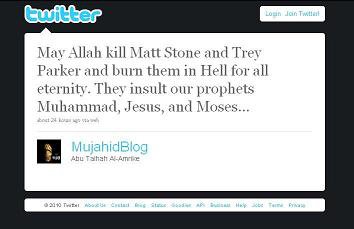
In a subsequent phone call, Chesser told Abdullah Muhammad that the fatwa that called for the killing of Salman Rushdie after he published The Satanic Verses “was a tremendous help in radicalizing” Muslims in the United Kingdom and that the threat regarding South Park might have a similar impact on Muslims in the United States.51 As Revolution Muslim had hoped by embracing these provocative tactics, the threat stirred an international firestorm that thrust RM into the limelight and galvanized anti-Islamist sentiment in the United States. Months later, when Chesser was arrested for attempting to join al-Shabaab, Abdullah Muhammad fled to Morocco, where he continued to run the website for a time.52
Revolution Muslim Disbands: The Group Stumbles, the Method Continues
Increased law enforcement attention brought by Revolution Muslim’s activities posed problems for the group. In November 2010, Abdullah Muhammad, fearing legal repercussions, announced a rebranding of RM to Islam Policy.53 It was an approach consistent with ALM’s own history of changing its name after being proscribed as an illegal organization, the changing the name of Muslims for Justice to the Islamic Thinkers Society, and even Osama bin Laden’s own advice to change al-Qaeda’s brand as its popularity declined in the Muslim world.54 Abdullah Muhammad stressed that Islam Policy would be less provocative but that it would continue working to garner support for a future caliphate among those residing in the West.55
Abdullah Muhammad was prescient that safe havens for jihadists and actual governance were on the horizon, but Islam Policy did not have an opportunity to contribute to that objective. On May 26, 2011, Abdullah Muhammad was arrested in Casablanca, Morocco, and set for extradition back to the United States. He ultimately pleaded guilty to conspiracy to communicate threats and solicit murder related to threats made by Revolution Muslim and its associates against the South Park TV show.
However, Revolution Muslim’s effective disbandment in May 2011 as a result of Abdullah Muhammad’s arrest failed to disrupt an advancing online Western jihadist network. Abdullah Faisal kept propagandizing from Jamaica and the locus of ALM-related activity returned to Britain. In the context of the Syrian civil war, the network grew exponentially.
Citations
- Paul Cruickshank, “The Growing Danger from Radical Islamist Groups in The United States,” CTC Sentinel, August 1, 2010.
- United States vs. Yousef al-Khattab, “Sentencing Hearing,” (Eastern District of Virginia, April 25, 2014).
- NYPD News, “Radical Cleric Shaikh Faisal Indicted For Recruiting Supporters And Facilitating Efforts To Join Islamic State,” Press Release, August 26, 2017.
- Carrie Johnson and Alice Crites, “‘Jihad Jane’ suspect dropped out before high school, married at 16,” Washington Post, March 11, 2010.
- Paul Cruickshank, “Suspect in ‘South Park’ threats pleads guilty,” CNN, February 9, 2012.
- Russia Today America, “Jihad Jane is Not Guilty?” YouTube video, 7:18, posted March 18, 2010. ; Paul Cruickshank and Tim Lister, “N.J. Suspects Attended Protests Organized by Radical Islamic Group,” CNN.com, June 11, 2010.
- Russia Today, “‘Jihad Jane’ Arrest: Muslims Radicalize Every Day,” YouTube video, 4:53, posted March 12, 2010.
- Alexander Meleagrou-Hitchens, “As American as Apple Pie: How Anwar al-Awlaki Became the Face of Western Jihad,” International Centre for the Study of Radicalisation and Political Violence, 2011.
- “Maryland Man Charged in Plot to Attack Armed Forces Recruiting Center,” U.S. Attorney’s Office, December 8, 2010.
- “Leader of Revolution Muslim Pleads Guilty to Using Internet to Solicit Murder and Encourage Violent Extremism,” U.S. Attorney’s Office, February 9, 2012.
- United States v Antonio Martinez aka “Muhammad Hussein,” “Criminal Complaint,” 10-4761JKB (District of Maryland, 2010).
- FBI Anchorage Office Press Release. “Alaska Man Sentenced to Eight Years for Making False Statements in Domestic Terrorism Investigation. August 24, 2101,
- Kim Murphy, “In Alaska, becoming the militants next door,” Los Angeles Times, December 22, 2011.
- “Alaska Man Pleads Guilty to Making False Statements in Domestic Terror Investigation,” U.S. Attorney’s Office, July 21, 2010.
- United States vs. Jesse Curtis Morton, “Statement of Facts,” 1:12cr35 (Alexandria Division, 2012)
- “Man Sentenced in Boston for Plotting Attack on Pentagon and U.S. Capitol and Attempting to Provide Detonation Devices to Terrorists,” U.S. Attorney’s Office, November 1, 2012.
- “Leader of Revolution Muslim Pleads Guilty to Using Internet to Solicit Murder and Encourage Violent Extremism,” U.S. Attorney’s Office, February 9, 2012.
- Email correspondence between Jose Pimentel and Younus Abdullah Muhammad in 2011, islampolicy@gmail.com
- Ibid.
- William K. Rashbaum and Joseph Goldstein, “Informer’s Role in Terror Case Is Said to Have Deterred FBI,” New York Times, November 11, 2011.
- “Revolution Muslim’s Web of Influence,” Anti-Defamation League, February 27, 2012.
- “Sources: Terror Suspect Wanted To Blow Up A Bomb On The USS Intrepid,” CBS New York, November 21, 2011.
- The People of the State of New York against Jose Pimentel aka “Muhammad Yusuf” (M 27, 2011).
- “The Rise of Islam Conference,” March 18, 2011.
- Duncan Gardham, “Terrorist whips up crowd minutes after release from jail,” Telegraph, October 28, 2010.
- “Islamic Revival Conference – 2010,” posted on SalafiMedia.com. November 10, 2010.
- Personal experience of the authors; email correspondence – June 2009 Revolutionmuslim@Gmail.com
- “Benefit grabbing extremist who hates Britain: Preacher wants non-Muslims to shave their heads and wear red belts around their necks,” Daily Mail, June 29, 2014. and Roger Farhat, “The Dangerous Nexus Between Radicalism in Britain and Syria’s Foreign Fighters,” War on The Rocks, August 7, 2014.
- Elizabeth Pearson, “The Case of Roshonara Choudhry: Implications for the Theory on Online Radicalization, ISIS Women, and the Gendered Jihad,” Policy & Internet 8:1, 2015.
- Vikram Dodd, “Roshonara Choudhry: Police interview extracts,” Guardian, November 3, 2010. ; United States vs. Jesse Curtis Morton, “Statement of Facts,” 1:12cr35 (Alexandria Division, 2012)
- Vikram Dodd, “Roshonara Choudhry: Police interview extracts,” Guardian, November 3, 2010.
- Interview with Jesse Morton, New York City, September 9, 2017.
- Vikram Dodd and Alexandra Topping, “Roshonara Choudhry jailed for life over MP attack,” Guardian, November 3, 2010. ; Caroline Davies, “Radical Muslim jailed for calling for jihad against MPs,” Guardian, July 29, 2011.
- “Blogger Who Encouraged Murder of MPs Jailed,” BBC News, July 29, 2011.
- “Leader of Revolution Muslim Pleads Guilty to Using Internet to Solicit Murder and Encourage Violent Extremism,” U.S. Attorney’s Office, February 9, 2012.
- Interview with Jesse Morton, New York City, September 9, 2017.
- Email correspondence, Nov. 7, 2010, islampolicy@gmail.com
- Jeremy Scahill, Dirty Wars: The World is a Battlefield, New York: Nation Books, 2013.
- Nick Grace, “Islamic Emirate of Somalia imminent as Shabaab races to consolidate power,” Long War Journal, September 8, 2008. ; Abu Abdullah Anis, “The Islamic Emirate of Somalia: A New Front to Beleaguer the Enemies of Allah,” December, 2011. Translation on Ansar al-Mujahideen English Forum, available at .
- Paul Cruickshank, “The Growing Danger from Radical Islamist Groups in the United States,” CTC Sentinel, 2010.
- Charles A. Radin, “From N.H. to Somalia: Recalling a Suspect’s Zeal,” Boston Globe, February 17, 2007.
- Jeremy Scahill, “The Purge: How Somalia’s Al-Shabaab Turned Against its Own Foreign Fighters,” The Intercept, May 19, 2015.
- Younus Abdullah Muhammad, “By Any Means Necessary– In Pursuit of the Objectives Amidst Improving Odds,” December 2008. means to migrate from a location where shariah is not implemented to one where it is. For ISIS’ position on the topic, see the third edition of their English-language magazine, Dabiq, available at
- United States v Yousef al-Khattab, “Sentencing Memorandum.” (1:13cr 418) January 13, 2014, ; personal experience of authors.
- Paul Cruickshank and Tim Lister, “Arrested Men Attended Protests by Radical Islamic Group,” CNN, June 12, 2010.
- Joshua R. Miller, “Virginia Man Accused of Trying to Join Somali Terrorist Group Appears in Court,” Fox News, July 22, 2010.
- “Revolution Muslim’s Web of Influence,” Anti-Defamation League, February 27, 2012. and United States of America vs. Abdel Hameed Shehadeh, “Warrant filed under seal,” (Eastern District of New York), October 21, 2010.
- “Staten Island Man Convicted Of Making False Statements In A Matter Involving International Terrorism,” U.S. Attorney’s Office, March 25, 2013. ; United States of America vs. Abdel Hameed Shehadeh, “Warrant filed under seal,” (Eastern District of New York), October 21, 2010.
- Dave Itzkoff, “‘South Park’ Episode Altered After Muslim Group’s Warning,” New York Times, April 22, 2010.
- “Abu Talhah Al-Amrikee: An Extensive Online Footprint,” Anti-Defamation League, May 17, 2010.
- United States vs. Jesse Curtis Morton, “Statement of Facts,” 1:12cr35 (Alexandria Division, 2012)
- Ibid; Aaron Y. Zelin, “Revolution Muslim: Downfall or Respite?” CTC Sentinel, November 1, 2010.
- Younus Abdullah Muhammad, “Announcement from IslamPolicy.com – on transfer from RevolutionMuslim,” November 13, 2010. Available at:
- Jason Burke, “Osama bin Laden considered rebranding al-Qaida, documents reveal,” Guardian. May 3, 2012. , original document available at
- Younus Abdullah Muhammad, “Announcement from IslamPolicy.com – on transfer from RevolutionMuslim,” November 13, 2010. Available at:
ISIS Takes Up the Revolution Muslim Template
When Revolution Muslim disbanded in 2011, it looked to many like the terrorist threat in the West was winding down. Three weeks before Abdullah Muhammad’s May 26 arrest in Casablanca, Navy SEALs killed Osama bin Laden in Abbottabad, Pakistan. In September 2011, the influential al-Qaeda ideologue and operational leader Anwar al-Awlaki was killed in a drone strike in Yemen. Meanwhile, al-Shabaab’s governance in Somalia dwindled and the Arab Spring raised hopes that jihadism would be left behind as an organizing principle for political action.1
However, Revolution Muslim’s emergence out of a broader tradition of Islamist organizing with its own history of splits, groups collapsing and new groups rising should have warned against focusing too much upon the fate of any one group. Revolution Muslim, despite its disbandment, had built a template for jihadist organizing online and proven its power. That template remained for other groups to adopt and use.
By 2014, the hopefulness receded as a new jihadist group, ISIS, seized global headlines by taking Mosul, Iraq’s second-largest city, declaring the establishment of an Islamic State, or caliphate, and recruiting thousands of foreign fighters from Western countries. ISIS’ strength was supported by its sophisticated use of the internet to recruit and spread its message. ISIS effectively integrated interactive social media, English-language propaganda magazines and direct communication platforms into its effort. Yet each of these strands of ISIS’ propaganda was foreshadowed by and built upon the Revolution Muslim template and network.
Interactive Social Media
ISIS’ use of interactive social media to recruit and spread its message is extensive and well known. From September through December 2014, ISIS supporters utilized between 46,000 and 70,000 Twitter accounts.2 Social media companies have removed hundreds of thousands of pro-ISIS accounts since, but ISIS’ online supporters continue to stress the importance of retaining influence over social media.3
Charlie Winter, a researcher at the International Centre for the Study of Radicalisation (ICSR), and Jade Parker, at the Terror Asymmetrics Project (TAPSTRI), have specialized in analyzing ISIS’ online activities. In their 2018 piece “Virtual Caliphate Rebooted: The Islamic State’s Evolving Online Strategy,” they note that one aspect of ISIS’ virtual caliphate is “ideological incubation. This manifests in social media and messaging platforms, on which members swap views about everything related to the Islamic State.”4 Winter and Parker further note:
“… supporters of the Islamic State have also tried to surreptitiously mainstream certain aspects of its ideology. One example of this is the invite-only mentoring circles and social media group pages for which normal indicators of Islamic State involvement are entirely obscured. These virtual seminaries operate at the scholarly end of the jihadist spectrum, disseminating religious texts and encouraging discussion and understanding, while also offering an opportunity for intensive peer-to-peer mentoring in the Islamic State’s creed.”5
Though it is ISIS’ use of such tactics in the news recently, Revolution Muslim’s own use of social media foreshadowed ISIS’ efforts. It was Revolution Muslim that first pioneered the shift to online discussion circles from the reliance on in-person meetings that predominated in the Islamic Thinkers Society.
Even with social media in a nascent state (Facebook would open to the public in September 2006, only a year before Revolution Muslim’s founding), Revolution Muslim realized its power. At its inception, RM started its own online forum connected to the organization’s core website. After attaining 500 followers and incorporating those most active and qualified on it into the organization more formally, the cofounders started to experiment with social media. Khattab and Abdullah Muhammad also kept in contact with Samir Khan, then running another popular U.S.-based jihadi blog, Inshallahshaheed, via Skype or Windows Instant Messenger. Khan connected Revolution Muslim to another key hub in the online jihadi network, the Ansar al-Mujahideen online forum (ansar1.info), a pro-al-Qaeda outlet affiliated with the Global Islamic Media Front (GIMF).6 The Ansar forum hosted Khan’s blog Inshallahshaheed on its server. Khan chose revolution.ansar.net for the name of his new domain. The Ansar forum also utilized free uploading sites to host and protect jihadist content from removal. Samir Khan and Revolution Muslim would then cross-post the content and tailor it for their American audience. The same process allows ISIS propaganda today to avoid deletion.
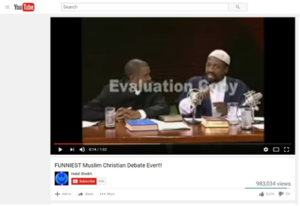
Revolution Muslim also utilized video uploading sites such as YouTube. Shortly before RevolutionMuslim.com launched in December 2007, Abdullah Faisal sent a DVD to the Revolution Muslim cofounders, according to Abdullah Muhammad.7 It was a copy of a nationally televised debate on a show in Jamaica called “Religious Hard Talk.” In it, Faisal attempted to embarrass a Catholic bishop by explaining that “Jesus, he preached Jihad.” Faisal pointed to a quote from a biblical parable. RM’s leadership created a simplistic video and uploaded the segment to YouTube. The video included on-screen titles that announced Faisal’s return to the public and requested that viewers purchase the full debate DVD through the website.8
YouTube
The video immediately drew attention. In the comments section, some Muslims celebrated Faisal’s return, and American youth who had no knowledge of his previous presence in Britain were exposed to his confrontational style. Moderate Muslims and Christians opposed the content and went into back-and-forth dialogue in their comments. Subscribers to RM’s YouTube channel started rising. To this day, Faisal’s video remains a radicalizing element. It’s been uploaded innumerable times to different accounts. One version has been viewed over 1 million times.9 It has been translated into Arabic, and requests to purchase a DVD of the debate continue to flow into the old Revolution Muslim Gmail account.10
The comments section on YouTube became a key means of interaction, recruitment and facilitating migration to more secure communication mechanisms. Revolution Muslim started making videos of all its activity and uploading them to YouTube. These activities included Q & A sessions with “Sheikh” Faisal, old lectures from Faisal’s time in the U.K., current events analysis and regular street dawah presentations outside New York City mosques, along with other public demonstrations. Revolution Muslim also experimented with Facebook, Twitter, Blip.tv and other relatively nascent social media platforms.11
While Revolution Muslim ceased to exist in 2011, its impact on the use of social media to promote jihadism continued. For example, the progression from these early efforts by Revolution Muslim on social media platforms were later adopted and adapted by ISIS. According to one analysis, from January through March 2014, three of seven English-language organizational Twitter accounts found to be deeply embedded in foreign fighter Twitter feeds were affiliated with ALM (and by extension Revolution Muslim). Anjem Choudary was by far the most followed. The list also included SalafiMediaUK, an organization run by Abu Waleed, a student of Omar Bakri and Abdullah Faisal who collaborated with RM,12 demonstrating Revolution Muslim’s lasting influence upon the larger ALM network. The third, a Twitter account called Millatu Ibrahim, was led by Mohamed Mahmoud, an Austrian who moderated the Ansar al-Mujahideen forum and who had once run the Global Islamic Media Front, which had collaborated with Revolution Muslim.13
English-Language Magazines
ISIS combined its social media savvy with well-produced English-language propaganda magazines, as well as similar magazines in languages including French, German, Russian, Indonesian and Uyghur.14 Yet the concept, structure and form of ISIS’ flagship English-language magazine Dabiq (now titled Rumiyah) had been developed and tested years earlier with Inspire by Samir Khan, a young American who joined Anwar al-Awlaki and Al-Qaeda in the Arabian Peninsula. Despite living in North Carolina, as a member of Revolution Muslim, Khan closely collaborated (remotely) with key figures within the organization before departing for Yemen in October 2009.
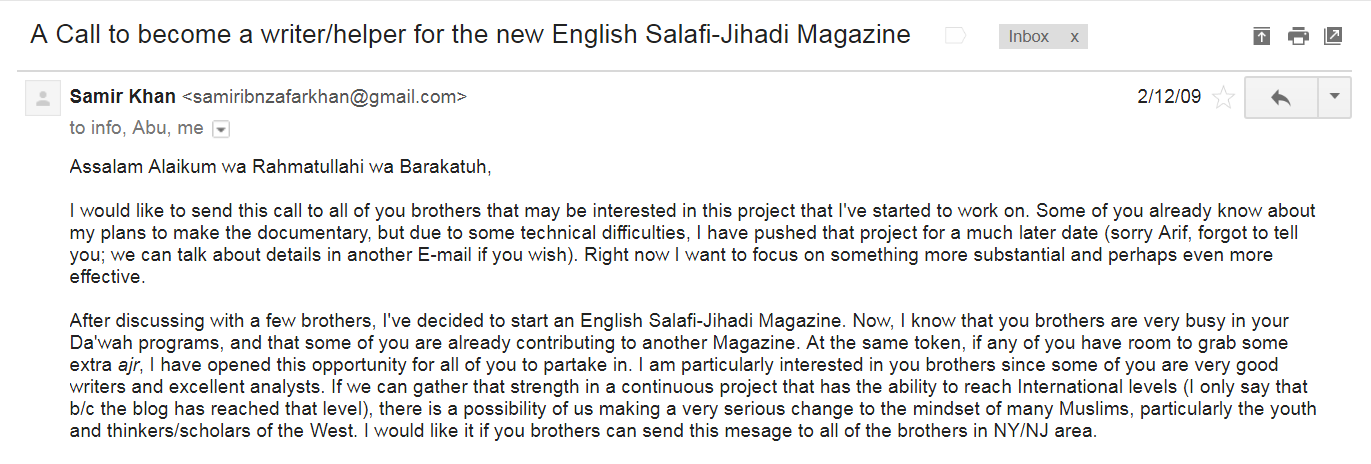
On February 12, 2009, Khan sent an email entitled “A Call to become a writer/helper for a new English Salafi-Jihadi Magazine.” It was addressed to two people, Arif al-Islam at ITS and Abdullah Muhammad at Revolution Muslim. The email read in part, “After discussing with a few brothers, I’ve decided to start an English Salafi-Jihadi Magazine.” Arif al-Islam declined to participate15—a sign of ITS’ reluctance to embrace explicit promotion of Salafi-jihadist terrorism—but Abdullah Muhammad agreed to pen the lead article for what would become Jihad Recollections.16
While English-language, jihadist-oriented magazines existed in the past, including during the recruitment drive for the Afghan-Soviet war in the 1980s, Jihad Recollections represented the most advanced jihadist magazine in the English language at the time.
The development and publication of the new magazine was collaborative. Members of al-Fursan Media and the Global Islamic Media Front advised Khan and Abdullah Muhammad.17 The most prominent online jihadi forum in English, Ansar al-Mujahideen, disseminated it throughout the online jihadist network.18
Samir Khan released the first edition of Jihad Recollections in April 2009, and its cover story was the piece by Abdullah Muhammad entitled “Predications of the Conquering of Rome.” In it, Abdullah Muhammad outlined a foreign policy grievance consistent with the narrative of al-Qaeda, arguing that terrorism against Americans was necessary and that jihadists needed to embed themselves in populist protests against Middle Eastern governments. The magazine included articles from a variety of people who would go on to commit or attempt to commit terrorism-related crimes. Asia Siddiqui, who wrote poetry for Jihad Recollections, was arrested with an accomplice for planning attacks in New York City in 2015.19 Mohamed Osman Mohamud, who was later convicted of plotting to attack a Christmas tree lighting ceremony in Portland, Oregon, also wrote articles for the magazine, including one on training without weights.20 Zachary Chesser also wrote for Jihad Recollections during his time as a Revolution Muslim propagandist.21
While over time the relevance of Jihad Recollections would become clear, its launch generated limited concern from counterterrorism experts at the time. For example, Thomas Hegghammer explained, “Jihadi Recollections sets a new standard for jihadi propaganda in English … but generally I think the importance of English-language propaganda tends to be overestimated by western analysts.”22 He mocked Mohamud’s article in particular: “I guess one indication would be if European jihadis suddenly start getting slender, flexible bodies.”23
Jihad Recollections operated for a mere six months, from April to September 2009, and published four issues. Yet its publication run was only the beginning of the collaboration between Samir Khan and Revolution Muslim with regard to the role of English-language propaganda magazines. Khan’s next magazine, Inspire, would be produced not by jihadist sympathizers in the United States, but by Al-Qaeda in the Arabian Peninsula (AQAP). Khan’s path from publishing Jihad Recollections to publishing Inspire from Yemen was in part enabled by Revolution Muslim, which would also play a major role in distributing Inspire once it launched.
In October 2009, Khan met with members of ITS and RM in New York City just before departing from JFK International Airport en route to Yemen. Khan informed his collaborators that he intended to continue the magazine project. He claimed that Anwar al-Awlaki had approved of Jihad Recollections. The initiative was to continue once he was safe and embedded with AQAP. According to Abdullah Muhammad, who was at the meeting, Khan said that once he arrived he’d be able to turn up the narrative.24
For the first several months that Khan spent in Yemen, he kept a low profile, preparing the groundwork for his next publication. Meanwhile, Revolution Muslim continued its efforts in the United States.
By the time Revolution Muslim recruited Zachary Chesser to join the group and issued the South Park threat on April 16, 2010, it was a well-known entity. However, the South Park threat thrust Revolution Muslim further into the limelight. The incident prompted responses from many, including Molly Norris, an artist from Seattle who started a Facebook page titled “Everybody Draw Mohammed Day.” She explained:
In light of the recent “veiled” (ha!) threats aimed at the creators of the television show South Park … by bloggers on Revolution Muslim’s website, we hereby deem May 20, 2010 as the first annual “Everybody Draw Mohammed Day!” Do your part to both water down the pool of targets and, oh yeah, defend a little something our country is famous for (but maybe not for long? Comedy Central cooperated with terrorists and pulled the episode) the first amendment.25
Meanwhile, by the summer of 2010, Samir Khan, working with Anwar al-Awlaki, launched Inspire magazine. The magazine was almost an exact replica of Jihad Recollections in form and content.
Khan and al-Awlaki utilized the controversy created by Revolution Muslim’s South Park threats to help launch the magazine and frame its effort. Inspire’s “Hear the World” section—consisting of quotes from “Friends and Foes” of al-Qaeda—included Revolution Muslim’s Yousef al-Khattab saying on CNN, “I love Usamah bin Laden, I … Walahi … I love him … pfft … like I can’t begin to tell you,” as well as Mitch Silber, NYPD director of intelligence analysis and coauthor of this paper, who called the Islamic Thinkers Society “bug lights for aspiring jihadists.”26
The issue also announced a new terrorist campaign targeting cartoonists who drew the Prophet Muhammad, entitled “The Dust Will Never Settle Down.” The announcement included a timeline of key events related to cartoons of Muhammad, a hit list of targets and a fatwa from Anwar al-Awlaki justifying the effort. Each of these sections of the campaign drew upon the work done by Revolution Muslim in making the South Park threats.
Revolution Muslim not only advised Khan on his efforts in developing the magazine but also played a central role in its distribution to aspiring jihadists in the West. Abdullah Muhammad posted the first edition on July 11, 2010, to the Revolution Muslim website a few days after its release over the Ansar forum.27 The prosecutor in his case would later state at the sentencing hearing that sharing the first edition of Inspire was “likely to cost innocent people their lives somewhere and someday.”28
Indeed, the first issue of Inspire included an article entitled, “Make a bomb in the kitchen of your Mom.” By including this article, Inspire took a step into explicit support for terrorist violence that its earlier incarnation in Jihad Recollections had avoided.
Abdullah Muhammad now explains that, while he didn’t think the prosecutor’s statement would prove prescient, “I remember watching CNN when it was revealed that the Tsarnaevs used the recipe at the Boston Marathon bombings and realizing the long-term consequences of Revolution Muslim-related propaganda.”29 Ahmad Khan Rahami, who cited the influence of ISIS in a journal, also utilized the same recipe to build the bombs that injured 31 people in New York and New Jersey in September 2016.30 More recently, Akayed Ullah, a 27-year-old Bangladeshi living in Queens, New York, utilized the recipe from Inspire to build a pipe bomb that he strapped to his chest and detonated at the Port Authority in Manhattan in December 2017.31
ISIS’ English-language magazine Dabiq and its successor, Rumiyah, are the latest versions of the template developed by Samir Khan in collaboration with Revolution Muslim. Absent some quality improvements, an issue of Dabiq or Rumiyah is almost identical to an issue of Jihad Recollections. Unsurprisingly, ISIS’ magazines have an editorial lineage that traces back to the network surrounding Revolution Muslim. ISIS claims that Ahmad Abousamra, an IT expert and Syrian-American in exile from America, played a key role in Al-Hayat—ISIS’ primary media arm—and was a key contributor to its English-language magazines.32 In 2004, Abousamra traveled with Tarek Mehanna,33 an American jihadist from Boston who was convicted in 2011 for providing material support to al-Qaeda, to seek out training camps in Yemen.34 Mehanna was connected to Khattab and members of the Islamic Thinkers Society.35
ISIS mastered the utility of English-language magazines. However, the true power of such magazines lies in their connection to a broader propaganda strategy that will likely survive ISIS’ fall. As Samir Khan put it in the Fall 2011 edition of Inspire, just before he was killed alongside Anwar al-Awlaki, “[I]t goes without saying that we have thrown something at America and her allies which they will forever be stuck with.”36
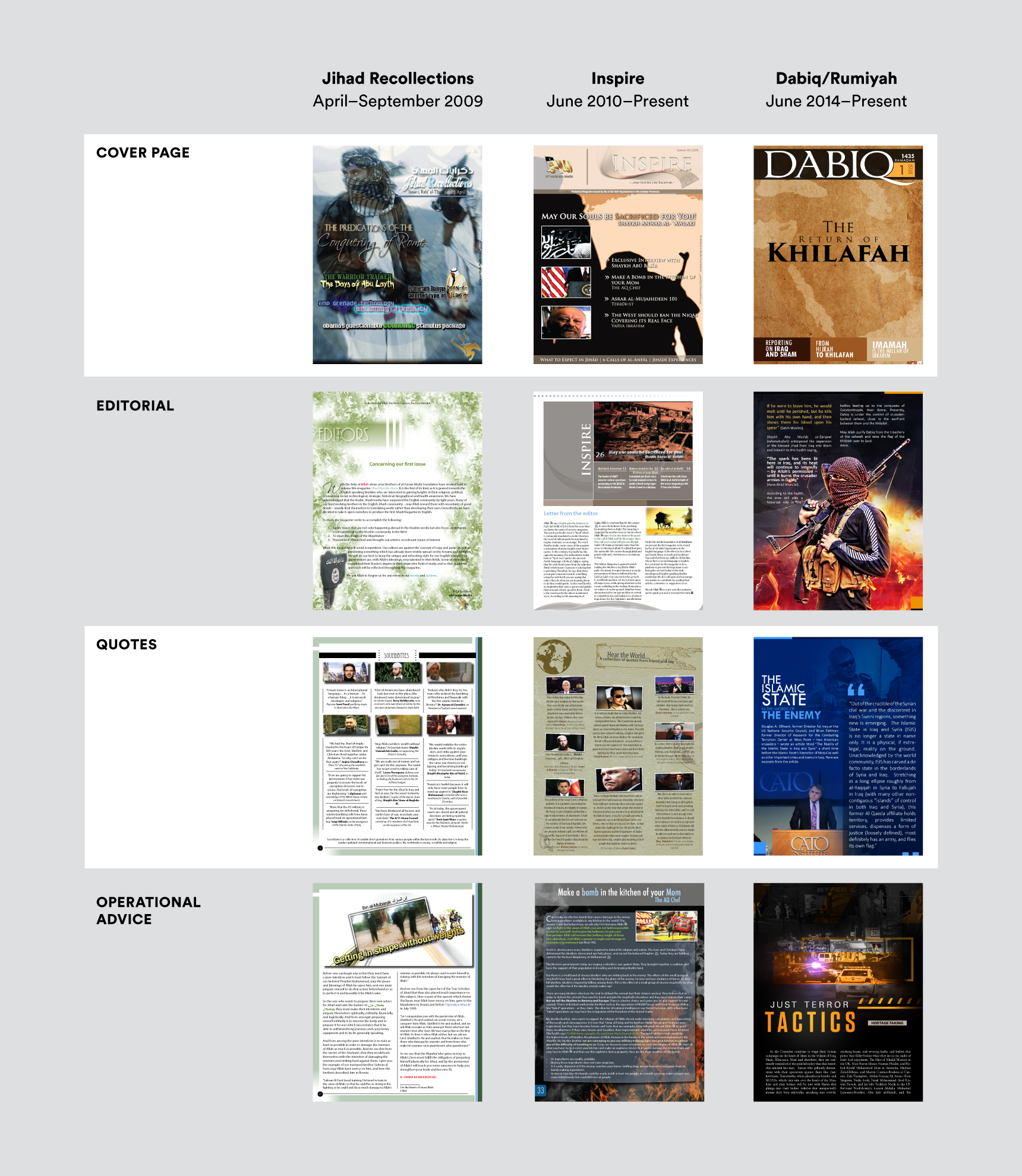
Direct Communication Platforms
In its recruitment and propaganda efforts, ISIS has made extensive use of direct communication platforms. Increasing numbers of Muslims have carried out attacks in the West in the name of ISIS following private communication with what the counterterrorism community now calls “virtual planners,” who are “members [of ISIS] who operate in the dark spaces of the Internet—to inspire and coordinate attacks abroad.”37 In the United States alone, at least 19 individuals have received encouragement or facilitation from an individual embedded with ISIS overseas.38
Yet, this threat is not altogether new. While ISIS took the use of direct messaging to a new level by providing explicit operational advice and support, Revolution Muslim introduced the tools and made initial use of direct communication to sanction and encourage terrorism—though not operationally support it—years before ISIS burst onto the global scene.
Revolution Muslim’s website encouraged sympathizers and supporters to contact the organization directly by phone, email and even Windows Live Messenger. Revolution Muslim used these platforms to collaborate with ALM members overseas, to field inquiries for regular Q & A sessions with Abdullah Faisal and to organize participation in protests and other activities. However, it became apparent that the reach of these platforms was limited. Revolution Muslim needed a platform that could amplify the message and facilitate direct communication simultaneously.
Revolution Muslim found its answer in a free, downloadable program called Paltalk, which allows users to communicate by video, chat and voice. RM organized regular lectures using the platform, which Omar Bakri had utilized extensively in the past. In 2005, Bakri started giving daily talks in an al-Muhajiroun chat room, where he expressed views more radical than those he expressed in public.39 For example, in public Bakri claimed that ALM adhered to the notion of a “covenant of security,” whereby acts of homegrown terrorism were forbidden by Islam.40 However, an investigation into the content of lectures on Paltalk revealed that the cleric preached that such a covenant had been “violated” by the U.K. government’s anti-terrorism legislation.41
Revolution Muslim expanded the use of Paltalk and integrated it within its public-facing, online propaganda approach—vastly extending the tool’s reach. Revolution Muslim created its own Paltalk room, “Masjid Syed Qutb,” early into its existence, using it sporadically until July 2010, when RM announced the creation of a new website, “Authentic Tauheed.” The outlet centered on Sheikh Faisal, but provided access to live 24/7 Paltalk discussions with contributors from the Revolution Muslim website, along with interactive lectures from a variety of radical clerics.42 The Paltalk chat room was embedded on the Revolution Muslim homepage so that anyone viewing the website could click on an audio button and listen in live. Lectures were promoted over RM social media platforms; photoshop posters grew more urbane and lectures were promoted with times in New York, London and Sydney. Faisal started giving lectures three times a day.43 The effort became an immediate draw and attracted additional attention and interactivity with those interested in the jihadist narrative.

Revolution Muslim also organized conferences over its Paltalk platform. Conferences drew a larger audience because they were formatted to include several preachers commenting on a specific topic or issue.
On July 31, 2010, for example, Authentic Tauheed coordinated a conference entitled “Ghazwatul Washington.”44 The event included Abdullah Muhammad, then residing in Morocco; Anjem Choudary; Abu Waleed, a Revolution Muslim collaborator and organizer of SalafiMedia in the U.K.; Omar Bakri; and Abdullah Faisal. Listeners could post freely during the lectures over a public chat service. Room administrators kept conversations focused, typed notes, bounced unwanted room members and directed some participants to the instant messaging service for more intimate discourse.
Unlike the programs ISIS uses today, Paltalk was not encrypted, but instant messaging provided at least a (perceived) layer of security as the RM leadership set up tiers of hierarchy. Administrators were recruited to monitor the room and to identify and log frequent onscreen nicknames. For intimate communication, room participants had to request an administrator to direct them to the member of the leadership they wanted to speak with. Administrators screened the types of questions the participants wanted to ask and were instructed to chat with them until the administrators verified their understanding of the ideology and felt confident they were not informants. Screened requests were then passed on. Once the lecturer or leader accepted the request, they could initiate an online text chat or communicate over audio.
Unlike ISIS, Revolution Muslim did not provide direct orders to carry out attacks or give operational information. However, RM did provide individualized sanctioning of terrorist activities through direct communication facilitated by Paltalk. For example, Rezwan Ferdaus, who was arrested for plotting to attack the U.S. Capitol and the Pentagon with a remote-controlled aircraft in September 2011, was a frequent participant in the Authentic Tauheed chat room and viewed Revolution Muslim’s website regularly. When he asked Abdullah Muhammad over the Revolution Muslim Gmail account on February 2, 2010, whether martyrdom operations were permissible, Abdullah Muhammad advised that they had some positive and negative ramifications but, “That is all I have time to say now, but if you log onto our site and join our Paltalk discussion on Thursday’s you can ask the questions and we will go into greater detail inshallah. Stay tuned to the homepage to find out what time.”45 During the investigation, Ferdaus told undercover informants that “viewing jihadi websites and videos” made him realize “‘how evil’ America is,” according to the complaint in the case.46
Rezwan Ferdaus was not a lone case of individuals plotting terrorist attacks after individualized sanctioning by Revolution Muslim leaders. Around Christmas 2010, several members of Call2Islam, then ALM-UK’s most influential offshoot, were arrested (and eventually convicted) for plotting to bomb the London Stock Exchange.47 Members of the plot were active in the Authentic Tauheed Paltalk room, and Mohammed Chowdhury, the alleged “linchpin” of the group, had even been approached by Abdullah Muhammad to help administer the Revolution Muslim website when he moved to Morocco.48 Before the plot was launched, Abdullah Muhammad had given a lecture on the Authentic Tauheed platform about the evils of financial institutions and specifically referenced conspiratorial claims about the City of London.49 Court records revealed that the London conspiratorswould meet on the street at Call2Islam dawah stalls and then continue their conversations on Paltalk at night.50 Abdullah Muhammad did not instruct them to conduct the attack, but sanctioned “terrorism” in private discourse over Paltalk’s instant messaging service.51
Today, ISIS utilizes Telegram, another instant messaging service, in a manner very similar to Revolution Muslim’s earlier efforts. To instruct adherents, it holds virtual “durus” (lessons) over public channels. Durus function as a means of formal education and further radicalization. These classes are taught by a “sheikh,” who opens text chat in the room for a question and answer session afterward. The chat session is followed by a brief quiz. Topics replicate those Revolution Muslim covered over Paltalk, teaching doctrinal differences with opposing interpretative schools, building social interaction and group cohesion and, where appropriate, facilitating one-on-one communication.52 From the broader conversations occurring on Telegram, ISIS then recruits individuals for more private discussions regarding potential attacks.53 ISIS’ innovation upon what Revolution Muslim had already done was expanding the method of personalized interaction and recruitment to provide operational assistance and using its ability to benefit from more available encryption.
Beyond Adopting the Template: ISIS’ Adoption of the ALM/RM Network
Revolution Muslim’s contribution to jihadist organizing was not merely its development of a template for utilizing the internet to great effect in recruitment and propaganda, but its stitching together of a large transnational jihadist network. From the time of Revolution Muslim’s disbandment in May 2011 until June 2014, when ISIS pronounced its caliphate, jihadist networks were sustained by Revolution Muslim progeny like Abdullah Faisal’s Authentic Tauheed platform and ALM propagandists in Britain who had been influenced by RM’s methods in the United States.54 As ISIS began to grow, it drew upon these networks that Revolution Muslim had nurtured, and called many to emigrate to join the caliphate or conduct attacks in the West.
One of the first criminal cases involving ISIS in the United States involved three young American siblings attempting to travel to join the group in Syria. The ringleader, 19-year-old Mohammed Hamzah Khan, had communicated with a pro-ISIS recruiter online. Khan asked the jihadist advocate whether he had to travel to Syria or could remain in the U.S. He was told that it was not obligatory but was advised that a single day under a caliph was better than to “to live and die in [ignorance].”55 Khan subsequently attempted to depart for Syria from Chicago with his younger sister and brother. The individual who advised Khan to travel to Syria was Abu Baraa (aka Mizanur Rahman), a leader of ALM in Britain, Anjem Choudary’s right-hand man and an acolyte groomed by Omar Bakri Muhammad to continue ALM into the next generation.56
ISIS’ adoption of the larger network built by ALM and its offshoots like Revolution Muslim was manifested not only in the flow of foreign fighters to Syria, but also in attacks in the West. On June 3, 2017, three perpetrators wearing fake explosive vests ran over pedestrians on London Bridge, then fled to stab others before they were all shot dead by police. The attack killed eight people and injured dozens.
The cell had deep ties to the ALM network, including to Revolution Muslim.The apparent ringleader of the cell was Khuram Butt, 27, of east London. Butt had been filmed in a 2015 documentary, The Jihadis Next Door, praying behind key members of ALM.57 Among those ALM leaders were Siddhartha Darr (aka Abu Rumaysa), who eventually emigrated to join ISIS and became one of the most senior commanders among foreign fighters in Mosul,58 and Mohammed Shamsuddin, Anjem Chouwdry’s one-time deputy,59who had connected with Abdullah Muhammad on Paltalk. Abdullah Muhammad, while working as an informant and analyst with the U.S. government, reported that Butt helped administer Revolution Muslim’s Paltalk platform in 2010 and that Butt was on the FBI’s radar as well.60
Butt had other ties to the ALM network. He was a regular at the Ummah Fitness Centre in Ilford, where cameras recorded him hugging the two other London attackers outside a few weeks before the attack.61 At the gym, he taught alongside Sajeel Shahid, a UK citizen who had visited New York before 9/11 on an ALM recruiting trip and who led ALM in Pakistan in 2001.62 According to Mohammed Babar, the New Yorker who had radicalized within ALM-NY, Shahid was present with him at a training camp in Pakistan.63 That camp was the location where Omar Khyam, the future leader of the 2004 London fertilizer bomb plot, and Mohammad Siddique Khan, the future leader of the London 7/7 bombings, trained.
A day after the London Bridge attack, ISIS’ news agency, Amaq, posted a message over Telegram in English: “A detachment of Islamic State fighters carried out the London attacks yesterday.”64 Soon thereafter, ISIS released a new issue of Rumiyah, the English-language magazine successor to Dabiq, built upon the template developed by Samir Khan in collaboration with Revolution Muslim. The magazine exclaimed that
“a unit of Islamic State soldiers, Abu Sadiq al-Britani, Abu Mujahid al-Britani, and Abu Yusuf al-Britani, carried out an operation striking two locations in London, the first being London Bridge where they ran over a number of Crusaders, and the second being a pub where they stabbed several others before attaining shahadah.”65
The attack demonstrated ALM’s resilience, despite the imprisonment of ALM leader Anjem Choudary in September 2016 and the jailing of other key leaders.66 More than 16 years after 9/11, the Islamist challenge that al-Muhajiroun and Revolution Muslim present in the West has not receded.
Citations
- Alexander Meleagrou-Hitchens and Hussein Solomon, “Factors Responsible for Al-Shabab’s Losses in Somalia,” CTC Sentinel, September 26, 2012.
- J.M. Berger and Jonathon Morgan, “The ISIS Twitter Census: Defining and describing the population of ISIS supporters on Twitter,” Brookings, March 2015.
- Audrey Alexander, “Digital Decay? Tracing Change Over Time Among English-Language Islamic State Sympathizers on Twitter,” George Washington University Program on Extremism, October 2017.
- Charlie Winter and Jade Parker, “Virtual Caliphate Rebooted: The Islamic State’s Evolving Online Strategy,” Lawfare, January 7, 2018.
- Ibid.
- Regarding Samir Khan’s ties to the Ansar forum and GIMF and his role in connecting them with Revolution Muslim, see personal experience of the authors; Jason Leopold, “An Exclusive Look Inside the FBI’s Files on the US Citizen Who Edited Al Qaeda’s Official Magazine,” Vice, September 22, 2014. ; Jihad Recollections, Issue 3, August 2009, p. 7; and email correspondence, November 7, 2010 Revolutionmuslim@gmail.com
- Personal experience of the authors; See also Jesse Morton, “My Former ‘Sheikh’ Abdullah Faisal: Arrested at Last by Jesse Morton,” Parallel Networks, August 29, 2017.
- “Sheik Faisal Returns – Refuting Christianity– Is Jesus God?” YouTube video, posted by “SheikFaisal,” November 18, 2007,
- “Funniest Muslim Christian Debate Ever,” YouTube video, posted by “Halal Sheikh,” August 9, 2011.
- “Debate between Sheikh Abdullah Al-Faisal and Bishop Joseph Adgol6.flv.” YouTube video, 5:07, posted by “mhmdzbayde,” December 9, 2010. ; personal experience of the authors.
- United States vs. Jesse Curtis Morton, “Statement of Facts,” 1:12cr35 (Alexandria Division, 2012)
- “Benefit grabbing extremist who hates Britain: Preacher wants non-Muslims to shave their heads and wear red belts around their necks,” Daily Mail, June 29, 2014.
- Jytte Klausen, “Tweeting the Jihad: Social Media Networks of Western Foreign Fighters in Syria and Iraq,” Studies in Conflict and Terrorism 38:1, 2015.
- Bethan McKernan, “Isis’ new magazine Rumiyah shows the terror group is ‘struggling to adjust to losses,’” Independent, September 6, 2016.
- Interview with Jesse Morton, New York City, September 9, 2017.
- Samir Khan, “A Call to become a writer/helper for the new English Salafi-Jihadi Magazine,” February 12, 2009, email.
- Steven Stalinsky and R. Sosnow, “The Life and Legacy of American Al-Qaeda Online Jihad Pioneer Samir Khan – Editor of Al-Qaeda Magazine ‘Inspire’ and A Driving Force Behind Al-Qaeda’s Push for ‘Lone Wolf’ Terror Attacks in the West,” Middle East Media Research Institute, Inquiry & Analysis Series, Report No. 886, September 28, 2012.
- “Al-Fursan Media: First English Jihad Magazine – Jihad Recollections no. 1.” Ansar al-Mujahideen Forum. April 7, 2009. Originally posted at . Screenshot retrieved on November 18, 2017, . Also see Jihad Recollections, Issue 3, August 2009, p. 7.
- United States of America Against Noelle Velentzas and Asia Siddiqui, “Complaint and Affidavit in Support of Arrest Warrants,” (15M303) April 1, 2015.
- United States of America vs. Mohamed Osman Mohamud (No. 14-30217) (United States Court of Appeals for the Ninth District, 2016)
- Personal experience of the authors; Paul Cruickshank and Tim Lister, “Alleged American Jihadists – Connecting the Dots,” CNN, August 2, 2010.
- Thomas Hegghammer, “Jihad Recollections,” Jihadica, April 7, 2009.
- Ibid.
- Personal experience of the authors.
- Jimmy Orr, “Creators of ‘Everybody Draw Muhammad Day’ drop gag after everybody gets angry,” Los Angeles Times, April 26, 2010.
- Inspire magazine, Issue 1, Summer 2010.
- United States vs. Jesse Curtis Morton, “Statement of Facts,” 1:12cr35 (Alexandria Division, 2012)
- United States vs. Jesse Curtis Morton, “Position of the United States with Respect to Sentencing Factors,” 1:12cr35 (Alexandria Division, 2012)
- Interview with Jesse Morton, New York City, September 9, 2017.
- Marc Santora and Adam Goldman, “Ahmad Khan Rahami Was Inspired by Bin Laden, Chargers Say,” New York Times, September 20, 2016.
- Zolan Kanno-Youngs and Scott Calvert, “After New York Attack, Investigators Ask: Should ISIS Material Be Online?” Wall Street Journal, December 15, 2017.
- Paul Cruickshank, “ISIS Lifts veil on American at the heart of its propaganda machine,” CNN, April 7, 2017.
- Milton J. Valencia, “Mass. Man May Be Supporting Militants in Syria,” Boston Globe, September 4, 2014.
- Milton J. Valencia, “Tarek Mehanna Guilty of Terror Charges,” Boston Globe, December 20, 2011.
- Personal experience of the authors; Paul Cruickshank and Tim Lister, “Arrested Man Attended Protests Organized by Islamic Radical Group,” CNN, June 12, 2010.
- Samir Khan, “The Media Conflict,” Inspire, Issue 7, Fall 2011.
- Bridget Moreng, “ISIS’ Virtual Puppeteers: How They Recruit and Train ‘Lone Wolves,’” Foreign Affairs, September 21, 2016.
- Alexander Meleagrou-Hitchens and Seamus Hughes, “The Threat to the United States from the Islamic State’s Virtual Entrepreneurs,” CTC Sentinel, March 9, 2017.
- Gary R. Bunt, iMuslims: Rewiring the House of Islam, University of North Carolina Press: 2009.
- John Horgan, Walking Away from Terrorism: Accounts of Disengagement from Radical and Extremist Movements, Routledge: 2009.
- Sean O’Neill and Yaakov Lappin, “Britain’s online imam declares war as he calls young to jihad,” The Times, January 17, 2005.
- H. Perez, “Attempted VBIED Attack at a Military Recruiting Center [Baltimore, Maryland],” CFIX Open Source Assessment, December 19, 2010.
- Interview with Jesse Morton, New York City, September 9, 2017; “Â鶹¹û¶³´«ý,” AuthenticTauheed.
- “Paltalk July 31st: Global Islamic Conference, Plotting World Domination,” Logan’s Warning, July 27, 2010.
- United States vs. Jesse Curtis Morton, “Statement of Facts,” 1:12cr35 (Alexandria Division, 2012)
- United States vs. Rezwan Ferdaus, “Affidavit of Special Agent Gary S. Cacace,” 11-mj-4270-TSH (Boston Division, 2011).
- “Terrorism gang jailed for plotting to blow up London Stock Exchange,” Telegraph, February 9, 2012.
- Paul Cruickshank, “Suspect in ‘South Park’ threats pleads guilty,” CNN, February 9, 2012.
- Dominic Casciani, “Anjem Choudary’s American Follower,” BBC, September 6, 2016.
- Raffaello Pantucci, We Love Death as You Love Life: Britain’s Suburban Terrorists, Hurst: 2015, p.169.
- Interview with Jesse Morton, New York City, September 9, 2017.
- Andre Gagne and Marc-Andre Argentino, “How the Islamic State uses ‘virtual lessons’ to build loyalty,” The Conversation, November 5, 2017.
- Joby Warrick, “The ‘app of choice’ for jihadists: ISIS seizes on Internet tool to promote terror,” Washington Post, December 23, 2016.
- Jytte Klausen et al., “The YouTube Jihadists: A Social Network Analysis of the Al-Muhajiroun Propaganda Campaign,” Perspectives on Terrorism, 2012.
- Janet Reitman, “The Children of ISIS,” Rolling Stone, March 25, 2015.
- Kevin Sullivan, “Police call him an ISIS recruiter. He says he’s just an outspoken preacher,” Washington Post, November 23, 2015.
- Jon Sharman, “Khuram Shazad Butt: Footage Emerges of London Attacker in TV Documentary ‘The Jihadis Next Door,’” Independent, June 5, 2017.
- Adam Withnall, “Isis sex slave kidnapped by British ‘new Jihadi John’ suspect Siddhartha Dhar,” Independent, May 1, 2016. ; David Casciani, “Who is Siddhartha Dhar?” BBC, January 4, 2016. ; William Booth and Rick Noack, “Man featured in a documentary called ‘The Jihadis Next Door’ was one of London attackers,” Washington Post, June 5, 2017.
- Counter Extremism Project. “Mohammad Shamsuddin.”,
- Matt Zapotosky, “The Feds billed him as a threat to American freedom. Now they’re paying him for help,” Washington Post, February 5, 2016. ; A.J. Chavar, Camilla Schick and Rukmini Callimachi, “Meet The Former Extremist Who Flagged a London Attacker in 2015,” New York Times, June 7, 2017.
- Fiona Simpson, “Terrorist Khuram Butt was inspired by YouTube Videos and met accomplices at Ilford gym, relatives say,” Evening Standard, June 8, 2017. ; Lizzie Deardon and May Bulman, “London attack: CCTV video shows terrorists laughing while planning atrocity at Ilford gym,” Independent, June 8, 2017.
- Peter Campbell et al., “Focus turns to east London gym with links to terror attacks.” Financial Times, June 8, 2017. ; “Re: United States v. Mohammed Junaid Babar,” 04-CR-528 (Southern District of New York, 2010).
- Richard Watson, “Has al-Muhajiroun Been Underestimated?” BBC, June 27, 2017.
- Brian Ross et al., “ISIS claims responsibility for London Bridge attack,” ABC News, June 4, 2016.
- Rumiyah, Issue 10, June 2017.
- Alexander Meleagrou-Hitchens, “The Toxic Movement that Brought Terror to London Bridge,” War on the Rocks, June 19, 2017.
Conclusion
Revolution Muslim, which emerged from a long tradition of Islamist organizing on the part of Omar Bakri and others, pioneered a method of “open-source jihad” that integrated outreach online to recruit, radicalize, promote and operationalize jihadist terrorism. Al-Qaeda in the Arabian Peninsula and the Islamic State adopted and adapted this method as well as the network that Revolution Muslim had formed around it, with deadly effect.
Today, ISIS is in retreat. The military campaign against the self-declared Islamic State has all but ended its control of territory.1 Yet the history of Revolution Muslim warns against optimism regarding the threat from ISIS. Revolution Muslim itself emerged out of a splintered and diverse tradition of Islamist organizing, illustrating the limitations of focusing on a specific group’s fortunes rather than broader shifts in the jihadist ecosystem.
As ISIS loses control of its terrain in Syria and Iraq, it is likely to evolve into more of a transnational “virtual caliphate,” which is what one set of researchers has defined as “a radicalized community online—that empowers the global Salafi-jihadi movement.”2 In doing so, it would revert to a small group of violent activists who seek to mobilize adherents through the multifaceted use of online media. In short, it would resemble Revolution Muslim.
If past is prologue to the future, there are valuable insights to be gleaned from the effort to combat Revolution Muslim. One lesson is that countering a fluid terrorist organization, like a virtual ISIS, will require the ability to predict and mimic the network’s rapid adaptations. One reason most of the plots linked to Revolution Muslim were thwarted was that the NYPD successfully integrated undercover officers into the heart of both the Islamic Thinkers Society and Revolution Muslim, providing critical human intelligence (HUMINT) about those individuals who planned to operationalize their ideology and the rapid shifts in the expression of that ideology.3
The increased use of digital HUMINT, comprising digital undercover officers and informants who can navigate the dark web and private communication channels of WhatsApp and Telegram, will be vital, particularly if a virtual ISIS relies more heavily upon encrypted operational instructions than Revolution Muslim did. This will require the sustained development and devotion of additional resources to this effort by federal and certain local law enforcement and intelligence organizations, as well as networked coordination with overseas partners.
A second key lesson of the effort against Revolution Muslim is that countering virtual jihadist recruitment will be an ongoing struggle, and law enforcement and intelligence agencies should not overemphasize the collapse of any particular group. Revolution Muslim emerged out of the collapse and re-forming of earlier groups that were part of a larger network. Al-Qaeda in the Arabian Peninsula and ISIS both expanded upon Revolution Muslim’s efforts even as RM itself fell apart.
With the 2017 arrest of Sheikh Abdullah Faisal in Jamaica (as a result of an NYPD investigation), the preachers around whom ALM, ITS and RM’s circles once revolved have been mostly removed from the playing field.4 Their removal is important, but the template that Revolution Muslim pioneered remains viable for other terrorist groups to adopt, use and weaponize to deadly effect despite the group’s disbandment in 2011.
Consequently, while the Islamic State appears to be defeated on the battlefield in Syria and Iraq and its appeal diminished, American policymakers and intelligence officials would be mistaken to underestimate the group’s continued threat. Relegated to primarily operating in the virtual realm, ISIS could morph into an almost completely virtual entity, with little need for a geographic footprint. This completely “virtual caliphate,” not unlike Revolution Muslim, “likely would manifest itself in the form of an expanded, transnational terrorist threat from dispersed but loyal operators,” as General Joseph Votel, commander of the U.S. Central Command, and colleagues have argued.5
As Revolution Muslim demonstrated, even a virtual organization with a dispersed network has the ability to inspire deadly attacks worldwide.
Citations
- Alex Ward, “ISIS just lost its last town in Iraq.” Vox, November 17, 2017.
- Harleen Gambhir, “The Virtual Caliphate: ISIS’s Information Warfare,” Institute for the Study of War, December 2016.
- Interview with Jesse Morton, New York City, September 9, 2017.
- Omar Bakri remains imprisoned in Lebanon, and Anjem Choudary and Abu Baraa were each sentenced in 2016 to serve five and a half years.
- Gen. Joseph L. Votel, Lt. Col. Christina Bembenek, Charles Hans, Jeffery Mouton and Amanda Spencer, “#Virtual Caliphate: Defeating ISIL on the Physical Battlefield is Not Enough.” Center for a Â鶹¹û¶³´«ýn Security, January 12, 2017.
More Â鶹¹û¶³´«ý the Authors

Mitchell Silber
Jesse Morton
Issues
Programs/Projects/Initiatives
Related