A Chapter of: A Portrait of Caring Black Men
Part 3: Parenting
A Snapshot of Black Fathers
To contextualize the portrait of Black men within the larger landscape of the care economy, this part of the report focuses specifically on Black fathers, some of whom also identify as high-intensity caregivers and/or parents.
In the United States, there is a long legacy of pathologizing Black family life. Pathologization characterizes an individual or a group as abnormal or aberrant from the "norm"鈥攎edically, psychologically, culturally, or morally. Historical, political, cultural, and academic discourse has pathologized Black families, blaming them, rather than structural racism and white supremacy, for adverse and disparate socioeconomic outcomes.1 Racial pathologization points the finger at people of color, reinforcing the white supremacist belief that Black people are inferior to and inherently different from white people, and that these 鈥渄ifferences鈥� explain racial disparities in wealth, income, education, and health. The 鈥渁bsent Black father鈥� stereotype is one manifestation of pathologization. This section of the report focuses specifically on Black fathers to disrupt this stereotype and the dangerous logic underpinning it.
The sample of Black men discussed in this section includes all Black fathers who said they were parents, including those who have cared for a child with special needs, as well as those who have not, and regardless of whether they have ever cared for an adult. As mentioned earlier in this report, 33 percent of Black fathers have had experience caring for an adult, 31 percent of Black fathers have had experience giving care to a child with special needs, and 19 percent have had experience caring for both an adult and a child with special needs.
A brief snapshot, this section presents key findings about Black fathers鈥� values and their experiences taking paid鈥攐r unpaid鈥攍eave from work to provide care, relative to white fathers鈥�. When placed within the context of a larger ongoing discussion about reshaping the narrative about Black fathers, it may help provide a clearer, more accurate depiction of who Black fathers are.
Contributing to existing discourse, this report reinforces findings from previous research which demonstrates that Black fathers are more similar than they are different from their white peers. In doing so, it seeks to assist in the dismantling of the 鈥渁bsent Black father鈥� myth, challenging the harmful assumptions underlying it, namely that Black fathers care less about their children than other fathers. Moreover, this report pushes back against centuries of pathologization that continues to harm Black families, parents, and men.
As explained by Color of Change and Family Story in their report, , stereotypical narratives that pathologize or caricature or perpetuate the false idea that Black people are inherently different from their white counterparts result in inaccurate depictions of Black people in the media.2 Ultimately infusing , such narratives also influence public which not only fail to understand and meet the needs of Black families but also cause them harm.3 Again, the "absent Black father" myth rests upon the false assumptions that Black fathers simply value parenting less than other fathers and that individual choices, rather than structural and systemic racism, explain why some Black fathers may have difficulty engaging in the lives of their children.
For centuries, social and economic systems, laws, policies, and practices actively separated Black fathers from their families. Forcefully and brutally, the economic, political, and social institution of slavery tore Black children from their parents and husbands from their wives, most notably through the international and鈥斺�攄omestic slave trade.4 Following the Civil War and the final abolition of slavery in , Black families invested money and energy into during the era of Reconstruction.5 Even then, industrial business owners and local farmers utilized to obtain free labor through the arrest, detainment, and sentencing of Black men (and women) for petty 鈥渃rimes,鈥� like unemployment, simply walking, or even 6 In these instances, Black men who were fathers, brothers, uncles, and friends were forcibly removed from their communities. Fast-forward to the 1960s, when, in some states, a mother鈥檚 eligibility for child welfare benefits required the absence of male 鈥�.鈥�7 Historically, systems and structures have played an integral role in separating Black fathers from their families.
According to the (CLASP), today, mass incarceration policies, barriers in the child welfare system, and economic inequality resulting in higher levels of unemployment are a few of the main structural barriers that disproportionately harm Black families.8 Yet in spite of them, Black men are engaged in the lives of their children as fathers, as demonstrated by and as shown in this report.9
Black fathers are more likely than white fathers to think that it鈥檚 very important that dads are active in raising younger children by way of feeding them, dressing them, and providing childcare.
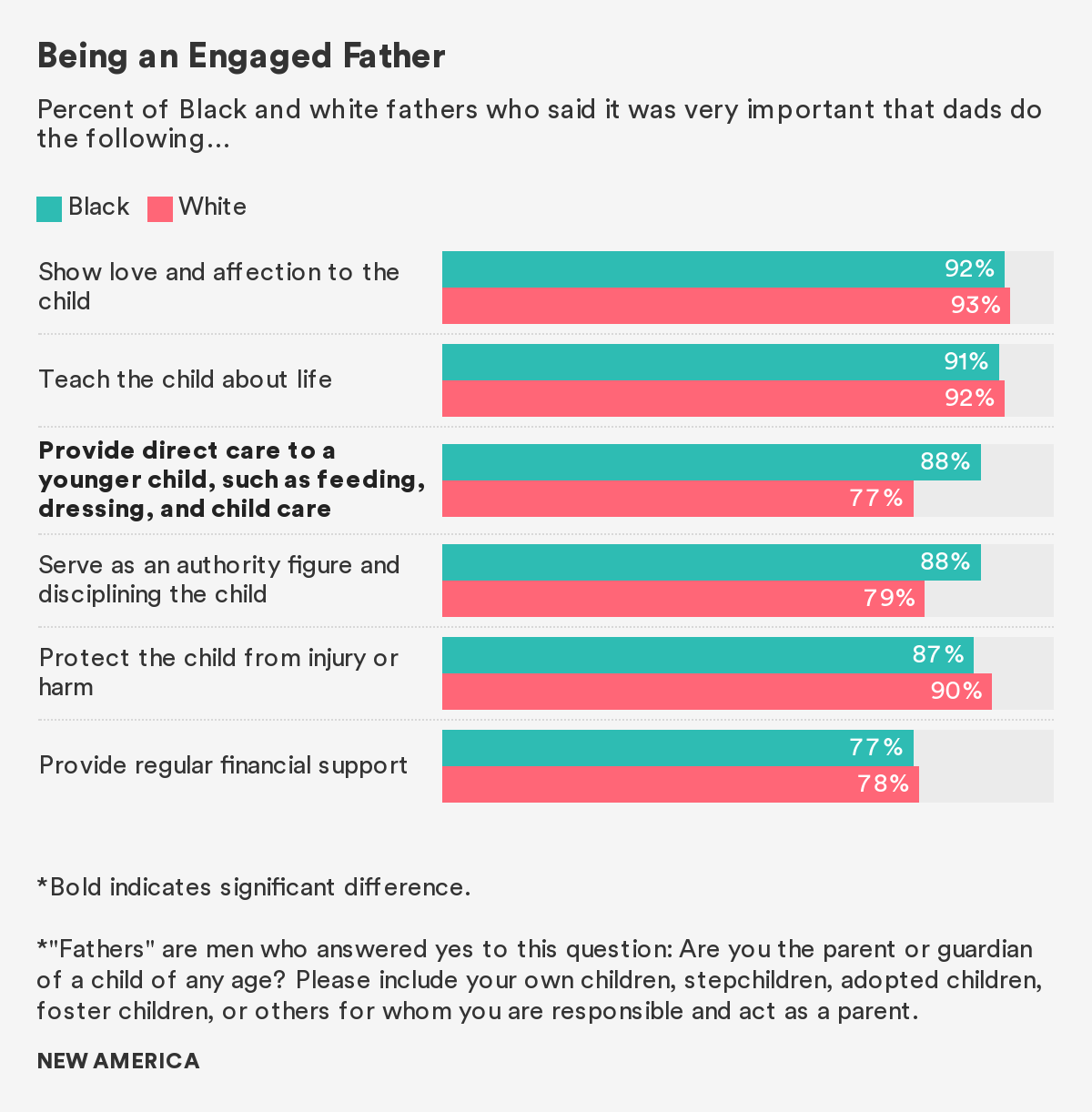
In our survey, Black fathers and white fathers have similar values around caring for their children. At least 90 percent of fathers of both races say that it is very important for fathers to teach their children about life and to show them love and affection. At least 85 percent of Black and white fathers say it is important for a father to protect his child from injury or harm. More than 70 percent of fathers in both racial groups say it is important to serve as an authority figure and to provide financial support.
However, one significant difference our survey found between the two groups of fathers in their parenting priorities was that more Black fathers (88 percent) than white fathers (77 percent) think that it鈥檚 very important that men are active in raising younger children by way of feeding them, dressing them, and providing childcare.
A majority of Black fathers are highly involved in caring for and raising their young children on a daily basis.
This study finds that more than two-thirds (69 percent) of Black fathers say they comfort, soothe, and emotionally support their children every day. Sixty-seven percent make meals and feed their kids daily, and 63 percent engage their children in play.
In addition to performing these hands-on tasks for their kids, Black fathers assist with other parenting duties necessary for maintaining a household suitable to raising children and family life. Within the domestic realm, 61 percent handle household chores daily and 62 percent provide transportation. A majority of Black fathers monitor their children鈥檚 educational progress and development: 59 percent take part in educational activities like managing homework, reading to their children, or attending parent-teacher conferences. Among Black fathers, 43 percent manage schedules regularly.
This study found no significant differences between Black and white fathers in terms of the parenting tasks they perform. Similar percentages of both groups feed, comfort, supervise, and provide transportation to their children.
Unfortunately, Black fathers and white fathers are also similar in that more than one-quarter of them say they encounter barriers that make it difficult for them to be the fathers they would like to be.
In our survey, more than 40 percent of fathers of both races, who have children under the age of eight years old, think that they do not spend enough time with their children. Additionally, the same percentage of Black and white fathers (only 47 percent) have ever taken leave following the birth or adoption of a child. Despite this similarity in experiences, there is a concerning difference in terms of how Black and white fathers financially cope with taking time off from work. Although a similar percentage of Black and white fathers used savings to cover the costs associated with their recent leaves, twice as many of Black fathers (30 percent) than white fathers (15 percent) used savings they had specifically set aside for health needs to fund their paid or unpaid leave.
An inability to have full wage replacement while on leave forces parents to dig into their own financial reserves to make ends meet. Considering more Black fathers than white anticipate needing to take leave for the adoption or birth of a child (36 percent to 20 percent, respectively), the disparity in access to paid leave is even more concerning. The fact that more Black fathers have to pull from their savings demonstrates that the existing unpaid federal leave policy in the United States may have the potential to cause more harm if it serves to increase, rather than diminish, the existing racial wealth gap between Black and white families. When social policies are not created within an equitable framework, they ultimately hurt people of color most. However, understanding how existing structures and policies harm Black fathers or fail to meet their needs reveals opportunities for reforms that will likely benefit all male caregivers.

Citations
- Ta-Nehisi Coates, 鈥�50 Years After the Moynihan Report, Examining the Black Family in the Age of Mass Incarceration,鈥� The Atlantic, October 2015, .
- Rashad Robinson and Nicole Sussner Rodgers, Changing the Narrative about Black Families (Oakland California: Color of Change and Family Story, October 13, 2020), ; Evi Taylor et al., 鈥淭he Historical Perspectives of Stereotypes on African-American Males,鈥� Journal of Human Rights and Social Work 4, no. 3 (September 1, 2019): 213鈥�25, .
- Joy Moses, 鈥淢oving Away from Racial Stereotypes in Poverty Policy鈥� (Washington, D.C.: Center for American Progress, February 2012), ; Ann Cammett, 鈥淒eadbeat Dads & Welfare Queens: How Metaphor Shapes Poverty Law,鈥� Boston College Journal of Law & Social Justice 34, no. 2 (May 22, 2014): 233.
- Social Welfare History Project, 鈥淎ct to Prohibit the Importation of Slaves 1807,鈥� December 5, 2015, .
- National Museum of African American History and Culture, 鈥淭he Historical Legacy of Juneteenth,鈥� June 19, 2019,.
- William Andrew Todd, 鈥淐onvict Lease System,鈥� New Georgia Encyclopedia, July 16, 2020, ; 鈥淲hat Is Convict Leasing?鈥� Exhibit, Sugar Land Convict Leasing – Woodson Research Center, ; Ta-Nehisi Coates, 鈥淭he Case for Reparations,鈥� The Atlantic, June 2014, .
- Linda Gordon, 鈥淎id To Dependent Children: The Legal History,鈥� Social Welfare History Project, January 19, 2011, .
- Center for Law and Social Policy, 鈥淔atherhood and Families鈥� (Washington, D.C.: Center for Law and Social Policy, n.d.), .
- Jo Jones and William D. Mosher, 鈥淔athers鈥� Involvement With Their Children: United States, 2006鈥�2010,鈥� National Health Statistics Report (Atlanta: Center for Disease Control and Prevention, December 20, 2013), .