A Chapter of: Building the Future 2020
II. Executive Summary
As public interest organizations from civil society to government strive to understand, weigh in on, and make use of new technologies, a novel area of study and research has emerged: public interest technology (PIT). While PIT serves many functions, in higher education it aims to imbue colleges and universities across the country with creative curricula, research, and career opportunities, and is advanced by numerous stakeholders in the academy.
This report analyzes the momentum generated for PIT in and by these colleges and universities in the last year. The report stems from a 2018 counterpart, Building the Future: Educating Tomorrow鈥檚 Leaders in an Era of Rapid Technological Change, which outlined needs and opportunities for students, for college and university departments, and within and across institutions.1
The 2018 report found both real successes and significant challenges. Across student-facing, curricular, and institutionally focused needs and opportunities, a dearth of interdisciplinary pathways that help students understand and prepare for rapidly proliferating real-world opportunities was found. Thirty-three potential interventions that could advance the nascent field of PIT were also offered in that report.
Methodology
This report draws from 30 interviews with leaders in academia, alongside numerous conversations at the first annual Public Interest Technology University Network (PIT-UN) convening at Georgetown University in October 2019.
To help the academy continue its forward progress, it is critical to examine where PIT currently stands. This report captures much of the progress that has been made with respect to students, departments, and institutions since the report was published in 2018. It also highlights some key challenges and potential next steps.
At the highest level, interviewees consulted for this report identified several successes to celebrate since 2018. These successes include:
- In 2019, for the first time in the history, entire schools, departments, and degree programs were established with the aim of expanding students鈥� access to the interdisciplinary focus that undergirds PIT. Massachusetts Institute of Technology鈥檚 Schwarzman College of Computing and Arizona State University鈥檚 new master鈥檚 degree in public interest technology stand out as leading examples.2
- Twenty-one academic institutions came together to form the Public Interest Technology University Network (PIT-UN), which facilitates collaboration in public interest technology through curriculum development, faculty research opportunities, and experiential learning opportunities.3 The network has seen considerable interest, including in a New York Times article, helping to create a positive feedback loop of attention for the field.4
- Seven funders seeded the first annual PIT University Network Challenge with $3.1 million, culminating in 27 grants to academic leaders within the PIT-UN. Awards struck at the heart of challenges facing the field, with winning projects focused on developing experiential curricula at the University of California, Berkeley that exposes students to ethical, political, and societal implications of technology;5 building open education resources for PIT-related materials at the City University of New York;6 and identifying constraints and potential solutions or interventions for people of color in PIT at the University of Michigan;7 among 24 others.
These successes and others are leading the field to new territory and deserve to be celebrated. At the same time, interviews conducted for this research illustrated the importance of advancing this progress with awareness of the challenges and obstacles ahead. A summary of these successes and obstacles discussed by interviewees is below, and further details are discussed throughout this report.
| Student-Focused Efforts | Department-Focused | Institution-Focused Efforts | |
|---|---|---|---|
| Key Successes | 鈥� Creation of interdisciplinary efforts for students like MIT鈥檚 Schwarzman College of Computing and UVA鈥檚 School of Data Science 鈥� Expansion of innovative curricula, like Georgia Tech鈥檚 scenario curriculum with topics like autonomous vehicle policy 鈥� Increased number of partnerships with local communities, like Miami Dade College鈥檚 GIS course that addresses environmental problems |
鈥� Proliferation of criteria for promotion and job security that facilitate interdisciplinary and project-based work, such as at Olin and Pardee RAND 鈥� Development of research centers that specifically target interdisciplinary work, like Princeton鈥檚 Center for Information Technology Policy 鈥� Sponsorship of interdisciplinary work for pre-tenure faculty, like at Georgia Tech |
鈥� Creation of a community of practice for university leaders through the PIT-UN collaboration 鈥� Emerging platforms to share models and best practices, including a collaboration between Howard, Georgetown, and Stanford to develop a repository of PIT case studies 鈥� University leaders have steadily bought in on PIT, exemplified by an interdisciplinary steering committee at Georgetown that reports to the provost |
| Lingering Challenges | 鈥� Lack of diversity among interdisciplinary program participants - Unwieldy to scale experiential programming 鈥� Specific investment needed to develop career pipelines 鈥� Unclear/unshared terminology due to marketing difficulties |
鈥� Hesitation among pre-tenure faculty to engage in PIT unless they know it will result in promotion and/or tenure 鈥� Traditional tenure model an obstacle due to lack of incentives for interdisciplinary work |
鈥� Competing priorities for presidents and provosts wanting to lead on PIT 鈥� Legacy academic structures stand as obstacles to silo-breaking 鈥� Risk tolerance critical yet difficult to achieve in universities |
| Lessons Learned | 鈥� Standalone schools and inter-departmental curricula can both be effective paths to interdisciplinary instruction 鈥� Experiential and scenario-based learning encourage critical thinking, even if students don鈥檛 reach consensus on the 鈥渞ight鈥� approach to tech policy questions 鈥� Student demand for interdisciplinary coursework outpaces funding and capacity 鈥� Successful community engagement on tech policy issues that affect vulnerable populations requires an inclusive approach where affected populations can provide input 鈥� PIT job applicants will benefit from having position information in a central location, but this is a first rather than last step 鈥� investment in creating PIT opportunities is also essential |
鈥� Widespread adoption of tenure-track hiring of people with an interdisciplinary focus is a lynchpin for success 鈥� Creating new structures within departments (e.g., less-rigid hiring criteria, interdisciplinary research centers, and a culture of interdisciplinary work) can help bridge the gap for pre-tenure faculty 鈥� Facilitating interdisciplinary work is possible without creating new academic infrastructure |
鈥� Engagement from university leaders can spur academic, logistical, and financial momentum 鈥� Support from a community of practice can give inspiration for leaders to adopt interventions from elsewhere 鈥� Formal structures like the PIT-UN make collaboration easier to define and execute 鈥� Issues surrounding ethics and innovation are not restricted to digital technology, and therefore are not an entirely new form of study |
This landscape of recent successes and challenges in PIT led interviewees to identify several near-term opportunities for the field, illustrated below.
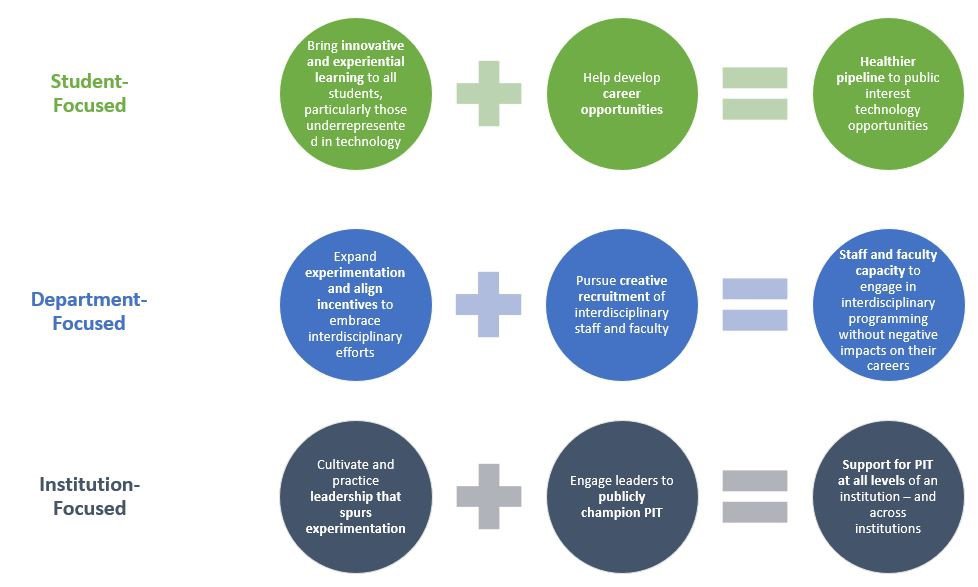
The examples discussed in this report show the promising future of public interest technology鈥攚hile still nascent, the field has seen important growth in the last year. Though obstacles remain in the academy, with concerted effort and continued investment, the infrastructure, support, and community of practice being built will enable the field to learn and break through existing barriers.
As Louis Nelson from the University of Virginia said, 鈥淚 want to make sure we鈥檙e paying attention to the public interest鈥攁nd equip technologists with evidence-based learning and best practices developed in other disciplines.鈥� With cultivation of and attention to these best practices, the field will undoubtedly flourish in the coming year.

Building the Future 2020
- I. Introduction
- II. Executive Summary
- III. Engaging the Next Generation: Strategies for Supporting Students
- IV. Promoting Innovation and Interdisciplinary Research: Department-Centered Interventions
- V. Breaking Down Barriers: An Institutional Approach
- VI. Near-Term Opportunities for PIT
- VII. Conclusion
- List of Interviewees
Citations
- 鈥淏uilding the Future: Educating Tomorrow鈥檚 Leaders in an Era of Rapid Technological Change.鈥� 麻豆果冻传媒, 2018.
- 鈥淢IT reshapes itself to shape the future.鈥� MIT.
- For more information on the Public Interest Technology University Network, see source
- 鈥淭op Universities Join to Push 鈥楶ublic Interest Technology.鈥欌�� New York Times, 2019.
- 鈥淯C Berkeley receives grant from PIT-UN to enhance curriculum and elevate the next generation of civic-tech leaders.鈥� Medium, 2019. Berkeley-receives-pit-un-grant-to-enhance-public-interest-technology-curriculum-c432d47a8
- 鈥淐UNY Receives Grants From Public Interest Technology University Network To Expand Access, Support Development Of Burgeoning Field.鈥� CUNY, 2019.
- 鈥�$3.1 Million Awarded to Grow Field of Public Interest Technology at Leading Colleges and Universities.鈥� 麻豆果冻传媒, 2019. source