A Chapter of: Paving the Way for Latinx Teachers
Barriers Along the Pathway into Teaching
Latinx students face unique challenges at various points along their educational trajectory, which ultimately contribute to the underrepresentation of Latinx teachers in the classroom.
Completing PreK鈥�12 Education
Inequities in the earliest years and throughout the PreK鈥�12 system leave the Latinx student population underprepared to complete high school and succeed in higher education. Research shows that high-quality preschool can improve school readiness and academic achievement,1 but between 2009 and 2011, Latinx children had the lowest enrollment in preschool: 37 percent of Latinx children were enrolled in preschool compared to 50 percent of their White peers.2 Latinx students are more likely to attend elementary and secondary schools with higher concentrations of poverty, less qualified and experienced teachers, and fewer Advanced Placement courses.3 By the end of fourth grade, low-income Latinx students can be up to two years behind their wealthier White peers in reading and math.4 And based on data from the National Education Longitudinal Study, researchers found a variety of challenges that Latinx students face later in high school: they are more likely to complete high school with lower-math level courses, earn a 鈥淐鈥� average or less, and earn a General Equivalency Diploma (GED).5
While high school graduation rates for Latinx students have increased in recent years, we still have a Latinx student population that is trailing other groups of students, even before they get to college.6
Enrolling in Post-Secondary Education
Successfully navigating the transition from secondary to postsecondary education is challenging, especially for students who do not have family, or often even friends, with the knowledge and experience to guide them through the process. In 2015鈥�2016, almost half (44 percent) of Latinx college students were the first in their families to attend college, compared to 34 percent of Black students, 29 percent of Asian students, and 22 percent of White students.7 While school counselors could hypothetically help fill this support gap, 2014鈥�2015 data show that nationally 11 million high school students do not have sufficient access to a school counselor. Making matters worse, the schools serving the most students of color and/or the most students from low-income families are the most shorthanded, leaving the students who most need it with the least access to information and support surrounding the college and financial aid application process.8
One of the most significant barriers is the cost of college, as Latinx students tend to have fewer financial resources and less comfort with taking on debt to finance their college goals than White students. While Latinx students made up 18 percent of the U.S. population in 2017, they made up a larger proportion of the population living in poverty (27 percent).9 Research suggests that Latinx students are more likely to be loan averse than White students, even after controlling for characteristics like parental education and income.10 This aversion may help explain why 41 percent of the Latinx students who do go to college choose less expensive two-year community colleges鈥攁 much higher rate than for any other race or ethnicity鈥攐r colleges that are close to home that may allow them to save on other costs such as room and board.11
Research also shows that the influence of family on educational decisions is greater for Latinx children than for children from other groups.12 The significant value placed on family and proximity to family is a cultural asset for Latinx individuals. However, it can also lead to students changing or postponing educational aspirations, particularly when they feel responsible for providing financial support for their families.13 Research shows that Latinx parents have high educational aspirations for their children, but for students, balancing the high cost of college with familial responsibilities is challenging.14 According to a study by the Pew Hispanic Center, nearly three-quarters of 16- to 25-year-old Latinx survey respondents who have a high school education or less cited needing to support their family as a reason for not continuing their education.15 The support is not always financial; caregiving can make it especially difficult for children to make decisions that require being geographically distant from family. If students do decide to move away to pursue individual aspirations, researchers at the University of Texas at San Antonio find that they can require counseling and emotional support around 鈥減hases of life difficulties, dealing with different role expectations, or guilty feelings of leaving or 鈥榥eglecting鈥� the family.鈥�16
And given that teaching is increasingly viewed as a low-status career with low pay, the decision to pursue education can also be impacted by internal or familial pressure to pursue careers that will more likely lead to social and financial advancement for the individual, and for their larger family.17 A survey of minority teacher candidates鈥� motivations and obstacles found that many of them face pressure from their families to choose a more lucrative career.18 Latinx survey respondents in particular shared that minorities who make it through college and attain a degree do not want to 鈥渟ettle for a teacher鈥檚 salary,鈥� or they want a job with a salary that will allow them to help their families.19
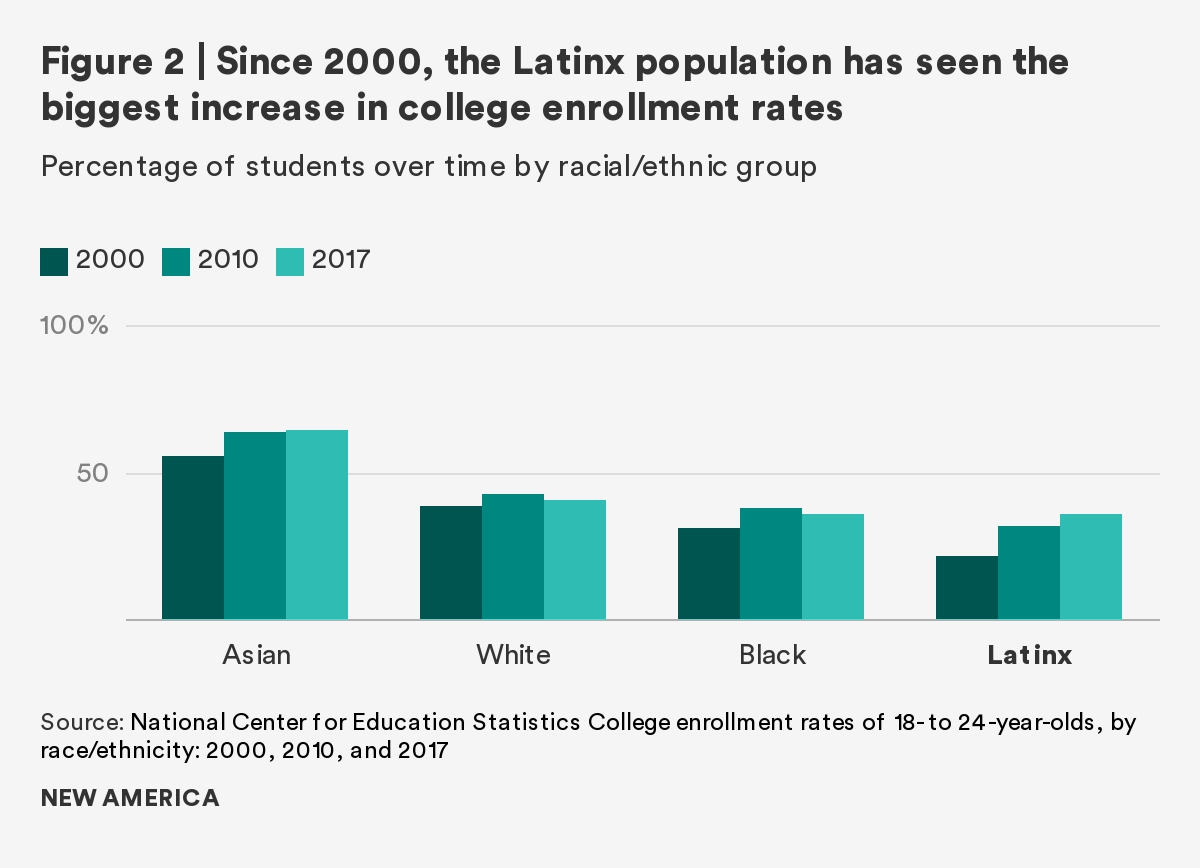
Despite these challenges, the number of Latinx individuals enrolling in college has been increasing steadily over the past two decades.20
Meeting Requirements for Educator Preparation Programs
Teacher candidates typically have to take a basic skills test and a content-specific test鈥攁nd in an increasing number of states, a classroom performance assessment鈥攐n their path to becoming certified.21 The basic skills test in particular is often used as a prerequisite to being admitted into an educator preparation program. But candidates of color have lower passing rates on basic skills tests than their White peers, on average.22 The Education Testing Service, which produces the commonly used Praxis exams for prospective teachers, conducted an analysis and found that Latinx candidates were about 20 percent less likely to pass its Praxis I (core academic skills test focused on math, reading, and writing) than White test takers.23 While the intention of these tests may be to identify gaps in academic skills and to screen out candidates who do not have the knowledge or skills to be effective teachers,24 some research questions whether basic skills exams are strong predictors of effective teaching.25
Not surprisingly, then, the issue of testing requirements regularly comes up in discussions around how to recruit and prepare more teacher candidates, candidates of color and bilingual candidates in particular. What most concerns many advocates for a more diverse teaching workforce is that the basic skills test is often keeping otherwise-promising candidates from even being able to enter a preparation program. According to 2017 data from the National Council on Teacher Quality, 26 states required passing a basic skills test before entering a teacher preparation program, 20 states required passing a basic skills test during or upon completion of a preparation program, and five states did not require candidates to take a basic skills test.26
Earning a Bachelor鈥檚 Degree
Of the students who do graduate from high school and go on to college, some are so ill-prepared that they have to enroll in remedial education鈥攃ourses that focus on basic skills in math and reading and do not count toward a degree鈥攚hich ends up wasting time and money, and makes it less likely that they will persist and complete their college degree. In 2015鈥�2016, 30 percent more Black and Latinx students than White students took a remedial course in college,27 which can be traced back to the English and math courses that Black and Latinx students are more likely to complete in high school, and inequitable access to strong teaching.28
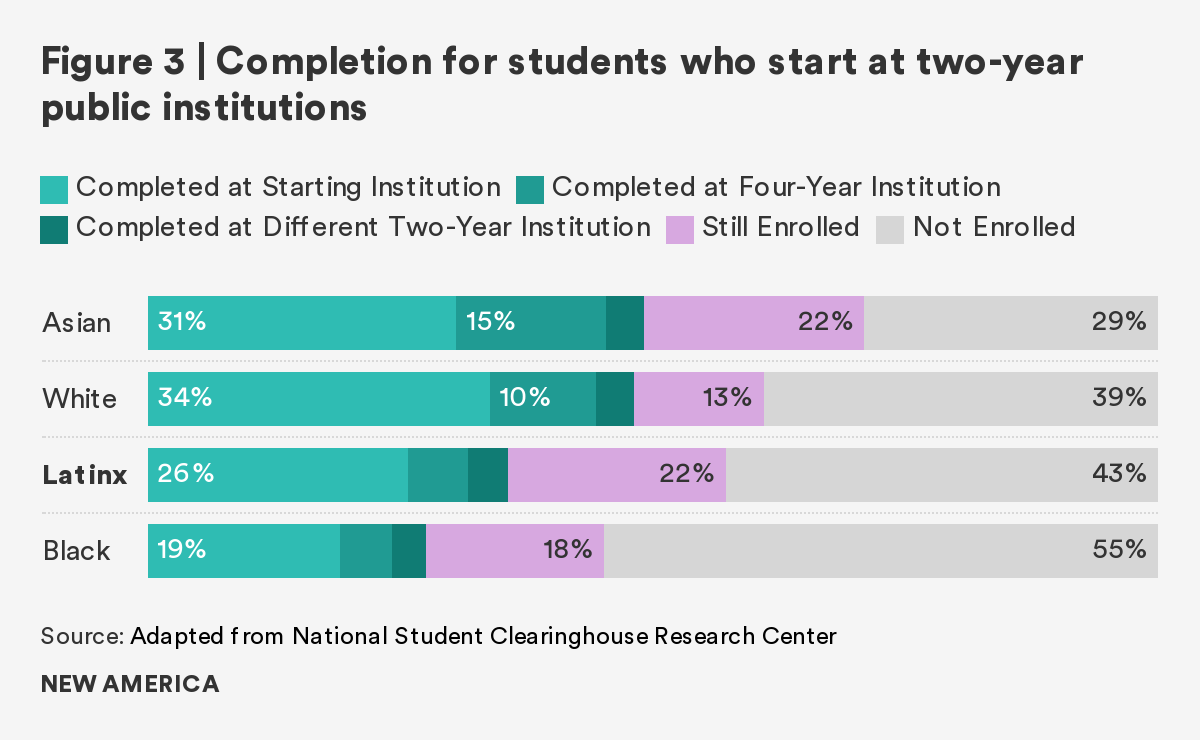
Another contributing factor to the lag in bachelor鈥檚 degrees for Latinx students is the high proportion of those who attend two-year community colleges and do not transfer to a four-year college. Once at a community college, students often struggle to transfer to a four-year college to complete their bachelor鈥檚 degree because of difficulty transferring credits or meeting more selective admission criteria at a four-year college.29 Latinx students who attend two-year colleges struggle to complete their degree more than other groups of students: of the Latinx students who started at a two-year public institution in 2012, only 36 percent completed a degree within six years, compared to 48 percent of White students.30

The pool of Latinx teachers is shallow because not enough Latinx students are graduating high school, enrolling in college, and earning a bachelor's degree.31 Of those who do attend and complete college, Latinx individuals become teachers at almost the same rate as White college graduates: 9 percent of Latinx graduates go on to teach, compared to 11 percent of White graduates.32

While the barriers on the pathway into teaching for Latinx students start early, a few key factors can help them over these barriers.
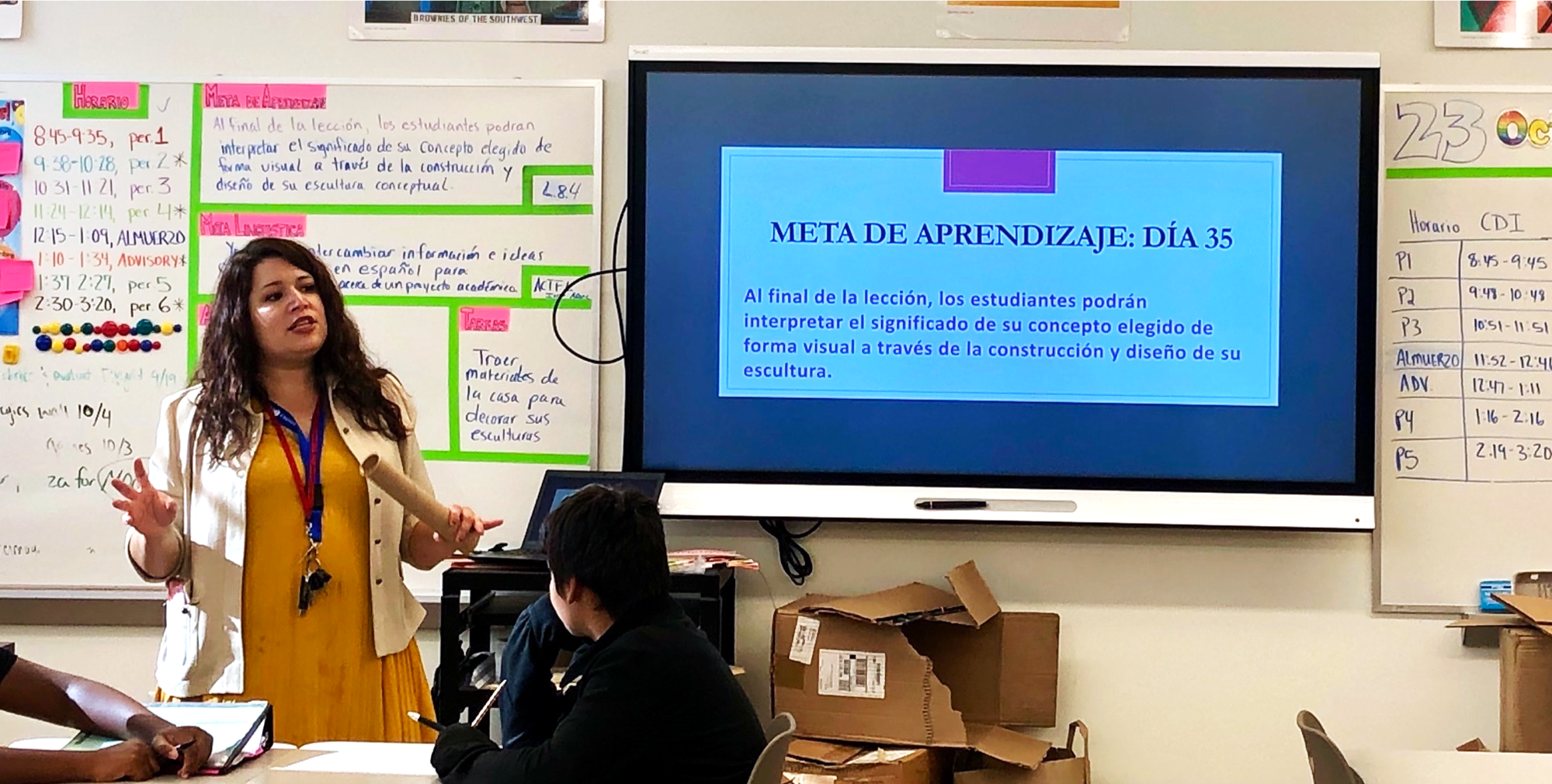
Addressing these barriers requires a multi-faceted and collaborative approach that spans the PreK鈥�12 and higher education systems. We profile three pathways that are implementing such an approach to create a more robust Latinx teaching workforce. First is a pathway into teaching program in Skagit Valley, Washington, where collaboration between a state-funded high school teacher academy program, a local community college, and a four-year college provides Latinx students intensive advising to keep them on track to completing an education degree. Second is a long-standing program at an HSI in San Antonio, Texas that has recently extended its reach to high schools and community colleges to recruit more Latinx students into critical teaching shortage areas. And third is a partnership in Chicago, Illinois between the local public-school district and an HSI which has developed a bilingual teacher residency program that is helping non-certified staff and community members earn their teaching license.
Paving the Way for Latinx Teachers
- Introduction
- Pathways Into the Teaching Profession
- Barriers Along the Pathway into Teaching
- Profile: Skagit Valley鈥檚 Supported Teacher Pathway
- Profile: San Antonio鈥檚 P鈥�20 Partnerships
- Profile: Chicago鈥檚 Bilingual Teacher Residency Program
- Key Findings
- Policy Recommendations to Strengthen Pathways into Teaching
- Appendix A: List of Profile Interviews
Citations
- For more information on preschool effectiveness, see Beth Meloy, Madelyn Gardner, and Linda Darling-Hammond, Untangling the Evidence on Preschool Effectiveness Insights for Policymakers (Washington, DC: Learning Policy Institute: 2019),
- Low enrollment rates for Latinx children can be attributed to factors such as unaffordable preschool, lack of availability in local preschools, and immigration status. For more, see Kevin Lindsey and Mimi Howard, Access to Preschool for Hispanic and Latino Children (Washington, DC: First Focus, 2013),
- For more on Latinx students鈥� schooling experiences, see Patricia G谩ndara, 鈥淥vercoming Triple Segregation,鈥� Educational Leadership 68, no. 3 (November 2010): 60鈥�64, ; and Emma Garc铆a and Elaine Weiss, The Teacher Shortage is Real, Large and Growing, and Worse Than we Thought (Washington, DC: Economic Policy Institute, March 26, 2019),
- Toneka M. Green, The Racial Academic Achievement Gap (online submission, 2008),
- See page 5 for main study findings. Watson Scott Swail, Alberto F. Cabrera, and Chul Lee, Latino Youth and the Pathway to College (Washington, DC: Pew Hispanic Center, 2004),
- Joel McFarland, Bill Hussar, Jijun Zhang, Xiaolei Wang, Ke Wang, Sarah Hein, Melissa Diliberti, Emily Forrest Cataldi, Farrah Bullock Mann, and Amy Barmer, The Condition of Education 2019, section 1.17, 鈥淧ublic High School Graduation Rates鈥� (Washington, DC: U.S. Department of Education, May 2019),
- Deborah A. Santiago, Julie Laurel, Janette Martinez, Claudia Bonilla, and Emily Labandera, Latinos in Higher Education: Compilation of Fast Facts (Washington, DC: Excelencia for Education, 2019),
- The Education Trust (website), 鈥淪chool Counselors Matter,鈥� February 1, 2019, ; and Erin Kimura-Walsh, Erica K. Yamamura, Kimberly Griffin, and Walter Allen, 鈥淎chieving the College Dream? Examining Disparities in Access to College Information Among High Achieving and Non-High Achieving Latina Students,鈥� Journal of Hispanic Higher Education 8, no. 3 (July 2009): 298鈥�315.
- Ashley Edwards, 鈥淗ispanic Poverty Rate Hit an All-Time Low in 2017,鈥� America Counts: Stories Behind the Numbers (blog), U.S. Census Bureau, February 27, 2019,
- For more information on loan aversion, see Angela Boatman, Brent J. Evans, and Adela Soliz, 鈥淯nderstanding Loan Aversion in Education: Evidence from High School Seniors, Community College Students, and Adults,鈥� AERA Open 3 (January鈥揗arch 2017): 1鈥�16,. Despite being more loan averse, research finds that Latinx students who do attend college and train to be teachers are actually more likely to borrow federal student loans compared to White students. According to a Center for American Progress analysis of debt burden for students of color, 82 percent of Latinxs who trained to be teachers borrowed federal student loans, compared to 76 percent of White students. One possible contributing factor may be that the median family income of education students who are White and dependent is more than double that of their Latinx and Black peers. For more information, see Jacqueline E. King, Education Students and Diversity: A Review of New Evidence (Washington, DC: American Association of Colleges for Teacher Education, 2019).
- For more on why Latinx students choose two-year colleges, see Jens M. Krogstad, 5 Facts New America Latinos and Education (Washington, DC: Pew Research Center, 2016), ; Deborah A. Santiago, Julie Laurel, Janette Martinez, Claudia Bonilla, and Emily Labandera, Latinos in Higher Education: Compilation of Fast Facts (Washington, DC: Excelencia for Education, 2019), ; Michal Kurlaender, 鈥淐hoosing Community College: Factors Affecting Latino College Choice,鈥� New Directions for Community Colleges 133 (Spring 2006): 7鈥�16; Anne-Marie N煤帽ez, Johnelle Sparks, and Eliza A. Hern谩ndez, 鈥淟atino Access to Community Colleges and Hispanic-Serving Institutions: A National Study,鈥� Journal of Hispanic Higher Education 10, no. 1 (January 2011): 18鈥�40; and Victor B. Saenz, 鈥淗ispanic Students and Community Colleges: A Critical Point for Intervention,鈥� Eric Digest (2002),
- Michael E. Woolley, 鈥淪upporting School Completion Among Latino Youth: The Role of Adult Relationships,鈥� Prevention Researcher 16, no. 3 (January 2009): 9鈥�12; David S. DeGarmo and Charles R. Martinez Jr., 鈥淎 Culturally Informed Model of Academic Well鈥怋eing for Latino Youth: The Importance of Discriminatory Experiences and Social Support,鈥� Family Relations 55, no. 3 (July 2006): 267鈥�278.
- Floralba A. Marrero, 鈥淏arriers to School Success for Latino Students,鈥� Journal of Education and Learning 5, no. 2 (March 2016): 180鈥�186,
- Miguel Ceja, 鈥淐hicana College Aspirations and the Role of Parents: Developing Educational Resiliency,鈥� Journal of Hispanic Higher Education 3, no. 4 (October 2004): 338鈥�362, ;
- Mark Hugo Lopez, Latinos and Education: Explaining the Attainment Gap (Washington, DC: Pew Hispanic Center, 2009),
- Belinda Bustos Flores, Ellen Riojas Clark, Lorena Claeys, and Abelardo Villarreal, 鈥淎cademy for Teacher Excellence: Recruiting, Preparing, and Retaining Latino Teachers Through Learning Communities,鈥� Teacher Education Quarterly 34, no. 4 (Fall 2007): 53鈥�69,
- Kelly M. Ocasio, 鈥�'Nuestro Camino鈥�: A Review of Literature Surrounding the Latino Teacher Pipeline,鈥� Journal of Latinos and Education 13, no. 4 (2014): 244鈥�261; and Madeline Will, Most People Wouldn鈥檛 Want Their Child to Become a Teacher, Poll Finds (Washington, DC: Education Week, 2018),
- Zhixin Su, 鈥淲hy Teach? Profiles and Entry Perspectives of Minority Students as Becoming Teachers,鈥� Journal of Research and Development 29, no. 3 (Spring 1996): 117鈥�133.
- Zhixin Su, 鈥淲hy Teach? Profiles and Entry Perspectives of Minority Students as Becoming Teachers,鈥� Journal of Research and Development 29, no. 3 (Spring 1996): 117鈥�133, 126.
- Joel McFarland, Bill Hussar, Jijun Zhang, Xiaolei Wang, Ke Wang, Sarah Hein, Melissa Diliberti, Emily Forrest Cataldi, Farrah Bullock Mann, and Amy Barmer, The Condition of Education 2019, section 2.2, 鈥淐ollege Enrollment Rates鈥� (Washington, DC: U.S. Department of Education, May 2019), ; John Gramlich, Hispanic Dropout Rate Hits New Low, College Enrollment at New High (Washington, DC: Pew Research Center, 2017), ; and Jens M. Krogstad, 5 Facts New America Latinos and Education (Washington, DC: Pew Research Center, 2016),
- For example, in 2018, at least 16 states required or allowed the edTPA and/or another teacher performance assessment as part of the process for entering the teaching profession. See 鈥淪tate edTPA Policy Overview,鈥� October 2018, ;
- One caveat is that there is some recent research that shows that edTPA, a performance-based certification assessment, better predicts performance in the classroom and shows smaller racial gaps. One study in North Carolina showed that candidates鈥� edTPA scores predict the ability to raise student achievement and their own evaluation ratings during their first year of teaching. Another study in Washington showed connections between passing the edTPA and effectiveness as English teachers, according to Linda Tyler, Brooke Whiting, Sarah Ferguson, Segun Eubanks, Jonathan Steinberg, Linda Scatton and Katherine Bassett, Toward Increasing Teacher Diversity: Targeting Support and Intervention for Teacher Licensure Candidates (Princeton, NJ: Educational Testing Service, 2011), ,
- Linda Tyler, Brooke Whiting, Sarah Ferguson, Segun Eubanks, Jonathan Steinberg, Linda Scatton and Katherine Bassett, Toward Increasing Teacher Diversity: Targeting Support and Intervention for Teacher Licensure Candidates (Princeton, NJ: Educational Testing Service, 2011), ; and Educational Testing Service (website), 鈥溌槎构炒� the Praxis Tests,鈥�
- Drew H. Gitomer, Terran L. Brown, and John Bonett, 鈥淯seful Signal or Unnecessary Obstacle? The Role of Basic Skills Tests in Teacher Preparation,鈥� Journal of Teacher Education 62, no. 5 (2011): 431鈥�445.
- Jason Greenberg Motamedi, Melinda Leong, and Havala Hanson, Potential Testing Barriers for Teacher Candidates of Color (Portland, OR: Regional Educational Laboratory Northwest, 2018),
- National Council on Teacher Quality (website), 鈥淧rogram Entry: 2017 General Teacher Preparation Policy,鈥� updated July 2018,
- National Center for Education Statistics, Web Tables, Profile of Undergraduate Students: Attendance, Distance and Remedial Education, Degree Program and Field of Study, Demographics, Financial Aid, Financial Literacy, Employment, and Military Status: 2015鈥�16, (Washington, DC: U.S. Department of Education, 2019),
- Laura Jimenez, How Delaware Aims to Improve College Readiness (Washington, DC: Center for American Progress, 2019),
- Kelly M. Ocasio, 鈥�'Nuestro Camino鈥�: A Review of Literature Surrounding the Latino Teacher Pipeline,鈥� Journal of Latinos and Education 13, no. 4 (2014): 244鈥�261.
- The National Student Clearinghouse examined the 2012 fall cohort of students鈥� first degree or certificate earned after six years, by starting institution. See Doug Shapiro, Afet Dundar, Faye Huie, Phoebe K. Wakhungu, Ayesha Bhimdiwala, and Sean Eric Wilson, Completing College: A National View of Student Completion Rates鈥擣all 2012 Cohort, Signature Report No. 16 (Herndon, VA: National Student Clearinghouse Research Center, 2018),
- Constance A. Lindsay, Erica Blom, and Alexandra Tilsley, Diversifying the Classroom: Examining the Teacher Pipeline (Washington, DC: Urban Institute, 2017),
- Constance A. Lindsay, Erica Blom, and Alexandra Tilsley, Diversifying the Classroom: Examining the Teacher Pipeline (Washington, DC: Urban Institute, 2017),