Introduction
With philanthropic support, locales are experimenting with what it takes to reform early learning. They aim to make sure that all community adults have the tools they need to support children鈥檚 development.
In the national movement to transform the teaching of our youngest children, California has not been a pioneer. In our 2015 report Not Golden Yet: Building a Stronger Workforce for Young Children in California, we found that the state was not doing enough to prepare early childhood educators to ensure its children are learning and developing important skills for school and life.1
The Learning Policy Institute called the state鈥檚 system of early education 鈥渇ragmented鈥� and "incoherent" in a report released in January.2 Cuts made to California鈥檚 preschool and child development programs during the Great Recession were so steep that full funding still has not been restored a decade later.
鈥淚 had this novice opinion that California鈥檚 funding for early education was more progressive,鈥� said Drew Giles, who came to Oakland public schools from Denver in 2015 to take an early childhood administrator position. 鈥淪o I thought the early learning workforce would also be well supported. But when I got here, I realized that the systems and structures were just not in place.鈥�
鈥淚 had this novice opinion that California鈥檚 funding for early education was more progressive … But when I got here, I realized that the systems and structures were just not in place.鈥�
The state does not have universal pre-K. Transitional kindergarten, introduced in 2012, created a new public school grade for some four-year-olds who had previously been served by California鈥檚 kindergarten, but only those with fall birthdays are eligible.3 California has dropped to 41st in the nation in per pupil spending for K鈥�12, when adjusted for cost of living.4 Its new funding formula for public education, intended to make funding more equitable, provides a lot of opportunities, but advocates say more resources are needed if the state is to adequately prepare its children鈥攎any of whom are low-income, children of color, and dual language learners.5 A new governor (Gov. Jerry Brown reaches the end of his term in December) brings the possibility of more substantial reforms on behalf of young children.
In select locales, however, those who care for young children are not waiting for Sacramento to take action. Rather, some communities and advocates that have been pushing for these changes for decades are conducting experiments in what it takes to reform an early learning system. It will be some time before data are available to show if and in what ways these experiments have impacted the young children living here, but some early signals point to the beginning of systems change. Networks of school leaders, county administrators, teachers, caregivers, librarians, social workers, and those from the foundation community are working together to improve access to and quality of early learning programs for young children. The state鈥檚 network of First 5s supports training and education, home visiting and developmental screening programs, and development of the state鈥檚 Quality Rating and Improvement System (QRIS). Communities are experimenting with innovative models that blend public and private dollars to make the most of existing resources, and ballot measures this year could bring in new money for early care and education in various counties across the state.6
麻豆果冻传媒 has been following work in three of the communities that, with the support of the Starting Smart and Strong Initiative from the David and Lucile Packard Foundation, are working to provide stronger teaching and caregiving by 2025. (See Box 1 for more on funding for the initiative.) Leaders in , , and a school district in are reforming how early childhood programs work and teachers are trained.
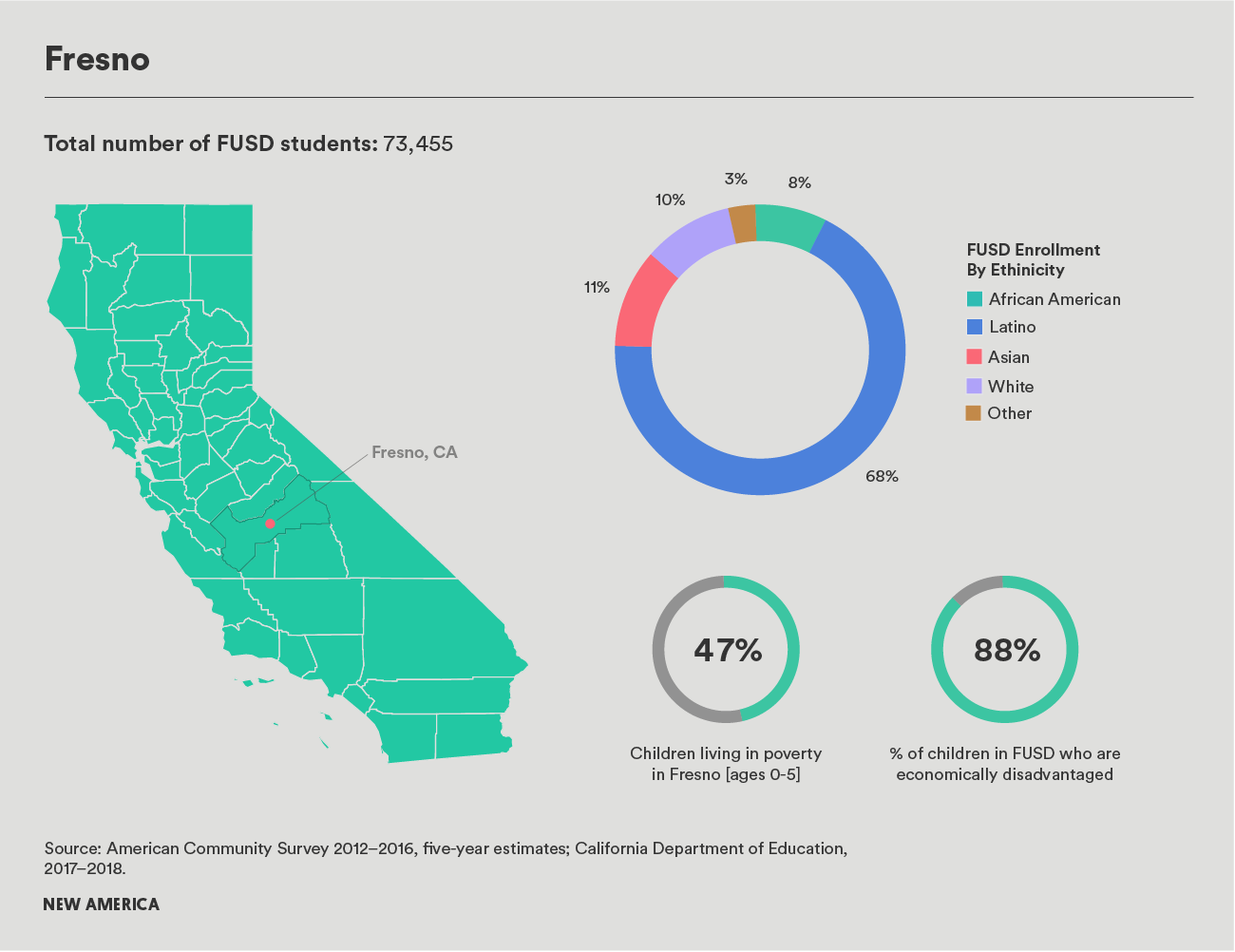
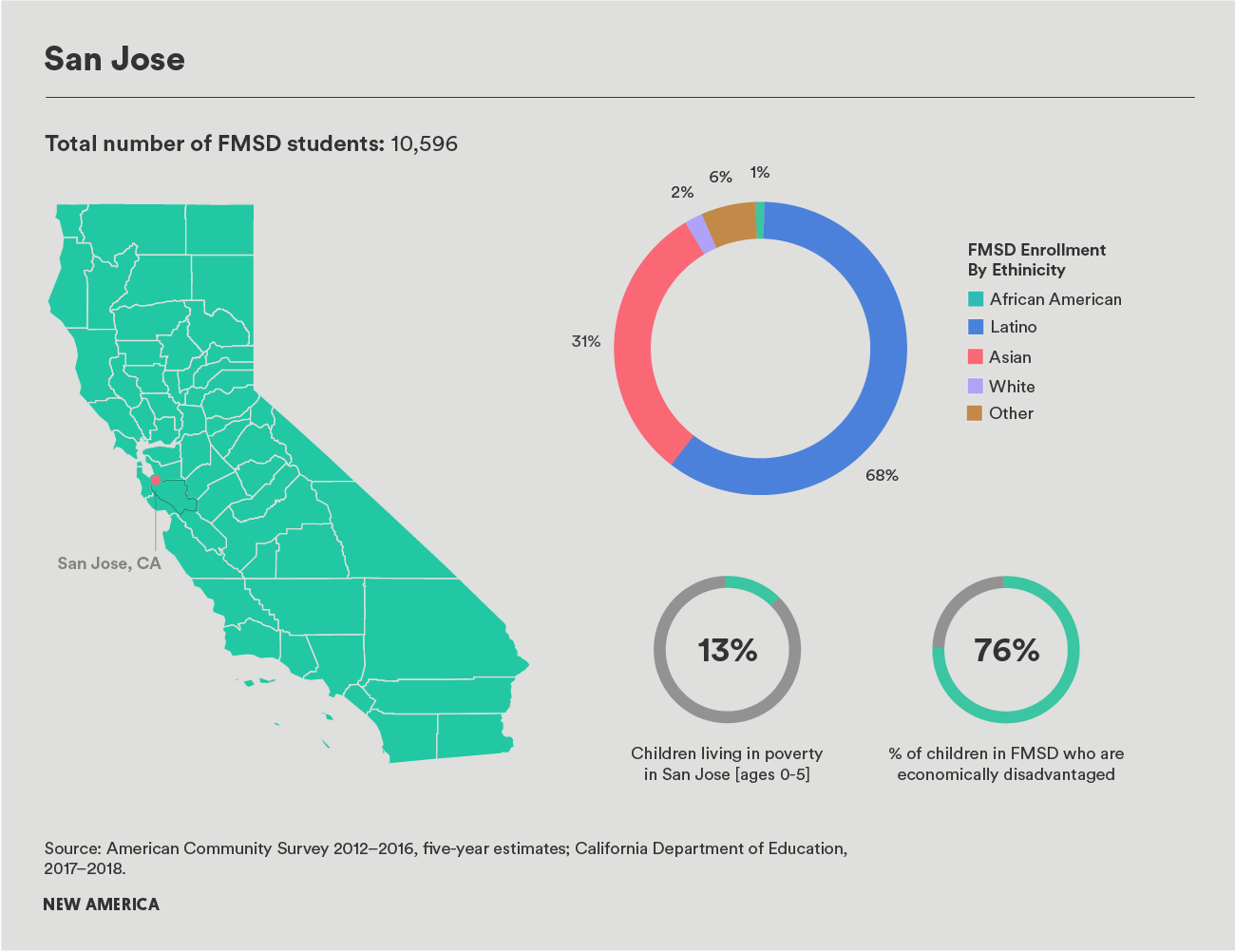
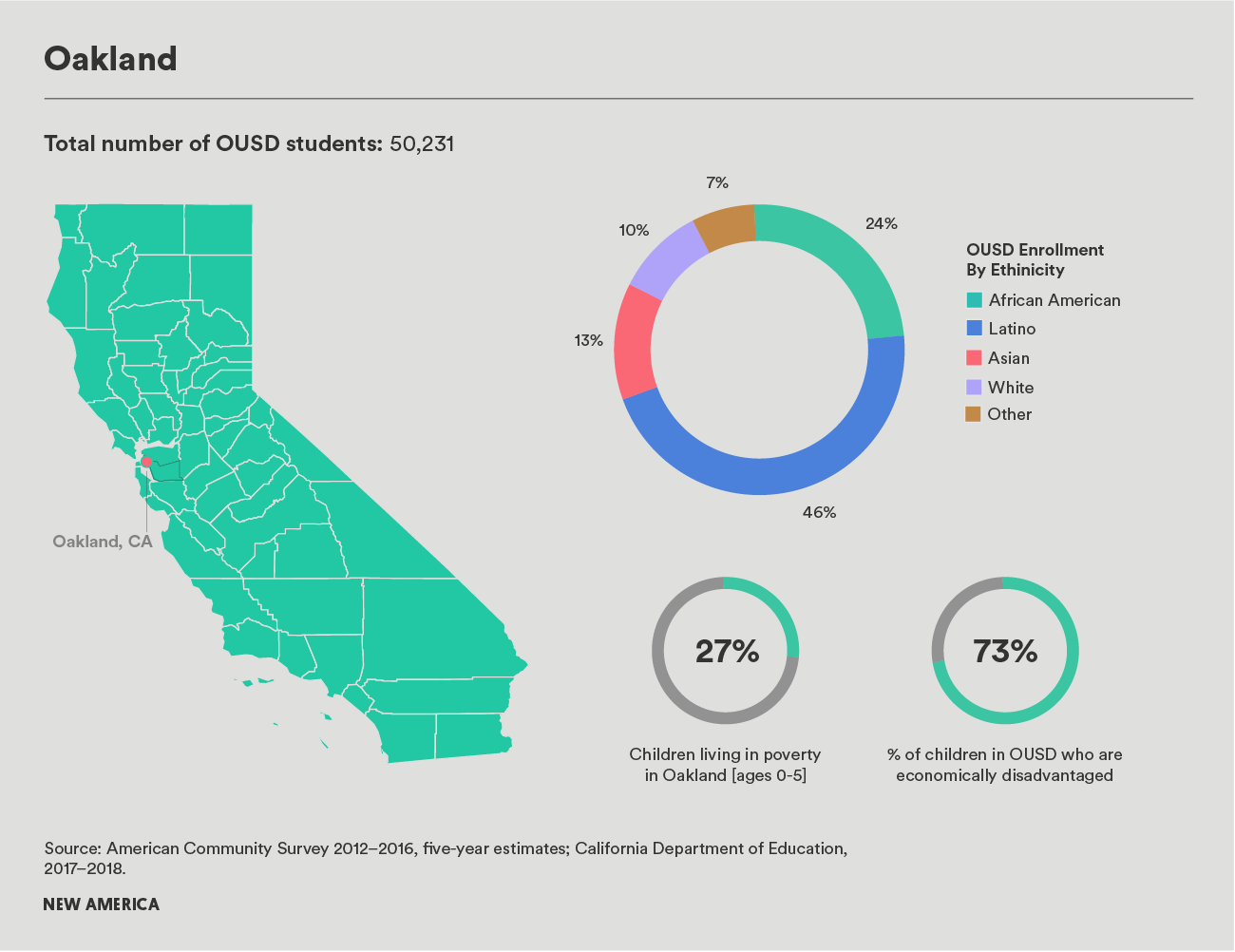
Starting Smart and Strong is a 10-year effort that aims to ensure all children grow up healthy and ready for kindergarten by improving the quality of adult-child interactions across all settings where young children learn and grow. (See Box 2 for more on adult-child interactions.) The Packard Foundation awarded grants of $500,000 each year for the past three years to the Franklin-McKinley School District (FMSD) in San Jose, the Fresno Unified School District (FUSD), and the Oakland Public Education Fund. The support has helped pay for professional development and training for early childhood educators, support for informal care providers (family, friends, and neighbors who are not licensed), developmental screenings, and collaborations between public and private systems to support young children, as well as planning and technical assistance. These three communities have blended this support with school district dollars, as well as with additional public and philanthropic funding streams.
In the state鈥檚 Central Valley, national attention Fresno received for its high poverty rates helped galvanize leaders to better align their systems to support children birth through age eight. In Silicon Valley, San Jose鈥檚 new Educare is building a 鈥渢eaching hospital model鈥� as a laboratory for educators of all types who care for young children. In the Bay Area, leaders in Oakland have begun a 10-year equity strategy that aims to create universal access to high-quality early learning experiences from birth for the city鈥檚 diverse population.
This report, based on three and a half years of reporting and interviews with 80 people across the three communities, provides a look at the capacity of these communities to engage families, improve teacher practice, collect and use data, and build cultures that support early learning. We also examine challenges they face in implementing these reforms and changing teacher practice. The central challenge all three face is how to scale up reforms so they make a real difference for all the children of these communities and eventually for California as a whole. Leaders say that the impact will come not just when they see good things happening for some children, but when this work results in community-wide improvement on key indicators of child well-being.
Box 1
Funding Stronger Teaching and Caregiving for California鈥檚 Youngest
Funding for Starting Smart and Strong comes from the David and Lucile Packard Foundation, which provides $500,000 a year to each community to support professional development and training, early learning department administrative positions, outreach to informal caregivers, and some additional work that varies from district to district. Support is also provided to school districts for technical assistance, evaluation, administration of the Early Development Instrument, and partnerships with groups like the New Teacher Center. After 10 years, foundation support will end, which means communities and school districts need to think about how to sustain the work into the future. Each school district has made financial contributions and has also sought out other philanthropic, community, and government support. In Fresno, partnerships with the housing authority and the Central Valley Children鈥檚 Services Network enabled outreach to families living nearby. Oakland has received additional money from the Hellman Foundation to help young boys of color. In San Jose, Franklin-McKinley School District's contributions to fund full-time early learning positions are increasing in small increments each year.
Aiming for Quality in Early Learning: Fresno, Oakland, and San Jose7
Box 2
Adult-Child Interactions
Decades of research have shown that interactions with adults, from birth, provide a crucial foundation for learning as children grow.8 In their book, Powerful Interactions: How to Connect with Children to Extend Their Learning, Amy Laura Dombro, Judy Jablon, and Charlotte Stetson describe a conversation that took place between a caregiver and infant:
Robert asks 6-month-old Baili, 鈥渁re you ready for me to pick you up so we can change that wet diaper?鈥� He waits for her to look at him and hold out her arms before reaching down. From this conversation, Baili learns about the give and take of communicating with another person. She also learns she can get her 鈥淚鈥檓 ready now鈥� message across, and that Robert listens to her.9
As the developmental psychologist Lev Vygotsky wrote, relationships affect all aspects of a child鈥檚 development: intellectual, social, emotional, physical, behavioral, and moral.10
Yet few children experience high-quality interactions with all the adults in their lives on a regular basis.11 The quality of experiences in infant-toddler settings鈥攃hild care centers, pre-K programs, early elementary classrooms鈥攊s often mixed, at best.12 One study of preschool programs in California found that most did not meet quality indicators linked to long-term school success.13
The communities profiled in this paper are hoping to change that. The Oakland Starting Smart and Strong initiative puts it this way: they want to make sure that all adults in a child鈥檚 life鈥攚hether formal educators like preschool teachers or informal caregivers like family members鈥攈ave the tools they need to support that child鈥檚 development every day through high-quality adult-child interactions.
For example, consider this interaction: 鈥淭eacher, look at my block tower!鈥� a four-year-old shouts across a busy classroom. The lead teacher at an Educare Center does not scold him for yelling. Instead, she goes over, kneels down next to him, and asks, 鈥渢ell me about what you made,鈥� making eye contact with the child. 鈥淚 see one, two, three blocks,鈥� she says, counting her way up the tower. 鈥淵ou figured out how to stack them; that was hard to do.鈥� The boy is proud. Through this interaction he learns that his ideas are good, that his effort is valued, and that there is every reason to love coming to school.
As Dombro and colleagues point out, purposeful exchanges like this one, which build on the existing trust between adult and child, can have a powerful effect on learning.
Citations
- Sarah Jackson, Not Golden Yet: Building a Stronger Workforce for Young Children in California (Washington, DC: 麻豆果冻传媒, September 2015), source.
- Hanna Melnick, Beth Meloy, Madelyn Gardner, Marjorie Wechsler, and Anna Maier, Building an Early Learning System That Works Next Steps for California (Washington, DC: Learning Policy Institute, January 2018), .
- The Kindergarten Readiness Act established a new grade level in public schools across the state鈥攖ransitional kindergarten (TK) for four-year-olds with fall birthdays. By changing the birthday cut-off from December to September for entering kindergarteners, the law addressed a long-held concern that children were entering kindergarten as four-year-olds unprepared to handle the increasingly academic curriculum. California had always had one of the youngest kindergarten entry dates in the nation. At the same time, it also had one of the most academically rigorous kindergarten curricula in the country, similar to today鈥檚 Common Core.
- Jonathan Kaplan, 鈥淐alifornia鈥檚 Support for K鈥�12 Education Is Improving, but Still Lags the Nation,鈥� California Budget & Policy Center fact sheet, January 2017, .
- Children Now (website), 鈥淪chool Funding & Equity: LCFF,鈥�.
- On June 5th a number of California counties voted on ballot measures looking to direct additional resources to early care and education. Results were still unofficial at press time, according to Early Edge, a statewide policy organization, as counties were still counting provisional ballots. These unofficial results show that a measure in Alameda County to expand access to and quality of child care and preschool for low-income families and to support the workforce will not pass. A similar measure in San Francisco also did not get the needed majority but is likely to be challenged in court. Preliminary results show that measures in Contra Costa and Yola Counties will pass. Additional ballot measures in other places around the state are being planned for November.
- Data gathered from American Community Survey 2012鈥�2016, five-year estimates; California Department of Education, 2017鈥�2018.
- For more information see Jack P. Shonkoff and Deborah A. Phillips, eds., Neurons to Neighborhoods: The Science of Early Childhood Development (Washington, DC: National Academy Press, 2000); publications from the Center for the Advanced Study of Teaching and Learning at University of Virginia; and publications from the National Association for the Education of Young Children.
- Amy Laura Dombro, Judy R. Jablon, and Charlotte Stetson, Powerful Interactions: How to Connect with Children to Extend Their Learning (Portsmouth, NH: Stenhouse Publishers, 2011).
- L. S. Vygotsky and Robert W. Rieber, The Collected Works of L. S. Vygotsky: Volume 1: Problems of General Psychology, Including the Volume Thinking and Speech (Springer Science & Media, 1987).
- Karen M. LaParo, Bridget K. Hamre, J. Locasale-Crouch, Robert C. Pianta et al., 鈥淨uality in Kindergarten Classrooms: Observational Evidence for the Need to Increase Children鈥檚 Learning Opportunities in Early Education Classrooms,鈥� Early Education and Development 20 (2009): 657鈥�692; Andrew Mashburn, Robert C. Pianta, Bridget K. Hamre, Jason T. Downer, Oscar Barbarin, Donna Bryant, Margaret Burchinal, Richard Clifford, Diane Early, and Carolee Howes, 鈥淢easures of Classroom Quality in Pre-Kindergarten and Children鈥檚 Development of Academic, Language and Social Skills,鈥� Child Development 79 (2008): 732鈥�749.
- Sarah Jackson, Not Golden Yet: Building a Stronger Workforce for Young Children in California (Washington, DC: 麻豆果冻传媒, September 2015), source; Karen M. La Paro, Bridget K. Hamre, Jennifer Locasale-Crouch, Robert C. Pianta, Donna Bryant, Dianne Early, Richard Clifford, Oscar Barbarin, Carollee Howes, and Margaret Burchinal, 鈥淨uality in Kindergarten Classrooms: Observational Evidence for the Need to Increase Children鈥檚 Learning Opportunities in Early Education Classrooms,鈥� Early Education & Development 20, no. 4 (2009): 657鈥�92; Andrew J. Mashburn, Robert C. Pianta, Bridget K. Hamre, Jason T. Downer, Oscar A. Barbarin, Donna Bryant, Margaret Burchinal, Diane M. Early, and Carollee Howes, 鈥淢easures of Classroom Quality in Prekindergarten and Children鈥檚 Development of Academic, Language, and Social Skills,鈥� Child Development 79, no. 3 (2008): 732鈥�49.
- Lynn A. Karoly, Preschool Adequacy and Efficiency in California: Issues, Policy Options, and Recommendations (Santa Monica, CA: RAND Corporation, 2009), .