Size: More Money Than Ever Before
Several interviewees, when asked about the key differences between their experience with ESSER funding and general school funding, pointed to the sheer size of the allocation. In total, the three COVID relief bills included $189.5 billion for ESSER: $13.2 billion in the Coronavirus Aid, Relief, and Economic Security (CARES) Act, $54.3 billion in the Coronavirus Response and Relief Supplemental Appropriations (CRRSA) Act, and $122 billion in the American Rescue Plan (ARP) Act, all signed into law within a 12-month period.1
Whether this is truly a lot of money is a matter of perspective. As some observers have noted, it amounts to approximately 6 percent more (about $856) per pupil for annual spending on average over the course of the four-and-a-half-year grant cycle鈥攏ot necessarily a game-changing increase.2 Still, interviewees comparing it to standard federal distributions had good reason to think of it as a very large amount of money to administer and spend. In 2019, the last year untouched by COVID aid, the entire federal government contribution to K鈥�12 school district funding was $57.9 billion, less than a third of the ESSER total and only 37 percent more than a one-year share of the ESSER dollars.3 The largest single federal funding category is Title I funding, which in 2019 was $14.07 billion.4 Four and a half years of funding at that level would be $63.3 billion, and ESSER is almost exactly triple that. The largest share of the relief dollars came last鈥擡SSER III comprised $122 billion out of the $189.5 billion total鈥攁nd was made available for use all at once, starting with the 2022 budget year (Figure 1).5
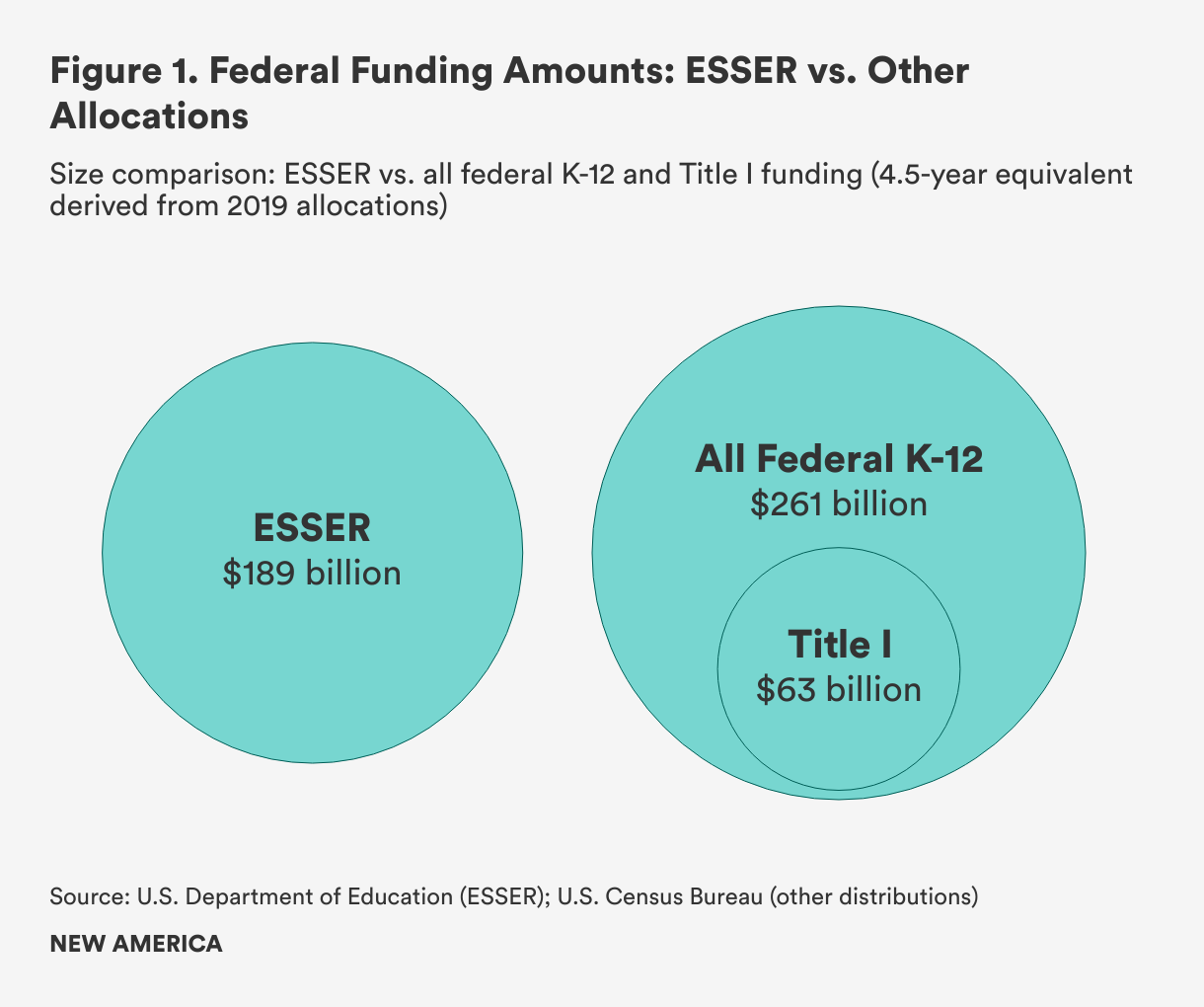
This large infusion of funds demonstrates policymakers鈥� recognition of the scale and urgency of the problem. The size of districts鈥� ESSER allocations also affected district officials鈥� experiences of spending, including their navigation of spending timelines, their usage choices, and their administration of the money.
An Unusually Large Amount, On a Deadline
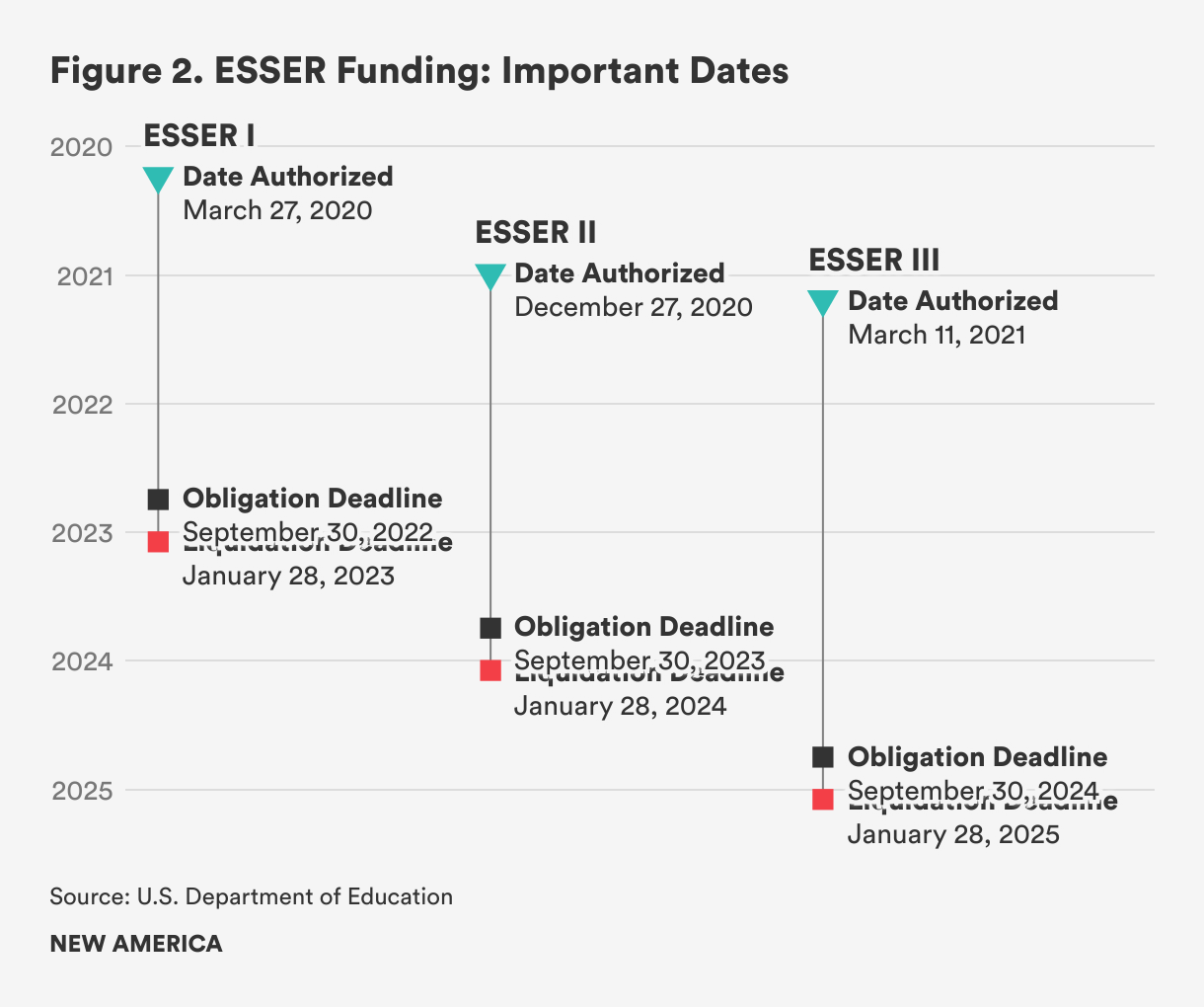
Broadly, districts were given 4.5 years to spend ESSER funding, though the different allocations came with different deadlines. Obligation deadlines for the first two tranches of funding have passed.6 (鈥淥bligation鈥� occurs when the district has a binding commitment to spend the money; this can occur when services are received, as when an employee works and is entitled to pay, or when a contract is made that will require payments in the future.)7 The largest portion, ESSER III, must be obligated by September 30, 2024 and fully spent 120 days later (Figure 2).8 The relatively short spending timeline reflected Congress鈥� urgency about addressing an immediate problem.
Some interviewees, especially those who received smaller allocations, felt they had enough time to make good use of the funds. Matthew Lentz is chief financial officer and board secretary of Upper Moreland School District in Pennsylvania, which enrolls just over 3,000 students and received a total of $3.7 million in ESSER funds. He explained that in the early part of the pandemic, outlays were unpredictable as the district dealt with sudden safety and technology expenses, as well as increases in staff costs as new employees were needed to cover for others鈥� paid medical leaves. Given all that, he said, it was beneficial to have aid that came quickly but didn鈥檛 come with immediate spending mandates. 鈥淚 think because it rolled out and there were laddered deadlines鈥� for the different ESSER allocations, he said, 鈥渢hat really helped you to incorporate it in your budget cycle. And we really made it a point to identify, year to year, what we were spending.鈥� For Upper Moreland, Lentz said, four and a half years was a reasonable timeline, allowing the district to plan and spend intentionally.
Other interviewees, though, felt that the timelines for spending the funds weren鈥檛 appropriate for such a large grant. Districts were repeatedly warned about the 鈥渇iscal cliff,鈥� the time at which the ESSER money would be gone and district budgets would drop precipitously. To avoid running short of operational dollars after the relief dollars run out, districts have been advised by many experts to direct these funds to one-time expenditures rather than recurring costs.9 But Hannah Barrick, executive director of the Pennsylvania Association of School Business Officials, represented the views of several respondents when she said, 鈥淲hile [it was] fantastic that schools had these resources to be able to get through COVID and then try to recover鈥� those big Title I districts got so much money in such a short amount of time. [It鈥檚] really hard to spend hundreds of millions of dollars on one-time expenditures within that window.鈥� One of her chief takeaways from the ESSER period was that spending timelines should match the size of the allocation. Spending well and responsibly in the time frame provided, she said, 鈥減robably made this already really chaotic period of COVID and post-COVID a lot more challenging than it needed to be鈥� and just a lot of chaos in terms of how to spend dollars well in the best interest of students.鈥� This difficulty affected districts鈥� choices about how to use the funds, as discussed in the next subsection.
Deadlines are a particular issue in the realm of efforts to address learning loss. As recent testing data and research indicate, the impact of disrupted schooling on students鈥� academic growth is ongoing and seems likely to outlast the final ESSER spending deadline.10 Recovery efforts, then, will still be part of COVID response whether they are charged to ESSER or not. As Barrick said, if spending deadlines had been extended another two or three years, 鈥測ou could have been more effective in being able to sustain some of the learning loss or other remediation programs. Schools could have been a little bit more confident in being able to do that without the fiscal cliff right on the horizon.鈥�
Districts鈥� experiences with trying to spend down their ESSER amounts in the allotted time point to two potential improvements to future funding distributions: Spending deadlines should be set such that there is more time to spend larger allocations, and deadlines could also be matched to particular purposes, such that funding put towards high-priority initiatives that are inherently longer-term are assigned longer spending timelines.
Big Amounts and Big Spending Choices
The interaction of the large size of the allocation with the limited timeline for spending also affected districts鈥� choices of how to use the money.
In cases where districts received larger allocations, it was often tempting to spend on items that were on the long-term wish list, even if they were not related to the current crisis. Sometimes, though, long-standing needs were also connected to pandemic problems. One lead finance official for a large, East Coast urban district said it was sometimes hard to parse what was an 鈥渋mmediate and emergent need鈥� rather than a long-deferred investment. For instance, 20 percent of ESSER III funds had to be spent on evidence-based efforts to accelerate learning, but academic opportunity and learning gaps had long preceded the pandemic. He explained, 鈥淵ou have a ton of money right now to spend. You must earmark a certain percentage of it. How are you directing things鈥f you consider the opportunity gap something that existed and was exacerbated by the pandemic? So, it鈥檚 emergent versus things we really want to get done with it. And I think that shift was always present in our planning.鈥� Air filters and outdoor classrooms were clearly new needs (even though aging HVAC systems and poor air quality were long-standing problems in many older school buildings). Initiatives like improving district literacy instruction and training educators in social-emotional learning strategies, though, were meant to address issues that both preexisted the pandemic and were worsened by it.
When it came to spending a large amount within the allotted time, districts often found that the advice to avoid using the money for recurring costs like staff salaries was hard to apply in practice. One large district received about $250 million in ESSER dollars. Its lead budget official said that once the district allocated funding for environmental health and safety, their core needs were operational: 鈥淵ou have this fiscal cliff coming up鈥� but everybody wants to put expenses into their specific area. And they want to hire more people, because education is a people business. Eighty percent of our annual spend is salaries and benefits, and then probably a good majority of the rest of our spend is on outside contractors basically providing services and labor.鈥�
The official cited this challenge as frustrating from a financial management perspective, but ultimately, the size of the distribution was a main reason that many districts felt they had to use the money to hire and pay employees. Education is indeed a 鈥減eople business.鈥� Practically all worthwhile initiatives require instructional or support staff. While smaller amounts were spent on goods like personal protective equipment, technology, and curricular materials, it likely would have triggered accusations of wasteful spending to use all the relief money for things that could be bought without any hiring. (This is not unique to ESSER dollars; the large majority of Title I funding is also spent on staff.11) Faced with questions about how to spend well, many districts chose to focus on the hiring that they felt would make the greatest difference and accepted the fiscal-cliff challenges as the lesser problem.
Superintendent Travis Reeves of Surry County Public Schools in North Carolina said, 鈥淭here鈥檚 two things I noticed real quick that our kids, our students, needed, and that was more academic time, with more adults. Because they had been home, there was a lack of structure, a lack of rigor, and we really had to focus on getting our kids back in our schools full time. And then we had to focus on [using] our funds for personnel.鈥� His district generally operates on a lean budget, without a large staff. Reeves knew that wouldn鈥檛 work for the recovery period. 鈥淲e used the majority of the funds to fund people, to reduce class size, to hire [teacher assistant] interventionists,鈥� he said. 鈥淲e just knew kids needed more time with more people. That鈥檚 been the basis of the way we spent the money. And now, going into year three [of ESSER spending]鈥攁nd we knew this鈥攚e couldn鈥檛 sustain funding. We knew these were temporary, and we made good use of the positions while we had them, and we are now beginning to get back to pre-COVID [staff] numbers, just because we have to, out of necessity.鈥�
Experts worried about the fiscal cliff may have advised making only non-recurring outlays for COVID-exclusive needs, but districts faced a more complex reality. In many cases, best use of the money required spending on new hires or long-standing but deferred priorities. Students didn鈥檛 experience COVID in a vacuum; they entered the pandemic at different academic starting points, in differently equipped districts and communities. Districts鈥� responses to the crisis had to take local circumstances into account, and that often meant using the funds to address long-standing needs or, in districts without high pre-pandemic staff-to-student ratios, staffing up to address new problems.
A Lot of Money to Manage
A specific challenge cited by multiple interviewees was administering the money effectively when little was spent to increase the number of finance and grants management staff at the district level.
This problem was less present at the state level. The American Rescue Plan Act specified that state education agencies (SEAs) could use up to 0.5 percent of their ESSER money for administrative costs. In a way, this explicit permission was a corrective to a shortcoming in the American Recovery and Reinvestment Act (ARRA) of 2009. When the Center for Education Policy looked back on the education stabilization funds provided through that bill, it noted that 鈥渢he funding benefits of ARRA appear, to a large extent, to have bypassed state education agencies, which play a crucial role in implementing the ARRA and state reform agendas. Many SEAs report having experienced funding cuts and staffing reductions over the past few years, which have affected their capacity to improve K鈥�12 education.鈥�12 With ESSER, specific allowances were made for state administrative needs.
There was no such explicit amount permitted for administration at the district level, and districts often didn鈥檛 choose invest in additional finance capacity. This took a toll. One lead finance official for a large, East Coast urban district reports that a while a couple of people on his team were focused on ESSER, there was a fiscal-cliff concern related to adding grant administration staff, in the same way that school leaders worried about adding instructional staff for whom funding would disappear at the end of the grant timeline. As a result, the official said, some finance team members saw their workload double as they tried to master new rules and process such large amounts of money without more support.
Miriam Rubin, former budget director of Boston Public Schools, said there was a clear need for more finance staff to handle her district鈥檚 $430 million ESSER allocation. ESSER III carried a requirement to do 鈥渕eaningful consultation鈥� with stakeholders when crafting a plan for the money.13 Boston undertook a community engagement process, which Rubin said that the central office team initially lacked the infrastructure to support.
More generally, she recalled the stresses of that time. 鈥淲e were just killing ourselves to move things forward quickly, and we knew what was at stake,鈥� Rubin said. 鈥淲e got this huge influx of money outside our normal budgeting process. At the same time, we were all dealing with our own COVID issues鈥eople were sick, many of us didn鈥檛 have child care and were managing online schooling, so we were already operating significantly under our normal capacity.鈥� Schools needed assistance urgently, and that translated into pressure on an overburdened team. 鈥淚f people want masks, they want masks tomorrow, and that push, over and over again, gets to people,鈥� she said. 鈥淎t the end of the day, we were public servants and stuck it out for as long as we needed to, but after things calmed down, many of us were burnt out and there was a lot of turnover on the team, including myself and other senior people.鈥� If administrative teams like Rubin鈥檚 had been given the staff capacity needed to process things faster, the aid would likely have been deployed more efficiently, with less of a long-term impact on staff members.
It is probably not a coincidence that out of all of our interviewees, the ones who found the ESSER experience most challenging were finance officials in large districts with especially big funding allocations. Still, small and mid-sized districts also struggled with the administrative stresses. Travis Reeves of Surry County Schools in North Carolina said, 鈥淲e had 100 percent turnover in the finance department,鈥� including resignations and retirements. One senior person even took a lower-level position in another county to relieve the pressure. The district did add one finance position, though. 鈥淲e were threatened that we were going to be audited, and we didn鈥檛 want to be the example鈥so] we hired an additional person just to track the funds,鈥� Reeves said.
It鈥檚 important to acknowledge that there was no rule against school districts using money for administration. Clearly, many would have benefited from doing so, or doing so to a greater extent. However, it is rarely politically popular to put money towards 鈥渙verhead costs,鈥� even if finance office capacity is needed to facilitatebetter, faster uses of funds for the benefit of students. It would have been helpful for the federal government to explicitly allow a set proportion of district ESSER dollars to be used for this purpose, much as it did for state education agencies. Such permission would have provided political cover to local education agencies and pointed towards administration as an important aspect of ESSER plan implementation.

Citations
- Office of Elementary & Secondary Education (website), 鈥淓lementary and Secondary School Emergency Relief Fund,鈥� last modified September 12, 2023, .
- 鈥淒ollars to Dashboards: A Winning Strategy for ESSER Transparency,鈥� Allovue, n.d., .
- United States Census Bureau, 2019 Public Elementary-Secondary Education Finance Data: Summary Tables (October 2021), distributed by the United States Census Bureau, .
- U.S. Census Bureau, 2019 Public Elementary-Secondary Education Finance Data.
- 鈥淒ollars to Dashboards: A Winning Strategy for ESSER Transparency,鈥� Allovue, n.d., .
- Office of Elementary & Secondary Education (website), 鈥淒eadlines and Announcements,鈥� last modified October 4, 2023, .
- Code of Federal Regulations (website), 鈥溌� 76.707 When obligations are made,鈥� title 34, subtitle A, last amended October 10, 2023, .
- Frequently Asked Questions: Elementary and Secondary School Emergency Relief Programs; Governor鈥檚 Emergency Education Relief Programs (Washington, DC: U.S. Department of Education, May 2021),聽Question E-2, . Per a letter issued on September 18, 2023, the Department may approve select districts for spending extensions, but no delays to the obligation deadline will be granted. This may allow districts to extend certain projects covered by already-obligated funds, such as capital construction occurring under existing contracts, but will not allow districts to continue paying employees with ESSER funds beyond the legislated deadline. Deputy Assistant Secretary Adam Schott, Washington, DC, ARP Liquidation Extension Request Letter, September 18, 2023, .
- See, for example, 鈥淪teering Clear of the Fiscal Cliff,鈥� The Bottom Line (blog), Allovue, ; Marguerite Roza, 鈥淭here鈥檚 a Fiscal Cliff Coming, and Some Districts Appear Hell-Bent on Making It Worse,鈥� Flypaper (blog), Thomas B. Fordham Institute, September 23, 2021, ; and Beverly Bunch, 鈥淩esponsible Budgeting in the Stimulus Age,鈥� PowerPoint, National Conference of State Legislatures, July 31, 2022, .
- See, for example, Matt Barnum, 鈥淣AEP Scores Show Big Drop in Wake of COVID,鈥� Chalkbeat, August 30, 2023, ; Thomas Kane, 鈥淜ids鈥� Learning Losses Are Worse than Educators Are Acknowledging,鈥� The Atlantic, May 22, 2022, ; and Sarah Schwartz, 鈥淲hat Two New Studies Reveal about Learning Recovery,鈥� Education Week, August 11, 2023, .
- Kerstin Carlson Le Floch, Jesse Levin, Drew Atchison, Courtney Tanenbaum, Steven Hurlburt, Karen Manship, and Stephanie Stullich,聽Study of Title I Schoolwide and Targeted Assistance Programs: Final Report (Washington, DC: U.S. Department of Education, 2018), 14, .
- Rentner and Usher,聽What Impact Did Education Stimulus Funds Have on States and School Districts? 2.
- Secretary Miguel Cardona, 鈥淎merican Rescue Plan Act Elementary and Secondary School Emergency Relief Fund: Interim Final Requirements,鈥� Federal Register 86, no. 76 (April 22, 2021): 21195, .