Zahava Stadler
Director, Education Funding Equity Initiative

On May 23, the U.S. Supreme Court decided , a case challenging South Carolina鈥檚 map of congressional districts. A six-justice conservative majority used the case to sharply limit the circumstances in which federal courts can order new legislative maps to address racial gerrymandering. Justice Clarence Thomas went further than his colleagues, though, writing a separate, concurring opinion that took a startling position: judges should stay out of redistricting entirely. He argued that courts should have no power to draw political boundaries, even to remedy constitutional violations鈥攁nd claimed the Supreme Court鈥檚 activity in this area dated back only to the 1950s, originally in connection not with voting rights, but school desegregation. He referenced a that in some cases, to integrate public schools, courts may require changes to school district boundaries.

Justice Thomas is right to see a link between school and legislative redistricting, even if he draws the wrong conclusion about whether the courts should be involved. Just like legislative districts, the boundaries of school districts do a huge amount to determine social and democratic equality in America. And just like legislative districts, the boundaries of school districts should be intentionally drawn to produce better, fairer public systems.
School district boundaries do two things. First, they define the area in which a particular set of children can go to a specific group of schools. And second, they outline the local taxing jurisdiction that supports those schools. Together, these two functions mean that a district鈥檚 boundary does a great deal to determine whether its students will have a diverse or segregated school system, and whether its schools will have access to the funding that students need to learn and thrive. Integrated and fairly resourced school systems are the foundation of a society where people of all races can live and work together and succeed on equal terms. But far too often, as our research has shown, district lines are drawn to separate students both from resources and from each other. In many cases, districts could be redrawn to include racially and economically mixed communities, though this happens all too rarely.
Legislative redistricting gets more public attention than school redistricting, perhaps because it happens relatively often. Voting districts get redrawn after each decennial census to account for changes in population. That means two things. First, there is a regularly scheduled adjustment meant to keep things fair. And second, there are regular openings for manipulation that can make things unfair, most often through . People tend to see clearly why this is dangerous鈥攈ow it can distort our democracy to give some groups disproportionately more or less weight in elections.
, the U.S. Supreme Court agreed that gerrymandering can violate the Constitution鈥檚 guarantee of equal protection. Over the next few decades, the Court the issue of voting district maps, refining the rules for ensuring fair and equal representation of the public by population size, race, and party affiliation. In the last few years, however, the Court鈥檚 rulings have taken a turn in the other direction. A held that partisan gerrymandering鈥攄rawing districts to disproportionately advantage one political party over the other鈥攚asn鈥檛 a violation that courts could address. The new ruling in Alexander represents another big step back. While it formally keeps the standard that racial gerrymanders are a constitutional problem, it significantly raises the bar for evidence of racial targeting, making them through the courts.
The Supreme Court鈥檚 approach to school redistricting for desegregation has followed a similar advance-and-retreat course. After finding in 1954 in that segregated public schools violated the U.S. Constitution, the Court returned to the case in , outlining ways in which courts might enforce desegregation rulings. These included 鈥渞evision of school districts鈥� to achieve a system of determining admission to the public schools on a nonracial basis鈥濃�攊n other words, redrawing school district boundaries so that they would no longer sort students into segregated schools. (This is the line that drew Justice Thomas鈥檚 ire.) Over the next twenty years, the justices school segregation cases, tightening enforcement of desegregation orders and refining oversight mechanisms. In 1972, the Court returned to the specific topic of school district boundaries. In decided on the same day, the Court ruled that states could not draw new, largely single-race 鈥渟plinter districts鈥� if those new districts would interfere with the desegregation of the district left behind.

Soon after, though, the Court began backpedaling. In 1974, the justices decided , a case about segregation in Detroit. White flight to suburban districts had left Detroit without enough diversity to desegregate the schools within its borders. The District Court had not seen this as an insurmountable problem. The students of Detroit were constitutionally entitled to public education in desegregated schools. The state of Michigan was required to provide that education, and could not offload that responsibility to local jurisdictions. 鈥淪chool district lines,鈥� the District Court explained, 鈥渁re simply matters of political convenience, and may not be used to deny constitutional rights." It ordered a desegregation plan that spanned the metropolitan area. But the Supreme Court disagreed. Showing a newfound deference to school districts as their own independent jurisdictions, the high court asserted (without strong historical evidence) that 鈥渘o single tradition in public education is more deeply rooted than local control鈥� and severely limited when desegregation plans could require changes to district boundaries. This heavy regard for localism has continued to be a feature of the justices鈥� thinking. , the Supreme Court even criticized a lower-court desegregation plan for including magnet schools that were meant to encourage voluntary movement of students across district lines鈥攁 far cry from the high court鈥檚 鈥渨hatever it takes鈥� attitude in Brown II.
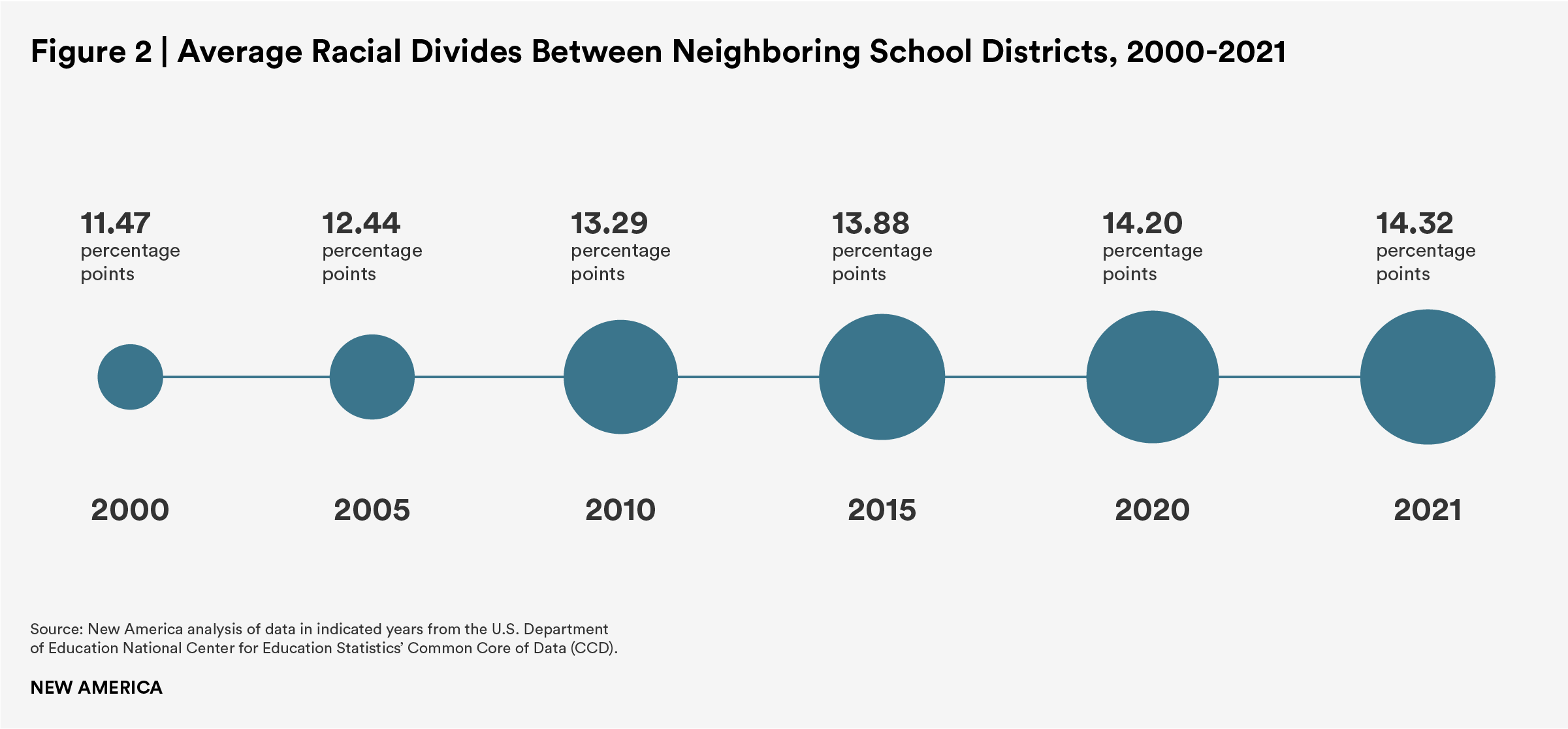
Voting rights advocates have been rightfully frustrated with the Supreme Court鈥檚 retreat from actively requiring fair legislative maps. But school districts are just as fundamental as legislative districts to the building of an equal society, and we should be just as bothered by the Court鈥檚 reluctance to order redistricting to ensure equitable and integrated schooling. As judicial oversight has waned in recent decades, schools have become . District boundaries have actually become more segregative, on average, since the beginning of the 21st century, marking a greater racial divide in 2021 than in 2000.
It doesn鈥檛 have to be that way. School district boundaries can and should be drawn intentionally to define school systems that are neither separate nor unequal鈥搕he essence of the opportunity promised to all students by a unanimous Court in Brown. Just as our voting districts should be drawn to give every voter an equal voice in our democracy, our school districts should be drawn to give every student an equal chance at success.
Director, Education Funding Equity Initiative