A Chapter of: Decision-Making in the Counter-ISIS War
What Drove the War's Snapback in Iraq and Syria?
Despite its support for the withdrawal from Iraq, the Obama administration returned American military forces to Iraq to wage war on ISIS and then extended the war into Syria. Initially the administration did not want to intervene. At the beginning of the counter-ISIS war, the administration relied more strongly on regional security, extraterritorial protection of Americans, and humanitarian war rationales than preventive war logic. When the administration escalated the war into Syria, it cited preventive war logic more extensively than it did before.
Understanding the Decision Timeline
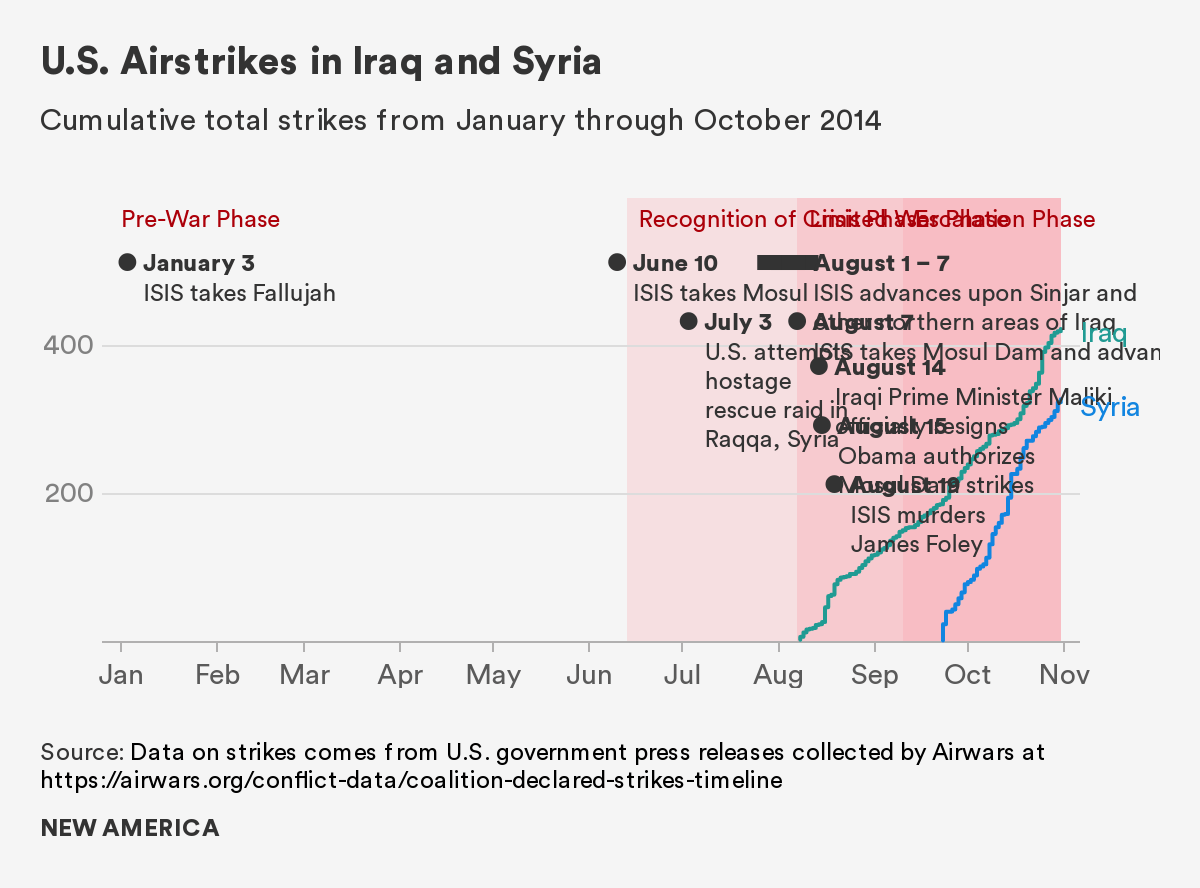
This report divides the war’s decision-making process into four phases divided by moments when Obama made major announcements regarding changes in the administration’s approach based on a review of the 28 official statements on the issue that Obama made from January 2014 through the end of September 2014.
Those phases are:
1) Pre-War (January 2014 – June 12, 2014): The Pre-War phase marks the period before the Obama administration began to consider military intervention against ISIS. During this phase, there are no official presidential statements directly addressing the threat from ISIS or raising the prospect of military action against the group. When Obama gave his counterterrorism policy address at West Point on May 28, 2014, he made no mention of ISIS and referenced the withdrawal of American troops from Iraq as a triumph of his presidency.1 In addition, during this phase, the United States had not started conducting military action as part of a war against ISIS.2
2) Recognition of Crisis (June 13, 2014 – August 6, 2014): Obama gave his first major remarks directly addressing ISIS and raising the prospect of potential U.S. military action on June 13, 2014.3 This speech ended the Pre-War phase and inaugurated the Recognition of Crisis phase during which the administration began to actively consider war. The Recognition of Crisis phase was in large part sparked by ISIS taking of Mosul, Iraq’s second largest city, on June 10, 2014.4 Deputy National Security Advisor Ben Rhodes described the period after Mosul’s fall as a time when “it was becoming apparent, that we would have to intervene again in Iraq.”5 Then Assistant Secretary of Defense for International Security Affairs Derek Chollet writes, “The sense of urgency changed after Mosul […] Obama decided it was time for the U.S. to get more involved directly.”6 On June 19, Obama gave a second statement in which he announced an increase in surveillance assets and a willingness to send 300 additional advisors to Iraq to support Iraqi forces.7 Throughout July, the United States would continue to consider and prepare for potential military options without initiating military action.8 The one known exception is that on July 3, the United States attempted a rescue of Americans held hostage by ISIS in Raqqa, Syria.9
3) Limited War (August 7, 2014 – September 9, 2014): On August 7, the Recognition of Crisis phase with its lack10 of military action gave way to a new phase: Limited War. Obama announced that he had authorized two military operations in Iraq; strikes to protect American personnel and strikes to break ISIS's siege of and genocidal threat to civilians trapped on Mt. Sinjar.11 The decision to initiate the operations was reportedly still being debated that day.12 Ben Rhodes describes August 7 as a “tipping point.”13 The first American strikes in Iraq began on August 8 near Erbil, the main site where American personnel were under threat.14
The authorized operations were limited in scope and duration.15 According to Chris Woods, the director of Airwars and a longtime monitor of American airstrikes, “The government was very precise in its press statements on strikes in the early stages of the conflict, being careful to say that it was conducting strikes to protect Americans.”16 Indeed, for much of the Limited War phase, American strikes occurred only in the areas around Erbil and Mt. Sinjar.17
However, the United States was also preparing to broaden the war. Then Secretary of State John Kerry notes in his memoir that the administration understood a larger campaign to repel ISIS was needed on August 7, but that the administration did not want to do so without a “comprehensive strategy” or while Nouri al-Maliki remained Iraq’s prime minister.18 According to Kerry, he presented a memo containing such a strategy including military aspects three days after the authorization and “the President embraced the strategy in full. The memo became the foundation of our approach from that point forward. I felt unleashed, fully empowered to pull together a decisive coalition that could rescue our friends from the clutches of extremist horror.”19
By the end of the Limited War phase, the broader strategy had taken form—even though its full authorization had not been announced. In early September, a week prior to his announcement of a shift in the authorization, Obama stated: “Our objective is clear, and that is: degrade and destroy [ISIS].”20 Some of the airstrikes during the later portion of the Limited War phase can be seen as having been early attempts at implementing a broader effort to degrade ISIS.21
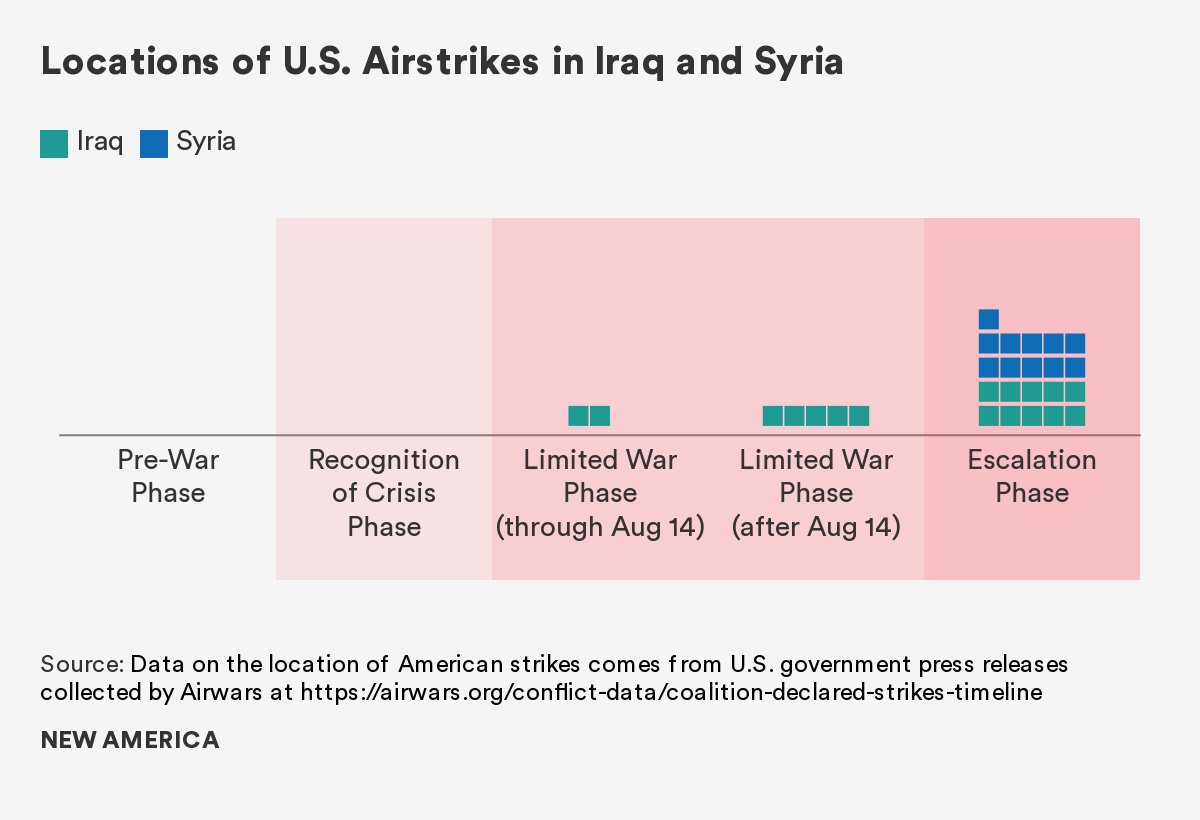
4) Escalation (September 10, 2014+): The final phase of decision-making began on September 10, 2014 when President Obama announced a broader campaign to degrade and destroy ISIS and declared his intent to extend the war into Syria.22 The first strikes in Syria occurred on September 23, 2014.23 On September 23, Obama described these strikes as an implementation of the strategy authorized and announced on September 10, stating: “Earlier this month, I outlined for the American people our strategy to confront the threat posed by the terrorist group known as ISIL. I made clear that as part of this campaign the United States would take action against targets in both Iraq and Syria […] And that's exactly what we've done.”24 The number of locations targeted by airstrikes more than quadrupled from five in the post-August 14 part (following Nouri al-Maliki’s resignation) of the Limited War phase to 21 during the Escalation phase.
During each of these phases, the five rationales of war addressed in this paper are assessed to have either been absent or referenced at a low, medium, or high level of importance, defined as follows:
Absent: There are no official presidential and few, if any, administration references to the rationale with regards to the question of waging war in Iraq or Syria, and there are no imminent military actions or preparations justified on its basis.
Low: The president and other administration officials make some reference to the rationale, but the references tend to be limited, mostly unofficial, and are not connected to an imminent or already-occurred decision to engage in military activity.
Medium: Administration officials make references to the rationale, and have either begun preparations for an option of military action on its basis in the near future or have taken one-off military actions on the logic’s basis but have not authorized a sustained campaign.
High: Administration officials cite the rationale, and are currently waging war beyond one-off actions based on it.
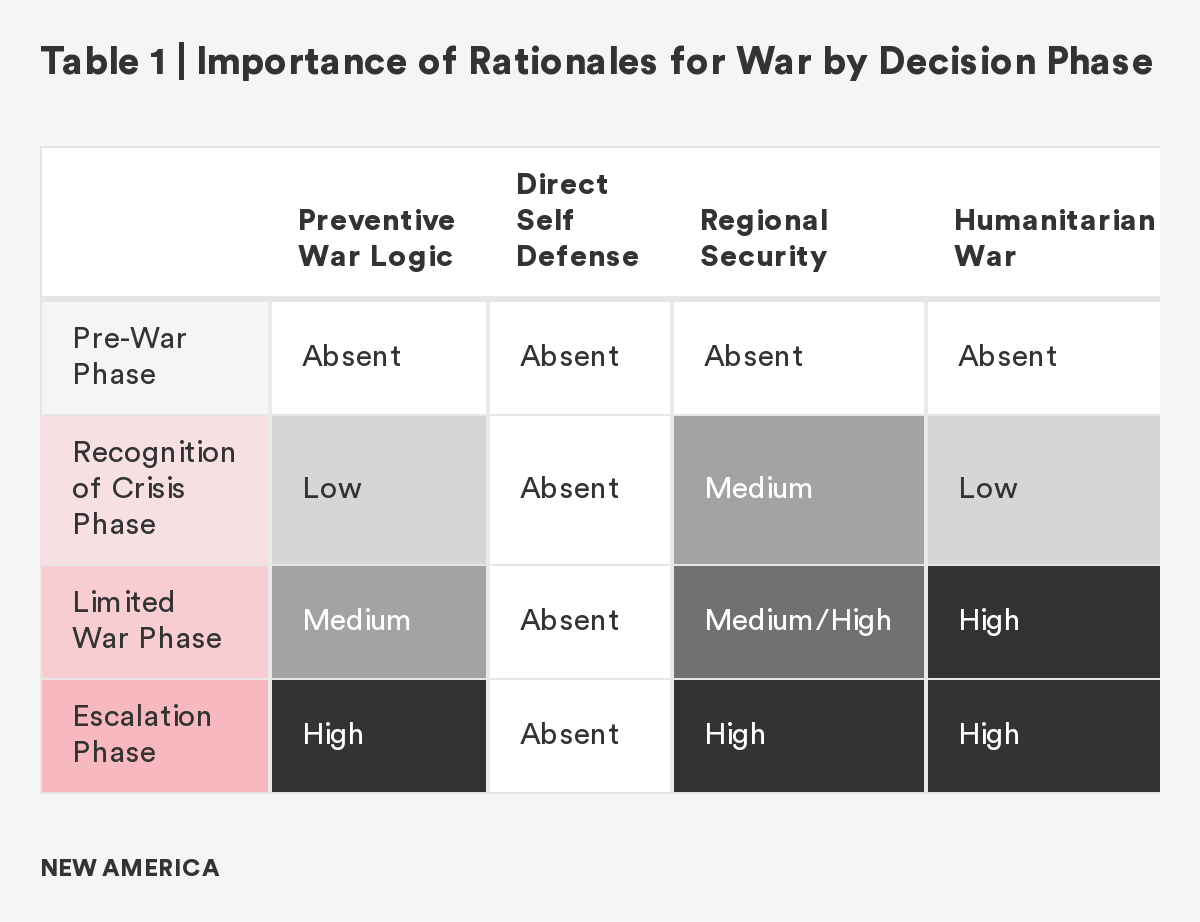
As can be seen in Table 1, the importance of each war rationale increased as the Obama administration moved through the decision phases. By the Escalation phase, the administration was citing every rationale at a high-level with the exception of direct self-defense, which was absent throughout.
Preventive war logic slowly grew in strength, taking on a high importance around the decision to escalate the war into Syria. However, the first rationales to be triggered at higher levels of importance were the regional security and the extraterritorial protection of American rationales. Humanitarian war justifications gained high importance more suddenly, but also did so before preventive war logic did.
The Slow and Steady Rise of Preventive War Logic
Preventive war logic played an important role in the Obama administration’s public justification for the counter-ISIS war. The logic took the form of an argument that, while ISIS did not currently pose a direct threat to the United States, military action was required to prevent it from developing that capability.
President Obama made this argument explicitly on September 10, 2014, using it as one of the primary justifications for authorizing an expansion of the war beyond limited military operations and into Syria. Obama stated:
If left unchecked, these terrorists could pose a growing threat beyond that region, including to the United States. While we have not yet detected specific plotting against our homeland, ISIL leaders have threatened America and our allies.25
During the Escalation phase, preventive war logic had a high importance and was present not just in the September 10 announcement but in a variety of other statements.26 Obama connected the logic directly to the implementation of a “systematic campaign of airstrikes.”27 He stated: “This is a core principle of my presidency: If you threaten America, you will find no safe haven.”28
Commentators recognized and publicly named the preventive war logic at the time. In Vox, Zack Beauchamp wrote: “Obama is applying a version of that preventive war logic to ISIS.”29 The Cato Institute’s Gene Healy called the September 10 speech a “case for preventive war.”30 Looking back from 2016, RAND terrorism scholar Brian Michael Jenkins wrote that “the administration's campaign against the Islamic State is an example of preventive war. […] America's objective is to prevent the Islamic State from becoming a launching pad for terrorist strikes on the United States.”31
Preventive war logic played an important role in the Obama administration’s public justification for the counter-ISIS war.
There is an open question regarding the extent to which Obama’s comments shaped governmental action versus simply being a public justification for action. The mission statement for Operation Inherent Resolve does not mention homeland security, instead describing success as a situation in which the war “defeats ISIS in designated areas of Iraq and Syria and sets conditions for follow-on operations to increase regional stability.”32
On the other hand, the Operation Inherent Resolve website uses language that echoes the preventive rhetoric: “Strikes are conducted as part of Operation Inherent Resolve, the operation to eliminate the ISIL terrorist group and the threat they pose to Iraq, Syria, and the wider international community. The destruction of ISIL targets in Syria and Iraq further limits the group's ability to project terror and conduct operations.”33
This report cannot rule out the possibility that the preventive war logic was mostly a public relations response to domestic political fear, including the hyped ISIS attack scenarios peddled by some Republican candidates. Commentators at the time understood the September 10 speech in part as an attempt to avoid hyping the domestic threat while still responding to political pressure.34 However, the rise of a publicly stated preventive war logic deserves analysis for its risks, even if other rationales dominated the actual policy implementation.
Preventive war logic was not always of high importance in the justification of the counter-ISIS military campaign. Compared to other rationales for war, preventive war logic had a slower ramp up in importance, as can be seen in Table 1. The slow ramp up suggests that the Obama administration was not eager to return to waging war in Iraq.
Pre-War Phase
During the Pre-War phase, preventive war logic was absent. There are no official presidential statements addressing the threat from ISIS during the Pre-War phase. Other sources show a general rejection of preventive war logic. On January 7, 2014, Obama told David Remnick, “I think there is a distinction between the capacity and reach of a bin Laden and a network that is actively planning major terrorist plots against the homeland versus jihadists who are engaged in various local power struggles and disputes, often sectarian.” 35 In the process, he infamously referred to ISIS as the “JV team” when asked about ISIS's territorial gains in Iraq.36
Obama’s differentiation was not absurd. Al Qaeda’s affiliate in Yemen and its core, as well as other groups in Pakistan, had attempted (not just plotted) attacks inside the United States in the years prior to the initiation of the counter-ISIS campaign.37 The United States conducted drone strikes in Pakistan and Yemen relying in part on the threat to the United States to justify the strikes. In contrast, the Obama administration refused to conduct airstrikes in Iraq in 2013 despite Iraqi requests to do so.38 While the refusal was in part a result of the overall reticence to re-engage in war in Iraq as well as a result of the lack of a formal39 Iraqi government request, at least some outside experts attributed the refusal to a belief that the group did not pose a “direct threat” to the homeland and thus did not justify strikes.40
Obama had made his support for ending the war in Iraq a central component of his presidential campaign. Ben Rhodes, Obama’s foreign policy speechwriter, for example, suggests in his memoir that “Obama would never have become president without the mistake America had made in Iraq.”41 John Kerry also noted the reticence among decision makers, even on August 7, to initiate strikes: “Unspoken but palpable in the room was the reality that a president who had been elected in 2008 promising to get the United States out of a war in Iraq had no choice but to order air strikes in that country again.”42
Obama aides interviewed by the New York Times noted that Obama viewed the previous administration as “too quick to pull the military lever whenever it confronted a foreign crisis.”43 The administration had also stripped the Bush administration’s rhetoric of preemptive war from its 2010 National Security Strategy.44 Multiple members of the Obama administration had criticized the Bush administration’s preemption doctrine.45
There are no official presidential statements addressing the ISIS threat during the Pre-War phase.
This is not to say the Obama administration fully abandoned preventive war logic prior to the counter-ISIS war. The 2010 strategy maintained continuities with previous strategies that could allow preventive war.46 Nor did Obama rule out preventive war on a range of issues, including as a tool to prevent Iranian acquisition of nuclear weapons.47 The historian and military scholar Andrew Bacevich rightly warned that the Obama administration, in large part, merely saw Iraq as the wrong theater of conflict without renouncing a preventive global war on terrorism.48 Yet Obama’s 2002 anti-Iraq war speech, which includes the rhetoric of only opposing “dumb wars” also included an emphasis on the “rash” character of the Iraq war, specifically emphasizing that “Saddam poses no imminent and direct threat to the United States.”49 This early emphasis on imminence and directness and their repetition during the lead up to the counter-ISIS war suggests Obama held some concern regarding preventive war logic.
Recognition of Crisis Phase
Preventive war logic increased to a low level of importance during the Recognition of Crisis phase. Obama made three official comments on ISIS during this phase, consisting of a June 13 statement, a June 19 statement, and a June 26 War Powers Resolution. Obama did not cite preventive war logic in the text of any of these statements.50 Instead, the statements referred to threats to the broader concept of “American interests.” In the June 13 statement, even the threat to American interests was framed preventively, with Obama noting the threat posed by ISIS to “Iraq and its people” and saying that “given the nature of these terrorists, it could pose a threat eventually to American interests as well.”51
However, when answering questions during the June 13 and June 19 statements, Obama did reference preventive war logic. On June 13, he replied to a question by saying: “What we’re going to have to do is combine selective actions by our military to make sure that we’re going after terrorists who could harm our personnel overseas or eventually hit the homeland.”52 On June 19, he made a similar comment when asked to detail the national interests involved:
We also have an interest in making sure that we don’t have a safe haven that continues to grow for ISIL and other extremist jihadist groups who could use that as a base of operations for planning and targeting ourselves, our personnel overseas, and eventually the homeland. And if they accumulate more money, they accumulate more ammunition, more military capability, larger numbers, that poses great dangers not just to allies of ours like Jordan, which is very close by, but it also poses a great danger potentially to Europe and ultimately the United States.53
In both of these cases, preventive war logic is placed relatively late in terms of threats listed and in regards to when the threat might manifest.
On July 24, 2014, Brett McGurk, then assistant secretary of state for Iraq and Iran, concluded his opening testimony to Congress on the issue by stating that while the immediate threat had been “blunted,” that “ISIL represents a growing threat to U.S. interests in the region, local populations, and the homeland.”54 The day after McGurk’s testimony, Chairman of the Joint Chiefs of Staff General Martin E. Dempsey, made a similar comment at the Aspen Security Forum, saying that “the United States military does consider ISIL a threat to—initially to the region and our close allies, longer term to the United States of America, and therefore we are preparing a strategy that has a series of options to present to our elected leaders on how we can initially contain, eventually disrupt and finally defeat ISIL over time.”55 The reference to multiple options suggests the preventive logic was not yet necessarily tied to war as the resolution. General Dempsey further stated, “If ISIL becomes a threat to this country, clearly we would have … the capability to deal with it. … But we haven’t actually come to that point. We’re still very much in the development of those options.”56
Limited War Phase
By the Limited War phase, preventive war logic had gained a medium level of importance. The Obama administration began to explicitly and publicly reference it – and not just in question and answer sessions.
The first explicit reference to preventive war logic in the actual text of an official presidential statement occurred on August 9, when Obama, during his weekly address, stated, “We’ll help prevent these terrorists from having a permanent safe haven from which to attack America.”57 This was not a lone explicit reference.58
In addition, the administration continued to make references to preventive war logic outside of the text of official statements. In an August 9 statement, Obama spoke generally of the danger of an ISIS “safe haven,” but during the question and answer session expanded on the point: “My team has been vigilant, even before ISIL went into Mosul, about foreign fighters and jihadists gathering in Syria, and now in Iraq, who might potentially launch attacks outside the region against Western targets and U.S. targets. So there’s going to be a counterterrorism element that we are already preparing for and have been working diligently on for a long time now.”59
During the Limited War phase, the strikes the United States was conducting were not publicly justified on the basis of preventive logic, but instead on carefully maintaining (at least rhetorically) the limited missions of protecting Americans threatened by ISIS and providing humanitarian support to persecuted minorities.
Preventive war logic played a highly important role in the Escalation phase, but the road to its citation was a slow ramp-up of references in large part due to Obama’s reticence to embrace preventive war. The American war against ISIS was first triggered not by a decision to wage a preventive war to protect the homeland but rather by rationales of regional security, extraterritorial protection of Americans, and humanitarian war that in turn helped to push along the development of a preventive war logic.
During the Limited War phase, the strikes the United States was conducting were not publicly justified on the basis of preventive logic, but on carefully maintaining the limited missions of protecting Americans threatened by ISIS.
The Role of Other War Rationales
Rationales of regional security, extraterritorial protection of Americans, and humanitarian war played the primary role in the initiation of the American counter-ISIS war in Iraq. As shown in Table 1, these rationales reached high levels of importance before preventive war logic did. In addition, these rationales played the primary role in the move from the Pre-War phase to the Recognition of Crisis phase and the Recognition of Crisis phase to the Limited War phase. During the Escalation phase, the concerns underlying these logics played an important role in generating a strongly-stated preventive war logic.
Pre-War Phase
During the Pre-War phase, regional security, extraterritorial protection of Americans, and humanitarian rationales were absent. The president made no official statements on ISIS. The administration was extremely reticent to get involved in Iraq again for any of these reasons. On January 3, ISIS captured Fallujah.60 At the same time, ISIS began to substantially contest Iraqi control of Ramadi.61 In the wake of these substantial ISIS advances, Obama dismissed them as “local power struggles” in his interview with David Remnick. Pressed by Remnick, Obama rejected calls for war against ISIS based on a regional security rationale, arguing that the threat was not specific enough or resolvable with military force:
Fallujah is a profoundly conservative Sunni city in a country that, independent of anything we do, is deeply divided along sectarian lines. And how we think about terrorism has to be defined and specific enough that it doesn’t lead us to think that any horrible actions that take place around the world that are motivated in part by an extremist Islamic ideology is a direct threat to us or something that we have to wade into.62
Obama was similarly resistant to humanitarian war rationales. In his May 2014 speech on counterterrorism at the U.S. Military Academy at West Point, Obama stated, regarding the Afghan surge, “[…]I am haunted by those deaths. I am haunted by those wounds. And I would betray my duty to you and to the country we love if I ever sent you into harm’s way simply because I saw a problem somewhere in the world that needed to be fixed.”63 This was not mere rhetoric. In 2013, Obama backed away from using military force in the aftermath of a Syrian chemical weapons attack and clashed with more interventionist aides over the wisdom of supporting the Syrian rebels for humanitarian reasons.64 While his refusal to intervene was shaped by Congress’s inaction, it was also informed by concern regarding the duration and toll of America’s wars and a view that the intervention in Libya had not been successful.65
The Obama administration was not resistant to extraterritorial protection of Americans rationales during the Pre-War phase. The West Point speech made clear Obama’s willingness to use force to protect Americans, as did the administration’s justifications for drone strikes and use of force to rescue hostages.66 However, the administration made no link between its willingness to use force for such ends and a prospective military campaign in Iraq or Syria.
Recognition of Crisis Phase
An increased perception of ISIS's threat to regional security interests and the group’s threat to Americans abroad drove the Obama administration’s Recognition of Crisis with regards to ISIS. During this phase, the regional security and extraterritorial protection of Americans rationales rose to a medium level of importance.
The opening paragraph of Obama’s June 13 statement reads:
Over the last several days, we’ve seen significant gains made by ISIL, a terrorist organization that operates in both Iraq and in Syria. In the face of a terrorist offensive, Iraqi security forces have proven unable to defend a number of cities, which has allowed the terrorists to overrun a part of Iraq’s territory. And this poses a danger to Iraq and its people.67
Obama went on to say that “nobody has an interest in seeing terrorists gain a foothold inside of Iraq, and nobody is going to benefit from seeing Iraq descend into chaos.”68 Obama concluded by emphasizing diplomacy as the key to “stability in Iraq or the broader region.”69 Obama’s June 19 statement also began by describing the threat “to the Iraqi people, to the region, and to U.S. interests” and warned of the threat to Iraq’s neighbors—specifically citing Jordan as well as referencing threats to Europe.70 Obama said, “We will be prepared to take targeted and precise military action, if and when we determine that the situation on the ground requires it.”71
Comments by administration officials emphasize the role of a perceived increase in the regional threat in generating the Recognition of Crisis. In a 2016 interview Obama stated, “The ability of ISIL to not just mass inside of Syria, but then to initiate major land offensives that took Mosul, for example, that was not on my intelligence radar screen.”72 Chuck Hagel, the secretary of defense at the time, in an interview after his resignation, called the June 2014 ISIS advances a “jolt” to the administration.73 In his memoir, Ben Rhodes, Obama’s deputy national security adviser, recalls that the shock and uncertainty surrounding ISIS's seizure of Mosul and the collapse of Iraqi forces shaped later decisions.74 Joshua Geltzer, a former senior director for counterterrorism at the National Security Council, similarly recalls: “It wasn't just that ISIS's surge surprised some in the U.S government—though there were also some who'd provided warnings about exactly that. It was also that the weakness of Iraqi forces came as something of a shock.”75
The fall of Mosul and ISIS's advances were seen as posing a regional threat beyond Mosul. According to Chris Woods, who has long tracked the United States' air wars in Iraq: “Mosul was an important symbol, but the collapse of the Iraqi army that accompanied it was potentially more troubling. ISIS took out an entire Iraq Army division along with its materiel, and funneled that into its broader war effort, including in Syria. The terrorist group was now also an occupying power, with a well-equipped ‘army.’”76 This fear existed within the administration. Geltzer, for example, notes that “for ISIS to take Mosul was a huge step, and a deeply concerning one. Not only did it show the group's ability to take control over a major urban area, but it also put at the group's disposal a huge population, major financial assets, and significant other resources that it could conceivably put toward its continued expansion of territorial control and other violence.”77
The extraterritorial protection of Americans rationale also increased during the Recognition of Crisis phase, reaching a medium level of importance with military preparations linked closely to protections of Americans commencing. In his June 13 statement, Obama emphasized, “Our top priority will remain being vigilant against any threats to our personnel serving overseas.”78 In his June 19 statement, Obama reiterated this rationale: “First, we are working to secure our embassy and personnel operating inside of Iraq. As President, I have no greater priority than the safety of our men and women serving overseas. So I’ve taken some steps to relocate some of our embassy personnel, and we’ve sent reinforcements to better secure our facilities.”79
The United States placed a low priority on humanitarian war rationales during the Recognition of Crisis phase.
Geltzer confirms that the protection of American personnel was a primary concern at the time, noting that “as ISIS pushed into Iraq from Syria, among the most immediate concerns for the U.S. government was protecting our own presence in Iraq, including in Baghdad.”80 At a Brookings Institution event, Brett McGurk recounted that the United States lacked the intelligence coverage to be able to determine the veracity of threats in Baghdad in June 2014, and that concern played a role in the deployment of advisors.81 This concern was registered by outside observers. According to Chris Woods, the perception at the time was that an ISIS advance on both Erbil and Baghdad looked distinctly possible.82
In addition, in the early hours of July 3, planes began to bomb an ISIS camp in Raqqa while U.S. Special Forces landed in a raid aimed at rescuing hostages, including American journalists James Foley and Stephen Sotloff, held by ISIS.83 This is the only clear instance of American use of military force in Iraq or Syria against ISIS prior to the August 7 authorization, which began the Limited War phase.84 A senior Department of Defense official described the raid to the Washington Post as “a risky operation, deep into Syria, where we hadn’t been before.”85 The raid was not viewed within the government as the beginning of a larger military campaign against ISIS; it was specifically about attempting to rescue the hostages.86
In contrast, the United States placed a low priority on humanitarian war rationales during this phase. Obama’s June 13 statement makes no reference to humanitarian interests.87 In a reply to a question during his June 19 remarks, Obama stated, “It is in our national security interests not to see an all-out civil war inside of Iraq, not just for humanitarian reasons, but because that ultimately can be destabilizing throughout the region.”88 The “not just” phrase suggests that humanitarian reasons were being considered but had little importance as the citation is contraposed to the more important issue of regional security. Even so, Brett McGurk’s congressional testimony makes clear that humanitarian rationales were not absent.89
Limited War Phase
During the Limited War phase, the humanitarian war and extraterritorial protection of Americans rationales reached high levels of importance with sustained military operations initiated on their basis. The regional security rationale reached a medium- to high-level of importance. It was not part of the explicit justification for the authorized operations, but it was part of the preparations for a broader escalation, which was already in development and not entirely separable from the military actions during this phase.
On August 7, Obama announced that he “authorized two operations in Iraq—targeted airstrikes to protect our American personnel, and a humanitarian effort to help save thousands of Iraqi civilians who are trapped on a mountain without food and water and facing almost certain death.”90
Obama’s statement also made clear that the decision differed from earlier remarks regarding the importance of protecting Americans due to a more immediate sense of threat:
First, I said in June—as the terrorist group ISIL began an advance across Iraq—that the United States would be prepared to take targeted military action in Iraq if and when we determined that the situation required it. In recent days, these terrorists have continued to move across Iraq, and have neared the city of Erbil, where American diplomats and civilians serve at our consulate and American military personnel advise Iraqi forces. To stop the advance on Erbil, I’ve directed our military to take targeted strikes against ISIL terrorist convoys should they move toward the city. […] We’re also providing urgent assistance to Iraqi government and Kurdish forces so they can more effectively wage the fight against ISIL.91
The first strikes on ISIS after the authorization included a strike on a mobile ISIS artillery piece that was shelling Erbil.92 The Pentagon tweeted: “US military aircraft conduct strike on ISIL artillery. Artillery was used against Kurdish forces defending Erbil, near US personnel.”93
Post-facto comments from those involved in the decision confirms the increased sense of danger to Americans constituted a tipping point for action. Ben Rhodes writes, “For a couple of days, a sense of crisis enveloped the White House.”94 He notes the role the threat to Erbil played, recalling: “Obama was angry that he didn’t have good information. ‘We didn’t get a warning that the Iraqis were going to melt away’ in Mosul, he complained to a group of us. ‘And now we can’t even get a read on how many Peshmerga’ – the Kurdish security forces – ‘are in Erbil. I’m not happy with the information I’m getting.’”95 The sense of surprise and concern was shared by military analysts and commentators outside of government as well.96
The role of humanitarian war rationales also jumped to a high level of importance during the Limited War phase. In the week leading up to Obama’s August 7 authorization of strikes, ISIS made rapid advances into Iraq’s Sinjar district.97 As ISIS advanced, hundreds of thousands of Iraqis belonging to Iraq’s various minority groups including Yazidis and Turkmen fled, but tens of thousands ended up stranded on Mt. Sinjar.98 As it advanced, ISIS systematically targeted these populations for murder and enslavement.99
ISIS's advance and the campaign of atrocities and genocide it waged against Yazidis and other minorities shaped the administration’s decision to use military force. Obama stated that he had “authorized targeted airstrikes, if necessary, to help forces in Iraq as they fight to break the siege of Mount Sinjar and protect the civilians trapped there.”100 In contrast to references to a humanitarian rationale in earlier phases’ statements, Obama left no doubt that humanitarian objectives had their own driving force rather than counterpoising them to national interests. Rather than making generic, non-descriptive references to ISIS's brutality as in earlier statements, Obama described ISIS atrocities at length, framing it in terms of prevention of genocide:
As ISIL has marched across Iraq, it has waged a ruthless campaign against innocent Iraqis. And these terrorists have been especially barbaric towards religious minorities, including Christian and Yezidis, a small and ancient religious sect. Countless Iraqis have been displaced. And chilling reports describe ISIL militants rounding up families, conducting mass executions, and enslaving Yezidi women. In recent days, Yezidi women, men and children from the area of Sinjar have fled for their lives. And thousands—perhaps tens of thousands—are now hiding high up on the mountain, with little but the clothes on their backs. They’re without food, they’re without water. People are starving. And children are dying of thirst. Meanwhile, ISIL forces below have called for the systematic destruction of the entire Yezidi people, which would constitute genocide. So these innocent families are faced with a horrible choice: descend the mountain and be slaughtered, or stay and slowly die of thirst and hunger101
The ISIS advance on Erbil was not the only example of extraterritorial protection rationale gaining importance. On August 19, the administration learned that ISIS had murdered American journalist James Foley, whom ISIS had taken hostage earlier, when the group placed video of his beheading on YouTube.102 Then Secretary of State John Kerry recalled in his memoir: “My profound feeling of injustice and sadness turned to anger. Something was horribly unimaginably sick and wrong in the world. I closed my eyes. I wanted this brave young journalist to be home with his family, safe, and alive. I wanted Daesh extinguished from the face of the earth. But now I could help accomplish only one of those things.”103 In the wake of the murder, the State Department placed a greater emphasis on its counter-ISIS work, giving the issue more senior-level attention.104
On August 20, Obama gave a statement on the murder, saying, “Jim was taken from us in an act of violence that shocks the conscience of the entire world.”105 He also framed the murder within ISIS's broader set of atrocities, including its “ambition to commit genocide against an ancient people.”106 Obama then reiterated his commitment to using military force to protect Americans, but unlike the more specific, limited effort in Erbil, he framed it as a broader matter of justice not contained to a particular location: “The United States of America will continue to do what we must do to protect our people. We will be vigilant and we will be relentless. When people harm Americans, anywhere, we do what’s necessary to see that justice is done. And we act against ISIL, standing alongside others.”107
ISIS's advance and the campaign of atrocities and genocide it waged against Yazidis and other minorities shaped the administration’s decision to use military force.
The importance of the regional security rationale in the Limited War phase changed over the course of the phase. On August 7, 2014, regional security rationale began moving from a medium level of importance towards a high level of importance.
On August 7, Obama only authorized two limited operations, but he made clear that he viewed the effort through a prism of broader regional security questions. He stated, “We can and should support moderate forces who can bring stability to Iraq. So even as we carry out these two missions, we will continue to pursue a broader strategy that empowers Iraqis to confront this crisis.”108
Kerry’s memoir shows that the humanitarian war and extraterritorial protection of Americans rationales were not separate from a broader regional security rationale. He writes, “In real time there was urgent evidence that Daesh’s threat was existential for the region. Not far from the Turkish border, the extremists terrorized a religious minority, the Yazidi families … Daesh was closing in on Erbil, the Kurdish city where we have a major consulate.” 109 General John Allen, former special presidential envoy to the Global Coalition to Defeat ISIS, has similarly portrayed the threat to Erbil as having broader regional security resonance, stating that ISIS's turn towards Kurdistan “was a major strategic mistake for them because that mobilized a lot of international support for the Kurds that we might not have otherwise seen if they had just gone south for Baghdad […] the potential for Kurdistan to go down to the Islamic State […] helped to mobilize international support so this was a real, dire moment.”110
The lack of immediate operations publicly linked to that broader strategy—rather than justified on the basis of the authorized limited operations—was less a result of an absence of regional security rationale as worries regarding initiating military action while Nouri al-Maliki, who the administration saw as partially responsible for stoking ISIS's rise through sectarianism, remained Iraq’s prime minister. Obama stated, “Once Iraq has a new government, the United States will work with it and other countries in the region to provide increased support to deal with this humanitarian crisis and counterterrorism challenge. None of Iraq’s neighbors have an interest in this terrible suffering or instability.”111
In his memoir, then Secretary of State John Kerry states that the administration did not want to take broader military action without a “comprehensive strategy” or while Maliki still led the country.112 On August 11, Obama gave a statement recognizing the naming of Haider al-Abadi as the new prime minister designate.113
On August 14, 2014, with Maliki having officially resigned, American strikes began to expand both in number and in the number of locations targeted.114 The Obama administration authorized U.S. strikes as part of the effort to retake Mosul Dam.115 In his War Powers Resolution letter conveying the authorization, Obama framed the authorized strikes as “limited in their scope and duration as necessary to support the Iraqi forces in their efforts to retake and establish control of this critical infrastructure site.”116 Legal commentators at the time noted the weakening of the limitations and broadening of the campaign.117
By early September, the Obama administration began to publicly reference a broader objective tied to regional security concerns—degrading and ultimately defeating ISIS.118 On September 5, Obama made reference to Secretary Kerry’s work in preparing the strategy and reiterated both in his statement and in responses to questions a regional security rationale.
By the end of the Limited War phase, regional security, humanitarian war, and extraterritorial protection of Americans logic rationales all reached a high level of importance. Yet the administration continued to provide only a medium level of importance to preventive war logic.
The Escalation Phase – How Non-Preventive Rationales Contributed to the Rise of Preventive War Logic
On September 10, Obama authorized a broader campaign. All of the rationales which had reached a high level of importance in the Limited War phase continued to be cited by the administration.119 The administration’s confrontation with ISIS's brutality and the threats addressed by the non-preventive war rationales described above, led the administration to increasingly view ISIS as a threat incompatible with American values. As a result, the administration adopted a public discourse of common threat and the need to defeat or extinguish ISIS, fueling the rise of preventive war logic by conceptually diminishing the perceived importance of the barriers that separated ISIS's threat abroad from the threat it posed to the United States homeland.
Horror at ISIS's actions helped generate a view that ISIS was not containable and had the intent to commit violence far afield from Iraq and Syria, setting the stage for a decision that war now to destroy those developing capabilities would be better than war later. This process accords with the findings of Max Abrahms that people infer terrorist intent from their actions and tend to see brutality and violence against civilians as a sign that terrorists have maximal goals and do not intend to curtail their violence in exchange for concessions.120 In the case of ISIS, the group did indeed hold maximal goals, though—as will be discussed later—even with groups like ISIS, intent to pursue such maximal goals varies along a spectrum (as does capability).
In turn, this tendency may have created a feedback loop in which the rise of preventive war logic increased uncertainty with regards to specific war aims, encouraging a further shift to a focus on maximizing the identity-based heuristic of eliminating ISIS's challenge to American values.121
Horror at ISIS's actions helped generate a view that ISIS was not containable and had the intent to commit violence far afield from Iraq and Syria.
Obama’s September 10 statement is explicit that ISIS's atrocities, murder of American hostages, and general regional threat played a key role in his decision. The statement used these threats to explain that ISIS had maximal goals fundamentally at odds with America’s safety in the long term. At first, Obama seemed to demur from such a conclusion, stating, “We can’t erase every trace of evil from the world, and small groups of killers have the capacity to do great harm. That was the case before 9/11, and that remains true today.”122 However, he then proceeded to explain why ISIS was different:
ISIL is a terrorist organization, pure and simple. And it has no vision other than the slaughter of all who stand in its way. In a region that has known so much bloodshed, these terrorists are unique in their brutality. They execute captured prisoners. They kill children. They enslave, rape, and force women into marriage. They threatened a religious minority with genocide. And in acts of barbarism, they took the lives of two American journalists—Jim Foley and Steven Sotloff. So ISIL poses a threat to the people of Iraq and Syria, and the broader Middle East—including American citizens, personnel and facilities […].123
These above-quoted lines directly lead into the statement of preventive war logic: “If left unchecked, these terrorists could pose a growing threat beyond that region, including to the United States.”124 This suggests a close connection between the reaction to ISIS's brutality and the more prominent public reference to preventive war logic.
Obama would later in the speech tie the ISIS regional threat to American identity—further suggesting that a shift had occurred from the analysis of costs, benefits, and limitations of American military might expressed during earlier phases of the decision process to a form of values matching reasoning. He stated, “This is American leadership at its best: We stand with people who fight for their own freedom, and we rally other nations on behalf of our common security and common humanity.”125
The roots of this thinking are visible during the Limited War phase in Kerry’s reaction to the murder of James Foley, which in his memoir he described as a turn from sadness to anger and the desire to “extinguish” ISIS.126 It can also be seen in Obama’s August 7 statement, where he states:
America has made the world a more secure and prosperous place. And our leadership is necessary to underwrite the global security and prosperity that our children and our grandchildren will depend upon We do so by adhering to a set of core principles. We do whatever is necessary to protect our people. We support our allies when they’re in danger. We lead coalitions of countries to uphold international norms. And we strive to stay true to the fundamental values—the desire to live with basic freedom and dignity—that is common to human beings wherever they are. That’s why people all over the world look to the United States of America to lead. And that’s why we do it.127
On September 13, Obama reiterated the concept of “common threat” adding that “because we’re Americans. We don’t give in to fear. We carry on.”128 It is a statement that neatly combines the shift to a focus on American identity and values, the interlinking of threats to interests abroad to those at home without evidence supporting an imminent link between the threats, and the refusal to make concessions that is often the reaction to perceived terrorist maximal goals.
The extent of any such shift away from cost-benefit analysis should not be overstated. According to Joshua Geltzer, “The question of how best to degrade and ultimately defeat ISIS was not something to be answered only a single time—instead, it was revisited repeatedly, throughout the course of the campaign. There were meetings at various levels of seniority, often multiple a week.”129 In 2017 the Obama administration held dozens of senior-level meetings over seven months to plan for and weigh the costs and benefits of different approaches in the effort to take Raqqa, eventually deciding that it should hold off as it was a major decision that the Trump administration deserved to have a say in.130 General John Allen similarly recalls such “significant debate.”131 According to Andrew Exum, who was deputy assistant secretary of defense for Middle East policy from 2015 through 2016, “Toward the end of the administration, […] we literally had cabinet secretaries debating the movement of three helicopters from Iraq to Syria.”132
Deliberations on tactical questions and their relation to strategy do not necessarily demonstrate the absence of a shift to values matching with regards to strategic ends and public framing. It is also worth noting that there appears to be a precedent for the Obama administration abandoning cost benefit analysis in the wake of a particularly brutal, violent act. In her memoir, former Ambassador to the United Nations Samantha Power recalls that in the wake of the August 2013 Syrian chemical weapons attack, Obama was “enraged,” and “rather than debating next steps with us, as he generally did, he made clear that he had decided to punish Assad.”133 She also notes that “administration officials who had previously argued against using military force in Syria were now in full agreement with the Commander in Chief. Chairman of the Joint Chiefs of Staff Martin Dempsey, the President’s top military adviser, told Obama in a National Security Council meeting two days after the attack, ‘normally I would want you to know what comes next. But this is not one of those times.’”134 However, this report did not find similarly explicit statements regarding the counter-ISIS war decision.
It is beyond the ability of this report to conclusively show that the regional security, extraterritorial protection of Americans, and humanitarian war rationales gave rise to the preventive war logic rather than it rising independently.135 However, the above statements suggest they played a role by increasing the salience of fear of ISIS's maximal goals and therefore the inferred potential threat to the United States. That conclusion holds a warning for those who would view the accomplishment of more limited military goals as separable from the risks of preventive war logic once a war is begun.

Citations
- “Remarks by the President at the United States Military Academy Commencement Ceremony,” White House Office of the Press Secretary, May 28, 2014, ; David Kilcullen, Blood Year: The Unraveling of Western Counterterrorism (New York: Oxford University Press, 2016), 4.
- “Lead Inspector General for Overseas Contingency Operations Operation Inherent Resolve Quarterly Report and Biannual Report to the United States Congress December 17, 2014−March 31, 2015” (Department of Defense Office of the Inspector General, April 30, 2015), ; “US-Led Coalition Air Strikes on ISIS in Iraq & Syria, 2014-2018,” Airwars, accessed September 10, 2019,
- “Statement by the President on Iraq,” The White House Office of the Press Secretary, June 13, 2014,
- Martin Chulov, “Isis Insurgents Seize Control of Iraqi City of Mosul,” Guardian, June 10, 2014,
- Benjamin Rhodes, The World as It Is: A Memoir of the Obama White House, First edition (New York: Random House, 2018), 290.
- Derek H. Chollet, The Long Game: How Obama Defied Washington and Redefined America’s Role in the World (New York: Public Affairs, 2016), 149.
- “Remarks by the President on the Situation in Iraq,” The White House Office of the Press Secretary, June 19, 2014,
- See for example: “Iraq at a Crossroads: Options for U.S. Policy: Statement for the Record: Deputy Assistant Secretary Brett McGurk,” Senate Foreign Relations Committee (2019),
- Karen DeYoung, “The Anatomy of a Failed Hostage Rescue Deep in Islamic State Territory,” Washington Post, February 14, 2015, ; Ruth Sherlock, Carol Malouf, and Josie Ensor, “The Failed US Mission to Try and Rescue James Foley from Islamic State Terrorists,” Telegraph, August 21, 2014, ; Nicholas Schmidle, “Inside the Failed Raid to Save Foley and Sotloff,” New Yorker, September 5, 2014,
- With the one known exception of the aforementioned rescue raid in Raqqa, Syria on July 3, 2014.
- “Statement by the President” (The White House Office of the Press Secretary, August 7, 2014), ; “Lead Inspector General for Overseas Contingency Operations Operation Inherent Resolve Quarterly Report and Biannual Report to the United States Congress, December 17, 2014−March 31, 2015. ”
- Helene Cooper, Mark Landler, and Alissa J. Rubin, “Obama Allows Limited Airstrikes on ISIS,” New York Times, August 7, 2014,
- Rhodes refers to early August but makes specific reference to ISIS's taking of Mosul dam, which occurred on August 7, 2014, the same day strikes were authorized. Rhodes, The World as It Is, 291; Alex Milner, “Mosul Dam: Why the Battle for Water Matters in Iraq,” BBC, August 18, 2014,
- “US-Led Coalition Air Strikes on ISIS in Iraq & Syria, 2014-2018.”
- “Letter from the President – War Powers Resolution Regarding Iraq,” The White House Office of the Press Secretary, August 8, 2014,
- Author’s Interview with Chris Woods, Director of Airwars, September 11, 2019.
- “US-Led Coalition Air Strikes on ISIS in Iraq & Syria, 2014-2018.”
- John Kerry, Every Day Is Extra, First Simon & Schuster hardcover edition (New York: Simon & Schuster, 2018), 545.
- Kerry, 546.
- “Remarks by President Obama at NATO Summit Press Conference,” The White House Office of the Press Secretary, September 5, 2014, ; Julie Hirschfeld Davis, “After Beheading of Steven Sotloff, Obama Pledges to Punish ISIS,” New York Times, September 3, 2014, ; Carol E. Lee and Colleen McCain Nelson, “U.S. Aims to ‘Degrade and Destroy’ Militants,” Wall Street Journal, September 3, 2014,
- For a discussion and examples of this matter, see Robert Chesney’s discussion of the legal basis for the strikes around Mosul dam as well as President Obama and CENTCOM’s references to broader objectives for the operation: Robert Chesney, “Article II and Iraq: Justifications for the Mosul Dam Operation in the WPR Notification,” Lawfare, August 17, 2014, ; Jethro Mullen and Susanna Capeluoto, “U.S. Airstrikes Critical in Mosul Dam Capture,” CNN, August 19, 2014, ; “U.S. Conducts More Airstrikes Near the Mosul Dam,” U.S. Department of Defense, August 18, 2014,
- “Statement by the President on ISIL,” White House Office of the Press Secretary, September 10, 2014, ; “Lead Inspector General for Overseas Contingency Operations Operation Inherent Resolve Quarterly Report and Biannual Report to the United States Congress December 17, 2014−March 31, 2015.”
- “US-Led Coalition Air Strikes on ISIS in Iraq & Syria, 2014-2018.”
- “Statement by the President on Airstrikes in Syria,” White House Office of the Press Secretary, September 23, 2014,
- “Statement by the President on ISIL,” The White House Office of the Press Secretary, September 10, 2014,
- “WEEKLY ADDRESS: We Will Degrade and Destroy ISIL,” The White House Office of the Press Secretary, September 13, 2014, ; “Weekly Address: The World Is United in the Fight Against ISIL,” The White House Office of the Press Secretary, September 20, 2014, ; “Remarks by the President at MacDill Air Force Base,” The White House Office of the Press Secretary, September 17, 2014, Also see Appendix.
- “Statement by the President on ISIL [September 10, 2014]”; “FACT SHEET: Strategy to Counter the Islamic State of Iraq and the Levant (ISIL),” The White House Office of the Press Secretary, September 10, 2014,
- “Statement by the President on ISIL [September 10, 2014].”
- Zack Beauchamp, “One Incredibly Revealing Line from Obama’s ISIS Speech,” Vox, September 10, 2014,
- Gene Healy, “Is Obama Abusing the Constitution to Combat ISIS?,” The National Interest, September 12, 2014,
- Brian Michael Jenkins, “President Obama’s Controversial Legacy as Counterterrorism-in-Chief,” RAND, August 22, 2016,
- “Our Mission” (Combined Joint Task Force Operation Inherent Resolve, July 17, 2017),
- “Strike Releases,” Operation Inherent Resolve, accessed September 20, 2019, .
- Michael Calderone and Sam Stein, “Americans Panicked Over ISIS Threat That Experts Say Isn’t Imminent,” Huffington Post, September 9, 2014,
- Glenn Kessler, “Spinning Obama’s Reference to Islamic State as a ‘JV’ Team,” Washington Post, September 3, 2014,
- Ibid.
- Examples include the 2009 New York City Subway bomb plot involving three men who trained with al Qaeda in Pakistan, the 2009 Christmas Day Underwear bomb attack directed by Al Qaeda in the Arabian Peninsula, the 2010 Times Square failed car bombing involving an American who trained with the Pakistani Taliban, and a series of later plots against aviation directed by Al Qaeda in the Arabian Peninsula.
- John Hudson, “U.S. Rules Out a New Drone War in Iraq,” Foreign Policy, October 3, 2013,
- On the lack of formality’s role as a factor see: “Terrorist March in Iraq: The U.S. Response,” House Committee on Foreign Affairs (2014),
- Hudson, “U.S. Rules Out a New Drone War in Iraq.”
- Rhodes’ memoir includes multiple variations on this theme as well as scenes that illustrate both the political and policy importance of getting out of Iraq to Obama. Rhodes, The World as It Is, 43.
- Kerry, Every Day Is Extra, 545.
- Peter Baker and Eric Schmitt, “Many Missteps in Assessment of ISIS Threat,” New York Times, September 29, 2014,
- Paul Reynolds, “Obama Modifies Bush Doctrine of Pre-Emption,” BBC, May 27, 2010,
- Jack Goldsmith, “Obama Has Officially Adopted Bush’s Iraq Doctrine,” Time, April 6, 2016,
- Aaron Ettinger, “U.S. National Security Strategies: Patterns of Continuity and Change, 1987–2015,” Comparative Strategy 36, no. 2 (March 15, 2017): 115–28, ; C. Henderson, “The 2010 United States National Security Strategy and the Obama Doctrine of ‘Necessary Force,’” Journal of Conflict and Security Law 15, no. 3 (December 1, 2010): 403–34,
- Peter Beinart, “How America Shed the Taboo Against Preventive War,” The Atlantic, April 21, 2017,
- Andrew J. Bacevich, “Redefining the War on Terror,” Council on Foreign Relations, July 30, 2008, ; Matt Duss, “Bacevich: ‘The Only Way To Preserve The American Way Of Life Is To Change It,’” ThinkProgress, November 24, 2008,
- “Transcript: Obama’s Speech Against The Iraq War,” NPR, January 20, 2009,
- “Statement by the President on Iraq [June 13, 2014]”; “Remarks by the President on the Situation in Iraq [June 19, 2014]”; “Letter from the President – War Powers Resolution Letter Regarding Iraq,” The White House Office of the Press Secretary, June 26, 2014,
- “Statement by the President on Iraq [June 13, 2014].”
- “Statement by the President on Iraq [June 13, 2014].”
- “Remarks by the President on the Situation in Iraq [June 19, 2014].”
- Iraq at a Crossroads: Options for U.S. Policy: Statement for the Record: Deputy Assistant Secretary Brett McGurk.
- General Martin E. Dempsey, “Gen. Dempsey Remarks at the Aspen Security Forum 2014” (Joint Chiefs of Staff, n.d.),
- Dempsey.
- “Weekly Address: American Operations in Iraq,” The White House Office of the Press Secretary, August 9, 2014,
- “Statement by the President,” The White House Office of the Press Secretary, August 28, 2014,
- “Statement by the President on Iraq,” The White House Office of the Press Secretary, August 9, 2014,
- Liz Sly, “Al-Qaeda Force Captures Fallujah amid Rise in Violence in Iraq,” Washington Post, January 3, 2014,
- Michael Knights, “The ISIL’s Stand in the Ramadi-Falluja Corridor,” CTC Sentinel 7, no. 5 (May 2014), ; Eric Robinson et al., “When the Islamic State Comes to Town” (Santa Monica, CA: RAND, 2017),
- Kessler, “Spinning Obama’s Reference to Islamic State as a ‘JV’ Team.”
- “Remarks by the President at the United States Military Academy Commencement Ceremony.”
- Jeffrey Goldberg, “The Obama Doctrine,” The Atlantic, April 2016, ; Samantha Power, The Education of an Idealist: A Memoir, 2019, 507, 511–15.
- On this point and also for a broader look at Obama’s concerns regarding military action for humanitarian reasons and the cases where he did support such action (including in Libya and against the Lord’s Resistance Army) see: Power, The Education of an Idealist, 359–90.
- “Remarks by the President at the United States Military Academy Commencement Ceremony”; “Fact Sheet: U.S. Policy Standards and Procedures for the Use of Force in Counterterrorism Operations Outside the United States and Areas of Active Hostilities,” The White House Office of the Press Secretary, May 23, 2013, ; “US Navy Seals Who Killed Bin Laden Rescue Two Hostages from Somalia,” AP, January 25, 2012,
- “Statement by the President on Iraq [June 13, 2014].”
- “Statement by the President on Iraq [June 13, 2014].”
- “Statement by the President on Iraq [June 13, 2014].”
- “Remarks by the President on the Situation in Iraq [June 19, 2014].”
- “Remarks by the President on the Situation in Iraq [June 19, 2014].”
- Kevin Liptak, “ISIS Rise Surprised Obama, US Intelligence,” CNN, December 7, 2016,
- Dan De Luce, “Hagel: The White House Tried to ‘Destroy’ Me,” Foreign Policy, December 18, 2015,
- Rhodes, The World as It Is, 291.
- Author’s Interview with Joshua Geltzer, former Senior Director for Counterterrorism at the NSC, September 5, 2019.
- Author’s Interview with Chris Woods, September 11, 2019.
- Author’s Interview with Joshua Geltzer, September 5, 2019.
- “Statement by the President on Iraq [June 13, 2014].”
- “Remarks by the President on the Situation in Iraq [June 19, 2014].” On the steps taken see: Iraq at a Crossroads: Options for U.S. Policy: Statement for the Record: Deputy Assistant Secretary Brett McGurk.
- Author’s Interview with Joshua Geltzer, September 5, 2019.
- “The Counter-ISIS Coalition: Diplomacy and Security in Action,” Brookings Institution, September 10, 2019,
- Author’s Interview with Chris Woods, September 11, 2019.
- Sherlock, Malouf, and Ensor, “The Failed US Mission to Try and Rescue James Foley from Islamic State Terrorists.”
- One indicator that this was the first military action is that planning for the raid was complicated because at the time, the United States was not flying surveillance drones over Syria. Schmidle, “Inside the Failed Raid to Save Foley and Sotloff”; DeYoung, “The Anatomy of a Failed Hostage Rescue Deep in Islamic State Territory.”
- DeYoung, “The Anatomy of a Failed Hostage Rescue Deep in Islamic State Territory.”
- Author’s Interview with a former senior government official.
- Obama does reference Iraqi security broadly, and in answer to one question calls ISIS “vicious,” but these statements do not constitute a specifically humanitarian focus as opposed to a concern with broader regional stability. Obama also during the question and answer session made one reference to humanitarian aid in the context of Syria, but this reference does not appear to be framed in terms of an effort to counter-ISIS or military action. “Statement by the President on Iraq [June 13, 2014].”
- “Remarks by the President on the Situation in Iraq [June 19, 2014].”
- Iraq at a Crossroads: Options for U.S. Policy: Statement for the Record: Deputy Assistant Secretary Brett McGurk.
- “Statement by the President [August 7, 2014].”
- “Statement by the President [August 7, 2014].”
- Alissa J. Rubin, Tim Arango, and Helene Cooper, “U.S. Jets and Drones Attack Militants in Iraq, Hoping to Stop Advance,” New York Times, August 8, 2014,
- Dan Roberts and Spencer Ackerman, “US Begins Air Strikes against Isis Targets in Iraq, Pentagon Says,” Guardian, August 8, 2014,
- Rhodes, The World as It Is, 291.
- Rhodes, 291.
- Priyanka Boghani, “Can the Kurds Hold Out Against ISIS?,” PBS Frontline, August 5, 2014, ; Zack Beauchamp, “Why the US Is Bombing ISIS in Iraq,” Vox, August 8, 2014, ; Kenneth M. Pollack, “Iraq: Understanding the ISIS Offensive Against the Kurds,” Brookings Institution, August 11, 2014,
- “Report on the Protection of Civilians in Armed Conflict in Iraq: 6 July – 10 September 2014” (Human Rights Office of the High Commissioner for Human Rights and United Nations Mission for Iraq Human Rights Office, September 26, 2014), 2,
- “Report on the Protection of Civilians in Armed Conflict in Iraq: 6 July – 10 September 2014,” 4.
- “Report on the Protection of Civilians in Armed Conflict in Iraq: 6 July – 10 September 2014.”
- “Statement by the President [August 7, 2014].”
- “Statement by the President [August 7, 2014].”
- Kerry, Every Day Is Extra, 545.
- Ibid.
- Author’s Interview with former State Department official familiar with planning on the issue.
- “Statement by the President,” The White House Office of the Press Secretary, August 20, 2014,
- “Statement by the President [August 20, 2014].”
- Ibid.
- “Statement by the President [August 7, 2014].”
- Kerry, Every Day Is Extra, 545.
- “The Counter-ISIS Coalition: Diplomacy and Security in Action.”
- “Statement by the President [August 7, 2014].”
- Kerry, Every Day Is Extra, 545.
- “Statement by the President on Iraq,” The White House Office of the Press Secretary, August 11, 2014,
- Tim Arango, “Maliki Agrees to Relinquish Power in Iraq,” New York Times, August 14, 2014,
- “Letter from the President – War Powers Resolution Regarding Iraq,” The White House Office of the Press Secretary, August 17, 2014,
- “War Powers Resolution Letter [August 17, 2014].”
- Robert Chesney notes that while there was a broadening of the justifications at work, the force protection argument was not unreasonable. Chesney, “Article II and Iraq: Justifications for the Mosul Dam Operation in the WPR Notification.”
- “Remarks by President Obama at NATO Summit Press Conference [September 5, 2014]”; Lee and Nelson, “U.S. Aims to ‘Degrade and Destroy’ Militants.”
- On the importance of a variety of rationales rather than a single precipitating event with regard to the September 10 announcement see: Anjali Tsui, “Chuck Hagel: U.S. ‘Credibility’ Was Hurt By Policy in Syria,” Frontline, October 11, 2016, Also see Appendix
- Abrahms does note that his work focuses on the inference that occurs when violence is conducted against the inferring state’s population, and that it is not clear if the effect holds for third party witnesses of atrocities. In the counter-ISIS case, it is the view of this author that the administration’s statements suggest that it does hold at least in this case. Author’s Interview with Max Abrahms, July 23, 2019.
- This phenomena is discussed in more detail in the section on the dangers of preventive war logic but draws upon: Michael J. Mazarr, Leap of Faith: Hubris, Negligence, and America’s Greatest Foreign Policy Tragedy, First edition (New York: Public Affairs, 2019); Gray, “The Implications of Preemptive and Preventative War Doctrines: A Reconsideration.”
- “Statement by the President on ISIL [September 10, 2014].”
- “Statement by the President on ISIL [September 10, 2014].”
- “Statement by the President on ISIL [September 10, 2014].”
- “Statement by the President on ISIL [September 10, 2014].”
- Kerry, Every Day Is Extra, 545.
- “Statement by the President [August 7, 2014].”
- “Weekly Address [September 13, 2014].”
- Author’s Interview with Joshua Geltzer, September 5, 2019.
- Author’s Interview with Joshua Geltzer; Adam Entous, Greg Jaffe, and Missy Ryan, “Obama’s White House Worked for Months on a Plan to Seize Raqqa. Â鶹¹û¶³´«ý Team Took a Brief Look and Decided Not to Pull the Trigger.,” Washington Post, February 2, 2017,
- “The Counter-ISIS Coalition: Diplomacy and Security in Action.”
- Michael R. Gordon, “Trump Shifting Authority Over Military Operations Back to Pentagon,” New York Times, March 19, 2017,
- Power, The Education of an Idealist, 365.
- Power, 365.
- An alternative hypothesis is that preventive war logic always had a high importance but for tactical reasons the administration did not want to emphasize a threat to the homeland publicly before it committed to taking action. Given the limitations of the reliance on public statements, this report cannot rule out this hypothesis.