A Chapter of: Bringing Americans Home 2020
2. Perceptions of the U.S. Government’s Hostage Recovery Enterprise
This report will build upon the work conducted by the James W. Foley Legacy Foundation in its 2019 report, providing the first non-governmental assessment of the implementation of EO 13698 and PPD-30.1 This section will draw upon interviews conducted with former U.S. hostages and wrongful detainees, their families, family representatives, and family advocates to analyze the impact of EO 13698 and PPD-30 on their interactions with the U.S. government.
In general, hostage participants interacted with the HRFC and SPEHA’s office while wrongful detainee participants worked with the SPEHA’s office but not the HRFC. Wrongful detainee participants also interacted with the U.S. Department of State’s Bureau of Consular Affairs, especially when a detention has not been classified as wrongful by the U.S. government. Therefore, this study included Consular Affairs in its examination of the experiences of wrongful detainee participants. Since not all participants had the same experiences, it is important to note that participants in this study only responded to questions related to agencies and offices with which they had relevant interactions.
This section will discuss how accessible the agencies and offices that make up the U.S. government’s hostage recovery enterprise are to the families of hostages and wrongful detainees, how well the U.S. government shares information with these families, and how clear the roles of these agencies and offices are to them. In addition, this section will examine the partnership between families and the U.S. government for recovery efforts, the priority that families feel the U.S. government assigns to their cases, and how well families understand U.S. hostage policy. Each of these discussions will address the perspectives of both hostage participants and wrongful detainee participants.
Accessibility of HRFC, SPEHA, and Consular Affairs to Hostages and Wrongful Detainees
Immediately following the kidnapping or detention of their loved one, one of the most difficult challenges for a family member is knowing where to go within the U.S. government for support. JWFLF asked its participants to what degree the HRFC, Consular Affairs, and SPEHA’s office was accessible to them after learning of their loved one’s captivity.
Both hostage and wrongful detainee participants in this year’s report generally agreed that the agencies and offices that make up the U.S. government’s hostage recovery enterprise were accessible to them. In JWFLF’s 2019 report, the ability of hostage families to access the U.S. government was a key concern for those who interacted with the U.S. government prior to the implementation of EO 13698 and PPD-30, while families who interacted with the government after the implementation of PPD-30 generally felt it was more accessible and helpful with their cases.2 The relatively positive perceptions in the 2020 interviews support the finding that the reforms made some difference.
Hostage Participant Responses
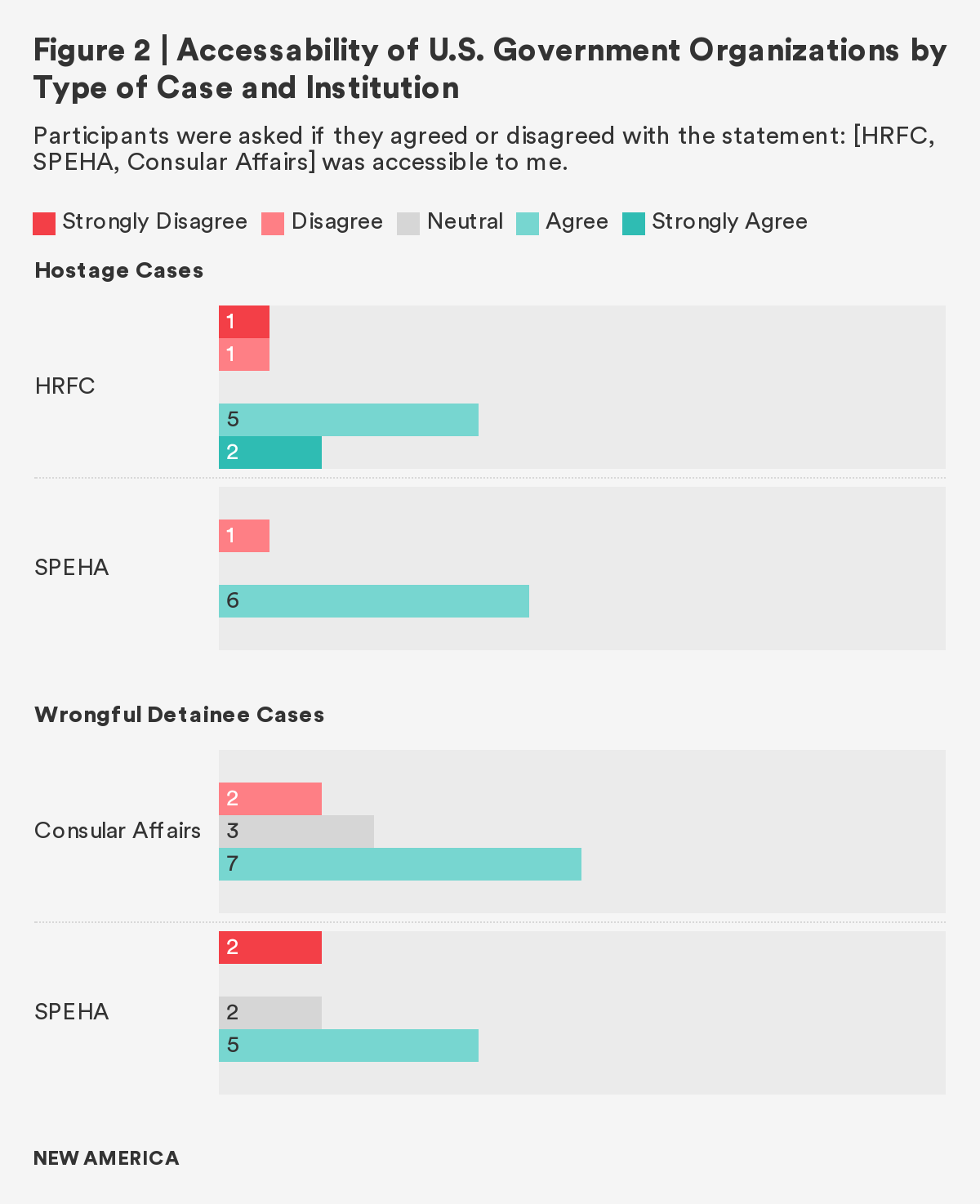
The majority, (seven of nine) hostage participants agreed (five) or strongly agreed (two) that the HRFC was accessible to them. The remaining participants disagreed (one) or strongly disagreed (one). The survey showed similar responses with the SPEHA’s office, where six of seven hostage participants agreed that the SPEHA was accessible to them. Only one participant disagreed that the SPEHA was accessible (Figure 2).
Most hostage participants agreed that they can reach out and call the HRFC at any time of the day. Other participants, however, expressed a decrease in accessibility to the HRFC with one participant sharing, “it had once been accessible but is not anymore, even with ongoing issues and concerns.”
While a majority of hostage participants agreed that the SPEHA’s office was accessible, some respondents shared their concerns over having less access to the SPEHA’s office due to the loss of Special Envoy Robert O’Brien when he was appointed national security advisor, and other personnel within the office. One participant shared that “it has been taking the SPEHA’s office longer to respond to our emails and requests” since the departure of O’Brien.
Wrongful Detainee Participant Responses
A slight majority, (seven of twelve) wrongful detainee participants agreed that Consular Affairs was accessible to them while the remaining participants strongly disagreed (two) or neither agreed nor disagreed (three). The perception of the SPEHA’s office was similar, showing a slight majority (five of nine) participants who agreed that the SPEHA’s office was accessible, while the remaining participants strongly disagreed (two) or neither agreed nor disagreed (two) (Figure 2). It is important to note that out of the eight wrongful detainee cases represented in this study, seven of the cases were recognized as wrongful or unlawful by the U.S. government, while one was not.
One family advocate shared that the family they were supporting “had to work way too hard to get the State Department’s attention and help.” Other participants shared similar responses, saying that “sometimes [Consular Affairs] will answer and other times they don’t. I had to use a third party to get any attention.” Another participant shared, “it took five months for Consular Affairs to initially respond to our case. No one returned phone calls or emails.”
Another participant expressed, “I started out trying to engage with the State Department at all levels, all the way up to the deputy secretary of state. My focus has more recently been shifted to the National Security Council because there seems to be a level of infighting going on at the lower level of the State Department and there seems to be differences [of opinion] in how my loved one’s case should be handled.” That participant continued, saying, “we’re going to the National Security Council to push for clarity on who is working on my loved one’s case so that there is some sort of continuity on how they are going to move forward.”
Access to the SPEHA’s office was solely dependent on whether a participant’s case was considered a wrongful detention. Participants shared that they remained working with Consular Affairs until their case was classified as a wrongful detention by the U.S. government. Several participants expressed their concern over not having access to the SPEHA because they believed that their case was “really a hostage situation because [my loved one] is really being held as a political pawn. At some point, working with Consular Affairs is not enough because we need a diplomatic solution to our case.”3
Even though wrongful detainee participants agreed that both offices were accessible, several participants shared their concerns over the high turnover rate within Consular Affairs and the SPEHA’s office. For example, one participant shared, “when turnover occurs, it puts a hard stop on our case.” Other participants reiterated this concern by sharing, “they [State Department] are accessible, but high turnover rate is a big problem. Each time there was a change, there’s a hard reset.” For some participants, accessibility was not the main concern, getting results was a more important issue. One participant shared, “the problem is not communication, it is getting results! I don’t feel neglected, I have had several calls, I fly in for meetings, I’ve been able to meet with senior officials. My problem is getting people at State to commit to the current policy and implement it.”
Consistency and Accuracy of Information
The consistency and accuracy of the information shared with hostage families was another major concern surrounding the need to improve the U.S. government’s interactions with hostage families. During the interviews for this report, participants generally expressed a lack of clear satisfaction with the consistency and accuracy of information shared with families. Prior to the implementation of EO 13698 and PPD-30, hostage families reported receiving inconsistent and sometimes contradictory information. After the implementation of PPD-30, 2019 respondents reported a significant increase from pre-PPD-30 respondents regarding consistency and accuracy of the information they received from the U.S. government.4 During the interviews for the 2020 report, participant responses showed a decrease in the satisfaction with the consistency and accuracy of information shared with families compared to 2019 responses.
Hostage Participant Responses
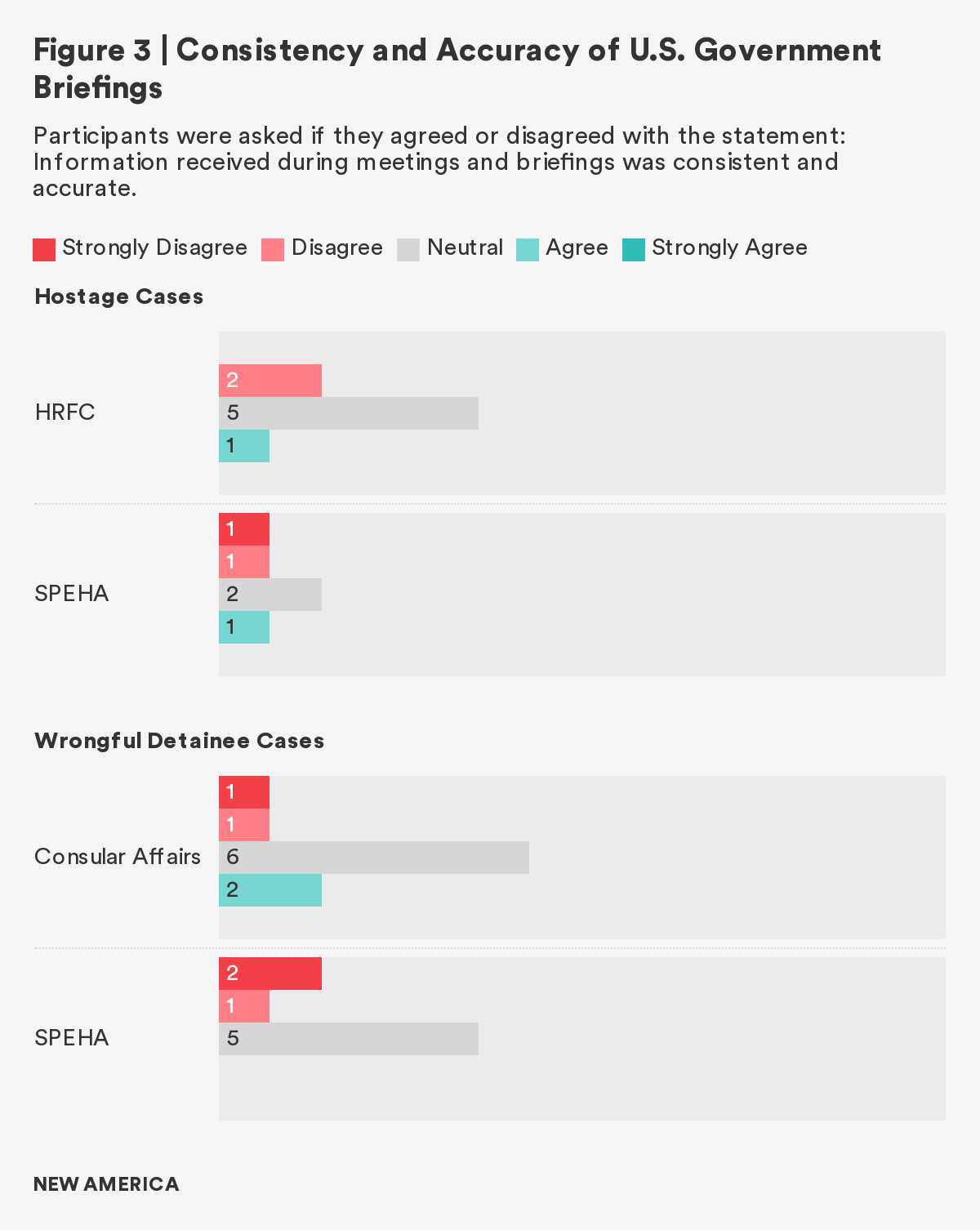
The majority (five of eight) hostage respondents neither agreed nor disagreed that they received consistent and accurate information from the HRFC. Two participants disagreed while only one participant agreed that the HRFC was consistent and accurate when sharing information about their case. Regarding the SPEHA’s office, only one individual agreed that the SPEHA’s office provided accurate and consistent information about their case while one participant strongly disagreed and another disagreed, and two neither agreed nor disagreed (Figure 3). A typical response from family members was that the SPEHA’s office did not provide “enough information on their part. It's mostly us giving them information instead of them giving us information.”
Wrongful Detainee Participant Responses
The majority (six of ten) of wrongful detainee respondents neither agreed nor disagreed that they received consistent and accurate information from Consular Affairs. Others strongly disagreed (one), disagreed (one), or agreed (two). With regard to the SPEHA’s office the majority (five of eight) of respondents neither agreed nor disagreed that they received consistent and accurate information. The remaining respondents strongly disagreed (two) and disagreed (one) (Figure 3).
Overall, the largest issue wrongful detainee families raised about consistency and accuracy of information being shared at the Department of State was related to their concern over the “really high” turnover rate. One family shared, “we don't get a lot of information. There’s also a high turnover rate which leads to a lot of misinformation. Our points of contact change constantly. We’ve had 3-4 different points of contact at Consular Affairs.”
Other wrongful detainee families shared that they requested weekly calls from Consular Affairs because they grew tired of not receiving any information and claimed that this was because Consular Affairs was short staffed. Family members, therefore, settled on bi-monthly updates. “It’s still frustrating because we are not receiving the allotted 30 minutes and are asked questions that they [Consular Affairs] should already know.” This leads some family members to believe that Consular Affairs is “filling the time up by asking questions that are already in the file.”
Another family shared their frustration because they are “not being updated by anyone at State and have to continue to request meetings to get any information whatsoever. So, it’s difficult, all of my answers are predicated [on whether] I would have any meetings at all if I wasn’t bugging people constantly.”
Regarding wrongful detainee interactions with the SPEHA’s office, some families expressed how much they liked working with former Special Envoy Robert O’Brien, but responses became very limited and “hard to comment” on because the SPEHA’s position has been vacant for so long.
One family member commented on the difficulty of getting a point of contact at the SPEHA’s office and that it was really “up to us to get information.” In addition, another family shared their impression that not having an appointed SPEHA left the office with limited influence to make decisions that would benefit their loved one’s case. One participant shared, “they are doing what they can but [they] are not in the position to make decisions as much as they would like to.”
Understanding of U.S. Departmental Roles
JWFLF’s 2019 report showed that the implementation of PPD-30 had an important impact on family members’ understanding of the roles and responsibilities of the various organizations within the U.S. government’s hostage enterprise.5 JWFLF asked its participants if they understood the role the HRFC, SPEHA, and Consular Affairs played in support of hostage or wrongful detainee recovery. Hostage respondents to this year’s report generally understood the roles of the HRFC and SPEHA, though some indicated they did not. Wrongful detainee respondents were somewhat more mixed in their assessment of whether or not they clearly understood the role of Consular Affairs.
Hostage Participant Responses
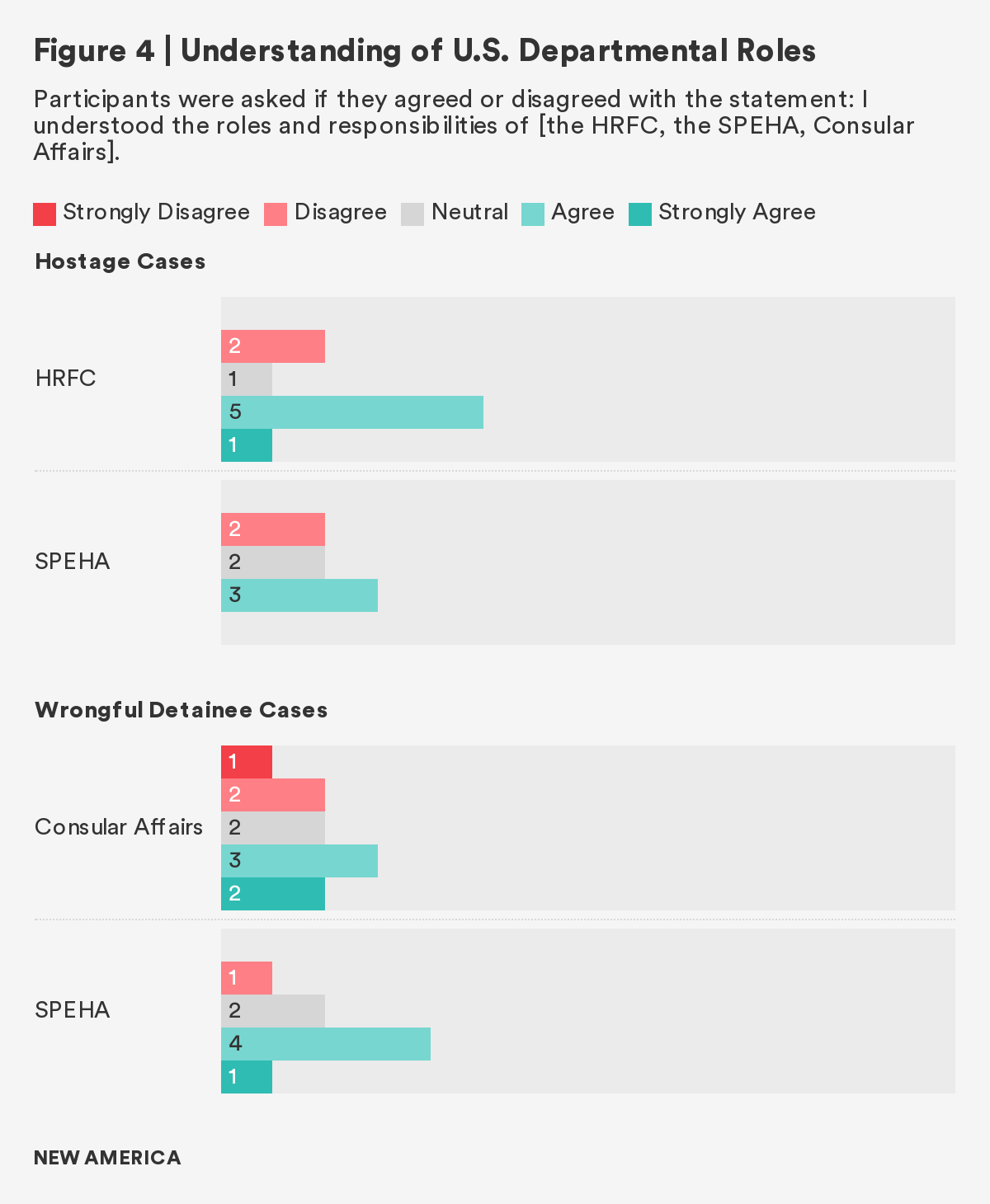
The majority (six of nine) of hostage participants who interacted with the HRFC strongly agreed (one) or agreed (five) that they had a clear understanding of the role the HRFC plays in support of hostage recovery and family engagement. Other participants either disagreed (two) or neither agreed nor disagreed (one). Regarding the SPEHA’s office, three participants agreed and two participants disagreed. The remaining two participants neither agreed nor disagreed that they understood the role the SPEHA’s office played in support of hostage recovery (Figure 4).
A common frustration shared by participants was confusion about whether the HRFC or SPEHA’s office was the lead agency in their loved one’s case. One family member shared, “I’m not sure who has the lead on our case. You don’t know when to go to either the SPEHA or HRFC.” Another family member shared, “I don’t know who I’m supposed to be talking to.” In some cases, the confusion appeared to have been based mostly on poor communication with the families, rather than interagency coordination. In other cases, there was confusion within the organizations themselves. According to one participant, neither the HRFC nor the SPEHA’s office was clear on which organization should be leading their case. This confusion within the hostage recovery enterprise was particularly upsetting for hostage participants, who were frustrated that bureaucratic confusion could hamper efforts to secure their loved ones’ releases and extend their loved ones’ arduous captivities.
Wrongful Detainee Participant Responses
Wrongful detainee participants reported mixed levels of understanding of the role of Consular Affairs. Half (five of ten) of JWFLF’s participants who interacted with Consular Affairs strongly agreed (two) or agreed (three) that they had a clear understanding of the role that Consular Affairs played in support of their loved one’s recovery. Others strongly disagreed (one), disagreed (two), or neither agreed nor disagreed (two) (Figure 4).
One participant expressed, “I'm having a hard time nailing down what exactly Consular Affairs is and what it's doing. I'm not sure exactly who I'm talking to. Initially, I thought Consular Affairs was responsible for participating in the negotiating, but recently was told they were not. So, I do not know who I've been talking to and what their roles are. I'm trying very hard to understand what Consular Affairs is.”
Other participants had a better understanding of the role of Consular Affairs. One participant explained that the office was responsible for visiting their family members in prison and checking on their overall wellness. Consular officers try to determine if their loved one is being fed, receiving legal representation, and whether they are being subjected to inhumane treatment such as torture and solitary confinement. However, these same participants were unclear if Consular Affairs was responsible for engaging with foreign governments in a more diplomatic manner. This concern was raised after a participant expressed concerns that the support they were receiving from Consular Affairs was insufficient to secure the release of their loved one. “It’s really a hostage situation,” the participant said, “because [my family member] is really being held as a political pawn. At some point, working with Consular Affairs is not enough because we need a diplomatic solution to our case.”
Most wrongful detainee participants who interacted with the SPEHA’s office (five of eight) strongly agreed (one) or agreed (four) that they had a clear understanding of the role the SPEHA’s office played in recovery of their loved one. One family member disagreed and the remaining two participants neither agreed nor disagreed (Figure 4). While wrongful detainee participants generally understood the role of the SPEHA’s office in their loved one’s case, there was some confusion about what tools the SPEHA had to secure their loved one’s release. “Can they make concessions?” one wrongful detainee participant asked, “Can they provide aid [to a foreign government]? Arrange prisoner swaps? What can the SPEHA’s office legally do?”
Information Sharing
Information sharing was a challenge raised by several participants in JWFLF’s initial 2019 examination of the U.S. government’s reorganization of its hostage recovery enterprise.6 This trend continued in the interviews undertaken as part of this report, with many of the same issues reappearing in the comments from JWFLF’s participants in this year’s responses. Hostage participants, in general, remain concerned about the level of completeness of the information they receive, while wrongful detainee participants were generally dissatisfied with the level of communication from the U.S. government related to their loved one’s case.
Hostage Participant Responses
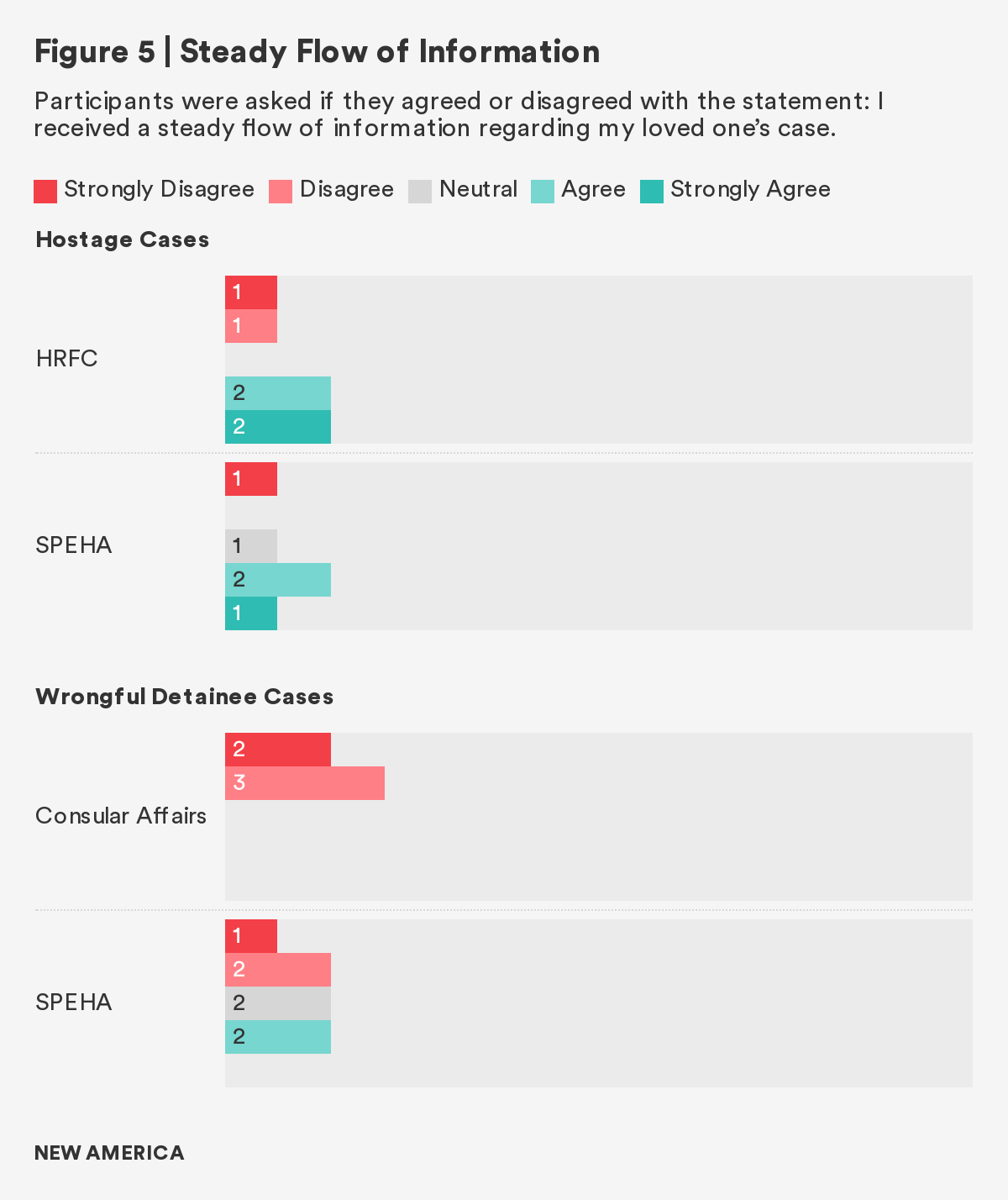
The majority (four of six) of participants who interacted with the HRFC strongly agreed (two) or agreed (two) that they received a steady flow of information regarding their loved one’s case. Other participants disagreed (one) and strongly disagreed (one). The same question yielded similar results regarding the SPEHA’s office. The majority (three of five) agreed (two) or strongly agreed (one). The remaining participants neither agreed nor disagreed (one) and strongly disagreed (one) that they received a steady flow of information regarding their loved one’s case (Figure 5).
“I have found when there is important information,” one participant shared, “I receive it right away from the HRFC.” Participants shared that the government also kept families informed about broader concerns within the hostage community. “The HRFC and Victim’s Services were great about letting families know about other releases before it hit the news,” another participant shared.
Other hostage participants were much less satisfied with the U.S. government’s information sharing. One participant said that they felt that the government shared “insufficient information” regarding their loved one's case, which left them feeling as though they did not “have all the details” and that they had no choice but to “trust [the U.S. government] blindly.” Another participant noted that “there has been very little information that has come from the U.S. government” about their loved one’s case. These experiences left the participant with very little confidence that the U.S. government would find a solution for their loved one’s case.
Regardless of their level of satisfaction with the government’s information sharing, most hostage participants brought up frustrations with the declassification of information within both the HRFC and the SPEHA’s office. Participants, broadly, expressed a desire to have increased access to information surrounding their loved ones’ cases, including complete, full, and timely access to all information and activities pertinent to the case. Participants expressed concerns with the restrictions placed on the U.S. government’s ability to declassify information and its willingness to do so. Several participants requested that the government create a mechanism through which they could receive an interim, limited security clearance in order to allow them to view the classified material pertinent to their case.
Another concern raised by hostage participants was information sharing between the government and third-party intermediaries (TPIs) working on behalf of the hostage family. One participant noted that, while the U.S. government will share information with them, they cannot share it with their TPI. “I find it a hindrance,” the participant said. “I have a person who is doing a lot of work, but the [government] is not working with him.” “I can’t utilize the information,” the same participant explained, “but if I have a person working on my behalf who can, then why can’t I share the information?” “I don’t get the sense that the government is trying to push [TPIs] aside,” said another participant. “When it comes to the bigger issue of what they're able to share, however,” the participant continued, “it's stifled.”
Wrongful Detainee Participant Responses
All the wrongful detainee participants strongly disagreed (two) or disagreed (three) that they had received a steady flow of information regarding their loved one’s case from Consular Affairs. Results were slightly more favorable from the SPEHA’s office where two participants agreed, two neither agreed nor disagreed, and the remaining participants disagreed (two) or strongly disagreed (one) (Figure 5).
Similar to hostage participants, one of the main concerns wrongful detainee participants shared involved classification issues. Participants shared that they were constantly being told, "we can't talk about that," "you don’t have a clearance," and "that’s classified." Some participants, in an attempt to find someone within the U.S. government who would share information, established relationships with Congressional staffers. “Even with Congress,” one participant shared “we'll ask what the State Department is saying, and they'll say, ‘not much.’ When the State Department does share information with Congress and we ask what was said, we get the same response as from State. ‘It’s classified.’” “What do we need to do to get past what is classified,” one participant asked in exasperation, “because we need to know more!” Others shared, “we get a little bit [of information] here and there, but mostly it’s us giving [the government] information.”
Another frustration raised by wrongful detainee participants involved a lack of interagency coordination and information sharing. “I have to be the one going from department to department, agency to agency, to share information, not only for my [loved one], but for the efforts of other departments and agencies as well,” shared one wrongful detainee participant. “If we don’t push for information, it’s not happening,” another wrongful detainee participant said.
Overall, wrongful detainee participants showed a level of fatigue from repeated disappointments with government information sharing about their loved one’s case. One wrongful detainee participant commented with frustration, “we’re not getting enough information whatsoever!” Another participant shared, “we have more to tell them then they have to tell us. That’s what the phone calls are for; not to give us information, but for them to get their information through us.” Some participants expressed doubts that the Department of State has any information, leading them to question whether the government is working on their loved one’s case at all. Additionally, participants are getting tired of hearing that they have “good ideas,” but that government officials are “going to see what happens.” Participants also expressed frustration that they did not receive updates about their loved ones’ cases. Instead, participants shared that they were told not to worry if they didn’t “see anything in the media, or if it’s not public, or if you don’t hear about it, or if we don’t tell you about it, that doesn’t mean that it’s not happening.” “It’s become normal,” one participant shared, “you get used to the response. It is what it is.”
Recovery Efforts Shared with Hostage and Wrongful Detainee Participants
A significant part of the U.S. government’s hostage review in 2015 and the subsequent changes directed by EO 13698’s restructuring of the government’s hostage enterprise was an attempt to sync up what President Obama described as “sincere, relentless efforts within the government” with hostage families. This, he believed, was an important step in ensuring hostage families, were treated as partners in the effort to recover their loved ones.7 This partnership is important to the families of hostages and wrongful detainees who have the most to lose from the continued captivity of their loved ones or from the consequences of a failed military rescue.
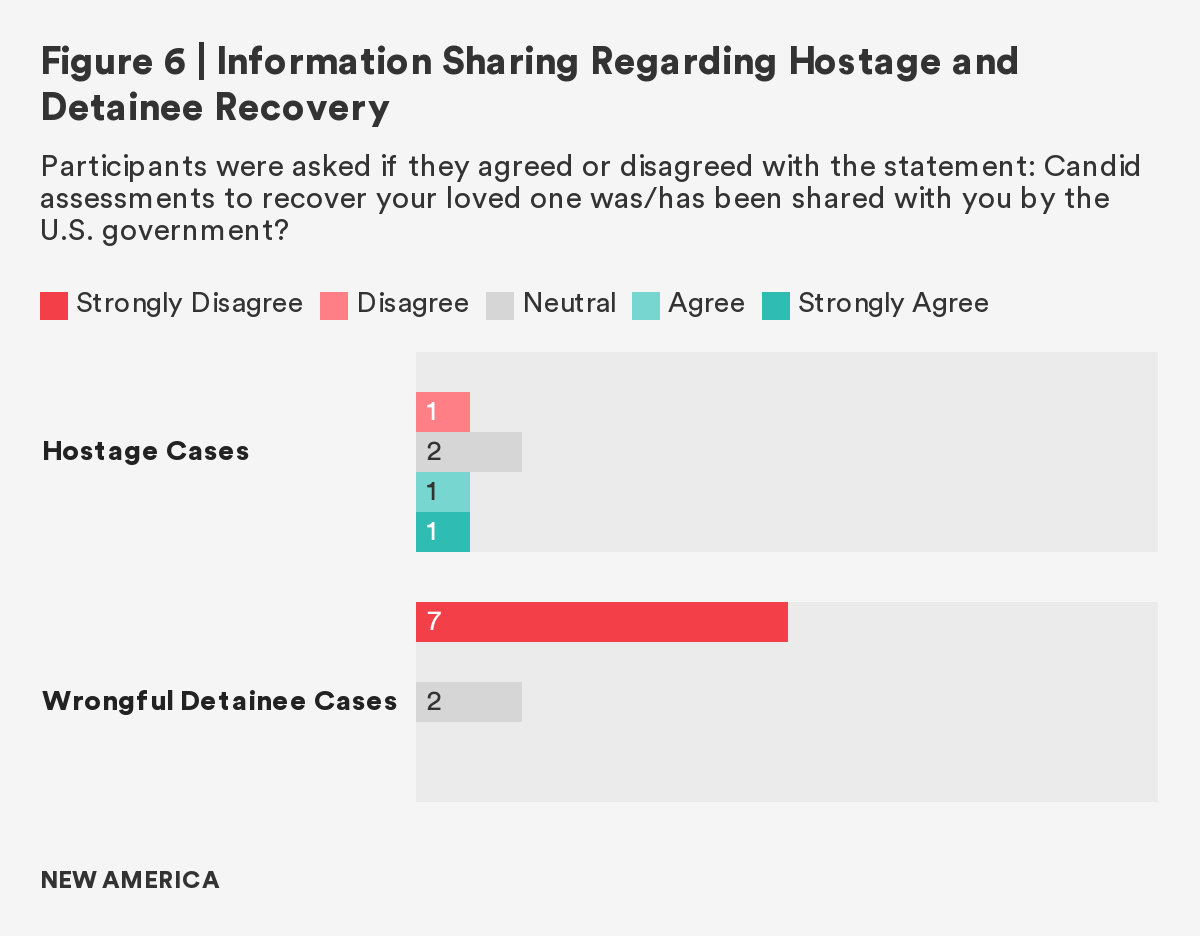
In the interviews with the 2019 and 2020 participants, JWFLF asked questions about the level of information sharing regarding recovery efforts.8 In the 2019 report, pre-PPD-30 participants generally disagreed that the U.S. government shared information regarding hostage recovery plans while post PPD-30 participants generally agreed that they did. In the interviews conducted for the 2020 report, hostage responses are mixed, while wrongful detainee responses are overwhelmingly negative (Figure 6). Hostage and wrongful detainee participants were most concerned with the U.S. government’s ability to recover their loved one and its openness in sharing candid assessment of recovery efforts.
Hostage Participant Responses
JWFLF asked its participants if the U.S. government shared candid recovery assessments for their loved ones. Of the five responses, two participants strongly agreed (one) or agreed (one), two neither agreed nor disagreed, and the remaining respondent disagreed (Figure 6).
While 2020 hostage responses were similar to 2019 post-PPD-30 responses, showing improvement in the provision of candid assessments regarding sharing recovery options after the implementation of PPD-30, there still remains concern over coordination between the HRFC and the Department of Defense.9
Some participants shared their concerns that the Department of Defense was withholding information from the HRFC and acting unilaterally without notifying the HRFC about details and the current status of their case. One participant expressed their “deep concern” about the risk that these unilateral operations might have on hostages broadly. Some participants argued that the HRFC’s standing within the U.S. government should be increased in order to prevent the Department of Defense from bypassing the HRFC.10
In addition to coordination of all the departments and agencies working towards the release of a hostage, bold leadership, lack of intelligence, and honesty and transparency were issues raised by participants. Participants shared their view on leadership attributes that they view as critically important to ensuring that their loved ones are released. They were particularly concerned that U.S. officials should have strong leadership skills that could affect change by influencing and engaging with top U.S. officials, as well as liaise and engage with multiple departments and agencies. From the participants’ perspective, the personality of the leadership in organizations working towards the release of their loved ones had a non-trivial impact on the safe return of their loved ones.
In addition, several participants indicated that they would like more transparency from the U.S. government regarding what the government can and cannot do to secure their loved one’s return. Participants also wanted more honesty about what the government is willing to do to bring their loved one home and what the government is unwilling to do. Other participants were less optimistic about the U.S. government’s ability to bring their loved ones home, citing minimal intelligence and influence in the areas where their loved ones are held.
Wrongful Detainee Participant Responses
When asked whether the U.S. government shared candid recovery assessments for their loved ones, the responses of wrongful detainee participants in the 2020 report mirrored those of pre-PPD-30 participants in the 2019 report.11 The majority (seven of nine) of wrongful detainee respondents strongly disagreed that the U.S. government shared information with them regarding recovery plans and strategies for their loved ones. Two participants neither agreed nor disagreed (Figure 6).
The interviews underscored the difficulty of securing the release of wrongful detainees, especially in cases where the foreign governments holding American nationals consider them leverage over the U.S. government. This is increasingly difficult when there are negative relationships between that government and the United States, a commonality in most wrongful detainee cases. These dynamics make the role of diplomacy an important part of recovery strategies for wrongful detainees. In addition, participants highlighted the importance of the SPEHA’s role in working with third party countries to influence foreign governments to release U.S. nationals.
Other families shared their frustration over not receiving any type of recovery plans or options to help bring their loved ones home. One participant shared, “we are not given any sort of sense where [loved one’s case] is within our government. I don’t know of any efforts in process.”
Often, adversarial governments willing to hold Americans as leverage will be holding more than one U.S. national. Wrongful detainee participants also shared their concerns about securing the release of their loved ones in these situations. Participants expressed their desire to know if the government had a coordinated plan to secure the release of all Americans held by the foreign government. Several wrongful detainee participants shared their confusion about what the release of a U.S. national meant for their loved one. One wrongful detainee shared, “Does one release indicate [the foreign government] is willing to continue negotiating or does it mean we missed our chance to get our loved one out? We don’t know.” Participants expressed concerns that the U.S. government’s departments and agencies may not be coordinated in their approach and that actions by one part of the government to secure the release of a wrongfully detained American might have an adverse impact on their loved ones.
Overall, bold leadership, intelligence, coordination, and communication between U.S. government departments and agencies, government response (diplomacy and military action), and third-party country and intermediary interactions were identified as important components required to recover an American held hostage or wrongfully detained abroad.
Prioritization of Hostage and Wrongful Detainee Cases
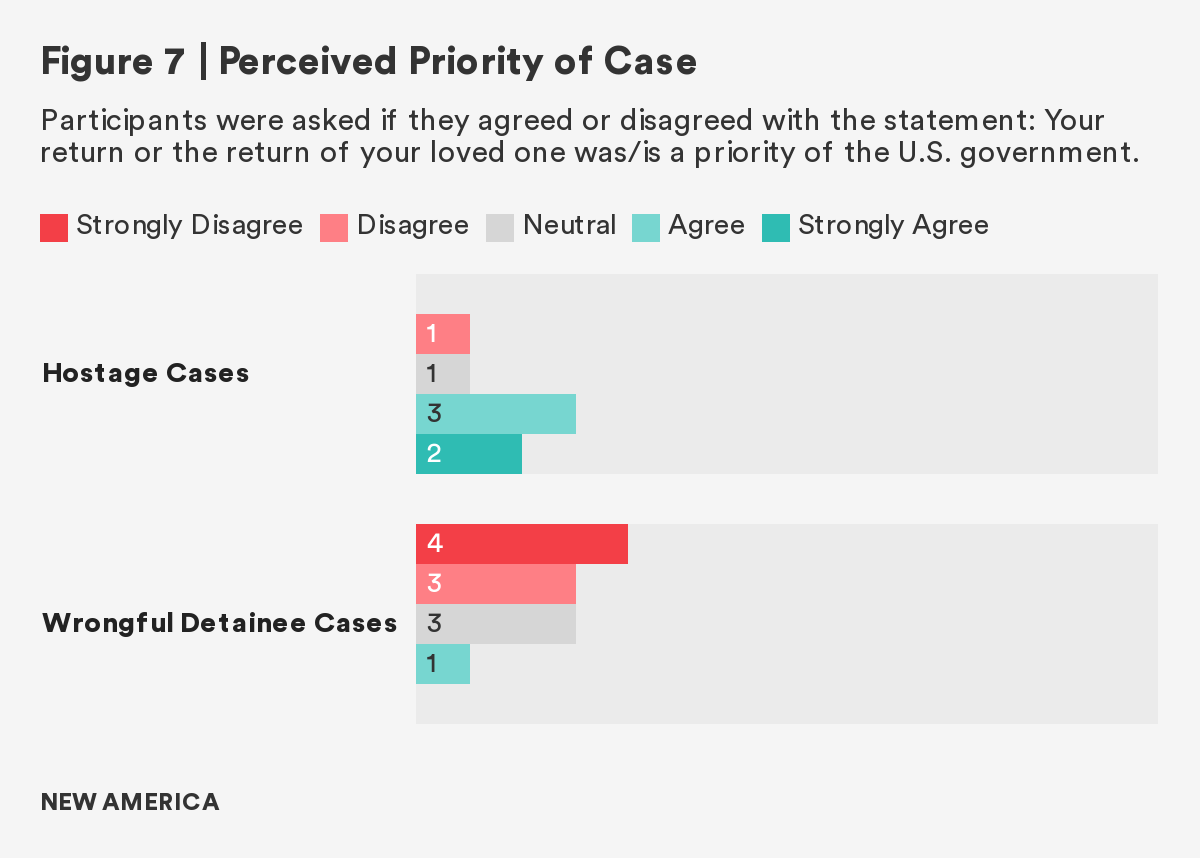
In JWFLF’s initial 2019 assessment of the efficacy of PPD-30’s implementation, the discussion of whether families of hostages and detainees felt as though the U.S. government considered their loved one’s case a priority was one of the most polarizing issues. Family members of hostages and detainees who interacted with the U.S. government prior to the implementation of PPD-30 often disagreed in the strongest possible terms that their loved one’s case was a priority for the U.S. government. Those family members who interacted with the U.S. government after the implementation of PPD-30 tended to agree that the U.S. government considered their loved one’s case a priority.12 In this year’s report, hostage participants generally agreed that the U.S. government considers their case a priority. The families of wrongful detainees, on the other hand, when asked about their perspective of whether the U.S. government considered their loved one’s case a priority had negative responses similar to those of the families of hostages prior to the implementation of PPD-30.
Hostage Participant Responses
The majority (five of seven) of hostage participants said that they agreed (three) or strongly agreed (two) that their loved one was a priority of the U.S. government. One respondent neither agreed or disagreed and the other respondent disagreed with the statement that they believed their loved one’s cases were a priority of the U.S. government (Figure 7).
One of the main issues hostage families raised was their concern that the HRFC and SPEHA’s office do not have enough authority to push their loved one’s case to the priority level they think is required to achieve a resolution of their case.13 Families understand that the release of their loved ones is in competition with other national security concerns. Their request, however, is that their loved one’s case be “one of the top priorities.” One family member commented, “if they don’t have a seat at the table [National Security Council Deputies Committee], it’s a lot harder to have hostage issues as a top priority.” Several participants responded favorably to the former SPEHA, Robert O’Brien, becoming the national security advisor. From their perspective, this potentially raises the priority level of their loved one’s case. One hostage family member who developed a good relationship with O’Brien responded, “having someone working at a higher level on our behalf raises the priority of my [loved one’s] case.”
Hostage families also raised concerns about the vacancy in the SPEHA position at the Department of State created by O’Brien’s assumption of the national security advisor position.14 Overall, families viewed the vacancy as an indicator that hostage issues were not a top priority of the administration. Working with an acting SPEHA resulted in fewer attempts to coordinate diplomatic efforts overseas in addition to personnel gaps within the SPEHA’s office that limited the ability of the office to carry out the duties and responsibilities of the SPEHA.
Additionally, families expressed their desire to see more action and follow through from the government based on the discussions and plans presented to them during meetings and briefings with the HRFC and SPEHA’s office.
Wrongful Detainee Participant Responses
The majority (seven of eleven) of wrongful detainee participants strongly disagreed (four) or disagreed (three), that their loved ones were a priority of the U.S. government. An additional three other participants neither agreed nor disagreed and only one family member agreed that that their case was a priority of the U.S. government, stating, “my case only became a priority after receiving Congressional attention” (Figure 7).
Wrongful detainee families responded similarly to hostage families in expressing a desire for engagement at higher levels of government. One wrongful detainee participant shared that by not having “the highest levels of government” highlighting their case, “shows the lack of priority the U.S. government places on us.” Another participant shared that “it would show [our loved one’s case] is a priority if the president, secretary of state, or national security advisor would publicly address their case.”
Several wrongful detainee participants expressed their frustration with the Department of State over having to go to numerous meetings without learning anything noteworthy about their case. One participant shared that such meetings “show that they don’t take the case seriously and [it] is not a priority of the U.S. government. They were asking about the place my [loved one] was held. They knew nothing about the case. New people come in and have no idea about the case, asking me what I can tell them about my [loved one’s] case. To not know, really breaks your heart. That’s why I get the sense that we’re not a priority.”
Other participants stressed the difficulty of getting the Department of State to make their case a priority. Some participants recognized that the priority level of their case was dependent on their ability to advocate for their loved one. These participants recognized the importance of having legal support or a human rights advocate in the Washington, D.C. area to be able to help increase the priority level of their loved one’s case. One family member shared that “it’s beneficial to be able to interact with decision makers, people who set the policies, and people who can set into motion the recovery of your loved one.”
Overall, wrongful detainee participants are desperate to get their loved ones out and want their cases to be a high priority of the U.S. government. One family member stated, “I want [my loved one] to be a priority, because if they stay in there any longer, they’re not going to make it! … All they [the U.S. government] say is that all hostages and detainees are a priority. I want them to say that my [loved one] is a priority!”
Understanding of Laws and Policy
The reforms enacted by EO 13698 and PPD-30 were designed to improve the government’s effectiveness in bringing home American hostages and to help clarify the U.S. government’s hostage policy. A key theme in JWFLF’s 2019 assessment of PPD-30’s implementation was a lack of clarity of the U.S. government’s hostage policy prior to PPD-30. After PPD-30, family members indicated they had more clarity about the U.S. government’s hostage policy, but lacked clarity on other issues, specifically the issue of whether family members and their intermediaries could be prosecuted for the payment of ransoms.15 JWFLF again asked its participants during interviews for this report about their understanding of these laws and policies. The resultant discussions, below, demonstrate a continued lack of clarity about issues surrounding ransom amongst hostage families. Wrongful detainee families again shared narratives consistent with pre-PPD-30 hostage families, signaling confusion about the U.S. government’s policies surrounding wrongful detainee cases.
Hostage Participant Responses
Hostage participants generally understood U.S. hostage policy, although some who have had less experience working with the government expressed confusion about all the nuances and provisions of PPD-30. The biggest area of confusion for hostage participants, as in the 2019 report, centered around the U.S. government’s stance on the private payment of ransoms to secure the release of their loved ones.
The payment of a ransom to secure the release of a hostage can technically be considered a provision of “material support” to a designated terrorist organization, conduct which is criminalized under U.S. criminal code.16 Prior to the implementation of PPD-30, some hostage families were threatened with prosecution if they paid a ransom to secure the release of their loved one. After the 2015 Hostage Policy Review, the U.S. government reaffirmed its stance against providing concessions, including the payment of ransoms, to terrorist groups. At the same time, the Department of Justice released a statement highlighting the fact that no families of hostages had ever been prosecuted for paying a ransom to secure the release of their loved one.17
Hostage participants expressed concerns that, despite the Department of Justice’s statement, “nothing is in writing. It can change instantly.” Hostage participants also expressed confusion about how far the freedom from prosecution would extend. “If I were to pay a ransom,” said one hostage participant, “I couldn’t go pay it myself, I’d have to send a negotiator. Would they be exempted from prosecution as well?” Other hostage participants expressed similar concerns, asking whether banks and/or financial donors would be safe from prosecution as well.
The U.S. government likely has legitimate reasons for this public lack of clarity. If it is clear that the U.S. government supports the payment of private ransoms, terrorist groups could be better positioned to pressure families to pay ransoms. At the same time, the government is not adequately explaining the nuances of its position to hostage participants behind the scenes, which would allow them to be able to make informed decisions on how to best secure their loved one’s release.
Wrongful Detainee Participant Responses
Unfortunately, wrongful detainee families identified difficulties understanding laws and policies regarding their cases. One participant said, “I have no idea what the current policy is. I didn't know there was one until you just mentioned that.” Another participant expressed frustration over still not having a clear definition of what makes one individual a hostage and another a wrongful detainee. One more wrongful detainee participant discussed their frustration trying to get a clear definition of what made a detention wrongful, triggering access to the SPEHA’s office. Aside from a lack of clarity over the definitional differences between hostages, detainees, and wrongful detainees, wrongful detainee participants also shared a lack of clarity on what the SPEHA’s office was legally allowed to do to support their loved one’s case. The SPEHA’s diplomatic role was clear, but according to one wrongful detainee participant, it was unclear what the SPEHA’s office was legally authorized to do. “What are their legal obligations,” the participant asked, continuing, “What tools do they have? How are they best supposed to support wrongful detainees?”
These experiences were very similar to those pre-PPD-30 hostage families shared in the 2019 report.18 This lack of clarity is a major stressor for the families of wrongful detainees, increasing frustration during an already extraordinarily challenging experience. Participants have consistently shared a desire to be told the truth, even if that truth is difficult. For these participants, having a consistent definition of a wrongful detention case, even if that means their loved one is not considered one, at least helps them understand how to best move forward advocating for the release of their loved one. In addition, having clarity on what the SPEHA’s office can achieve helps them know when they need to find support outside of the U.S. government.

Bringing Americans Home 2020
- Foreword
- Executive Summary
- 1. Introduction
- 2. Perceptions of the U.S. Government’s Hostage Recovery Enterprise
- 3. Key Concerns Amongst Hostage and Detainee Families
- Conclusion
- Appendix A: Current Needs, Requests, and Recommendations from Hostage Participants
- Appendix B: Current Needs, Requests and Recommendations from Wrongful Detainee Participants
- Appendix C: Hostage Interview Responses
- Appendix D: Wrongful Detainee Interview Responses
Citations
- Loertscher, “Bringing Americans Home: The First Non-Governmental Assessment of U.S. Hostage Policy and Family Engagement.”
- Loertscher, “Bringing Americans Home: The First Non-Governmental Assessment of U.S. Hostage Policy and Family Engagement,” 74–76.
- See the third section of this report on key concerns among hostage and detainee families for a more in-depth discussion of this issue.
- Loertscher, “Bringing Americans Home: The First Non-Governmental Assessment of U.S. Hostage Policy and Family Engagement,” 44.
- Loertscher, “Bringing Americans Home: The First Non-Governmental Assessment of U.S. Hostage Policy and Family Engagement,” 47.
- Loertscher, “Bringing Americans Home: The First Non-Governmental Assessment of U.S. Hostage Policy and Family Engagement,” 32–34.
- “Statement by the President on the U.S. Government’s Hostage Policy Review” (White House Office of the Press Secretary, June 24, 2015),
- This discussion uses the term “recovery efforts” to mean all options to secure the release of U.S. nationals held hostage or wrongfully detained, including: diplomatic engagement to facilitate releases; coercive diplomatic efforts, like sanctions to pressure foreign governments; negotiations facilitated by third parties; and military efforts. like hostage rescue operations.
- Loertscher, “Bringing Americans Home: The First Non-Governmental Assessment of U.S. Hostage Policy and Family Engagement,” 32, 42.
- See the third section of this report on key concerns among hostage and detainee families for a more in-depth discussion of this issue.
- Loertscher, “Bringing Americans Home: The First Non-Governmental Assessment of U.S. Hostage Policy and Family Engagement,” 33–43.
- Loertscher, “Bringing Americans Home: The First Non-Governmental Assessment of U.S. Hostage Policy and Family Engagement,” 37.
- See the third section of this report on key concerns among hostage and detainee families for a more in-depth discussion of this issue.
- See the third section of this report on key concerns among hostage and detainee families for a more in-depth discussion of this issue.
- Loertscher, “Bringing Americans Home: The First Non-Governmental Assessment of U.S. Hostage Policy and Family Engagement,” 26–30.
- Providing Material Support or Resources to Designated Foreign Terrorist Organizations, 18 U.S.C. § 2339B (2016).
- “Department of Justice Statement on U.S. Citizens Taken Hostage Abroad” Department of Justice Office of Public Affairs, June 24, 2015),
- Loertscher, “Bringing Americans Home: The First Non-Governmental Assessment of U.S. Hostage Policy and Family Engagement,” 26–27.