A Chapter of: The 5.9 GHz Band
The Rise of 5G and the Imperative of Gigabit-Fast Wi-Fi at 5 and 6 GHz
During the two decades that the 5.9 GHz band has sat idling, Wi-Fi has emerged as an essential pillar of our wireless ecosystem and an essential enabler of affordable connectivity in homes, workplaces, and schools, and for the productivity of a broad and diverse set of industries. The FCC acknowledged Wi-Fi鈥檚 critical role in the economy in its 6 GHz NPRM, stating: Wi-Fi 鈥渉as become indispensable for providing high data rate local area network connections for smart phones, tablets, mobile computers, and other devices to interconnect and access the Internet. Wi-Fi has also enabled the offloading of data from commercial wireless networks… and it has provided a means for devices throughout the home to wirelessly interconnect.鈥�1
The 5.9 GHz band is increasingly a key part of the potential solution to the 鈥渟pectrum crunch鈥� in unlicensed bands, and as a means of accelerating both the availability and affordability of 5G-capable connectivity to all Americans. Because mobile carrier 5G networks will be built out first in mostly urban, high-traffic and high-return areas, next-generation Wi-Fi will be essential to heading off a new 5G digital divide if rural, small-town, exurban, and even lower-income urban neighborhoods lack mobile carrier 5G.
5.9 GHz: A Roadblock on the FCC鈥檚 Wi-Fi Superhighway
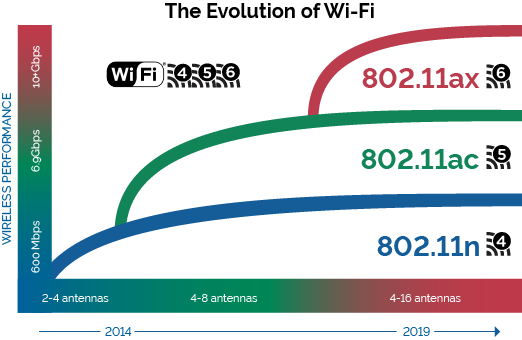
The virtually unused 5.9 GHz band has become a roadblock to an immensely valuable Wi-Fi superhighway comprised of contiguous wide channels capable of delivering gigabit-fast and affordable wireless connectivity to all of America鈥檚 homes, workplaces, enterprises, schools, and public spaces. Very soon the two primary bands for 5G-quality Wi-Fi 6 connectivity will be immediately adjacent to the 5.9 GHz band (one above and one below). The auto industry has let the band lay fallow for 20 years while both vehicle safety technology and the enormous social and economic importance of Wi-Fi in 5 GHz has passed it by.
Over that same 20-year period, Wi-Fi has become critical to broadband connectivity and to the U.S. economy more broadly. Unlicensed technologies鈥攑rincipally Wi-Fi鈥攃ontributed $525 billion in economic value to the United States alone in 2017, an impact expected to surge to more than $834 billion this year.2 Wi-Fi alone is projected to generate nearly $1 trillion in economic benefit for the U.S. economy by 2023.3 Wi-Fi also generates complementary economic benefits due to the mobile industry鈥檚 reliance on the technology for offloading mobile data. Wi-Fi cellular offloading by itself produced an estimated $25.2 billion in economic value in the United States in 2017.4

The 5.9 GHz band, if repurposed for Wi-Fi, could provide added 鈥済ains to economic welfare in the form of consumer and producer surplus of $82.2 billion to $189.9 billion,鈥� according to research from the RAND Corporation.5 A 2020 study by New York University economist Raul Katz concluded that 鈥淸o]pening 45 MHz of the 5.9 GHz band to unlicensed use will generate economic value of $23.042 billion in terms of GDP contribution, and $5.098 billion in consumer surplus between 2020 and 2025.鈥�6
Wi-Fi is particularly important for the role it plays in making mobile device connectivity faster and more affordable, notably indoors where more than 80 percent of mobile device data is consumed and where mobile carrier signals are often weak or unavailable.7 According to Cisco, 59 percent of all mobile device data traffic will be offloaded onto fixed networks through Wi-Fi by 2022.8 In January, Verizon鈥檚 Executive VP and Consumer Group CEO Ronan Dunne told a Citibank investor conference that Wi-Fi is believed to be offloading between 70 and 75 percent of mobile device data traffic.9 Charter has reported that its cable network currently supports over 300 million devices and that 80 percent of the wireless data its customers use flow over Wi-Fi directly onto Charter鈥檚 cable network.10
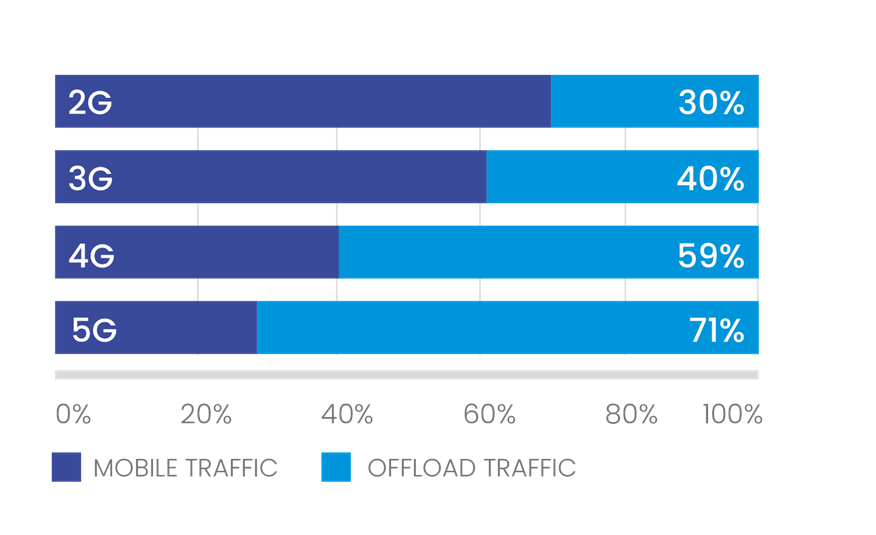
Wi-Fi鈥檚 value for mobile offloading will only increase as 5G applications become more bandwidth intensive.11 Cisco predicts that 71 percent of global 5G data traffic will be offloaded onto Wi-Fi by 2022.12 The emerging Internet of Things (IoT) will similarly make higher-capacity Wi-Fi more critical. Machine-to-machine data transfer and IoT networks are mostly dependent on unlicensed spectrum. These networks support, among many other functions, energy and environmental monitoring, mobile healthcare applications, industrial automation, and smart city operations such as intelligent transportation, smart meters, vehicle tolling, and inventory tracking. These use cases are already seeing dramatic growth with declining costs to consumers thanks to the connectivity fueled by unlicensed spectrum.13
The Surging Consumer and Business Benefits of Gigabit Wi-Fi
Wi-Fi also enables use cases that meet the critical needs of community anchor institutions and businesses of all types. Thanks to the specific characteristics of Wi-Fi and its ability to spread high-speed broadband connectivity across a wide space indoors (and outdoors), it empowers innovative applications to boost education, work, farming, office automation and many specific industry use cases.
Farming and Ranching
Wi-Fi already plays a large role in the burgeoning smart agriculture space, which is already being adopted across the country. For smart farming operations, Wi-Fi networks are preferable to LTE and 4G networks because, once deployed, they are more cost-effective to sustain, customize, and operate.14 Using Wi-Fi-enabled smart agriculture, farmers and ranchers can check data and weather conditions, as well as monitor crops, soil conditions, and animals.15 Microsoft鈥檚 FarmBeats program鈥攚hich provides complex data analytics to the farming industry鈥攊s a prime example of how unlicensed technologies such as Wi-Fi and TV white spaces can offer revolutionary advances in efficient farming techniques.16
Another example is the farm Wi-Fi network built by the company BlueTown, in partnership with the University of California鈥檚 Kearney Agricultural Research and Education Center (KARE). Each Wi-Fi access point delivers 250 Mbps throughput and provides coverage over a 250-meter radius.17 KARE鈥檚 solution collected data from sensors distributed throughout an alfalfa field that detect and review subsurface irrigation in comparison to flood irrigation.18 鈥淥ne of the nice things about the W-Fi is we can move to real-time evaluation of the data that is coming off this field,鈥� Dr. Jeffery A. Dahlberg, director of KARE, told RCR Wireless.19
Equipment manufacturers expect IoT connectivity to play a large role in the future of farming. Deere & Company has told the commission: 鈥淎s these machine populations continue to grow… the ability of farmers using Deere鈥檚 agricultural equipment and systems to improve efficiency, yield, and smart resource use will depend on their ability to leverage high speed broadband connections capable of enabling real-time M2M and machine to farm (M2F) interaction. The IoT in rural America will include not only smart meters and smart appliances, but also smart farming equipment and systems needed to drive local economies.鈥�20 Wi-Fi helps power precision farming, which in turn catalyzes cost-effective agriculture. This outcome helps small farms in particular, as these entities are more likely to be struggling for higher yields and labor efficiencies compared to their larger competitors.
Factory and Warehouse Automation
Wi-Fi and Bluetooth, another unlicensed technology, increasingly add value to factory automation and are becoming a key input to the manufacturing and goods distribution sectors more generally. Entire warehouses and production lines are equipped with customized Wi-Fi networks that monitor and administer the synchronized movements of robots, sensors, inventory tracking, and other efficiency gains.
Amazon, for example, uses unlicensed spectrum to control the robots in their enormous warehouse fulfillment centers (more than 100,000 robots as of 2017), through the use of a customized indoor network based on variations of the Wi-Fi 802.11 standard.21 Amazon relies on a secure, customized Wi-Fi network to control the robots in its warehouses.22 The robots increase efficiency. Prior to the adoption of the robot networks, warehouse workers had to individually search the shelves for a specific item and then carry it to the packing and shipping area before sending it out. Thanks to the Wi-Fi-enabled communication, robots guide warehouse employees to find packages and then transport it if the package is too heavy.23 The scurrying robots avoid employees by reading unlicensed transmissions from their Bluetooth badge.
Smaller companies have been harnessing the ability of Wi-Fi to orchestrate robots in manufacturing as well. Robotic startup, 6 River Systems (6RS), builds robots similar to Amazon鈥檚 that lead employees to shelves to find particular items, calculating the most efficient path and carrying up to 160 pounds.24 All of these functions are requiring more and more Wi-Fi capacity.25 "All they need is Wi-Fi in the warehouse," Jerome Dubois, 6RS co-founder and co-CEO, said in an interview with Forbes. "It makes it easier to implement because there's no tearing out stuff or retrofitting the facility."26
Hospitals, Schools, and Libraries
Hospitals are critical community anchor institutions that support an increasing number of applications that require higher bandwidth and strong Wi-Fi for reliability. Next-generation Wi-Fi technologies (Wi-Fi 6) will bring these internet-connected benefits (as well as telehealth), only as long as there is enough contiguous, wide-channel spectrum available. The Wi-Fi Alliance has underscored the importance of Wi-Fi for health care: 鈥淗ospitals are a perfect example of congested, high traffic, constantly changing environments that would benefit from Wi-Fi 6. Wi-Fi is common in hospitals given the many benefits it provides.鈥�27 Doctors and nurses are able to remotely monitor patients and devices, they can use interconnected devices to communicate accurate patient records and real-time data analysis, and they can send and receive real-time alerts and observation data鈥攁ll through Wi-Fi networks.28
Schools, libraries, and other educational institutions are increasingly reliant on robust Wi-Fi connectivity. Schools can only take advantage of gigabit internet connections and make simultaneous use of hundreds of laptops and other devices in a school if the Wi-Fi network has the capacity to distribute that bandwidth to every classroom and individual student. Students use Wi-Fi in school to enable individualized lesson plans, which addresses learner variability. Interactive video, virtual reality, multi-user educational gaming, and other bandwidth-intense applications will only add to this challenge. The broader public also uses Wi-Fi services in libraries to conduct research, search for jobs, and connect to services they may need internet access to use (healthcare, financial, and government services). That鈥檚 why the contiguous and wide channels at the top of the 5 GHz band and across the 6 GHz band are essential to actually realize the potential of the gigabit-fast fiber connections that nearly all local school districts are deploying with subsidies from the commission鈥檚 E-Rate program.
The evolution of the FCC鈥檚 E-Rate program, which subsidizes high-speed broadband connections at qualifying schools and libraries, shows how the educational use of internet access is changing. The high participation rate of schools and libraries in the program鈥檚 category two funding for internal connections (which most of the time refers to Wi-Fi) reflects the reality that schools have shifted from designated computer labs to an expectation that every student and teacher in every classroom has high-speed connectivity. Since the FCC modernized the E-Rate program, expanding category two funding, participation has skyrocketed. According to the FCC Wireline Competition Bureau鈥檚 2019 report on E-Rate鈥檚 category two budget, the average number of schools receiving category two funding (or pending requests) is about 45,000 per year鈥攁 525 percent increase from the time period of Fiscal Year 2008 and Fiscal Year 2012.29 Libraries went through a similar increase in participation; about 2,700 libraries per year receive category two commitments or pending requests鈥攁n 865 percent increase.30
The E-Rate program鈥檚 increasing expenditures on Wi-Fi networks are producing results. Since the FCC鈥檚 2014 reforms of the E-Rate program, 83 percent of school districts have invested in Wi-Fi upgrades, a staggering increase from 14 percent for the 2011-2014 period.31 Nearly 200 school and district leaders and over 50 education organizations stated in a FCC filing: 鈥淐ategory two services that support high-speed internet access, including reliable Wi-Fi, are vital for providing all students with a quality education to prepare them for today鈥榮 modern economy.鈥�32 Wi-Fi is also seen as crucial for libraries, as evidenced by the American Library Association鈥檚 long standing advocacy for Wi-Fi as central to supporting the expanding role of libraries as community technology centers in communities across the country.33
Using Wi-Fi to distribute a fast broadband connection to every classroom and individual student enables teachers to vary their lesson plans and meet the learning needs of individual students. According to a teacher survey of Alexandria City Public Schools in Virginia conducted by 麻豆果冻传媒, 80 percent of teachers reported that two of the most common student uses for internet-connected devices (Chromebooks, iPads, and desktop computers) are to bring a variety of instructional methods to daily lessons, and to tailor learning experiences to individual student needs.34 Three-quarters of the teachers also reported that internet-connected devices allow teachers to offer more self-directed learning and independent practice.35
Schools also deploy Wi-Fi networks outside of the classroom for teachers and students to access in football fields, theaters, gymnasiums, and all over the school鈥檚 grounds, just as most colleges and universities do today. As Zeus Kerravala, founder and principal analyst at ZK Research, said in an interview with EdTech Magazine, 鈥淭he most important reason for it is being able to expand learning capabilities outside the traditional classroom.鈥�36
The availability of Wi-Fi in libraries, coffee shops, and other public spaces such as restaurants is another essential use of Wi-Fi to advance educational needs. The availability of Wi-Fi in public spaces, particularly for students without internet access at home, is absolutely essential, as 70 percent of teachers in the United States assign homework that requires internet access to complete, a share that is substantially higher in high schools.37 Twelve percent of U.S. teenagers surveyed by the Pew Research Center reported having to use public Wi-Fi to do homework due to a lack of broadband access at home鈥攁 share that is even higher among low-income teenagers, where 21 percent of respondents said the same.38 Stories of students using free Wi-Fi at local McDonald鈥檚 locations and even on school buses due to a lack of internet service at home are a common feature of the homework gap.39
Dr. Nicol Turner Lee recently wrote of an ice cream parlor near a school that offered free Wi-Fi so that students had the internet access they needed to complete their homework. The owner wrote of the need to provide safe hotspot locations to local communities: 鈥溾�榃e sometimes have more white people here [at The Social] because [the Black students] have no transportation… I really wish that I could figure that problem out because we are here to offer a safe space for the kids to do their homework.鈥� From this statement and the general case study findings, it was also clear that there were not too many places that offered Wi-Fi or fixed broadband services to community residents.鈥�40
Citations
- Notice of Proposed Rulemaking, Unlicensed Use of the 6 GHz Band; Expanding Flexible Use in Mid-Band Spectrum Between 3.7 and 24 GHz, ET Docket No. 18-295 and GN Docket No. 17-183 (rel. Oct. 24, 2018).
- Raul Katz, Telecom Advisory Services LLC, 鈥淎 2017 Assessment of the Current & Future Economic Value of Unlicensed Spectrum in the United States,鈥� WifiForward (April 2018), available at
- In a global comparative study, Dr. Katz estimated that Wi-Fi alone generated $500 billion in economic value for the U.S. in 2018, an impact that would rise to nearly $1 trillion ($993 billion) by 2023. Raul Katz & Fernando Callorda, Telecom Advisory Services, LLC, The Economic Value of Wi-Fi: A Global View (2018 and 2023), at 6-7, 33-34 (Oct. 2018), available at
- 鈥淓conomic Value of Unlicensed Spectrum in the U.S. Tops $525 Billion,鈥� WifiForward (May 17, 2018),
- Diana Gehlhaus Carew, et al., 鈥淭he Potential Economic Value of Unlicensed Spectrum in the 5.9 GHz Frequency Band,鈥� RAND Corporation (2018),
- Dr. Raul Katz, 鈥淎ssessing the Economic Value of Unlicensed Use in the 5.9 GHz and 6 GHz Bands,鈥� WifiForward, at 4 (April 2020),
- See Comments of the Open Technology Institute at 麻豆果冻传媒, American Library Association, et al., GN Docket Nos. 17-258, 15-319, 17-183, 14-177 (Sept. 11, 2018), at 22-23 1118.pdf (鈥淭he mobile device data traffic transported over Wi-Fi networks 鈥� rather than over mobile carrier networks — is increasing and vastly exceeds all other wireless technologies, making more spectrum capacity for Wi-Fi critical鈥︹��).
- Cisco Visual Networking Index: Global Mobile Data Traffic Forecast Update, 2017鈥�2022, Cisco White Paper (Feb. 2019) (鈥淐isco 2019 VNI鈥�), available at
- Verizon, Citi 2020 Global TMT West Conference, Webcast (Jan. 7, 2020), available ; Monica Alleven, 鈥淰erizon Anticipates Indoor 5G Without Wi-Fi,鈥� Fierce Wireless (Jan. 7, 2020),
- Notice of Ex Parte Presentation of Charter Communications and CableLabs, ET Docket No. 18-295, GN Docket No. 17-183, at 1 (Feb. 21, 2020).
- David Nield, 鈥淲hy You'll Still Need Wifi When 5G Is Everywhere, According to the Wi-Fi Alliance,鈥� Gizmodo (Dec. 18, 2018), available at
- Cisco 2019 VNI, supra note 47.
- See Richard Thanki, 鈥淭he Economic Significance of License-Exempt Spectrum to the Future of the Internet,鈥� at 65 (June 2012).
- Stephanie Bergeron Kinch, 鈥淎griculture: A Cash Cow for Wi-Fi-based IoT?,鈥� Wi-Fi NOW (June 2, 2018), available at Agnov8鈥榮 CEO Andrew Cameron 鈥渟ays that Wi-Fi has a competitive advantage over LTE and 4G networks because it is more economically feasible to maintain and operate once it is installed. Farmers can check data and conditions on their smartphones and tablets, and the system is compatible with other Wi-Fi-enabled technology. Wi-Fi works especially well for smaller farms, he says.鈥� Ibid.
- Ibid.
- Kyle Wiggers, 鈥淲ith FarmBeats, Microsoft makes a play for the agriculture market,鈥� VentureBeat (Nov. 4, 2019), available at 鈥淔armBeats leverages unlicensed TV white spaces 鈥� the radio frequencies allocated to broadcasting services 鈥� to establish a high-bandwidth link from a farmer鈥檚 home internet connection to a base station, sometimes supplemented by the open source long-range IoT protocol LoRa. Sensors, drones, and the like connect to the base station, which draws power from a battery-backed solar panel pack. The base station has three components: a TV white space transmission device, a Wi-Fi connectivity module, and a controller. The Wi-Fi module lets farmers connect off-the-shelf soil temperature, pH, carbon dioxide, and moisture sensors with their phones to access farming productivity apps. As for the controller, it鈥檚 responsible for caching collected data when the TV white space device is switched on, and for planning and enforcing power cycle rates, depending on the current battery status.鈥� Ibid.
- Susan Rambo, 鈥淗igh-speed Wi-Fi at ag research center may be blueprint for rural communities,鈥� RCR Wireless (July 20, 2018), available at
- Ibid.
- Ibid.
- Comments of Deere & Company, GN Docket No. 17-199 (Sep. 21, 2017), available at 20NOI.pdf
- Nick Wingfield, 鈥淎s Amazon Pushes Forward With Robots, Workers Find New Roles,鈥� The New York Times (Sep. 10, 2017),
- Pablo Valerio, 鈥淎mazon Robotics: IoT in the Warehouse,鈥� Information Week (Sept. 28, 2015),
- Will Knight, 鈥淚nside Amazon鈥榮 Warehouse, Human-Robot Symbiosis,鈥� MIT Technology Review (July 7, 2015),
- Alex Knapp, 鈥淭his Robot Startup Just Raised $25 Million to Make Warehouse Fulfillment Easier,鈥� Forbes (April 4, 2018), available at
- Ibid.
- Ibid.
- Jay White, 鈥淲i-Fi 6 and Healthcare,鈥� Wi-Fi Alliance (Jan. 15, 2019),available at
- Ibid.
- Wireline Competition Bureau Report, WC Docket No. 13-184, at 鈦嬧亱 17-18 (Feb. 11, 2019),
- Ibid.
- EducationSuperHighway, 鈥�2018 State of the States鈥� (Oct. 2018), available at School districts are increasingly investing their own budgets in Wi-Fi as well. $2.9 billion went to deploying Wi-Fi networks from 2015 to 2018, compared to $1.5 billion between 2011 and 2014.
- Reply Comments in the Form of a Letter From 191 School and District Leaders from 38 States Requesting that the Federal Communications Commission Support High-Speed Broadband and Wi-Fi through E-Rate Category Two Services, WC Docket No. 13-184 (Nov. 7, 2017), available at
- Comments of American Library Association, WC Docket No. 13-184 (Oct. 23, 2017), available at (鈥淗igh-speed internet connections and robust Wi-Fi are essential for all libraries and underpin services on which communities across the country depend.鈥�).
- Lindsey Tepe and Chris Ritzo, 鈥淢easuring Broadband in Alexandria City Schools,鈥� 麻豆果冻传媒 (June 6, 2017), source
- Ibid.
- Dan Tynan, 鈥淪chools Expand Wi-Fi Beyond the Classroom鈥� (Jan. 11, 2018),
- Alia Wong, 鈥淲hy Millions of Teens Can鈥檛 Finish Their Homework,鈥� The Atlantic (Oct. 30, 2018)
- Monica Anderson and Andrew Perrin, 鈥淣early one-in-five teens can鈥檛 always finish their homework because of the digital divide,鈥� Pew Research Center (Oct. 26, 2018),
- Anton Troianovski, 鈥淭he Web-Deprived Study at McDonald's,鈥� The Wall Street Journal (Jan. 28, 2013), ; Alia Wong, 鈥淲hy Millions of Teens Can鈥檛 Finish Their Homework,鈥� The Atlantic (Oct. 30, 2018) ; Cecilia Kang, 鈥淏ridging a Digital Divide That Leaves Schoolchildren Behind,鈥� The New York Times (Feb. 22, 2016)
- Nicol Turner Lee, 鈥淏ridging digital divides between schools and communities,鈥� The Brookings Institution (March 2, 2020), available at