
15 Years: The Journey from Cocktail Napkin to Broadband Nutrition Label
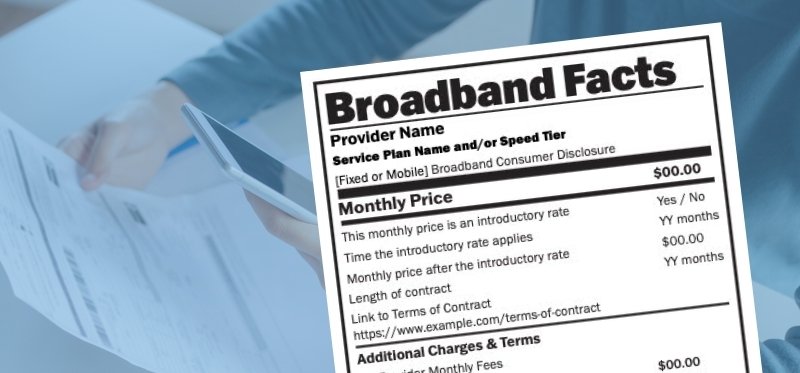
Normally, if you鈥檙e looking to buy something at the store鈥攕ay, a box of cereal or can of beans鈥攖he nutritional value of that product (from carbohydrates to protein to Vitamin D) is clearly displayed on the item itself, with a large price sticker attached to the item鈥檚 spot on the shelf.
This straightforward consumer experience has been unavailable for those trying to buy internet service. Confusing bills have long been the norm, and they鈥檙e with dissatisfaction among internet consumers鈥攅ven among those who would rate their service as reliable.
But last week, the state of play finally started to improve: major internet service providers serving more than 100,000 subscribers started releasing information about their fixed and mobile broadband service offerings鈥攚hether it be via a fixed wired home connection or a laptop dongle鈥攊n a standardized format often referred to as the 鈥渂roadband nutrition label.鈥� This consumer-friendly disclosure format will help people understand how much it will cost them to get connected鈥攁nd stay connected鈥攚ith high-speed internet.
We鈥檙e taking a look back at how OTI鈥檚 15 years of advocacy successfully enabled the adoption of the broadband nutrition label, which will be available on every internet service provider鈥檚 website and at their retail locations to inspire consumer advocacy for the decades to come.
What鈥檚 Happening

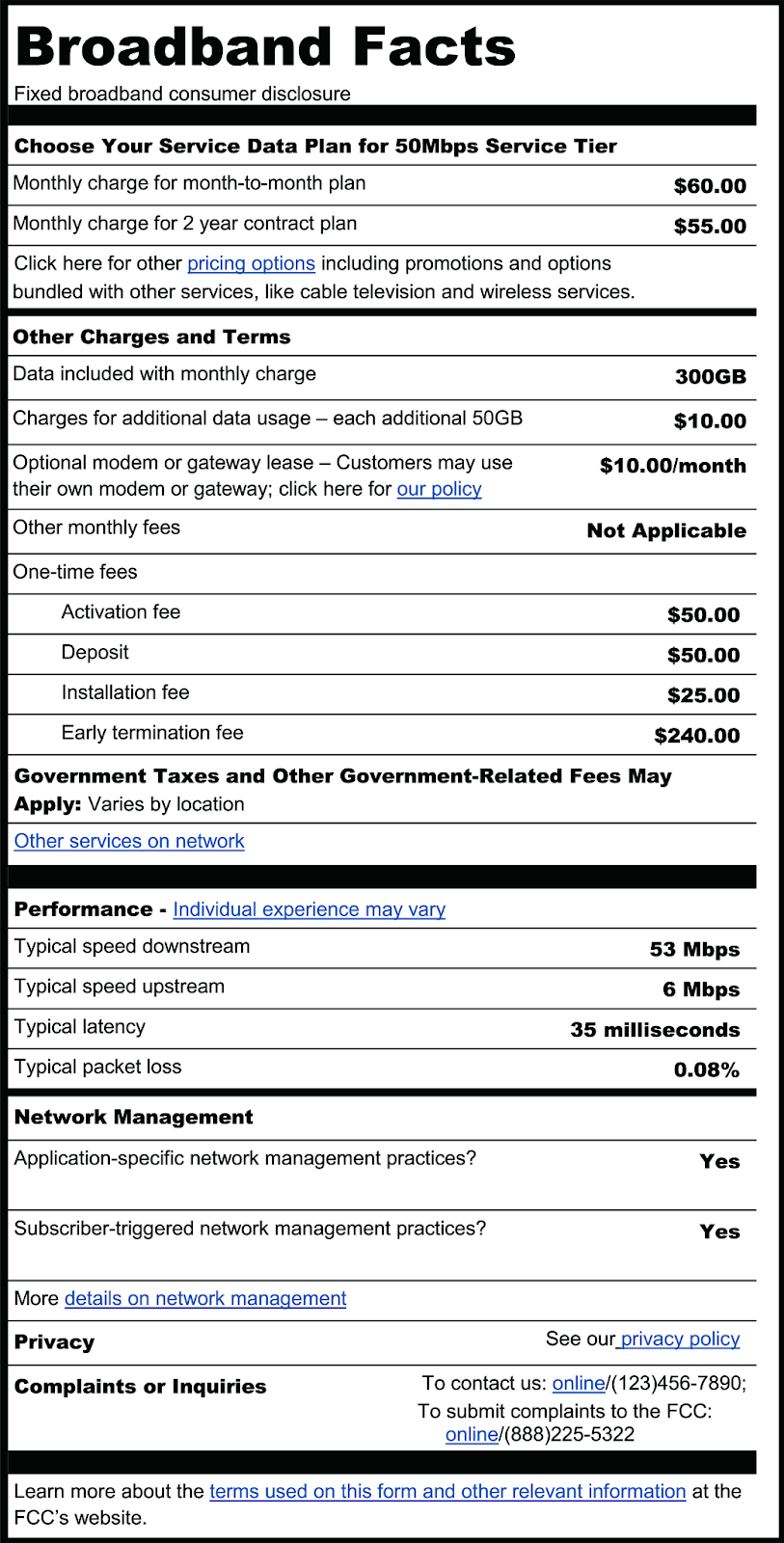
As of last week, labels based on this template from the Federal Communications Commission (FCC) will be available at point of sale next to the advertised service, whether online or at a retail location. The labels will feature a breakdown of service prices, including associated fees, data allowances, typical speeds and latency. They will also include links consumers can consult to learn more about other important aspects of service, such as network management practices, privacy policies, and other discounts.
, , and are some of the larger ISPs who have already posted their labels.

First Steps Toward Truth-in-Labeling
When OTI first , top internet speeds worldwide were in the Mbps rather than Gbps鈥攂ut even then, customers were often frustrated that the actual performance of their internet service regularly fell far below the advertised speeds. When the FCC鈥檚 2010 report confirmed that actual download speeds experienced by U.S. consumers were not even as fast as advertised, OTI argued that consumers needed a better, publicly agreed-upon measure of broadband performance that reflects their actual experiences of service. As such, it called on the FCC to work with different stakeholders to develop measurement standards that would include those details. At the same time, OTI also proposed its first template for 鈥淏roadband Truth-in-Labeling鈥� to display those metrics. Initially brainstormed on a cocktail napkin, this consumer-friendly label was designed to feature ISP disclosure of advertised versus actual speeds, including minimum speeds, minimum reliability, and details about latency, or delays in achieving those speeds.
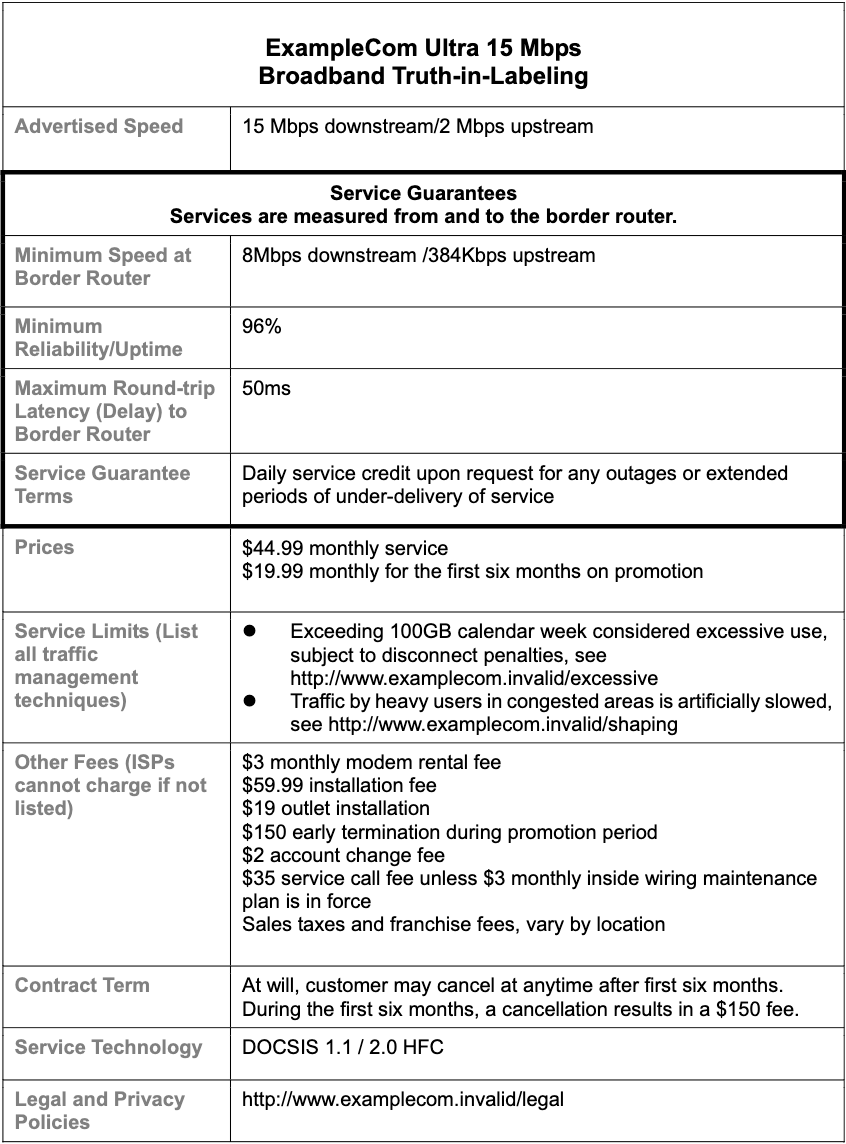
OTI鈥檚 early label included disclosures of not just service quality, but also price. This was an important early acknowledgment of the role cost plays in broadband access and adoption. OTI has tracked the price of service year after year, and its Cost of Connectivity research consistently shows that people in the U.S. frequently pay more than their international peers for slower internet service. Even if an ISP offers quality, high speed service, if people can鈥檛 afford it, they cannot be said to have access. As such, any meaningful discussion of closing the digital divide must include affordability as a consideration鈥攁nd part of affordability is having a clear understanding of what expenses you can expect.
A Bumpy Road: From Voluntary, to Scrapped, to Mandatory
Following OTI鈥檚 initial label proposal, the FCC included in its 2010 a transparency rule for ISPs to voluntarily release information about network practices like congestion management, expected and actual access speed and latency, and pricing and privacy policies. Despite industry pushback, the FCC reaffirmed this transparency rule in a . Meanwhile, OTI further refined its and updated its example standardized disclosure format:
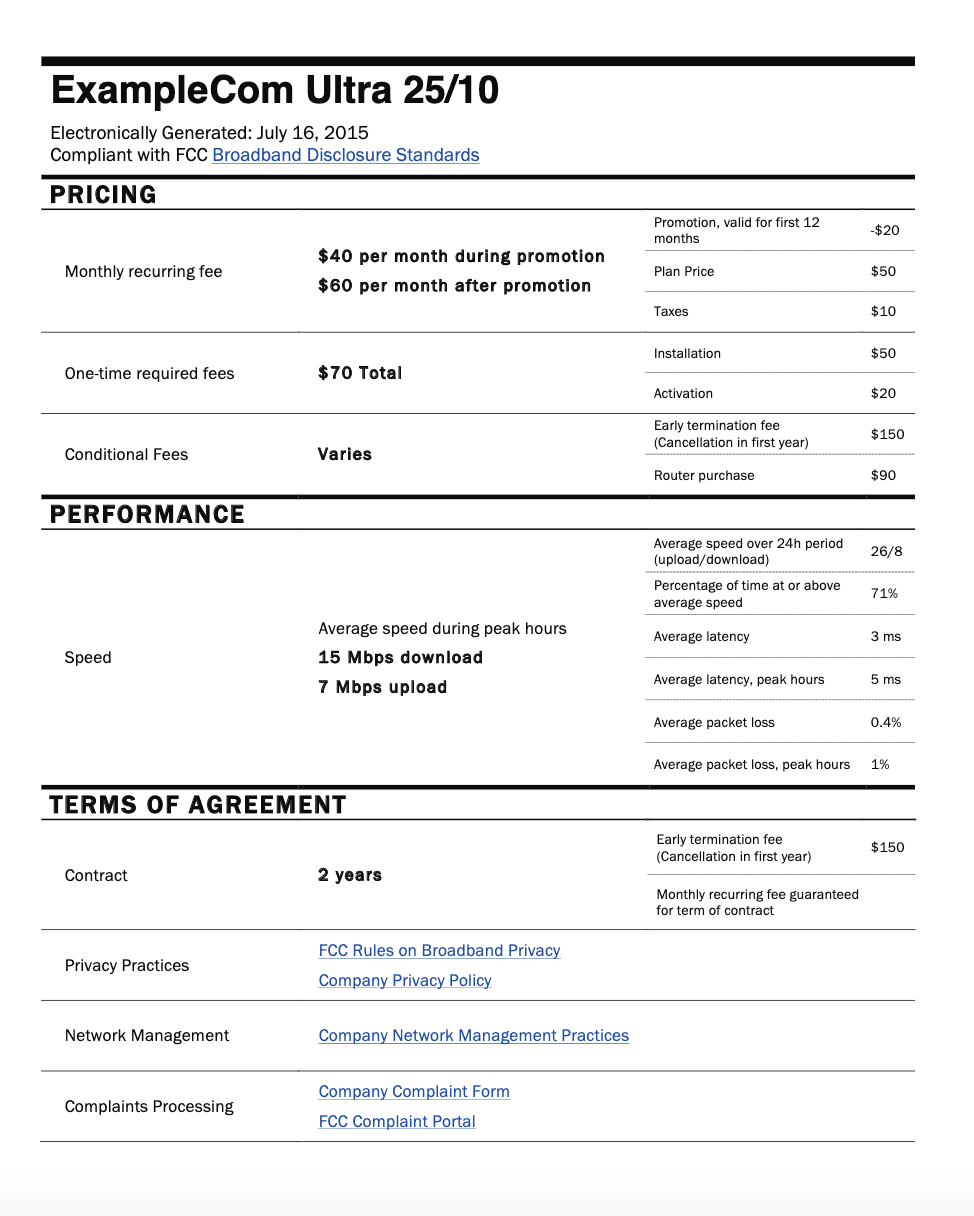
In this 2015 report, OTI again stressed that information about different internet service offerings needed to be provided in a standardized, uniform format, so that consumers can actually compare available broadband service offerings without having to interpret and translate non-uniform disclosures for the purposes of comparison themselves.
Most significantly, the 2015 label proposed by OTI included a breakdown of costs, including any and all fees, which influenced the standalone disclosure label in the FCC鈥檚 2015 Open Internet Order.
The FCC鈥檚 2016 label drew from OTI鈥檚 example label, including more detailed information on pricing, performance metrics, and network management practices:
However, without a mandate requiring ISPs to disclose information in this uniform format, these companies continued to confuse and overcharge consumers. In 2019, for instance, CenturyLink made a with the state of Colorado for 鈥渦nfairly and deceptively charging hidden fees, falsely advertising guaranteed locked prices, and failing to provide discounts and refunds it promised.鈥�
Following the 2017 Restoring Internet Freedom Order鈥攚hich scrapped the broadband nutrition label and other important protections for internet users, such as net neutrality principles鈥擮TI and fellow public interest advocates continued fiercely advocating for a more open and secure internet.
Ultimately, President Biden encouraged the revival of the label in an in July 2021. The label鈥檚 implementation was later made mandatory by the Infrastructure Investment and Jobs Act, which President Biden signed into law in November 2021.
What鈥檚 Next
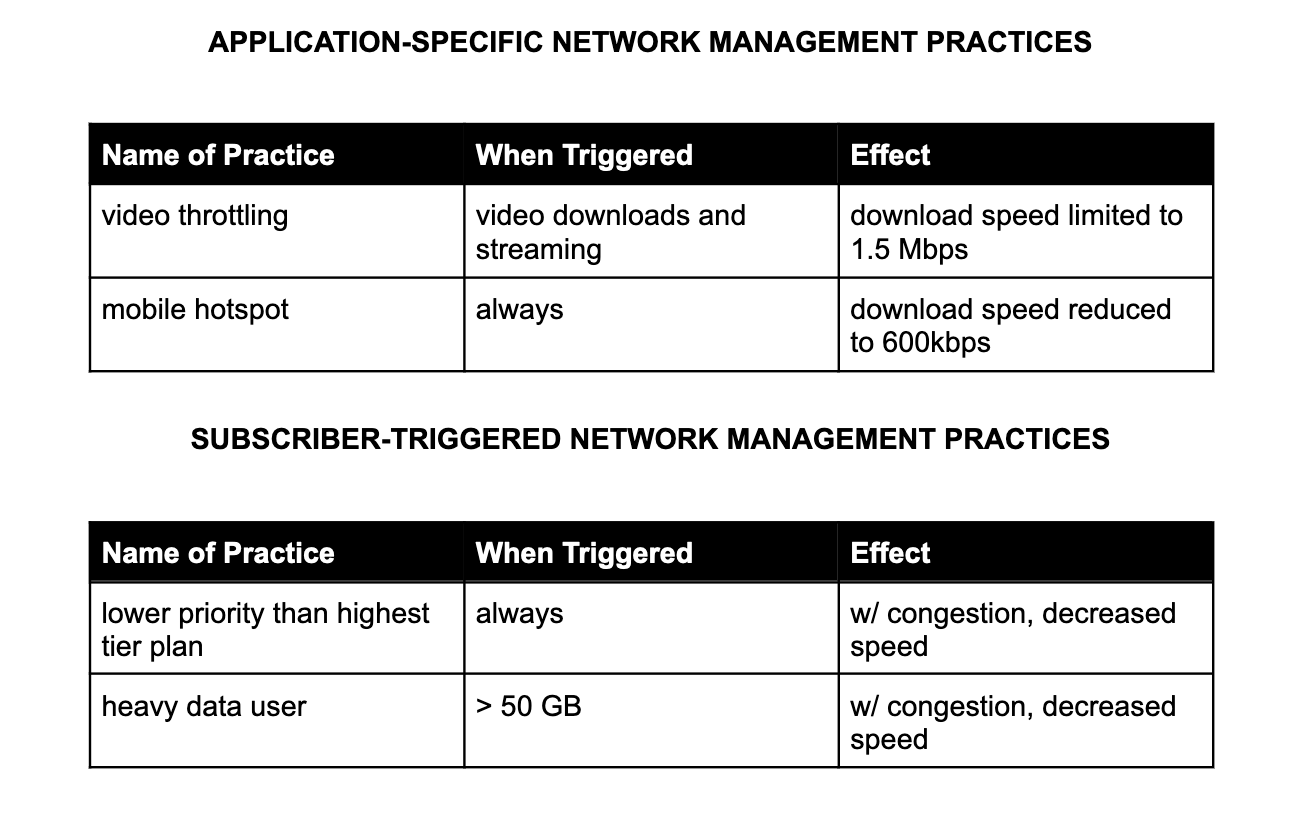
While the current contents of the label required by the FCC is a significant step towards clarity and transparency for consumers, the FCC currently does not require ISPs to display the label beyond point of sale, despite OTI and other public interest organizations calling for its inclusion within consumers鈥� monthly . Also, the FCC鈥檚 current label requirements still omit several suggestions OTI and many others made in the 2022 process following the IIJA mandate. One recommendation, for instance, was to include information about 鈥攍ike video throttling and mobile hotspotting鈥攊n the label itself, rather than relegate such information to links that consumers need to separately click through to access.
Despite arguments from mostly groups that 鈥渁dorning the label with too much information is not a consumer-friendly way to enable comparison shopping,鈥� a recent study of 32,000 consumers revealed that the want to know about the 鈥渢echnical鈥� aspects of their internet service. This includes metrics about performance and changes in service during peak usage times, in line with OTI鈥檚 consistent advocacy for more transparency around such factors that can really impact service. Additionally, in line with OTI鈥檚 advocacy around pricing transparency, study participants wanted to understand in-depth what they would pay for service, further emphasizing the importance and perceived value of more specificity around fees and costs associated with service.

OTI has also encouraged the FCC to explore creating standards or grades for reliability and cybersecurity that would allow the label to display a simple message rather than numerical metrics without context. Industry groups have attempts to provide greater transparency around both, but as the FCC has already made it for wireless providers to improve public awareness on reliability and restoration of service in emergencies, including such information in the label would only help providers fulfill federal reporting requirements and provide greater transparency for consumers.
Furthermore, OTI has also continued pushing for through the ongoing Title II proceeding, including recommendations to display real-world costs and relevant performance characteristics, as well as median speeds (rather than 鈥溾�� speeds, which can be interpreted any number of ways).
Finally, along with other public interest and civil rights groups, OTI has pointed out repeatedly that labels should be available in . While the labels are currently required to be available in all languages used in an ISP鈥檚 marketing, websites like CDC.gov and Healthcare.gov, for example, are available in 15 non-English languages, including Arabic, Chinese, Farsi, Polish, Spanish, and Tagalog, and ISPs have the resources to provide the same.
After 15 years, the broadband nutrition label is finally being implemented as a mandatory disclosure to benefit consumers and the public. OTI will continue to advocate for label improvements鈥攁nd to fight for every community to have equitable access to the internet and its benefits.
More 麻豆果冻传媒 the Authors

Chhaya Kapadia
Senior Operations Lead, Technology & Democracy, 麻豆果冻传媒
Issues
Programs/Projects/Initiatives
Related


Our Takeaways: State of the Union 2023