
Sarah Gilliland
Senior Policy Manager, New Practice Lab
As the new administration gets underway, the Early Care and Education Implementation Working Group takes stock of what to expect and how to prepare.

This is the tenth blog in our series on the Early Care and Education (ECE) Implementation Working Group. For more information on the group鈥檚 origin and activities, please see our first blog Implementation is Everything, and Early Care and Education is No Exception and a recent update Meet the Early Care and Education Implementation Working Group. For a deep dive into some of the findings from the initial working group cohort, see our briefs Family Outreach, Centralized Enrollment, and Participatory Planning.
The first few weeks of the Trump Administration have unfolded at a disorienting pace, with a volume of far-reaching executive actions, major news announcements, and sudden pivots. For local government leaders, it can be hard to keep up鈥攍et alone keep track of what the new policies and proposals mean for their work and the communities they serve.
In January, the ECE Implementation Working Group met to discuss how the new administration鈥檚 priorities might impact local early childhood initiatives. There are still many unknowns, but the conversation provided some grounding to understand what could happen and how some of the administration鈥檚 proposals could impact programs at the local and state levels. Before delving into possible responses to the rapidly evolving landscape, it is important to understand the federal early childhood funding landscape and its relationship with delivery of programs on the ground in American communities.
In this blog post, we explain the ways federal funds support programs for young children at the local level. Then, we delve into what is known about the new administration鈥檚 posture toward early childhood programs from both campaign platforms and from Project 2025. We then synthesize key takeaways from the working group鈥檚 discussion about administration transitions in late January. By sharing this information more broadly, we hope to support other local leaders working to make sense of current events and make strategic decisions on behalf of the families they serve.
In the United States, there is no single source of dedicated funds for early childhood, and most early childhood programs are cobbled together through a patchwork of federal, state, and local funding streams. Across the primary ECE programs, federal funding totals roughly $29.4 billion (which then generates required state matching funds). Federal early childhood programs are primarily administered through states and target specific populations, including low-income children and children with disabilities.
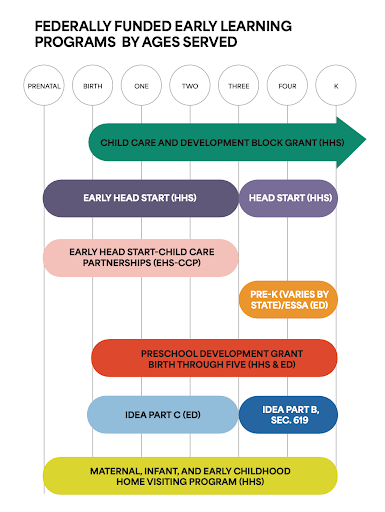
The primary federal programs are included below, with credit to for aggregating information on each funding stream and its relative size:
Federally funded early childhood programs include requirements established by law when they are enacted and authorized by Congress; but aside from those, they are largely left to the states to administer under a system that is 鈥渇ederalist鈥濃�攖hat is, that shares power between levels of government. In general, the legislative branch appropriates funds, the executive branch provides rules and guidance, states administer, and actual services are delivered locally. The share of total funding coming from federal programs varies widely across jurisdictions depending on the extent of local investment, and state and local early childhood programs rely on a mix of resources to support families, even in a program that looks universal.
[We previously wrote about the varying ways that states approach funding for local early childhood programs. Read more here: How Local Early Childhood Initiatives Can Shape State Policy]
Regardless of how they get there: funds flow from the federal government into early childhood programs at the community level, supporting Head Start providers directly, going to child care providers as CCDBG-funded reimbursements, and supporting Early Intervention services through IDEA.
Over the past several decades, there have been multiple attempts to expand federal investment in early care and education. During the Biden administration, the proposed Build Back Better bill sought to remake through an expanded child tax credit, universal preK and child care, and paid family leave. Lack of political will, close Congressional margins, and cost concerns doomed these initiatives, and early childhood provisions were stripped out in late 2021. In its stead, Congress passed the Inflation Reduction Act, a slimmed down version of the bill focused on infrastructure, climate policy, and other domestic priorities. Family policy experts on both sides of the aisle have underscored how poorly served families with young children are in the United States compared to the rest of the world. Despite ongoing efforts to reanimate the debate about how to make America friendlier to families, the path to a coherent national policy that truly meets families鈥� needs is indeterminate.
Our nation鈥檚 early childhood systems were already in a very tenuous position going into 2025. Last year鈥檚 election highlighted affordability concerns across the spectrum, with families of young children bearing the brunt of high child care costs in addition to rising costs of housing, food, and other household goods. Across political lines, that child care was for them at the polls and they were hoping their candidate of choice would bring some financial relief. But simple solutions are evasive, because the roots of the problem are both complex and deeply entrenched.
In the language of economists, and has been for a long time. Families are pushed to the limit of what they can afford to pay for care, while providers can鈥檛 charge enough to cover the true cost of providing quality care. This economic mismatch, combined with the operational challenges of running a child care program, prevents new providers from entering the market鈥攚orsening the existing supply gap.
During the pandemic, families and child care providers received some relief. Federal relief dollars plugged some of the gaps, giving providers a welcome boost in operating revenue that helped keep family costs stable. Since those funds expired though, the system is flailing. National survey results and a growing number of child care providers have closed their doors.
Some states after the pandemic dollars expired. Other states were able to build on the momentum from the COVID-19 investments and take the work even a step further. For example, New Mexico has the family fee requirement from its child care subsidy program and Vermont has eligible for care.
In many places though, gaps remain. And as states work to comply with well-intentioned, but underfunded, directives to improve federally funded programs and , they are being squeezed further. As some states implement new policies that make subsidized care more affordable for families and improve payment procedures for providers, they are facing budgetary constraints that lead them to limit new enrollments in state child care subsidy programs. In , the state has stopped accepting most new applicants for its child care subsidy program until further notice.
The delicate economic balance facing the child care sector means that child care providers, families, and local program administrators are even more on edge with the uncertainty that a new federal administration brings.
During the campaign, President Trump and the Republican Party did not lay out a particular platform or approach to early learning. When asked about the high cost of child care, . Vice President Vance spoke about the in providing care, but gave no other indication of specific policies the administration might champion.
Project 2025 laid out some more explicit threats to existing early care and education programs鈥攏amely, by proposing the elimination of Head Start and the federal Department of Education. In many communities, Head Start is the primary preschool education offering for low-income children. The Department of Education does not directly fund many early education programs but oversees the PDG B-5 grant program, and plays a pivotal role in ensuring the delivery of services to children with disabilitiesthrough IDEA Part C, and in supporting early childhood education in low-income school districts through Title 1. Under this proposal, IDEA Part C would shift to HHS indefinitely, Title 1 funds would phase out after ten years. There was no proposed replacement for Head Start, a nearly six decades old program that serves nearly 800,000 young children living at the federal poverty level with early education, meals, and medical screenings. Project 2025 to make child care universally available, and deprioritized center-based child care in favor of one parent staying at home with children, or the use of in-home family care.
Many federal early education programs, including CCDBG and Head Start, are managed by the Department of Health and Human Services. HHS Secretary Robert Kennedy Jr.has said little publicly about what his early care and education agenda might look like within the agency, though he during the 2024 election. Many experts assumed any changes to child care would fall lower on his priority list and that those programs might be largely delegated to sub-Cabinet officials.
Beyond explicit commitments to early care and education policies, President Trump campaigned on policy ideas that would have sweeping and negative impacts to children of color, low-income children, and immigrant children including mass deportation, elimination of equity-focused programs, and threats to broader social safety net benefits. Whether or not these commitments directly impact preschool classrooms, they certainly impact the children in those classrooms and threaten the health and well-being of young children and their families.
In the House and Senate, there may be for some child care proposals, like increases to the which allows parents and guardians to claim a portion of their child care expenses as a tax deduction. In theory, the tax credit is a flexible tool to give parents financial relief while empowering them to make the child care choices best for their family, but in practice the current size of the tax credit is too low to be meaningful for families given today鈥檚 cost of care. (The tax credit was . A temporary expansion made in tax year 2021 has expired.) It is not clear whether the executive branch would support this amid other budget priorities.
Any summary of Trump Administration actions will be outdated from nearly the moment it is published based on the sheer speed at which new announcements are unfolding. When the ECE Implementation Working Group held its first meeting of 2025鈥攋ust three days into the new administration鈥攖here had already been several executive orders impacting immigrant families, including the , which would allow immigration officers to enter locations like schools. The administration made additional statements about and intimated . Early childhood education was not directly implicated, but cuts to SNAP, Medicaid, and other entitlements would certainly impact low-income children served by many of the early childhood programs represented in the working group.
In the weeks since the group鈥檚 January meeting, major federal actions have continued to unfold. The administration鈥檚 initial guidance directing a was rescinded and at least temporarily halted in court, but if fully implemented, will have massive ramifications for CCDBG, Head Start, and other programs. Even after the freeze on funds was lifted, confusion around fund distribution left several states . Head Start programs across the country . Even if the funds are all fully restored, there is still done from the friction faced when families were forced to unenroll temporarily, and child care providers fell behind on bills or payroll because the government did not pay them what they were owed.
A steady stream of executive orders targeting diversity efforts in and around public education have left early educators somewhat on edge, as have continued rumors that there will be an executive order related to shutting down the Department of Education. Continued immigration actions, including the first very-public deportations, have led local leaders to make public declarations about whether they will鈥攐r will not鈥攃ooperate with ICE actions in their communities.
At its January meeting, members of the ECE Implementation Working Group tried to make sense of what they were hearing to that point and to discuss what actions they could take locally to support children, families, and providers; how they could support each other; and how to build the stamina for four years of surprises.
A few major themes emerged:
There are some slivers of optimism, too. We saw bright spots in 2024 when to raise funds for early care and education. In many communities 鈥� including some in the working group 鈥� leaders are feeling emboldened to take stronger action on early care and education locally in part because they expect little new funding at the federal level. Already, some governors have launched new child care proposals this year, like in and . There are some working group members whose local initiatives launched or expanded during the last Trump Administration. Federal instability can create local opportunity.
At the risk of being too sentimental or introspective, members of the Working Group also see the ongoing federal uncertainty as reinforcement for why a group like this is so necessary. As implementation of early care and education remains a local pursuit, and as local leaders seek out peers to support them in this work, we hope and believe this Working Group can be a source of strength and inspiration.
The ECE Implementation Working Group is a group of early childhood education leaders from cities and counties across the country. These leaders gather to share best practices from their experience working with families and local communities, and their work aligns with the New Practice Lab鈥檚 theory of change: that implementation lessons should inform policy design from the start. More information about the Working Group can be found here. You can reach out to us with questions about the group and its work at [email protected].
Senior Policy Manager, New Practice Lab
Independent Researcher and Policy Consultant