How to Measure English Learners’ Development More Accurately
The ancient Greek philosopher聽聽that it is impossible to step into the same river twice. That is, by the time you go back for the second dip, the water you touched the first time is long downstream. This makes it challenging to get clear understanding of the river: is it full of fish? What鈥檚 its temperature? Etc. Each splash into the water is simply one slice of time. To get more complete knowledge, you鈥檇 need to measure it over a longer period of time.
This is as good an analogy as any for illustrating the challenges of responsibly assessing language learners. Each assessment is a limited time slice, and since these students鈥� abilities will show up differently on assessments鈥攚hether they are measuring English language proficiency聽or聽content knowledge鈥攁s their English language skills develop. This is why we usually measure these students鈥� linguistic and academic聽growth, rather than focusing only on their proficiency. We want to monitor how they鈥檙e performing over time, even when they fall short of mastery. But there are other problems with how we use assessments to define these students鈥� success.
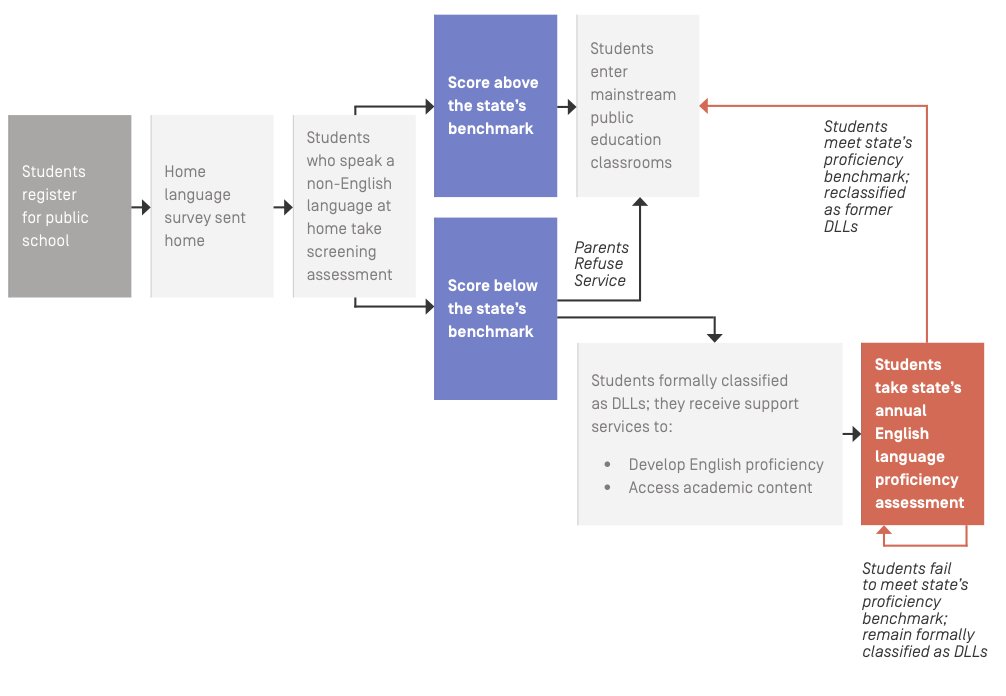
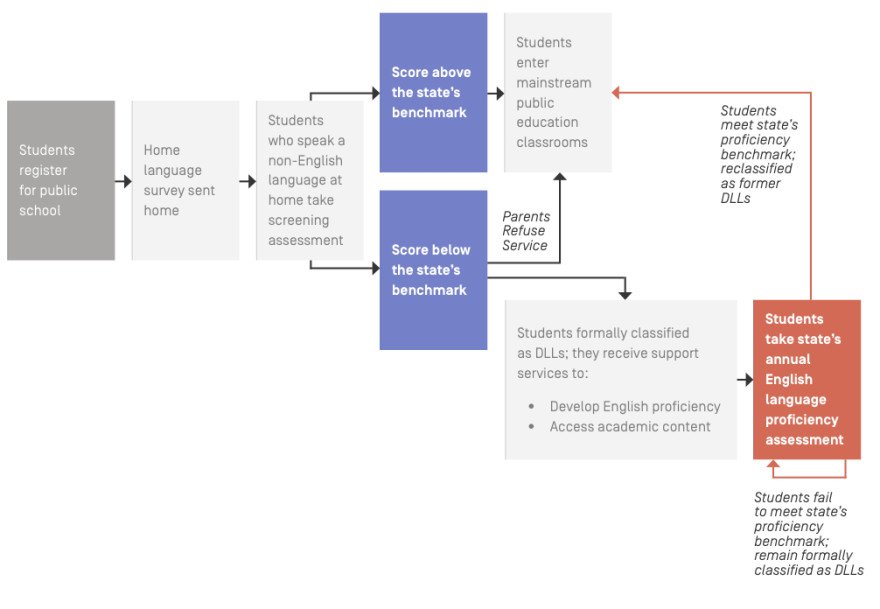
Like any good diagnosis of a problem, we need to start by outlining the status quo. In our current system, we check the English language abilities of all students and then classify those with 鈥渓imited English proficiency鈥� as 鈥淓nglish Learners鈥� (though different states use different terms for this classification). Students who fall into this group must, pursuant to聽, receive research-based language support services. These continue until their English skills develop to a point when they鈥檙e able to access instructional content in English, participate in mainstream academic classes (taught in English), and demonstrate their academic knowledge on the state鈥檚 math and literacy assessments. When students reach that point, they are reclassified as 鈥�蹿辞谤尘别谤听English Learners鈥� and cease to be language learners as far as the state is concerned. At that point, No Child Left Behind requires that states monitor the academic performance of former ELs for two years after they are reclassified. Here鈥檚 a diagram of the process from my 2014 paper,聽Chaos for Dual Language Learners:
麻豆果冻传媒
There鈥檚 a basic level of systemic coherence to the approach: screen students to assess their linguistic strengths and needs, offer supports, measure their academic progress, check their English development, and end language services when they are no longer necessary.
But it has a data problem related to the river analogy I used above. We often hear about achievement gaps between students classified as English Learners (ELs) and students who are not classified. But there鈥檚 a problem with that framing. As Working Group for ELL Policy researchers Megan Hopkins, Karen D. Thompson, Robert Linquanti, Kenji Hakuta, and Diane August聽, current policies create 鈥渁 鈥榬evolving door鈥� effect, as more [English] proficient students exit and less [English] proficient students enter the EL subgroup.鈥� That is,
Under current policy, the more successful schools are in reclassifying their ELs, the more poorly their EL subgroup performance looks…This poses a problem for accountability because it provides faulty information about the performance of the EL subgroup on long-term outcomes.
In other words, once an EL student develops his or her English language skills to a point where he or she begins to perform well on math and literacy assessments, he or she leaves the EL group. As a result, the EL group isn鈥檛 a static pool of students. Each time educators dip into that 鈥渞iver鈥� with an assessment, they鈥檙e surveying a meaningfully different group of students.
Not only does this contribute to an unfair and inaccurate narrative about language learners鈥攖hat, as a group, they are supposedly a drag on schools鈥� academic performance鈥攂ut it makes accountability systems problematic. As Hopkins and her co-authors put it, 鈥渁s former ELs are systematically removed from the subgroup, it becomes impossible to determine which schools and practices are successful for these students.鈥�
Congress could simply require that districts monitor former ELs beyond the current two years鈥攁ll the way until graduation.
And without information about how various instructional practices support English acquisition, it鈥檚 hard to set appropriately rigorous expectations for students, teachers, schools, or districts or to build comprehensive policy systems that support ELs. As I chronicled in Chaos for Dual Language Learners, states define ELs in a wide variety of ways鈥攂ut most of federal law treats these students as a constant, commonly-defined subgroup. But if one state uses a low English proficiency bar and of language services, it鈥檚 hard to compare their approach (let alone their results) with a state that uses and generally takes longer to reclassify ELs.
Those differences in policies mean that each state鈥檚 EL subgroup can vary in important ways from other states鈥� EL populations. It鈥檚 impossible to set the right reclassification policies without considering states鈥� approaches to ELs鈥� language supports, assessment, and more. To do that, we鈥檇 need better data on how ELs鈥攁nd former ELs鈥攄evelop and perform over a much longer time frame.
Fortunately, there鈥檚 a straightforward fix to this problem. Congress could simply require that districts monitor former ELs beyond the current two years鈥攁ll the way until graduation. Hopkins and her co-authors suggest doing this by creating a 鈥淭otal English Learners鈥� (TELs) subgroup. This new grouping would make it possible for states to disaggregate the achievement data of all current and former ELs, which would make it possible to see how different states鈥� approaches to educating ELs work across a longer time horizon.
In addition, this change would dramatically change how the education system views鈥攁nd treats鈥攍anguage learning students. When I discussed the TEL proposal with a colleague who works with DLLs on a daily basis, she was excited enough to reanalyze her students’ math achievement data in that way. The results were amazing: she found that the TEL group started slightly behind native English speakers at the beginning of this year, but outgrew鈥攁nd outperformed鈥攖he native English speakers by the mid-year interim assessment. She agreed that this provided a more accurate reflection of these students鈥� knowledge than the current system.
So: whenever it gets serious about rewriting No Child Left Behind, Congress really should consider making this (relatively聽easy) fix. Let鈥檚 hope that day comes soon (though ).
(For more reform ideas from the Working Group on ELL Policy, .)
—Note: This post is part of 麻豆果冻传媒鈥檚 Dual Language Learners National Work Group. for more information on this team鈥檚 work.“
More 麻豆果冻传媒 the Author
Issues
Programs/Projects/Initiatives
Related

In 2026, States and Congress Will Need to Mitigate the Damage to PreK-12 Education

Identifying English Learners in Pre-K: State Policies, Rationale, and Practices
What to Know 麻豆果冻传媒 Education Funding in Biden鈥檚 Budget