Early Learning Standards for DLLs: How Can States Do Better?
The current political hostility surrounding the Common Core State Standards has challenged academic standards’ place in education policy. But, standards on their own (i.e. unattached to other controversial policies) are a valuable聽lever for improving teachers’ practice. Combined聽with strong guidelines聽for implementation, standards promote聽quality instruction and聽set聽clear expectations for聽both educators and students. And while many state standards 鈥� like the Common Core 鈥� address聽kindergarten through 12th grade, early learning standards聽are similarly important. Public investments in pre-K are , and early learning standards聽can help policymakers define quality for these programs.
The good news is that, report, all of the 53 state-funded pre-K programs in 40 states and Washington, D.C. now have comprehensive early learning standards聽in place. That鈥檚 progress. In 2004, less than half of state programs 鈥� 49 percent 鈥� had such聽standards in place.
As more states have adopted early learning standards, many are recognizing that dual language learners (DLLs) have unique linguistic and academic needs. And given that , policymakers cannot afford to overlook them in their efforts to get early learning right.
How, then, are states supporting pre-K-aged DLLs through early learning standards and guidelines? And how can they improve?
by the BUILD Initiative answers these questions by analyzing trends across 21 states and Washington, D.C. ((The following states were analyzed: Alaska, Arizona, California, Delaware, Georgia, Hawaii, Illinois, Iowa, Maine, Maryland, Massachusetts, New Jersey, New York, North Carolina, North Dakota, Oregon, Rhode Island, South Carolina, Texas, Washington, Wisconsin, and the District of Columbia.)) Researchers Linda Espinosa and Miriam Calderon analyzed the early learning standards聽of states with a high proportion of DLLs and those participating in the recently formed . First, they identified the specific standards and supporting documents that each state uses to address DLLs, 3鈥�5 years old. Then, they determined how well those standards align with the 鈥渆xplosion of research鈥� in the past decade on best practices for DLLs.
Let鈥檚 take those up in reverse: first, we鈥檒l explore the researchers鈥� approach to evaluating states鈥� early learning standards. What exactly does this 鈥渆xplosion of research鈥� suggest?
Most fundamentally, dual language development is increasingly recognized as a that should be nurtured in DLLs to support their . As recently reported, has been 鈥渓inked to numerous positive and long-term benefits, including , , and .鈥�
However, the BUILD report notes, DLLs鈥� language development unfolds differently, in ways that 鈥渕ay look like delays to the uninformed observer.鈥� Indeed, DLLs can make make slower initial progress than monolinguals. However, any delays for DLLs are most often 鈥渢emporary and disappear as young DLLs become more proficient in each of their languages.鈥� Further, these lags are understandable given that fact that a bilingual child, navigating two languages at once, has to process language in a much more complex way than a monolingual peer. The fact that the bilingual brain has to work harder is precisely what researchers believe helps DLLs develop the 鈥�.鈥�
The researchers also pointed to socioemotional benefits to supporting DLLs鈥� native languages. For example, the use of their native languages in early learning environments helps DLLs preserve the ability to fully communicate with parents and family members and can foster closer relationships with their teachers.
The report鈥檚 authors used this body of research to classify each state鈥檚 early learning standards聽into one of three categories: a dual language approach, English Language Development (ELD), or English immersion.
On one end of the spectrum, the dual language designation indicates that a state鈥檚 standards explicitly prioritize maintaining students鈥� bilingualism. In the middle ground, an ELD classification denotes a hybrid of English as a Second Language (ESL) instruction and transitional bilingual education (i.e. temporary bilingual supports used to speed up the acquisition of English). (For more on the difference between additive and subtractive bilingual models, see .) On the other end, English immersion captures states using 聽a 鈥渟ink-or-swim鈥� English-only approach.
Out of the 21 states, only one 鈥� New Jersey 鈥� outlines an explicitly dual language approach in its pre-K standards. Five states 鈥� Hawaii, Maryland, Massachusetts, South Carolina and D.C. 鈥� use an English immersion approach.
The majority of states, 15, fell somewhere in the middle; that is, they use an ELD approach.
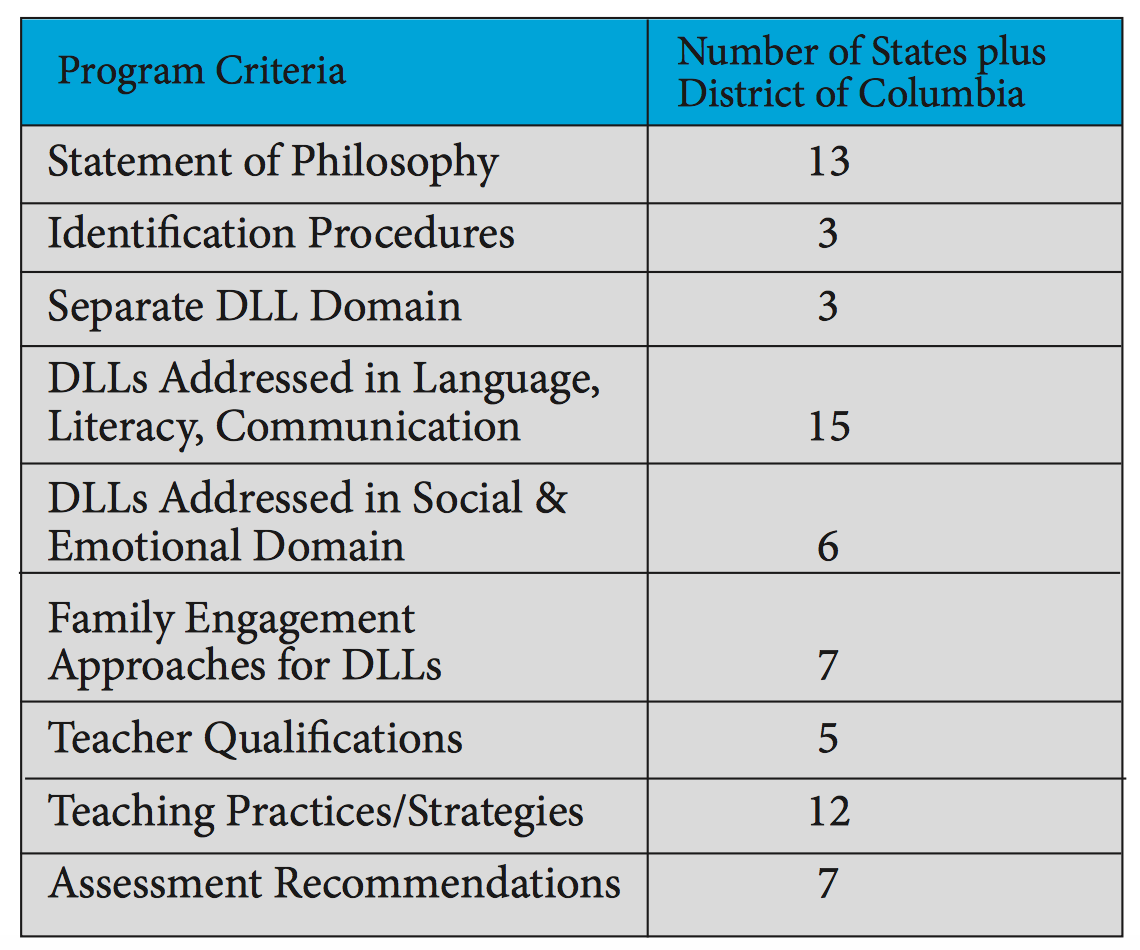
To unpack the characteristics of those 15 states鈥� standards and guidelines further, researchers examined other criteria, including: their statements of philosophy, use of a separate domain for language development, DLL identification procedures, DLL assessment recommendations, multilingual family engagement strategies, teacher qualification rules, and instructional strategies.

The results 鈥減resent a picture of highly variable approaches鈥� to supporting DLLs across the country. Particularly worrisome is the fact that most states fail to provide a clear process for identifying and assessing DLLs, a distinct developmental trajectory for DLLs, and specific qualifications for teachers of DLLs. 聽
But, on a more encouraging note, the report highlights exemplar states in these generally weak areas, including Texas and California. In Texas, provides clear regulations on state pre-K teachers and with literacy and language techniques aligned to each standard. These include the use of role playing, anchor charts, graphic organizers, visual cues, restating commands in the home language, and more.
California has a separate English-language development domain in its , which was only the case in two other states. California also has specific assessment recommendations in its : these stipulate that DLLs must be assessed in their home language across all domains other than English proficiency 鈥� and they provide guidance on how to do so.
Importantly, the report considered supplemental state materials when categorizing standards. As the report concludes, 鈥渟imply stating a learning expectation…without detailed guidance on how to assess what the child should know and what instructional guidelines will help achieve that learning expectation, does not constitute a standard (and likely will leave programs frustrated when it is communicated as an expectation for them).鈥� So, while research-based, developmentally appropriate standards are fundamental, standards alone do not chart the course of how an educator feasibly reaches those guideposts.
Nevertheless, standards remain a vital starting point for states to articulate the foundational expectations that will drive granular-level practices in the classroom. The report is a call for most states to think more critically about their early learning approaches. It asks them to consider: what is our philosophy towards supporting DLLs? Why? Is it backed in research? Too often, states are myopic with regard to language learners. They focus on academic gains in the short- versus long-term, inadequately accounting for DLLs鈥� developmental needs and stripping them of their bilingualism. This report sheds light on the need for many states to rethink their approach to serving DLLs and, by highlighting examples from exemplar states, drives the conversation forward on how to do so.
.
鈥�This post is part of 麻豆果冻传媒鈥檚 Dual Language Learner National Work Group.聽. To subscribe to the biweekly newsletter, click here, enter your contact information, and select 鈥淓ducation Policy.鈥�
“
More 麻豆果冻传媒 the Author
Issues
Programs/Projects/Initiatives
Related

In 2026, States and Congress Will Need to Mitigate the Damage to PreK-12 Education

Identifying English Learners in Pre-K: State Policies, Rationale, and Practices

What to Know 麻豆果冻传媒 Education Funding in Biden鈥檚 Budget