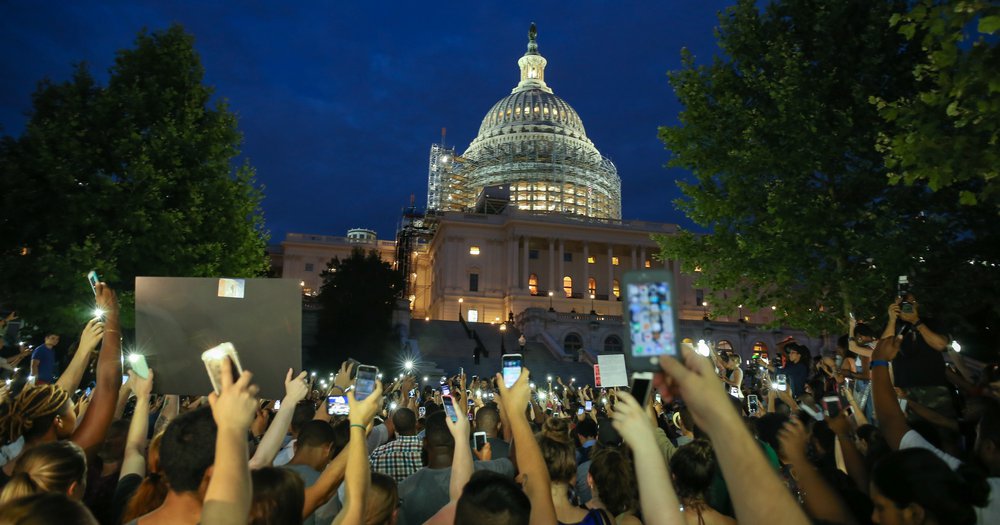
The Politics of Antitrust Enforcement

When the news broke that the Department of Justice would be challenging the merger between AT&T and Time Warner Cable in November 2017, soon followed. After all, the 45th president had been during his campaign: 鈥淎s an example of the power structure I鈥檓 fighting, AT&T is buying Time Warner and thus CNN, a deal we will not approve in my administration because it鈥檚 too much concentration of power in the hands of too few.鈥� With his speculations that 鈥溾�� because of the deal, 麻豆果冻传媒 campaign promise on its surface may seem like it was stemming from legitimate antitrust concerns. At the same time, however, President Trump has also , calling it 鈥淔ake News CNN鈥� and 鈥淭HE LEAST TRUSTED NAME IN NEWS鈥� in his tweets, casting doubt onto the objectivity of the antitrust case against AT&T and Time Warner.
Though the premise of presidential influence in the merger review process is indeed dangerous in itself, it is important to not lose sight of the significance of the case in generally (the Justice Department鈥檚 theory of harm in part discusses AT&T鈥檚 economic incentive to foreclose access to content or to raise costs for competitors).
Given the president鈥檚 statements, nonetheless, AT&T tried to argue in court that the lawsuit arising from presidential interference in what should be the objective merger review process. The company relied on this argument to request detailed email and phone logs between the White House and the Department in pretrial proceedings. Judge Richard J. Leon, who is overseeing the trial, , stating that 鈥淸d]efendants have fallen far short of establishing that this enforcement action was selective.鈥�
This isn鈥檛 the first time that the question of whether antitrust law can be politicized has been raised in U.S. history. In 1971, President Richard M. Nixon considered 鈥擜BC, NBC, and CBS鈥攚ith antitrust prosecution in an attempt to sway their negative media coverage of his presidency. White House recordings at the time captured the president : 鈥淚f the threat of screwing them is going to help us more with their programming than doing it, then keep the threat鈥�. Our gain is more important than the economic gain. We don鈥檛 give a goddam about the economic gain. Our game here is solely political.鈥�
The specter of presidential overreach is an extreme example of how politics may jeopardize the impartiality of antitrust law enforcement. Utilizing antitrust enforcement as a political tool is unquestionably a threat to rule of law. Even just the appearance of undue political influence is dangerous, as it both distracts us from and makes us doubt the antitrust merits of the case. Antitrust enforcement should be driven by sound theories and objective evidence, not by capricious politics. Yet, U.S. antitrust enforcement nonetheless operates within the constraints of larger political factors, including the appointment of antitrust officials.
With each new administration, the president has the opportunity to appoint new leadership overseeing the antitrust agencies, which has implications for antitrust enforcement. Though these officials operate independently of the president, they are appointed with the expectation that their ideologies are aligned with the president鈥檚. With the appointment of Makan Delrahim as the Assistant Attorney for the Antitrust Division at the Department of Justice and the nomination of Joseph Simons to chair the Federal Trade Commission, the Trump Administration an approach to antitrust enforcement that focuses on economics and disfavors interventions鈥攁 marked departure from the Obama Administration, which had been during its second term. Indeed, Professor Steven C. Salop has found that in terms of the types of cases challenged. The Justice Department under the George W. Bush Administration brought significantly fewer civil non-merger complaints than under the Clinton and Obama Administrations.
Just as importantly, the allocation of resources is another means through which ideology affects antitrust enforcement. Michael Kades, Director of Markets and Competition Policy at Washington Center for Equitable Growth, found that while the level of between 2010 and 2016, funding to the Department of Justice Antitrust Division and the Federal Trade Commission has remained relatively the same, with just a 3.7 percent increase in nominal appropriations. As such, antitrust enforcers may lack the resources to pursue more vigorous enforcement. The lack of additional funding reflects the administration鈥檚 priorities, and is an uncompromising constraint on antitrust enforcement.
Presidential interference is no doubt an extreme example of how antitrust enforcement may be politicized and rule of law compromised. Other political factors, such as the appointment of political officials and budget allocations, may also affect the political ideologies underlying antitrust enforcement in less nefarious ways. Recognizing their associated constraints enables us to identify ways to move toward more effective antitrust enforcement.
This blog is part of Caffeinated Commentary – a monthly series where the Millennial Fellows create interesting and engaging content around a theme. Because the fellows are hosting聽a symposium focused on elevating new voices and policy ideas聽this month, they will each create content around their own policy research topics.
More 麻豆果冻传媒 the Author
Issues
Programs/Projects/Initiatives
Related
The Millennial Money Myth

Online, Vulnerable Groups Only Become More Vulnerable

One Year Later: Reflecting on the Millennial Public Policy Fellowship