
Richard Davis Jr.
Policy Analyst, Higher Education

This analysis was developed in partnership with , a nonprofit strategic research and technical assistance firm dedicated to advancing postsecondary education and strengthening the workforce by delivering unparalleled insights into the student experience, from application through graduation.
Caregiving students鈥攖hose who are parenting, caring for other dependents, or providing financial support for family members鈥攆ace housing insecurity at rates and in ways that the higher education system in the United States has yet to fully reckon with. Until recently, the data needed to understand their experiences simply did not exist.聽
The Student Financial Wellness Survey (SFWS) is an established survey developed and administered by Trellis Strategies. For the fall 2025 survey, 麻豆果冻传媒’s Higher Education program partnered with Trellis to add a set of questions on housing insecurity for caregiving students, producing some of the only data available that directly examines how this population experiences housing insecurity. What those students told us reveals a set of challenges that are urgent, underappreciated, and actionable for institutions, states, and federal policymakers willing to act.
Housing insecurity for caregiving college students extends beyond access alone. Students who moved three or more times in the past year most commonly did so out of necessity, not choice. While some moved to be closer to school, many moves were driven by unaffordable rent or unsafe living conditions. The data also show disparities across age, race, and institution type. Older caregiving students aged 25 or more were more than twice as likely as younger students to move because they could not afford rent. Black and Hispanic caregiving students reported moving for affordability and safety reasons at higher rates than their white peers, and students attending two-year colleges had higher rates than those at four-year institutions.
A major barrier to stability is both a lack of awareness and a shortage of available resources. Nearly three-quarters of caregiving students did not know they could request additional institutional assistance for housing costs. Just 3 percent of caregiving students asked for and received aid to support their housing needs. Awareness gaps were more pronounced among first-generation students, women, and those experiencing basic needs insecurity.聽
Housing discrimination also remains a real and racialized barrier. Nearly one in 10 caregiving students experiencing basic needs insecurity reported facing discrimination in the housing market. Black caregiving students were nearly twice as likely as white students to experience discrimination, further limiting their access to safe and stable housing.
These survey findings point to opportunities for action at every level of the higher education system. At the federal level, policymakers should invest in emergency aid for caregiving students, establish standardized data collection on parenting students so that this population is counted and not overlooked, and target policy interventions for these students. States can address the resource gap by investing in emergency aid programs and reforming cost of attendance policies to more accurately reflect what caregiving students across a state actually spend. And institutions, operating within the constraints that federal and state policy define, can close the awareness gap around available aid and ensure that housing is explicitly integrated into basic needs strategies.
Colleges and universities have made real progress in recent years in recognizing that students cannot succeed in the classroom if their basic needs are not met. Campuses across the country have invested in dedicated basic needs staff, emergency aid programs, and wraparound support services, efforts that reflect a growing understanding that financial and personal stability are preconditions for academic success. Housing insecurity,1 however, has received less attention than other basic needs challenges, and the experiences of students who are not just supporting themselves but also caring for children, aging parents, or other dependents have been even less visible. That invisibility has a cost: When policymakers cannot see a population clearly, they cannot design the supports, funding structures, or data systems that population needs to succeed.聽
The stakes for these students are real. Prior 麻豆果冻传媒 research, including an analysis of eviction risk for parenting students2 and a series on homelessness among parenting students,3 has shown that not having access to safe, stable housing harms students in many ways. It makes maintaining enrollment and obtaining a credential more difficult for students with dependents, and it threatens a family鈥檚 economic trajectory, a child鈥檚 stability, and the future that higher education is supposed to make possible. When caregiving students are not supported with basic needs resources that help them stay enrolled, it also undermines federal and state investments in higher education.
This analysis builds on that work, going deeper into the experiences of caregiving students with housing insecurity by using new data from Trellis Strategies鈥� 2025 Student Financial Wellness Survey (SFWS). For the fall 2025 survey, 麻豆果冻传媒鈥檚 Higher Education policy program partnered with Trellis to add questions specifically on housing insecurity for caregiving students, including those who are parenting. The result is a dataset that captures not just whether caregiving students experience housing insecurity, but how, including their reasons behind repeated moves, their awareness of available aid, and their experiences of discrimination in the housing market.
The survey findings presented in this brief reflect responses from 24,361 undergraduate students who identified as parents, caregivers for other dependents, or individuals providing financial support for children, spouses, or parents or other family members in the Fall 2025 SFWS. Full survey methodology is available in the appendix.
For the purposes of this brief, the term 鈥渃aregiving鈥� is used to describe these students. What they shared about their housing experiences reveals challenges that are urgent and unevenly distributed, and that demand attention from institutions, states, and the federal government alike.
Caregiving students are navigating a higher education landscape that was not built with their day-to-day realities in mind. Their experiences with housing insecurity, financial aid, and housing discrimination reveal systemic gaps that not only impact their academic success, but also their families鈥� well-being.
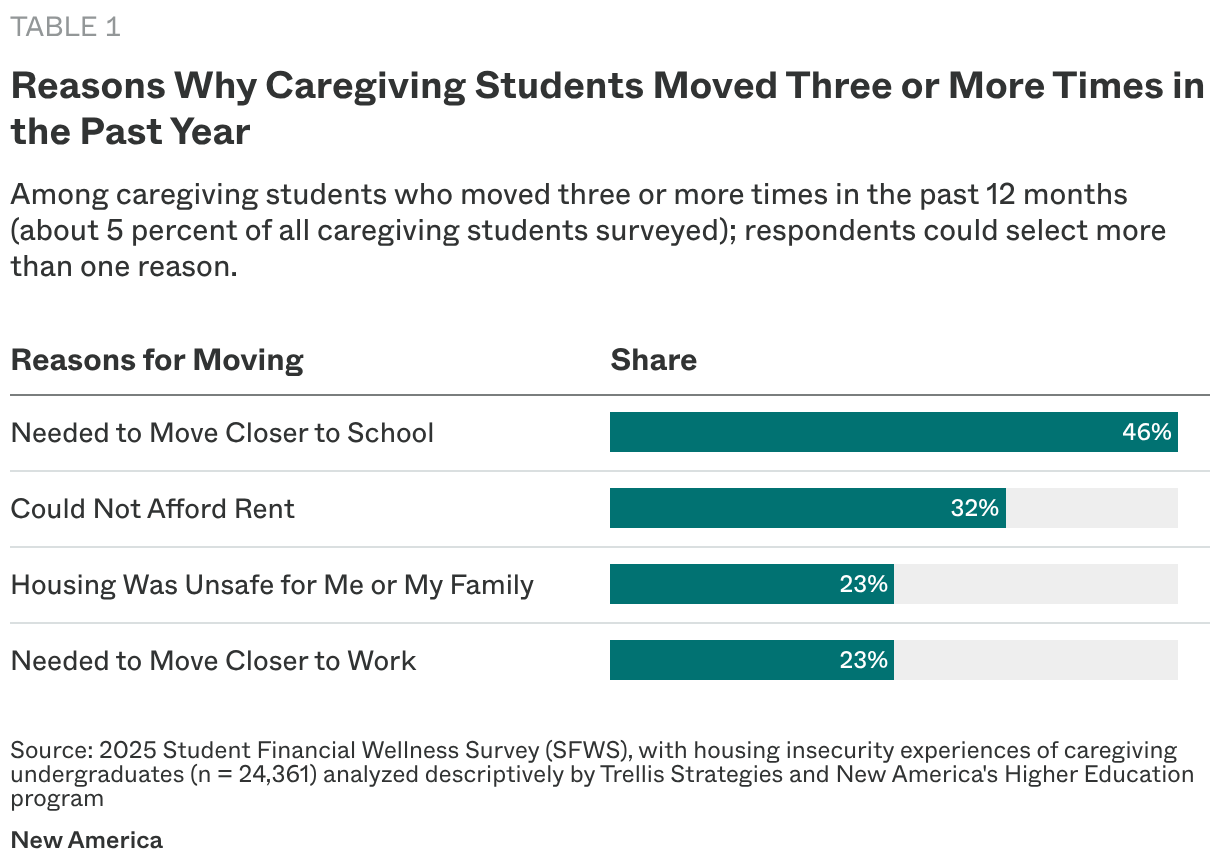
For caregiving students, housing insecurity often means moving not out of choice, but necessity. SFWS data show that among caregiving students who moved three or more times in the past year, the most common reason was the need to be closer to school (46 percent), a finding that reflects the practical constraints that caregiving students navigate in finding housing that works for their lives. But affordability and safety tell a more urgent story: Nearly a third said they moved because they couldn鈥檛 afford rent (32 percent), and nearly a quarter said their living conditions posed risks to themselves or their families (23 percent) (see Table 1).
Those burdens are not distributed evenly. Older students, Black and Hispanic students, and those attending two-year colleges all face disproportionately high rates of rent-driven and safety-driven moves (see Figure 1).
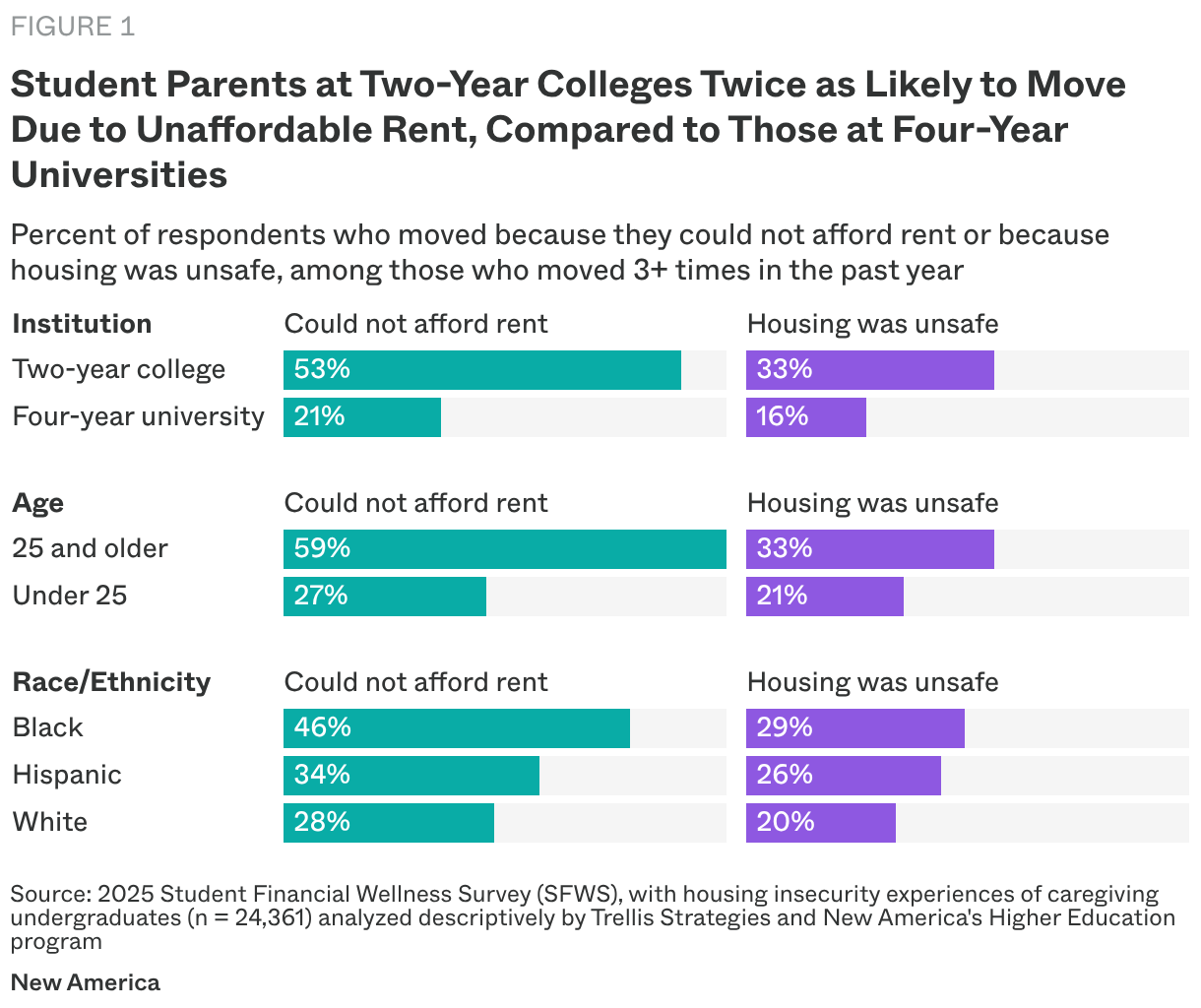
The burden is especially pronounced for older students. Nearly three in five caregiving students aged 25 and older who moved three or more times in the past year said they did so because they could not afford rent, more than double the rate of their younger peers under 25 (27 percent).聽
Racial disparities are notable. Black and Hispanic caregiving students reported moving due to affordability or safety concerns at higher rates than their white peers. Nearly half of Black caregiving students who moved did so because they couldn鈥檛 afford rent, compared to just over a quarter of white students. Safety concerns followed a similar pattern; Black and Hispanic caregiving students were also more likely to report moving because their previous housing was unsafe for themselves or their family.
The type of institution attended (two-year or four-year) matters too. Students who attend two-year colleges were more likely than those at four-year universities to report moving due to unaffordable or unsafe housing, a disparity that reflects the resource gaps facing community college students.聽
These findings make it clear that housing insecurity for caregiving students is not simply about access to housing, but about whether housing is affordable, safe, and supportive of both their education and families.
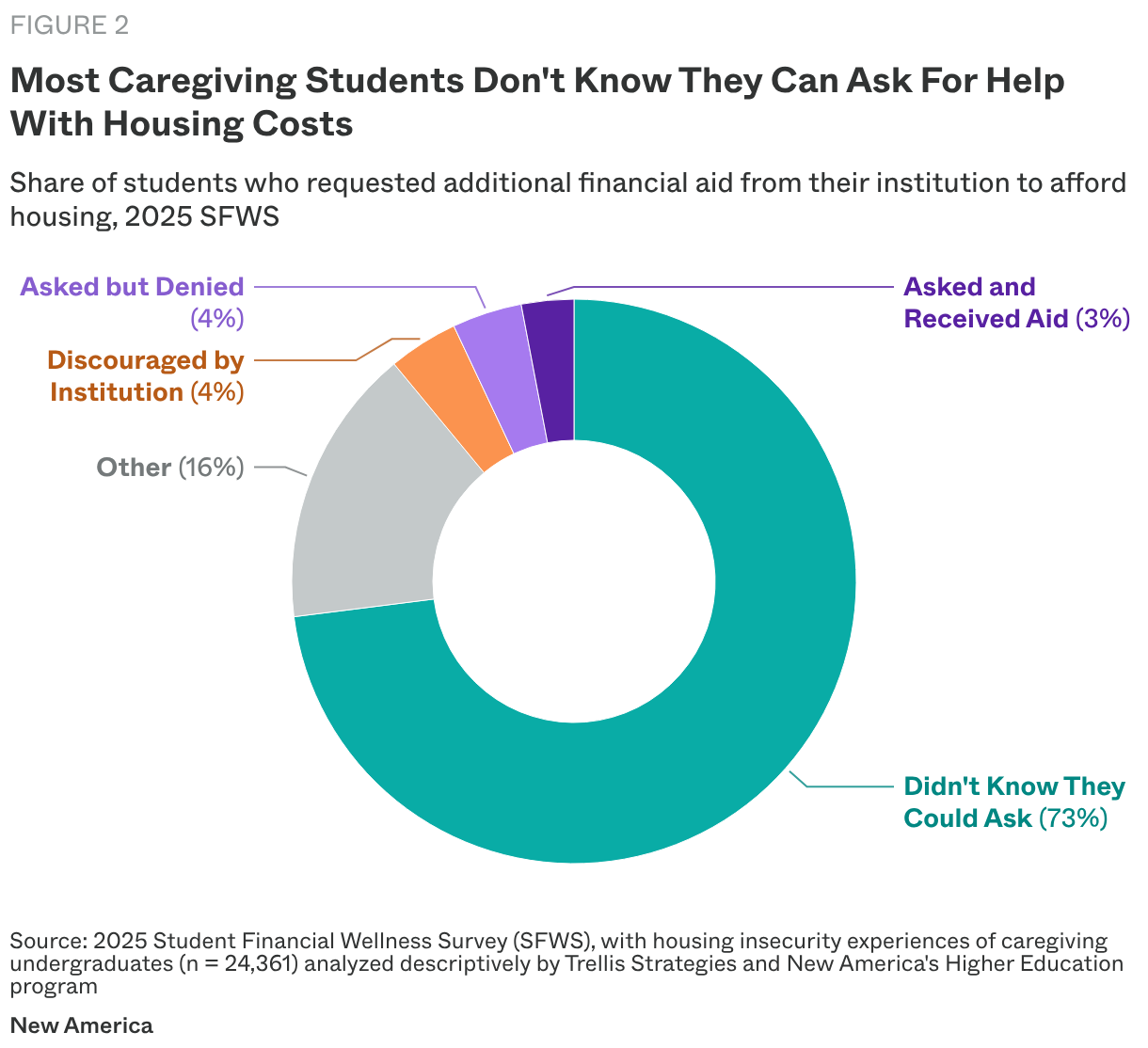
Nearly three-quarters (73 percent) of caregiving students in the 2025 SFWS said they didn鈥檛 know they could seek additional financial assistance from their institution to help cover housing costs (see Figure 2).
Additional aid can take different forms, such as emergency grants, cost of attendance adjustments that may unlock additional financial aid eligibility, or help accessing previously declined aid, such as grants or loans. However, these options are only useful if students know they exist and if they are actually available at the institution.
Even among those who did ask for financial help from their college or university, few received it. Just 3 percent of caregiving students reported requesting and receiving additional aid. Another 4 percent said they asked but were denied. That leaves the vast majority of caregiving students without the financial support they need.
Awareness gaps exist across student groups. Three-quarters of first-generation caregiving students (75 percent) were unaware that they could request housing-related aid, a pattern mirrored among female caregiving students (74 percent).
Those facing the greatest hardship are often the least likely to know they can request help. Among students experiencing basic needs insecurity, more than three-quarters (76 percent) did not know they could request additional housing assistance.
When students don鈥檛 know that more institutional support could be an option, they鈥檙e more likely to turn to short-term fixes, such as moving in with others, taking on additional work, or delaying enrollment, rather than accessing the timely support that could help them stay housed and stay enrolled.聽
麻豆果冻传媒 7 percent of all caregiving students reported experiencing housing discrimination, and that burden falls unevenly (see Figure 3).聽
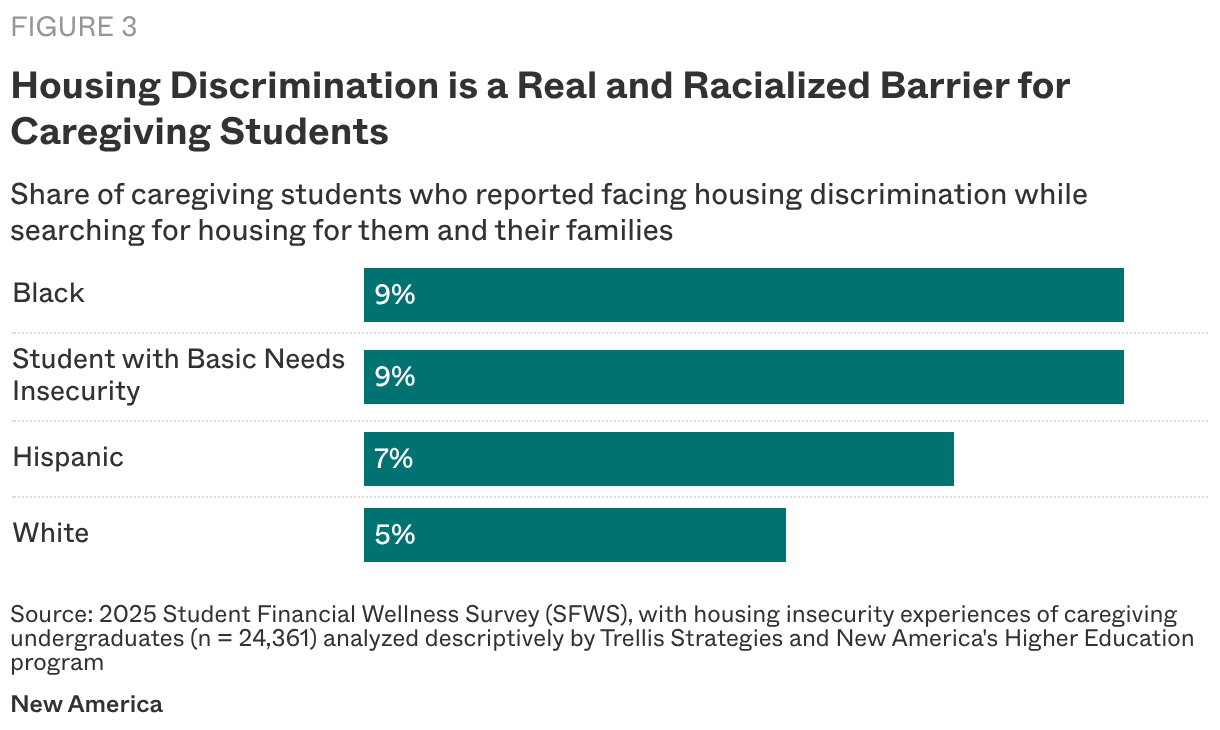
Black caregiving students were nearly twice as likely as white students to report housing discrimination, 9 percent compared to 5 percent. Among students facing basic needs insecurity, about one in 10 caregiving students reported experiencing discrimination in the housing market.
Discrimination adds another layer to housing insecurity. It limits options, pushes students into unsafe or unstable living situations, and increases the stress and uncertainty that caregiving students already face. When the housing market itself becomes a barrier, the path to a degree becomes even steeper.
The three findings describe not three separate problems but one compounding one. Caregiving students are moving repeatedly, often because they cannot afford rent or because their housing is unsafe, and they are doing so without knowing that their institution may be able to help. When they do seek help, most are turned away. And a meaningful share navigates a housing market that discriminates against them, narrowing their options before they ever get to the question of affordability. Each of these challenges is serious on its own. Together, they describe a population that faces challenges at multiple points simultaneously.
None of this is inevitable. The awareness gap is closeable. The resource gap is addressable. The data gap, which makes all of these students harder to see and harder to serve, is solvable with the right federal and state action. What the survey findings point to is not a population too complex to help, but a set of specific gaps at the institutional, state, and federal levels that, if addressed, could meaningfully change outcomes for caregiving students and the families depending on them.
The federal government shapes the financial aid rules, funding levels, and housing program structures that set the boundaries of what is possible at every other level. The federal financial aid system has not kept pace with the real costs that today’s students face, and for caregiving students managing housing, child care, and family expenses on top of tuition, that gap is especially acute. Meaningful progress on caregiving student housing insecurity will require federal investment that matches the scale of the problem. The data from the SFWS show there are two ways the federal government can act to support caregiving students in the near term.
The SFWS finding that fewer than 3 percent of caregiving students successfully requested and received additional financial aid, against a backdrop in which nearly three-quarters didn鈥檛 know they could ask, points to a systemic gap that federal investment can help close. That gap exists in part because federal aid programs were not designed with caregiving students’ full costs in mind. Pell Grants, the federal government’s primary need-based aid program, have not kept pace with the true cost of attendance for students supporting families. Even maximum Pell recipients are left with substantial unmet need once housing, child care, and other caregiving costs are factored in,4 and caregiving students are among the least likely to have other resources to absorb that gap.聽
The clearest proof of concept for what targeted federal investment can accomplish is the Higher Education Emergency Relief Fund (HEERF). During the COVID-19 pandemic, emergency grants distributed through HEERF demonstrated that flexible aid could reach students at scale and support persistence, with housing consistently among the top ways that students spent their funds.5 That lesson should inform how Congress approaches need-based emergency aid moving forward.
Congress can take concrete steps in this direction. The Supplemental Educational Opportunity Grant (SEOG) program currently reaches nearly 1.9 million students annually, but its traditional structure requires institutions to package funds upfront at the start of the academic year, leaving nothing in reserve when students face unexpected crises mid-semester.6 The current funding formula has also resulted in more well-resourced institutions receiving the aid, rather than the underresourced institutions that serve the most disadvantaged populations, such as caregiving students.7 Changing the formula to reach more caregiving students and restoring the flexibility, made available during the pandemic, to allow institutions to hold back a portion of SEOG for emergency microgrants would give colleges a dedicated mechanism for responding to acute housing needs.
The Federal Basic Needs for Postsecondary Students Grant Program takes a complementary approach. Rather than providing aid directly to students, it supports institutions in building the coordinated infrastructure, such as basic needs centers, navigator programs, and housing referrals, that make aid accessible in practice. Early evidence from grantee institutions is promising, with some reporting persistence rates well above institutional averages among students served.8聽 Sustaining and increasing investment in that program matters especially now, as it faces funding uncertainty at a moment when the caregiving students described in this brief need those systems most.
Better policy starts with better data, and right now, the data on caregiving students are insufficient at every level. Throughout this brief, we have examined housing insecurity among caregiving students broadly, including those who are parenting, caring for other dependents, or providing financial support for family members. Yet at both the state and federal levels, legislative efforts to close data gaps have focused primarily on parenting students. While that scope is narrower than the population this brief describes, improved data on parenting students would go a long way to understanding this issue, as parenting students represent a significant share of the caregiving student population.聽
The 2025 SFWS represents one of the only datasets that directly examine housing insecurity among caregiving students. That it required a deliberate partnership and purpose-built survey questions to produce underscores how large the gap in routine data collection remains. Most institutions do not know who among their students is parenting, so colleges, states, and the federal government are making decisions about a population they cannot fully see.聽
This knowledge gap is especially consequential for housing. Without consistent data on how many parenting students exist on campus and what their needs are, it is difficult for institutions to design targeted supports or for policymakers to make the case for investment. At least five states have enacted legislation to improve data collection on parenting students: Oregon, Illinois, Michigan, Texas, and California. Other states, like Virginia, have passed similar measures. However, a patchwork of state standards creates inconsistency and limits opportunities to compare nationally.聽
Federal policymakers should consider establishing a standard definition of a parenting student, requiring campus-level data collection, and mandated reporting through the Integrated Postsecondary Education Data System (IPEDS).9 A federal standard would not only improve the quality of data available to institutions and policymakers but would also reduce the burden on states and institutions currently navigating a fragmented landscape and help ensure that parenting students are counted rather than overlooked. Lessons from such a collection could inform future efforts to more broadly define caregiving students.
Within the framework that federal higher education policy establishes, states play a meaningful role in shaping how institutions identify and respond to student housing insecurity, through financial aid programs, cost of attendance policy, and emergency aid. There are two ways states can act to better support caregiving students facing housing insecurity.聽
The SFWS data reveal a compounding problem: Nearly three-quarters of caregiving students did not know they could seek additional assistance from their institution to help cover housing costs. Only 3 percent of caregiving students asked for and received aid to support housing costs. That gap between awareness and access points to a shortage of available resources, one that states are positioned to help address.10
Emergency aid is one of the most direct tools available to help students facing housing insecurity immediately afford rent or related expenses, and the evidence on impact is strong. Data from Ascendium鈥檚 Dash Emergency Grant pilot found that 94 percent of recipients at four-year institutions re-enrolled, graduated, or persisted, compared to 83 percent nationally. At two-year institutions, 86 percent of recipients persisted, compared to 62 percent nationally.11聽 These outcomes are impressive given that caregiving students are disproportionately enrolled at two-year institutions and face some of the steepest barriers to persistence.
States that administer or fund emergency aid programs should explicitly require that housing-related costs, including back rent, security deposits, and utility payments, be eligible expenses. And since many caregiving students attend college part-time, not necessarily by preference but because caregiving and work responsibilities make full-time enrollment difficult to sustain, states should ensure that emergency aid programs are designed to support part-time students.12
Spotlight: Virginia鈥檚 College Attainment for Parent Students (CAPS) Program13
Virginia鈥檚 CAPS program, administered through all 23 institutions in the Virginia Community College System, illustrates how emergency aid embedded within a population-specific initiative can make a meaningful difference for caregiving students. The statewide program provides stipends of up to $4,800 per semester to Pell-eligible single parents to help cover child care and unexpected expenses. Participants can also access emergency student success funds for acute, unexpected needs.
A 2025 evaluation of the program found that housing and utilities were the top use of both stipends鈥攚ith 70 percent of stipend recipients and 67 percent of emergency fund recipients directing dollars toward housing costs鈥攗nderscoring that even aid designed primarily for child care ends up meeting students’ most pressing housing needs. CAPS participants also completed credentials at twice the rate of their non-CAPS peers (48 percent compared to 24 percent), offering early evidence that targeted, flexible financial support is associated with meaningful gains in student persistence and completion.
Nearly three-quarters of caregiving students responding to the 2025 SFWS did not know they could seek additional assistance from their institution to help cover housing costs, and one of the mechanisms for doing so is a cost of attendance (COA) adjustment. COA adjustments allow institutions to revise the standard estimate of what it costs to attend college to better reflect a student鈥檚 actual expenses, potentially unlocking additional financial aid eligibility in the process. But that tool is only useful if institutions have clear policies for making those adjustments, and if students know they can ask.
The problem starts with how cost of attendance is calculated in the first place. Standard COA estimates are designed around a traditional student鈥攖ypically young, single, and without dependents鈥攁nd don鈥檛 account for the actual housing, child care, and transportation costs that caregiving students face.14 For example, research from the Education Trust and California Competes has shown that parenting students pay over $7,500 more (per child) than their non-parenting peers in out-of-pocket costs each year, primarily in child care and housing costs.15 That gap is not reflected in the financial aid system for most caregiving students, which means that they are systematically underserved by the very mechanisms meant to make college affordable. When housing costs are undercounted, financial need is under-calculated, and caregiving students are left to try to make up the difference on their own with an unrealistic budget.
States are well positioned to address this problem at scale. Rather than leaving COA adjustment practices to institutional discretion, states should consider requiring or incentivizing public institutions to develop adjustment policies that account for caregiving students鈥� actual costs, including housing, child care, and transportation. Paired with data collection systems that identify student parents and track their outcomes, these policies can help ensure that aid reflects reality rather than a standard estimate that is not designed with caregiving students in mind. While the federal government could also develop better COA policies, it would require a long regulatory process that may not be nimble enough to recognize each state鈥檚 particular housing, child care, and transportation costs. State-level approaches to COA could help inform a federal-level approach in the future.聽
Spotlight: California GAINS for Student Parents Act (AB 2458)16
Signed into law in 2024, California鈥檚 Greater Accessibility, Information, Notice, and Support (GAINS) for Student Parents Act requires public colleges and universities to develop COA adjustment policies that account for the actual food, housing, transportation, and child care costs of student parents, not standard estimates. Implementation is underway, with campuses developing financial aid adjustment methodologies and, in some cases, automating student parent identification through admissions applications. The GAINS Act offers a replicable model for states looking to move COA reform from institutional discretion to a system-level expectation. 聽
Colleges and universities have the most direct relationship with caregiving students, but they operate within the constraints defined by federal and state policy. And for many institutions, particularly under-resourced ones where caregiving students disproportionately enroll, those constraints are significant. The findings from the 2025 SFWS point to two concrete areas where institutions can do more to support caregiving students’ access to safe, stable housing.聽
These findings point to two distinct but related problems: Students are unaware that more help might be available, and at many institutions, particularly under-resourced ones where caregiving students disproportionately enroll, those options are simply not available, even when students ask.聽
Institutions have tools at their disposal, though their reach varies. Some have their own emergency aid programs that can be made flexible to meet housing needs.17 All institutions participating in federal financial aid programs can make cost of attendance adjustments that may help unlock additional aid eligibility for caregiving students whose actual housing costs exceed standard estimates.18 Institutions can also help students access any previously declined aid, such as grants and loans, though these tools are only useful if there are transparent, simple ways to access them and if students know they exist in the first place. Institutions that do not yet have emergency aid programs should build that capacity, even through small, targeted funds19 which state and federal investment can help make possible.
Closing this gap requires proactive outreach, not information buried on websites. This means promoting FAFSA (Free Application for Federal Student Aid) completion so that every caregiving student receives the aid they are entitled to; including details on how to unlock more aid or access emergency aid funds into financial-aid related communications such as offer letters; training financial aid administrators to adequately calculate and discuss true non-tuition costs, including housing, child care, and transportation, with students who identify as caregivers; and embedding housing insecurity prompts into basic needs navigator intake forms and advising touchpoints.聽
Colleges and universities have made significant strides in addressing food insecurity among college students, but housing insecurity has received less attention, in part because housing solutions tend to be more complex and costly and often require action well beyond what institutions can control. Caregiving students report facing discrimination in the housing market at meaningful rates, and when the housing market itself becomes a barrier, institutions can play a role in helping the most vulnerable students access safe, affordable shelter.聽
Institutions with basic needs centers or navigator programs should ensure housing is explicitly included, not treated as secondary to food assistance or child care. This includes designating staff members or liaisons who connect caregiving students to housing resources, and who understand the needs of students with dependents, which include child care, transportation, referrals to housing for families with children, and legal resources in the face of housing discrimination.20
Institutions without dedicated housing infrastructure should start by building referral relationships with community-based housing organizations and social services agencies, a step that is especially important for community colleges, which are less likely to have on-campus housing.21 Even institutions that do have housing should pursue community referral relationships. Where possible, institutions should also consider investing in housing options that work for students with dependents. Wallace State Community College offers a recent example: The institution received a federal Housing and Urban Development grant to develop a student family housing project on campus, recognizing that for caregiving students, the absence of family-appropriate housing is itself a barrier to enrollment and persistence.22 Caregiving students are disproportionately enrolled at community colleges,23 where on-campus housing is typically not an option, so they stand to benefit from this kind of investment.
The challenges outlined in this brief are serious, but real near-term progress can be made. The awareness gap that leaves nearly three-quarters of caregiving students not knowing they can ask for help is a solvable problem, one that institutions can begin to close today through proactive outreach, clearer financial aid communications, and basic needs infrastructure that treats housing as central rather than secondary. The resource gap that means that some students are turned away when they do ask requires investment at the state and federal levels, through emergency aid programs designed with caregiving students in mind and cost of attendance policies that reflect what these students actually need. And the data gap that makes this population hard to see and harder to serve requires a federal commitment to counting parenting students consistently and completely.聽
What makes action urgent is not just the scale of the problem, but who is bearing it. The caregiving students described in this brief are not struggling in spite of their efforts, they are struggling because a system built for a different kind of student has not caught up to their reality. They are managing coursework, jobs, caring for children, and in many cases discrimination in the housing market, often without knowing that help might exist. When they cannot access safe, stable housing, the consequences extend beyond their own academic trajectories to the children and family members depending on them.
The findings from this brief make clear what federal, state, and institutional higher education policymakers should do to address housing insecurity among their caregiving student populations. Solutions are achievable if policymakers recognize the full scope of the challenges faced by caregiving students, and respond with resources and policies equal to what these students are carrying. With more informed policymaking, we can move from stopgap measures toward a system that is built to support students who are balancing college and caregiving, one where there is finally a place to land.聽
The Fall 2025 Student Financial Wellness Survey was implemented between October 20 and November 11, 2025, with invitations sent to 845,121 undergraduate students at 153 institutions in 23 states. Responses were received from 65,816 undergraduate students for a response rate of 7.8 percent. The responses were weighted by sector, gender, age, and enrollment intensity to better reflect the total population of the participating institutions.
For this brief, 麻豆果冻传媒’s Higher Education program partnered with Trellis Strategies to add a module of questions specifically examining housing insecurity experiences among caregiving students. Survey data were analyzed descriptively to examine the housing insecurity experiences of caregiving undergraduate students (n=24,361), including their reasons for moving, awareness of available financial assistance, and experiences of housing discrimination.聽
For all findings noted in this brief, comparisons are statistically significant at the p<.01 level with the exception of the percentage of Hispanic students who moved three or more times because their housing was unsafe (Table 2) compared to their white peers, which was significant at the p<.1 level. Significance testing is a way to help understand whether a result is likely to be real or just due to random chance.
Respondents were categorized as caregiving students if they responded “Yes” to any of the following questions:
麻豆果冻传媒 would like to thank Imaginable Futures and the Annie E. Casey Foundation for their generous support of this project. The views expressed in this brief are those of its authors and do not necessarily represent the views of the funders, their officers, or their employees.
Thanks to Bryan Ashton, Stephanie Baker, Rachel Fishman, and Wesley Whistle for reviewing early drafts and providing thoughtful feedback and helpful suggestions. The work is better for their review. Thanks to Katherine Portnoy, Amanda Dean, Natalya Brill, and Sabrina Detlef for communication support, data visualization, and copyediting.
Policy Analyst, Higher Education

Director of Research at Trellis Strategies
Trellis Strategies

Principal Research Associate at Trellis Strategies
Trellis Strategies