LGBTQ Rights on Campuses Through the Decades
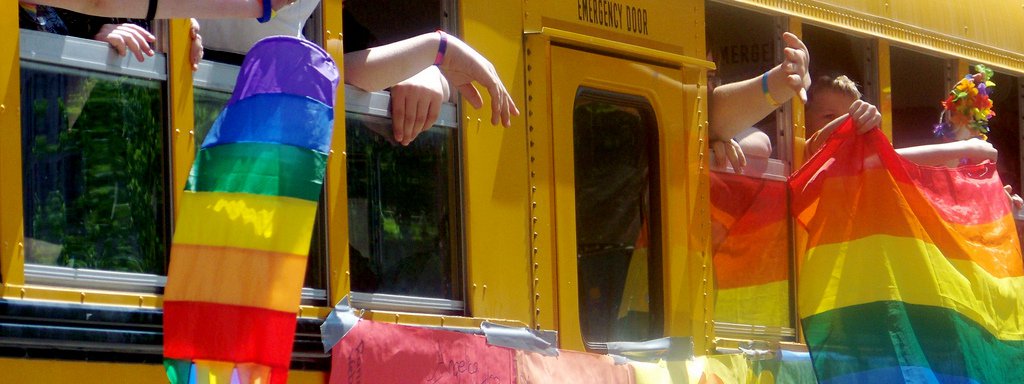
Every year since the 1969 Stonewall riots, the month of June has been dedicated to celebrating lesbian, gay, bisexual, transgender, and queer (LGBTQ) culture and history. Fifty years ago, there was effectively no public support for LGBTQ rights, and today, marriage equality is the law of the land. Between these two ends of the spectrum lies a rich history of fighting for equality in virtually every area of public life. Yet all too often overlooked in the queer narrative is the fact that students of sexual and gender minorities are among the most underserved demographics, despite growing visibility in recent years. What鈥檚 more, these students鈥� safety and rights are constantly at risk. This June, as we celebrate how far we鈥檝e come, it鈥檚 worth taking critical stock of the victories and challenges that shape the modern LGBTQ student experience.
The past 10 years have seen an effective push from advocates at the state and local levels for comprehensive, or enumerated, anti-bullying policies in K-12 schools. Eighteen states , which protect students from harassment on the basis of sexual orientation and gender identity. Thirteen states and the District of Columbia have nondiscrimination laws, and more are following suit as state legislatures see a groundswell of support.
But some hurdles remain, of course, and they鈥檙e quite dizzying. Of the states that aren鈥檛 in the enumeration process, seven still have laws on the books that expressly forbid teachers from discussing gay and transgender issues. These types of laws鈥攃ommonly, and derisively, known as 鈥淣o Promo Homo鈥� laws鈥攕ometimes prohibit teachers from even saying 鈥淟GBTQ鈥� aloud in the classroom. Only Utah, a state where 64 percent of the population is 鈥渉ighly religious,鈥� has its No Promo Homo law, and only in March of this year.
On the opposite end of the spectrum, with some of the country鈥檚 most inclusive protections, is California, which recently became the first state to adopt an inclusive K-12 history and social science curriculum. What does this mean? History lessons there now cover key milestones in the fight for LGBTQ equality, as well as important historical figures and the evolution of LGBTQ identities over time. While inclusive curricula may be taught in other parts of the country, no other state requires them鈥攁nd in No Promo Homo states, teachers could be fired for using them.
LGBTQ students have seen gains outside the classroom, too. More than 1,000 gay-straight alliances (GSAs) over the past decade in public, private, and charter schools. GSAs are student-led clubs that provide a supportive environment for LGBTQ students and their allies. And this matters because students who have a GSA in their school to feel safe in and connected to their community, less likely to miss school, and less likely to commit or attempt suicide. Crucially, the majority of these wins have been achieved by and for lesbian, gay, and bi students and advocates.
That said, the rights of students of gender minorities, as opposed to sexual minorities, remain hotly contested, as states cope with ever-changing federal rules regarding transgender students鈥� status. Most infamously, some states to regulate transgender students鈥� right to use school facilities with 鈥渂athroom bills,鈥� which force students to use the restroom corresponding to the biological sex they were assigned at birth. In 2016, the Obama administration overruling districts who enforced such policies. Early this year, however, the Trump administration , allowing districts鈥攐nce again鈥攖o force transgender students to use the . Research shows that forcing students to use certain facilities , as some suggest, but rather victimizes transgender students and makes them more susceptible to health problems that result from not using the bathroom.聽
But the transgender student experience is shaped by more than just misinformed bathroom rules. Last month, the Gay, Lesbian, and Straight Education Network released a report that plague transgender students in K-12 schools. Specifically, 75 percent of transgender students reported feeling unsafe at school, 50 percent couldn鈥檛 use the name or pronouns that match their identity, and 28 percent couldn鈥檛 wear clothing of their choice. These numbers are even higher for transgender students of color. Particularly for students in rural and religious communities, the outlook isn鈥檛 likely to improve unless explicit federal protections are put in place.
Fortunately, for transgender students鈥攁nd LGBTQ students more broadly鈥攚ho attend college, campuses are generally considered safe spaces. According to , 38 colleges offer gender-neutral housing options for LGBTQ students, and many colleges have on campuses. Gender-neutral housing is a system that allows students to select roommates without regard to their sex or gender. Many universities are also allowing students to use in their registries and are making it easier for students to in university databases and official documents, . LGBTQ, Gender, and Women鈥檚 Studies departments have also cropped up at many institutions, including the University of Arizona鈥檚 inaugural program for .
College Associations are also working to ensure protections and support for LGBTQ students. Last spring, for example, the NCAA stipulated that campuses who want to host NCAA events must prove they have for the rights of LGBTQ athletes and event attendees. The policy made waves when the NCAA banned NC State from hosting the NCAA March Madness tournament in response to the state鈥檚 HB2 law.
So where are the next battle lines for LGBTQ equality on campuses?
Well, despite all the programs, policies, and systems that have been created to protect LGBTQ students in higher education, there is still a lot of work to be done. The in enforcing its initially-celebrated policy, and Campus Explorer reports that LGBTQ college students 鈥渇ear for their physical safety due to their gender identity or their perceived sexual orientation.鈥� LGBTQ students are also than their straight counterparts to be the victims of harassment or sexual assault on college campuses鈥攁n alarming trend given the already-high rates of sexual assault for the general college population.
The potential repeal of the Affordable Care Act could also put LGBTQ students at risk, as they already face and discrimination in obtaining healthcare. Many traditional college students may receive care under their parents, if their parents are covered and if there is a nearby facility that will serve them鈥攕omething that isn鈥檛 typically hard for most straight people to find. LGBTQ students, on the other hand, must be out to their families, must be accepted by their families, must have families who are covered, and must live near a facility that will serve them. Outside of liberal urban areas, this for most LGBTQ students.
Unsurprisingly, student health coverage, official university policies, and inclusive curricula aren鈥檛 usually the focus of Pride month. At least in part, this is because the mythical notion of a post-marriage equality world has permeated even progressive circles, giving the impression that we鈥檝e achieved true equality. But a quick lesson in public education or any area affecting it, such as healthcare, shows that this isn鈥檛 the case. LGBTQ students鈥� experiences are nuanced and complex, affected by individual circumstances and , and include new challenges every day. While fair treatment has, on the whole, increased for these students over the past 20 years, continuing this momentum during the Trump administration will take fierce public support and a belief that all students deserve to be safe and accepted.
So while we continue to celebrate the victories of the movement this Pride Month, keep in mind how far we鈥檝e come鈥攁nd how far we have left to go.
More 麻豆果冻传媒 the Authors

Sabia Prescott
Policy Analyst, Education Policy
Issues
Programs/Projects/Initiatives
Related

‘AI University’ Is Losing Its Accreditation. It Shouldn鈥檛 Get It Back.

The Trump Administration Gives Predatory Beauty Schools a Years-Long Pass on Accountability

What Was Supposed to Save Taxpayers Hundreds of Millions Will Instead Cost Billions: New College Accountability Rules